×

French Guiana🇬🇫 | beachesLes Hattes BeachLeatherback nesting nights, Kali’na village, Maroni estuary, empty sand | things to do and best time to go

Explore Kourou BeachExplore Remire-Montjoly Beach

Backpacking in Les Hattes Beach
🏆 Top pickbeach ranked #2
By Johan Kruseman 🇳🇱 | Updated October 19, 2026

Les Hattes Beach is one of the main nesting grounds in the world for leatherback turtles, and the sand you walk on at night can hold clutches the size of your fist. It sits in the northwest of French Guiana, on the Maroni estuary beside Awala-Yalimapo, where the road ends at the Suriname border. The beach is long, wide and nearly empty, backed by palms, with brown, silty water that you wade in rather than swim, and a current that deserves respect. Surf is not a draw, and the muddy sea has no snorkeling or diving to speak of. Sand flies and mosquitoes arrive at dusk, so you smell repellent more than salt. Cabin stays and hammock spots are simple and cheap, and small snack stands serve grilled fish and rice. Getting here takes effort, since public transport is thin, but the reward is wind in the palms and a dark beach, with only a flashlight beam on a turtle. It suits patient nature lovers and slow travelers. Nightlife seekers and swimmers should skip it.

Discover everything you want to know in the 📖 French Guiana Travel Guide.


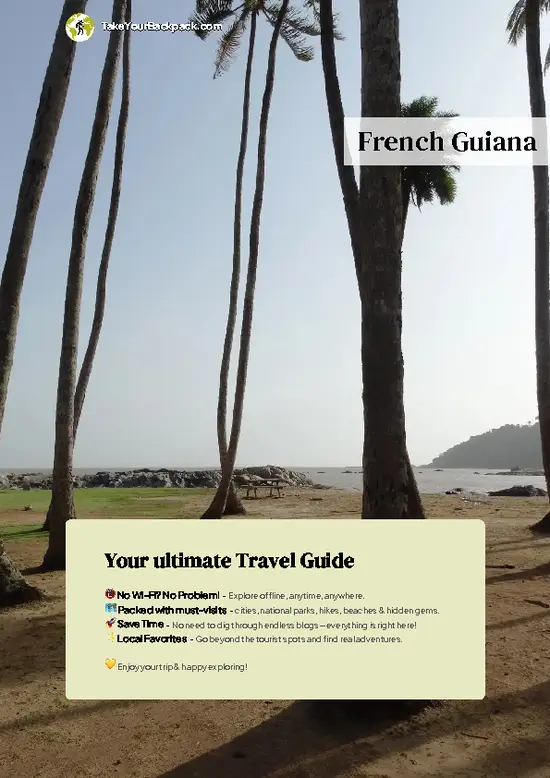
example page 0 from our offline Travel Guide for French Guiana
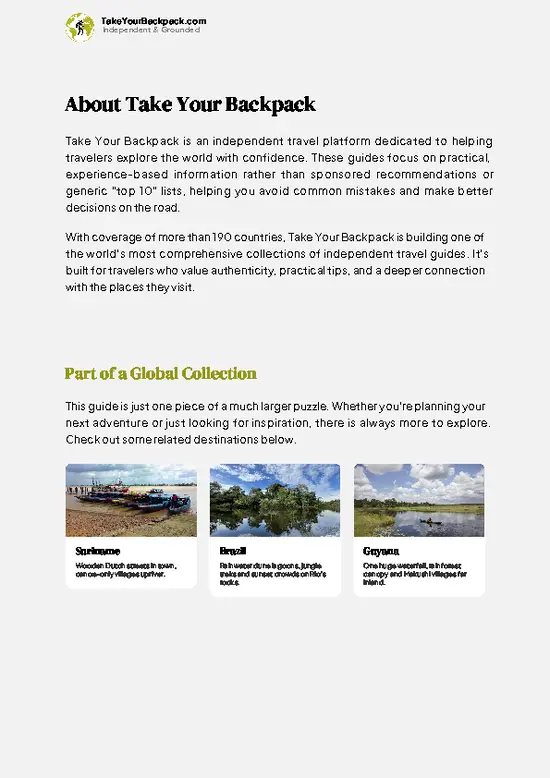
example page 1 from our offline Travel Guide for French Guiana
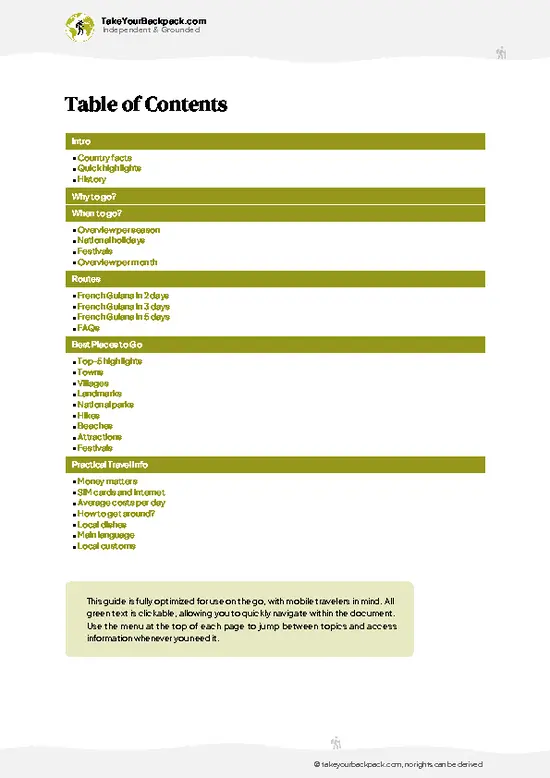
example page 2 from our offline Travel Guide for French Guiana
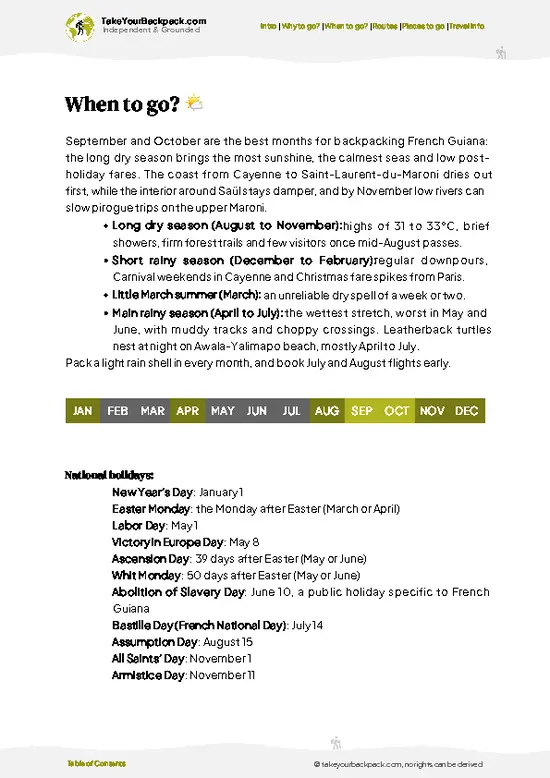
example page 3 from our offline Travel Guide for French Guiana
example page 4 from our offline Travel Guide for French Guiana
example page 5 from our offline Travel Guide for French Guiana
example page 6 from our offline Travel Guide for French Guiana
example page 7 from our offline Travel Guide for French Guiana
Loading the map 🌍
CLICK TO FILTER
towns
villages
landmarks
national parks
hikes
beaches
attractions
festivals
SHOW COUNTRY’S BESTSHOW ALL

✨ Why go?
Ranked #2 beach in French Guiana
The unique appeal for travelers

Les Hattes Beach exists on the backpacker map for one reason, and it has a calendar. Between roughly April and July, huge leatherback turtles haul themselves up the sand at night to lay eggs, and guided walks let you watch from a respectful distance with red light only. Nothing on the Guianese coast compares, and the sight costs little beyond a guide fee and a late night.

The second pull is the village behind it, Awala-Yalimapo, a Kali’na community where you can sleep in a carbet (open-air hammock shelter), eat local fish and learn about the people who have lived on this coast for centuries. It is a quiet, unhurried contrast to the busier towns of the coast.

The third reason is geography. Les Hattes Beach lies about an hour from Saint-Laurent-du-Maroni, where the ferry crosses the Maroni … read more 👉
Les Hattes Beach exists on the backpacker map for one reason, and it has a calendar. Between roughly April and July, huge leatherback turtles haul themselves up the sand at night to lay eggs, and guided walks let you watch from a respectful distance with red light only. Nothing on the Guianese coast compares, and the sight costs little beyond a guide fee and a late night.

The second pull is the village behind it, Awala-Yalimapo, a Kali’na community where you can sleep in a carbet (open-air hammock shelter), eat local fish and learn about the people who have lived on this coast for centuries. It is a quiet, unhurried contrast to the busier towns of the coast.

The third reason is geography. Les Hattes Beach lies about an hour from Saint-Laurent-du-Maroni, where the ferry crosses the Maroni to Albina in Suriname, so it works as a calm pause for overlanders linking the two countries. Bring your own food stocks and patience, and the pace here will slow you down in a good way.

💡 HighlightsTop highlights of Les Hattes Beach

  1. Leatherback turtle nesting walks: The reason the beach is famous. In nesting season, night walks led by local guides take you along the dark sand to watch giant females dig, lay and cover their nests, using only red light. It is quiet, slow and humbling.
  2. Hatchling emergence at dawn and dusk: Later in the season, tiny hatchlings scramble toward the surf. Watching them is free, and you will see tracks across the sand even when you miss the moment.
  3. Awala-Yalimapo Kali’na village: Just behind the beach, this indigenous community offers a small museum-style introduction to local culture, craft stalls and a chance to talk with residents about life on the estuary.
  4. Maroni estuary sunset walks: The beach faces a wide river mouth where the water shifts from brown to gold. Walk the long, flat sand with
… read more 👉
  1. Leatherback turtle nesting walks: The reason the beach is famous. In nesting season, night walks led by local guides take you along the dark sand to watch giant females dig, lay and cover their nests, using only red light. It is quiet, slow and humbling.
  2. Hatchling emergence at dawn and dusk: Later in the season, tiny hatchlings scramble toward the surf. Watching them is free, and you will see tracks across the sand even when you miss the moment.
  3. Awala-Yalimapo Kali’na village: Just behind the beach, this indigenous community offers a small museum-style introduction to local culture, craft stalls and a chance to talk with residents about life on the estuary.
  4. Maroni estuary sunset walks: The beach faces a wide river mouth where the water shifts from brown to gold. Walk the long, flat sand with palms behind you and watch pirogues cross toward the border.
  5. Beachside fish meals: Small family-run spots grill the catch of the day with rice and chili. Eating with the sound of waves, a cheap plate beats any fancy dinner here.
For a first visit, the leatherback nesting walk is the one to book, because nothing else on this coast comes close.
Spotted a mistake or missing something? Contact us.

🌤️ When to go?Weather, crowds, and seasonal trade-offs

  • Turtle Season (April to July): Leatherbacks come ashore to nest at Les Hattes, peaking around May and June. Expect 26 to 31°C (79 to 88°F), and plan on night walks with a guide after dark. This is also the main rainy season, with May and June the wettest months.
  • Dry Season (August to November): Rain drops off, skies clear and the sea is calmer. Highs reach 30 to 32°C (86 to 90°F). Green turtle nesting and the start of hatchling emerging can still occur early in this window, and crowds are thin.
  • Short Wet Spell (December to January): Showers return, with 25 to 30°C (77 to 86°F) and muddier tracks. Rooms are easy to find and prices are low.
  • Little Summer of March (February to March): A short drier break between the two rainy seasons. Few visitors come, and some guesthouses close.
Daylight stays … read more 👉
  • Turtle Season (April to July): Leatherbacks come ashore to nest at Les Hattes, peaking around May and June. Expect 26 to 31°C (79 to 88°F), and plan on night walks with a guide after dark. This is also the main rainy season, with May and June the wettest months.
  • Dry Season (August to November): Rain drops off, skies clear and the sea is calmer. Highs reach 30 to 32°C (86 to 90°F). Green turtle nesting and the start of hatchling emerging can still occur early in this window, and crowds are thin.
  • Short Wet Spell (December to January): Showers return, with 25 to 30°C (77 to 86°F) and muddier tracks. Rooms are easy to find and prices are low.
  • Little Summer of March (February to March): A short drier break between the two rainy seasons. Few visitors come, and some guesthouses close.
Daylight stays close to 12 hours all year, so night turtle outings start late, often after 10 pm. Book lodging a few weeks ahead for June and July, when the village fills up.


source: climatestotravel.comJANJanuary: fair for travelingFEBFebruary: fair for travelingMARMarch: fair for travelingAPRApril: fair for travelingMAYMay: fair for travelingJUNJune: good for travelingJULJuly: good for travelingAUGAugust: highly recommended for travelingSEPSeptember: excellent for travelingOCTOctober: excellent for travelingNOVNovember: excellent for travelingDECDecember: excellent for traveling
french-guiana-beach-les-hattes-beach
© Google | João Leitão

✈️ The backpacker research shortcutFrench Guiana Travel Guide

An offline-friendly backpacking guide with optimized travel routes, ranked highlights, transport advice, and the best areas to stay.
example page 0 from our offline Travel Guide for French Guiana
example page 1 from our offline Travel Guide for French Guiana
example page 2 from our offline Travel Guide for French Guiana
example page 3 from our offline Travel Guide for French Guiana
example page 4 from our offline Travel Guide for French Guiana
example page 5 from our offline Travel Guide for French Guiana
example page 6 from our offline Travel Guide for French Guiana
example page 7 from our offline Travel Guide for French Guiana
The digital guide (130 pages) contains:
✅ 31 highlights, ranked by travel appeal
✅ Optimized 2, 3 & 5-day travel routes
✅ Cities, national parks, landmarks, beaches
✅ How to get around
✅ Offline-friendly for travel without Wi-Fi
👉 Click to see all 30+ guide features

📅 Plan smarter in minutes, not weeks
✅ Month by month travel advice
✅ Festivals & national holidays
✅ Budget expectations

🗺️ Go to the right places, skip the overrated ones
✅ Honest pros & cons of destinations
✅ Top hikes, parks & viewpoints
✅ Lesser-known places most travelers miss
✅ Clear “worth it vs skip it” guidance

🛏️ Travel smoothly without rookie mistakes
✅ Best areas to stay
✅ Transport systems explained simply
✅ Common scams & safety advice
✅ SIM cards, money & practical tips

🌍 Understand the country, not just visit it
✅ Culture & traditions
✅ 52 Essential phrases & customs
✅ Festivals worth planning around
✅ Traveler-friendly historical context
✅ Insights that make places more meaningful

📱 Built for real travel conditions
✅ Fully downloadable PDF
✅ Works completely offline
✅ Optimized for phone use
✅ Useful in remote areas & buses
✅ Everything in one place
Stop searching, start planning
Get instant access to your full guide. 30‑day money-back guarantee.
+ Add another guide for just

By proceeding you agree to our terms.
Sent to your inbox immediately after payment • 100% Secure Checkout
Best Backpacking Travel Advisor 2025 tourism awardBest Backpacking
Travel Advisor
2025
What others say about Take Your Backpack Guides:
⭐⭐⭐⭐⭐
Fantastic, amazing amount of information!
⭐⭐⭐⭐⭐
My goodness this is amazing, it's what I've been looking for hats off too you!
⭐⭐⭐⭐⭐
I think this is absolutely BRILLIANT
⭐⭐⭐⭐
Very complete and informative. It's still missing places, but I gotta to commend you
⭐⭐⭐⭐⭐
This is truly amazing, thank you, can't wait to explore it with my kids!
⭐⭐⭐⭐⭐
Awesome resource, thank you!
⭐⭐⭐⭐⭐
This is amazing! Can't wait to explore the ones I haven't seen
⭐⭐⭐⭐
I love this! Well done, great idea.
⭐⭐⭐⭐⭐
Thanks for taking the time to make this gem!
⭐⭐⭐⭐⭐
This might be the best website I've ever seen.
⭐⭐⭐⭐⭐
Congratulations, and thank you so much for your work; it's incredibly valuable.
⭐⭐⭐⭐
In all seriousness I think you did a great job pointing out the important spots
⭐⭐⭐⭐⭐
10/10 very good
⭐⭐⭐⭐⭐
As someone who's only just starting to visit regularly this is awesome, thank you.
⭐⭐⭐⭐
Thank you very much! I'm going to visit my dad, it's going to be very useful!
⭐⭐⭐⭐⭐
This is really cool! We'll be travelling for the first time and this definitely come in handy.
⭐⭐⭐⭐⭐
You are now our minister of culture, congratulations 👨‍💼
⭐⭐⭐⭐⭐
Just wanted to tell you that this is a pearl! Going to follow your recommendations.
⭐⭐⭐⭐⭐
This is so cool. I'll definitely be using the resource for my travels soon.
⭐⭐⭐⭐⭐
This is very impressive! Good work.
⭐⭐⭐⭐⭐
This is an amazing and informative site. Very well done!

🛏️ Where to stay?Where staying makes the most sense

Awala-Yalimapo village is the place to sleep, because it sits right behind Les Hattes Beach and the turtle nesting sands are a short walk away. It is a spread-out Kali’na community, not a resort strip. Guesthouses, small lodges and a few carbet (open-air hammock hut) camps line the sandy road toward the beach, and the cheapest options are hammock spaces at roughly €12 to 20 a night, with simple private rooms from about €45 to 80.

The best area for meeting other travelers is the stretch near the beach car park and the turtle information point, where people gather before night walks and share meals. … read more 👉
Awala-Yalimapo village is the place to sleep, because it sits right behind Les Hattes Beach and the turtle nesting sands are a short walk away. It is a spread-out Kali’na community, not a resort strip. Guesthouses, small lodges and a few carbet (open-air hammock hut) camps line the sandy road toward the beach, and the cheapest options are hammock spaces at roughly €12 to 20 a night, with simple private rooms from about €45 to 80.

The best area for meeting other travelers is the stretch near the beach car park and the turtle information point, where people gather before night walks and share meals. Staying here means you can walk to the sand and back by torchlight (red light only) without needing a ride, which matters because taxis are nearly nonexistent after dark.

Saint-Laurent-du-Maroni, about 45 minutes away by road, is the alternative. It has more rooms, restaurants, shops and an ATM, and suits anyone arriving by public transport or wanting to stretch the budget. The trade-off is that you need a car or a pre-arranged lift for the evening turtle trips. Most backpackers pick Awala-Yalimapo for at least one night and use Saint-Laurent as the supply stop.

🛡️ SafetyScams, Hazards, and Annoyances

Les Hattes Beach is a quiet, low-risk place, and the main thing to manage is the water itself. The Maroni and Atlantic currents leave the sea brown and muddy, with a shifting shoreline, strong tidal pulls and sandbanks that change from week to week. Swimming is possible, but there are no lifeguards, so wade in only where locals do and avoid going out alone. Rays can lurk in the shallows, so shuffle your feet.

Sun is intense from mid-morning, and shade is scarce on the open sand, so bring a hat and strong sunscreen. Mosquitoes and biting midges come out at dusk and during night walks, so cover your arms and legs and carry repellent.

The nesting beach is a protected area. Use only red light, keep your distance from turtles and follow your guide. Theft is rare, but keep valuables locked away rather than left in a parked car at the beach.

FAQCommon questions from travelers

Les Hattes Beach lies in the village of Awala-Yalimapo, roughly 45 minutes by road from Saint-Laurent-du-Maroni, which is itself about 3 to 4 hours from Cayenne. Public transport to the village is very limited, so most travelers rent a car (from about €40 to 60 a day) or arrange a taxi from Saint-Laurent, which can cost roughly €50 to 70 one way. Hitchhiking is possible but unreliable.
Les Hattes Beach is better for turtle watching than for conventional beach activities. The water is murky and brown from Amazon and Maroni sediment, with tidal currents and no lifeguards, so swimming is fine only in calm spots near where locals wade. Surfing and snorkeling are not practical because there are no consistent waves and visibility is close to zero.
Les Hattes Beach is free to walk on, with no entry fee to the sand during the day. Guided night turtle walks during nesting season (April to July) usually cost around €8 to 15 per person, and bookings are made through local guides or the village information point. Parking is free, though guesthouses charge for lodging and meals.
⚠️ Things can change over time, so always validate details locally before you go.

Other French Guianese beaches near Les Hattes Beach

Explore more nearby:

  • Awala-Yalimapo Beach—sea turtle nesting, remote sands, Amerindian village| 0 km away
  • Kourou Beach—Spaceport views, Îles du Salut horizon, seafront promenade, grilled fish stalls| 158 km away
  • Cayenne Beach—urban edge, jogging paths, food stalls| 203 km away

💡 Not sure where to go next?
Create a personalized itinerary for French Guiana including Les Hattes Beach and the places that fit your trip.

Generate my itinerary

👉 Discover all beaches

Or checkout all French Guiana has to offer (think cities, towns, villages, national parks, hikes, beaches, festivals)
Country photo of French Guiana

We 💚 feedbackParting advice and final tips

Les Hattes Beach is best between April and July, when leatherbacks come ashore after dark and the village fills with a quiet, curious crowd. Go then, book your guide a day ahead, and pack long sleeves and strong repellent for the evening. Outside the season the beach is lovely but sleepy, so I would only come if you want true stillness.

✍️ Help improve this page!
The information on this page is based on in-depth research, insights shared by experienced travelers, and feedback from the local travel community in French Guiana. While every effort is made to keep the information accurate and current, conditions can change — so if you spot anything incorrect or outdated, please get in touch.


🙋‍♂️ Give feedback

👋 Meet the founderWho’s Behind Take Your Backpack?

Johan, backpacker and founder of TakeYourBackpackHi, I’m Johan (Netherlands 🇳🇱), the creator of TakeYourBackpack. Over the past 3 decades, I’ve backpacked through 90+ countries across six continents, gaining extensive experience with independent travel, long-term trips, and overland routes.

This site is built on a combination of firsthand travel experience and carefully curated insights from other backpackers. Many guides are based on places I’ve personally visited, while others bring together tips, observations, and practical advice shared by trusted travelers I’ve met along the way.

The goal is to provide realistic, experience-driven guidance — not generic itineraries — so you can explore destinations with better context, clearer expectations, and more confidence.