×

French Polynesia🇵🇫 | best villagesTop-Rated 2 villages in French Polynesia

Villages in French Polynesia are small coastal communities strung along island roads, usually one church, a snack caravan and a lagoon-side dock. The Society Islands are easiest and priciest, while the Tuamotus, Marquesas and Australs are quieter, costlier to reach and cheaper once you land. Independent travelers do best with family pensions, a rental bike and a Sunday morning free for singing.

By Johan Kruseman 🇳🇱 | Updated October 19, 2026
Explore the best landmarks in French Polynesia

Why go?Why Travelers Love These Spots

French Polynesia spreads 118 islands across an area as large as Europe, so each village grew around its own lagoon, valley or atoll, with its own dialect and traditions. Mission history left a Protestant or Catholic church at the center of nearly every settlement, and Sunday hymns are a living custom rather than a show. Villages here are small, with a few hundred residents, and most visitors stay in family pensions rather than hotels.

Before choosing the country for its villages, know that distance drives cost. Inter-island flights with Air Tahiti and the Aranui supply ship are the main links, and prices climb the farther you go from Papeete. Shops close early, often by late afternoon, and many shut on Sunday. Cash in CFP francs matters outside the main islands, and a bag of groceries from Papeete saves money on remote atolls.
Evaluating the Top Choices
The list of best villages in French Polynesia is created based on authenticity, scenic beauty, community spirit, traditions, and overall character. If you feel a village is missing in this list, please let us know.

When to go?Optimal Periods for Travel

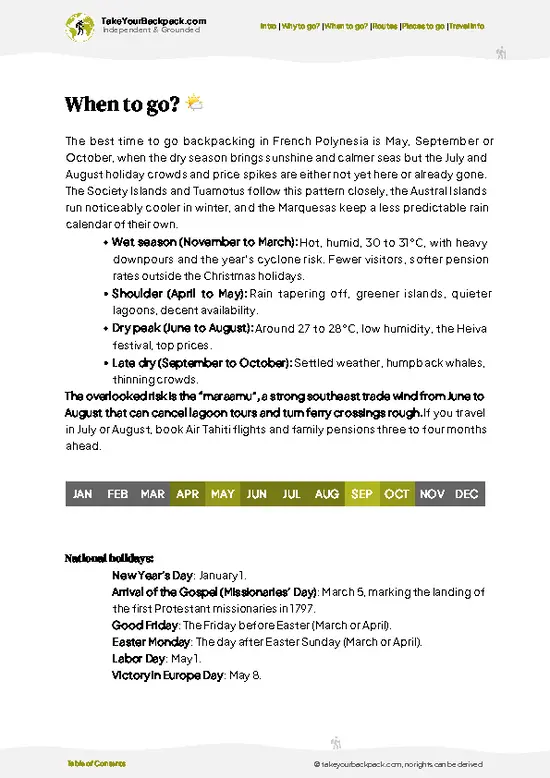
Best months and weather: May to October is the best window because the dry season brings lower humidity, steadier skies and daytime highs around 27 to 29°C, ideal for walking village roads. The wet season, November to April, is hotter at 29 to 32°C with heavy downpours that can flood dirt tracks and delay boats.
Shoulder seasons and prices: May, June and October are the sweet spot for lower pension rates and fewer crowds. July and August are peak, and flights and rooms fill early, so book ahead. The Heiva festival in July lifts prices in the Society Islands. The Marquesas run slightly drier and a little cooler year-round, while the Tuamotus stay breezy and sunny from May to September.

village hoppingSuggested Travel Strategies

Time and pacing: A multi-village trip needs 10 to 16 days, with two to four nights per stop so you actually meet people instead of just ticking off ports. Grouping and direction: Start in Papeete and cover the Society Islands first, since ferries and short flights between Tahiti, Moorea and Huahine take 30 minutes to 3 hours. Then fly onward to the Tuamotus (about 1 hour from Tahiti) before ending with a long hop to the Marquesas (about 3.5 hours by air).
Common mistakes: Travelers cram five islands into a week and spend it in airports. Skip that. Build in a spare day before international flights, since weather delays small planes, and avoid planning transfers on Sunday, when services thin out. Pick one or two island groups instead of all of them.

The ListMust-Visit villages in French Polynesia

1 Vaiea

Teurafaatiu climb, lagoon ring road, manta cleaning station, family pensions

Cycle the 10-kilometer lagoon road around Vaiea, snorkel with manta rays near the pass, and finish the day at a shared pension dinner.

french-polynesia-city-vaiea
© Google |

2 Atuona

Gauguin and Brel graves, Atuona harbor, black-rock shoreline, Marquesan valleys

Climb to the hillside cemetery above Atuona, then walk the village museums and harbor before heading inland by 4WD toward jungle tiki sites.

french-polynesia-city-atuona
© Google | Matthieu Cantin
Loading the map 🌍

Expert viewWhat You Should Know

How many villages: I advise four to six villages on a two-week trip. Fewer than four and you miss the contrast between island groups. More than six and flights eat the budget and leave no time to sit on a dock and talk with locals. Every extra stop costs a day of transit and often US$100 to 250 in flights, which means the fifth village rarely gives as much as an extra night in the second.
Which kind to prioritize: For a tight budget, the Society Islands give the most for the money because ferries and roads are cheap. For culture, the Marquesas are worth the splurge, with carving, tattoo traditions and hiking, but expect higher flights. For quiet and snorkeling, pick a Tuamotu atoll, where pensions often include meals, and you spend little otherwise.
What it costs: Budget US$80 to 140 a day in … read more 👉
How many villages: I advise four to six villages on a two-week trip. Fewer than four and you miss the contrast between island groups. More than six and flights eat the budget and leave no time to sit on a dock and talk with locals. Every extra stop costs a day of transit and often US$100 to 250 in flights, which means the fifth village rarely gives as much as an extra night in the second.
Which kind to prioritize: For a tight budget, the Society Islands give the most for the money because ferries and roads are cheap. For culture, the Marquesas are worth the splurge, with carving, tattoo traditions and hiking, but expect higher flights. For quiet and snorkeling, pick a Tuamotu atoll, where pensions often include meals, and you spend little otherwise.
What it costs: Budget US$80 to 140 a day in the Society Islands on pension half-board and local snacks. Remote islands run US$110 to 180, because food is imported and half-board is usually your only option. Guided hikes or lagoon excursions cost roughly US$30 to 90 per person. Village entry is normally free, though a small donation at a church or craft cooperative goes a long way. Inter-island flights run about US$80 to 400 one way depending on distance, so buy a multi-island pass in advance if you plan three or more hops.
Safety and etiquette: Villages are very safe, and crime is low. Dress modestly away from the beach, with shoulders and knees covered for church services, and ask before photographing people or private land. Many marae and valleys sit on family land, so hire a local guide rather than wandering in. Greet everyone with “Ia ora na,” and bring cash, mosquito repellent for dengue, and reef-safe sunscreen.

✈️ The backpacker research shortcutFrench Polynesia Travel Guide

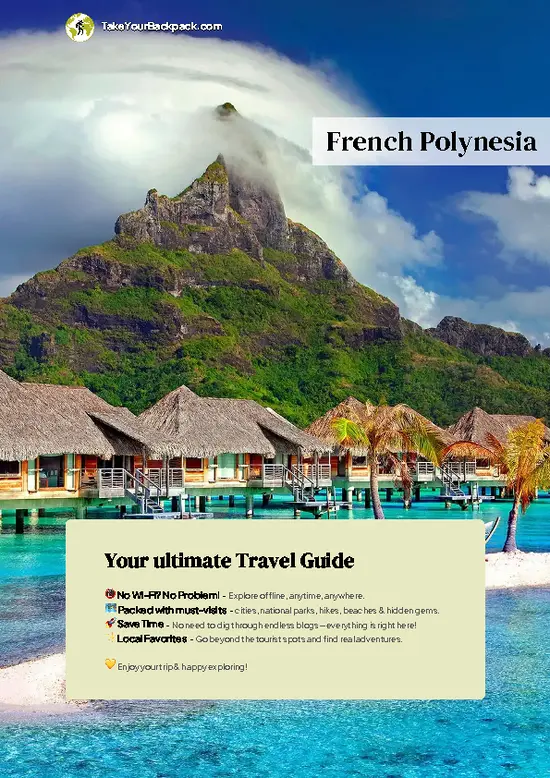
An offline-friendly backpacking guide with optimized travel routes, ranked highlights, transport advice, and the best areas to stay.
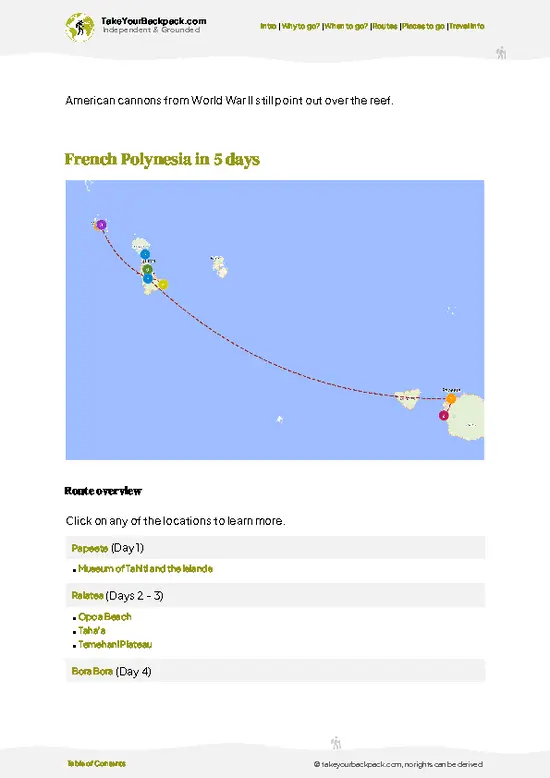
example page 0 from our offline Travel Guide for French Polynesia
example page 1 from our offline Travel Guide for French Polynesia
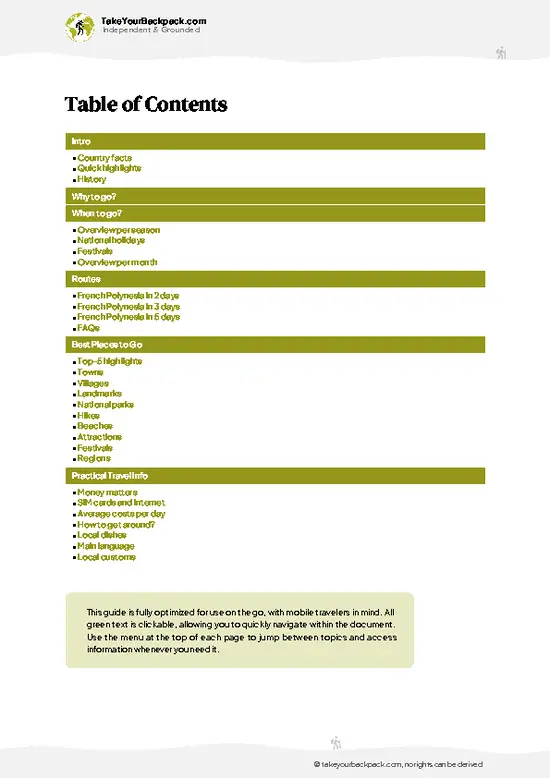
example page 2 from our offline Travel Guide for French Polynesia
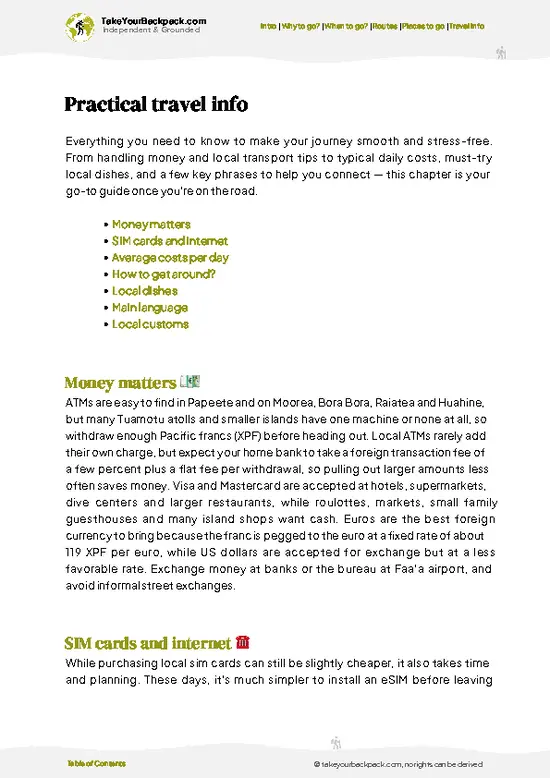
example page 3 from our offline Travel Guide for French Polynesia
example page 4 from our offline Travel Guide for French Polynesia
example page 5 from our offline Travel Guide for French Polynesia
example page 6 from our offline Travel Guide for French Polynesia
example page 7 from our offline Travel Guide for French Polynesia
The digital guide (149 pages) contains:
✅ 41 highlights, ranked by travel appeal
✅ Optimized 2, 3 & 5-day travel routes
✅ Cities, national parks, landmarks, beaches
✅ How to get around
✅ Offline-friendly for travel without Wi-Fi
👉 Click to see all 30+ guide features

📅 Plan smarter in minutes, not weeks
✅ Month by month travel advice
✅ Festivals & national holidays
✅ Budget expectations

🗺️ Go to the right places, skip the overrated ones
✅ Honest pros & cons of destinations
✅ Top hikes, parks & viewpoints
✅ Lesser-known places most travelers miss
✅ Clear “worth it vs skip it” guidance

🛏️ Travel smoothly without rookie mistakes
✅ Best areas to stay
✅ Transport systems explained simply
✅ Common scams & safety advice
✅ SIM cards, money & practical tips

🌍 Understand the country, not just visit it
✅ Culture & traditions
✅ 52 Essential phrases & customs
✅ Festivals worth planning around
✅ Traveler-friendly historical context
✅ Insights that make places more meaningful

📱 Built for real travel conditions
✅ Fully downloadable PDF
✅ Works completely offline
✅ Optimized for phone use
✅ Useful in remote areas & buses
✅ Everything in one place
Stop searching, start planning
Get instant access to your full guide. 30‑day money-back guarantee.
+ Add another guide for just

By proceeding you agree to our terms.
Sent to your inbox immediately after payment • 100% Secure Checkout
Best Backpacking Travel Advisor 2025 tourism awardBest Backpacking
Travel Advisor
2025
What others say about Take Your Backpack Guides:
⭐⭐⭐⭐⭐
Fantastic, amazing amount of information!
⭐⭐⭐⭐⭐
My goodness this is amazing, it's what I've been looking for hats off too you!
⭐⭐⭐⭐⭐
I think this is absolutely BRILLIANT
⭐⭐⭐⭐
Very complete and informative. It's still missing places, but I gotta to commend you
⭐⭐⭐⭐⭐
This is truly amazing, thank you, can't wait to explore it with my kids!
⭐⭐⭐⭐⭐
Awesome resource, thank you!
⭐⭐⭐⭐⭐
This is amazing! Can't wait to explore the ones I haven't seen
⭐⭐⭐⭐
I love this! Well done, great idea.
⭐⭐⭐⭐⭐
Thanks for taking the time to make this gem!
⭐⭐⭐⭐⭐
This might be the best website I've ever seen.
⭐⭐⭐⭐⭐
Congratulations, and thank you so much for your work; it's incredibly valuable.
⭐⭐⭐⭐
In all seriousness I think you did a great job pointing out the important spots
⭐⭐⭐⭐⭐
10/10 very good
⭐⭐⭐⭐⭐
As someone who's only just starting to visit regularly this is awesome, thank you.
⭐⭐⭐⭐
Thank you very much! I'm going to visit my dad, it's going to be very useful!
⭐⭐⭐⭐⭐
This is really cool! We'll be travelling for the first time and this definitely come in handy.
⭐⭐⭐⭐⭐
You are now our minister of culture, congratulations 👨‍💼
⭐⭐⭐⭐⭐
Just wanted to tell you that this is a pearl! Going to follow your recommendations.
⭐⭐⭐⭐⭐
This is so cool. I'll definitely be using the resource for my travels soon.
⭐⭐⭐⭐⭐
This is very impressive! Good work.
⭐⭐⭐⭐⭐
This is an amazing and informative site. Very well done!

🛏️ Where to stay?Where to Base Yourself

Budget beds in French Polynesia are scarce: true hostels are limited to a handful of dorms in and around Papeete, so most backpackers rely on family-run guesthouses called “pensions,” where a dorm bed or simple room runs roughly 3,500 to 9,000 XPF (€30 to 75) a night. Papeete has the most options and puts you next to the Moorea ferry terminal, the market and the evening food trucks, but it is noisy and some downtown streets feel rough after dark, while Faa’a and Punaauia on the west coast are quieter, closer to the airport and beaches, yet need a bus or car for anything else. Beyond Tahiti, Moorea (especially Haapiti on the west side) has the best spread of affordable pensions with lagoon access … read more 👉
Budget beds in French Polynesia are scarce: true hostels are limited to a handful of dorms in and around Papeete, so most backpackers rely on family-run guesthouses called “pensions,” where a dorm bed or simple room runs roughly 3,500 to 9,000 XPF (€30 to 75) a night. Papeete has the most options and puts you next to the Moorea ferry terminal, the market and the evening food trucks, but it is noisy and some downtown streets feel rough after dark, while Faa’a and Punaauia on the west coast are quieter, closer to the airport and beaches, yet need a bus or car for anything else. Beyond Tahiti, Moorea (especially Haapiti on the west side) has the best spread of affordable pensions with lagoon access and almost no nightlife, and on Bora Bora the few budget rooms cluster around Matira, close to the island’s best public beach.

If you enjoy meeting fellow travelers, consider choosing hostels with high ratings for atmosphere. On the other hand, if you prefer having your own space, a hotel might be a better option.

French PolynesiaExpand Your Journey

👋 Meet the founderWho’s Behind Take Your Backpack?

Johan, backpacker and founder of TakeYourBackpackHi, I’m Johan (Netherlands 🇳🇱), the creator of TakeYourBackpack. Over the past 3 decades, I’ve backpacked through 90+ countries across six continents, gaining extensive experience with independent travel, long-term trips, and overland routes.

This site is built on a combination of firsthand travel experience and carefully curated insights from other backpackers. Many guides are based on places I’ve personally visited, while others bring together tips, observations, and practical advice shared by trusted travelers I’ve met along the way.

The goal is to provide realistic, experience-driven guidance — not generic itineraries — so you can explore destinations with better context, clearer expectations, and more confidence.