×

French Polynesia🇵🇫 | landmarksRangiroaTiputa Pass, drift diving, Blue Lagoon, coral-soil vineyard | things to do and best time to go

Explore Bora Bora LagoonExplore Taha’a Vanilla Plantations

Backpacking in Rangiroa
🌟 Highlightunique site ranked #2
By Johan Kruseman 🇳🇱 | Updated October 15, 2026

Rangiroa is one of the largest atolls in the world, and its lagoon is big enough to hold the entire island of Tahiti with room to spare. That scale surprises people who expect a tiny ring of sand. It sits in the Tuamotu archipelago, in the north of French Polynesia, northeast of Tahiti. The wow-factor is underwater: the Tiputa Pass fills with dolphins, sharks and drifting currents, and drift diving here is the real draw. Snorkeling the pass edge is worth your time. The villages are sleepy, with one main road, a few pensions, and little to do after dark, so don’t come for nightlife. The Blue Lagoon and Pink Sand Beaches are pretty and photograph well, but they are tour-boat stops that cost real money, and you can skip them if the budget is tight. Cheap local pensions beat resorts for atmosphere. Book your flight from Tahiti and your pension together, because seats on the small planes fill quickly.

Discover everything you want to know in the 📖 French Polynesia Travel Guide.


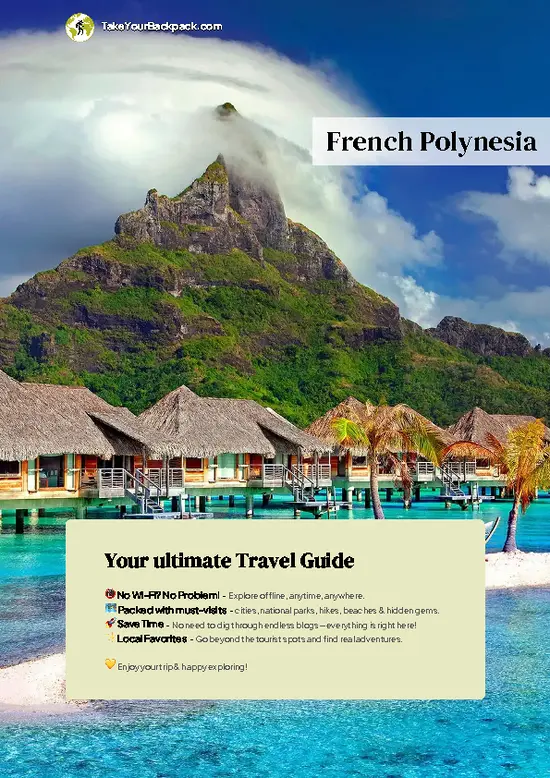
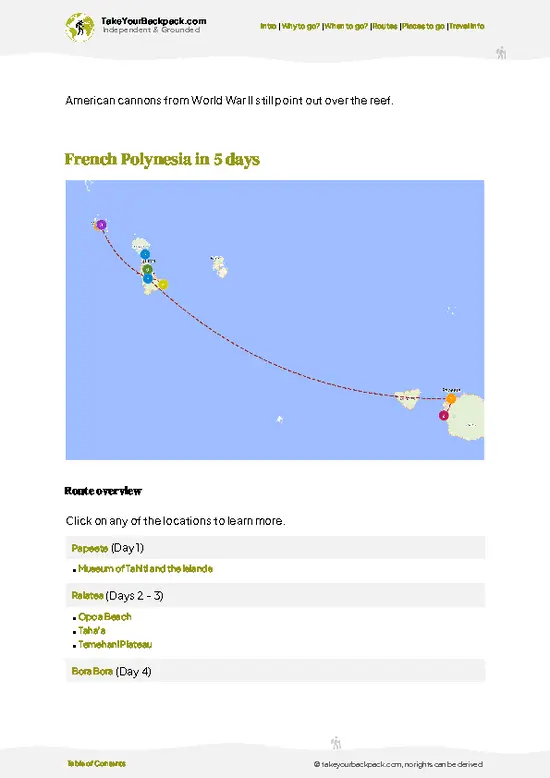
example page 0 from our offline Travel Guide for French Polynesia
example page 1 from our offline Travel Guide for French Polynesia
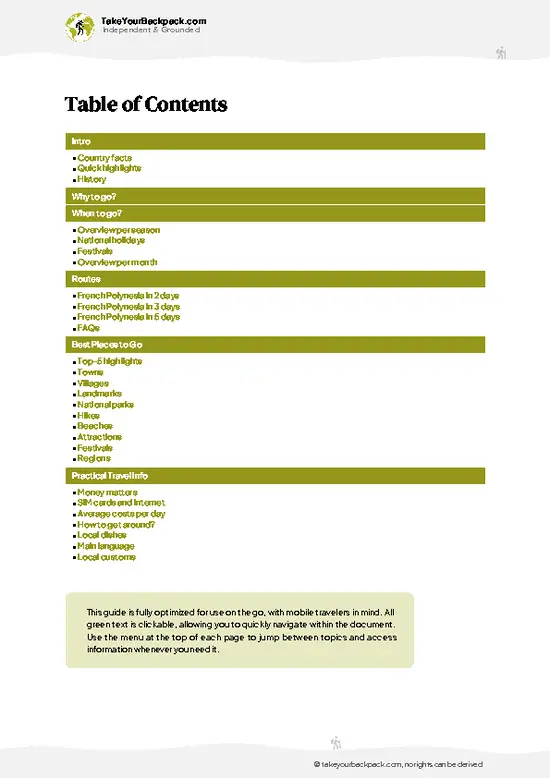
example page 2 from our offline Travel Guide for French Polynesia
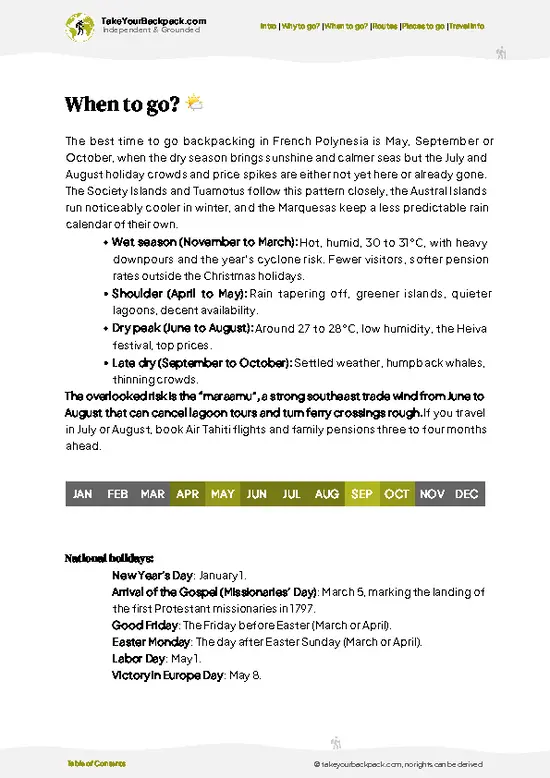
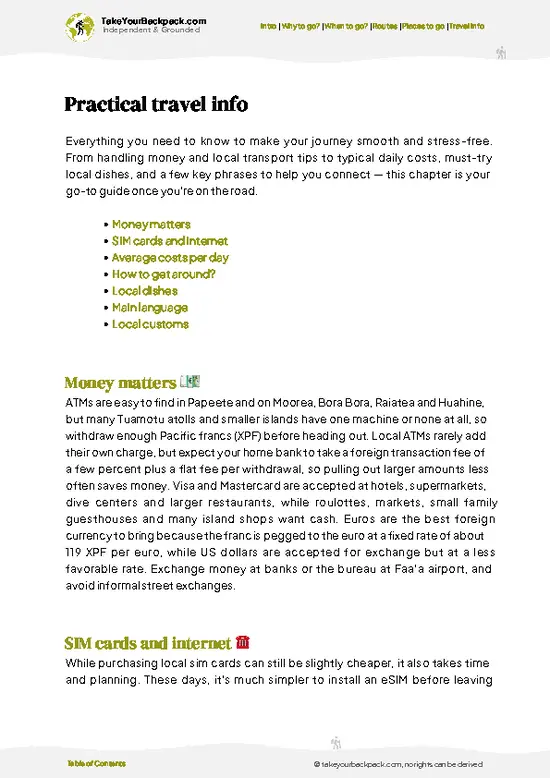
example page 3 from our offline Travel Guide for French Polynesia
example page 4 from our offline Travel Guide for French Polynesia
example page 5 from our offline Travel Guide for French Polynesia
example page 6 from our offline Travel Guide for French Polynesia
example page 7 from our offline Travel Guide for French Polynesia
Loading the map 🌍
CLICK TO FILTER
towns
villages
landmarks
national parks
hikes
beaches
attractions
festivals
regions
SHOW COUNTRY’S BESTSHOW ALL

✨ Why go?
Ranked #2 unique site in French Polynesia
The unique appeal for travelers

Rangiroa earns the flight because the Tiputa Pass is one of the few places where you can watch bottlenose dolphins surf the incoming tide wave from the shore, no boat needed. Divers come for the gray reef sharks and hammerheads, but snorkelers with a calm head can float the pass edge with a guide and see the same cast. The second reason is the lagoon itself. Inside the Tuamotu ring, the water runs from milky turquoise to deep indigo, and the motus (small islets) hold coconut plantations, a vineyard, and pearl farms you can actually walk into. Few places let you see a Polynesian wine harvest beside a black pearl workshop. Rangiroa also fits a classic route neatly: a few nights here after Tahiti or Moorea, then onward to Fakarava or Bora Bora if your budget stretches. The airport is the only … read more 👉
Rangiroa earns the flight because the Tiputa Pass is one of the few places where you can watch bottlenose dolphins surf the incoming tide wave from the shore, no boat needed. Divers come for the gray reef sharks and hammerheads, but snorkelers with a calm head can float the pass edge with a guide and see the same cast. The second reason is the lagoon itself. Inside the Tuamotu ring, the water runs from milky turquoise to deep indigo, and the motus (small islets) hold coconut plantations, a vineyard, and pearl farms you can actually walk into. Few places let you see a Polynesian wine harvest beside a black pearl workshop. Rangiroa also fits a classic route neatly: a few nights here after Tahiti or Moorea, then onward to Fakarava or Bora Bora if your budget stretches. The airport is the only real gateway, and rental bikes cover the two main villages, Avatoru and Tiputa, with ease.

💡 HighlightsThe experiences that define the visit

  1. Tiputa Pass: The deep channel linking lagoon to ocean is where dolphins ride the tidal wave and sharks patrol the drop-off. Dive it on the incoming tide or snorkel the edge with an operator.
  2. Blue Lagoon: A shallow, clear basin on the far side of the atoll with reef sharks cruising the shallows and sandbars to wade across. It is reached by boat tour and is best early before the day-trip groups arrive.
  3. Pink Sand Beaches (Les Sables Roses): Crushed red coral gives the sand a pale blush at the lagoon’s southeast edge. It is photogenic in low light, and a good place for a quiet swim.
  4. Vin de Tahiti vineyard: Grapes grow on coral soil, an unlikely farm, and tastings include white, rosé and a sweet Muscat. The setting beside the lagoon is half the appeal.
  5. Gauguin’s Pearl: A working pearl farm where a
… read more 👉
  1. Tiputa Pass: The deep channel linking lagoon to ocean is where dolphins ride the tidal wave and sharks patrol the drop-off. Dive it on the incoming tide or snorkel the edge with an operator.
  2. Blue Lagoon: A shallow, clear basin on the far side of the atoll with reef sharks cruising the shallows and sandbars to wade across. It is reached by boat tour and is best early before the day-trip groups arrive.
  3. Pink Sand Beaches (Les Sables Roses): Crushed red coral gives the sand a pale blush at the lagoon’s southeast edge. It is photogenic in low light, and a good place for a quiet swim.
  4. Vin de Tahiti vineyard: Grapes grow on coral soil, an unlikely farm, and tastings include white, rosé and a sweet Muscat. The setting beside the lagoon is half the appeal.
  5. Gauguin’s Pearl: A working pearl farm where a grafter demonstrates seeding an oyster and explains how black Tahitian pearls form. You can see the full process before choosing what to buy.
  6. Avatoru village: The main settlement is a stretch of low houses, a pretty white church, and bike-friendly lanes. It gives you a feel for daily atoll life without any show.
  7. Bird Island: A tiny coral islet with a scatter of coral pools, sea birds and a quiet, wild feel. Boat trips usually combine it with the Blue Lagoon.
Most visitors miss the evening at Tiputa village, where you cross by ferry or small boat and watch the sunset glow over the pass with a cold drink in hand.
Spotted a mistake or missing something? Contact us.

Things to do around Rangiroa

Ratings based on Tripadvisor reviews. When you book through this link, you support our work at no extra cost to you.

🌤️ When to go?Choosing the right time of year

May to October is the best window for Rangiroa, with dry, breezy weather and the clearest water in the Tiputa Pass.
  • Dry Season (May to October): Days run about 26 to 29°C (79 to 84°F), nights dip to roughly 23°C (73°F), and rain is light. Visibility for diving is excellent, and sunrise is around 6:00 with sunset near 17:30.
  • Wet Season (November to April): Expect 28 to 31°C (82 to 88°F), heavier humidity, and short, sharp downpours. Daylight stretches to nearly 12.5 hours. Lodging is easier to book and sometimes cheaper, and the lagoon stays warm for swimming.
  • Peak Months (July and August): Honeymooners and European holidaymakers fill pensions, and flights from Tahiti sell out. Prices for rooms and dive trips sit at their highest.
  • Dolphin and Shark Action: Dolphins ride the pass waves year-round,
… read more 👉
May to October is the best window for Rangiroa, with dry, breezy weather and the clearest water in the Tiputa Pass.
  • Dry Season (May to October): Days run about 26 to 29°C (79 to 84°F), nights dip to roughly 23°C (73°F), and rain is light. Visibility for diving is excellent, and sunrise is around 6:00 with sunset near 17:30.
  • Wet Season (November to April): Expect 28 to 31°C (82 to 88°F), heavier humidity, and short, sharp downpours. Daylight stretches to nearly 12.5 hours. Lodging is easier to book and sometimes cheaper, and the lagoon stays warm for swimming.
  • Peak Months (July and August): Honeymooners and European holidaymakers fill pensions, and flights from Tahiti sell out. Prices for rooms and dive trips sit at their highest.
  • Dolphin and Shark Action: Dolphins ride the pass waves year-round, while grey reef and hammerhead sightings are best between roughly December and March.
Book Papeete flights and your pension at least two months ahead for July and August.


source: climatestotravel.comJANJanuary: fair for travelingFEBFebruary: fair for travelingMARMarch: fair for travelingAPRApril: highly recommended for travelingMAYMay: excellent for travelingJUNJune: excellent for travelingJULJuly: highly recommended for travelingAUGAugust: highly recommended for travelingSEPSeptember: excellent for travelingOCTOctober: excellent for travelingNOVNovember: highly recommended for travelingDECDecember: fair for traveling

✈️ The backpacker research shortcutFrench Polynesia Travel Guide

An offline-friendly backpacking guide with optimized travel routes, ranked highlights, transport advice, and the best areas to stay.
example page 0 from our offline Travel Guide for French Polynesia
example page 1 from our offline Travel Guide for French Polynesia
example page 2 from our offline Travel Guide for French Polynesia
example page 3 from our offline Travel Guide for French Polynesia
example page 4 from our offline Travel Guide for French Polynesia
example page 5 from our offline Travel Guide for French Polynesia
example page 6 from our offline Travel Guide for French Polynesia
example page 7 from our offline Travel Guide for French Polynesia
The digital guide (149 pages) contains:
✅ 41 highlights, ranked by travel appeal
✅ Optimized 2, 3 & 5-day travel routes
✅ Cities, national parks, landmarks, beaches
✅ How to get around
✅ Offline-friendly for travel without Wi-Fi
👉 Click to see all 30+ guide features

📅 Plan smarter in minutes, not weeks
✅ Month by month travel advice
✅ Festivals & national holidays
✅ Budget expectations

🗺️ Go to the right places, skip the overrated ones
✅ Honest pros & cons of destinations
✅ Top hikes, parks & viewpoints
✅ Lesser-known places most travelers miss
✅ Clear “worth it vs skip it” guidance

🛏️ Travel smoothly without rookie mistakes
✅ Best areas to stay
✅ Transport systems explained simply
✅ Common scams & safety advice
✅ SIM cards, money & practical tips

🌍 Understand the country, not just visit it
✅ Culture & traditions
✅ 52 Essential phrases & customs
✅ Festivals worth planning around
✅ Traveler-friendly historical context
✅ Insights that make places more meaningful

📱 Built for real travel conditions
✅ Fully downloadable PDF
✅ Works completely offline
✅ Optimized for phone use
✅ Useful in remote areas & buses
✅ Everything in one place
Stop searching, start planning
Get instant access to your full guide. 30‑day money-back guarantee.
+ Add another guide for just

By proceeding you agree to our terms.
Sent to your inbox immediately after payment • 100% Secure Checkout
Best Backpacking Travel Advisor 2025 tourism awardBest Backpacking
Travel Advisor
2025
What others say about Take Your Backpack Guides:
⭐⭐⭐⭐⭐
Fantastic, amazing amount of information!
⭐⭐⭐⭐⭐
My goodness this is amazing, it's what I've been looking for hats off too you!
⭐⭐⭐⭐⭐
I think this is absolutely BRILLIANT
⭐⭐⭐⭐
Very complete and informative. It's still missing places, but I gotta to commend you
⭐⭐⭐⭐⭐
This is truly amazing, thank you, can't wait to explore it with my kids!
⭐⭐⭐⭐⭐
Awesome resource, thank you!
⭐⭐⭐⭐⭐
This is amazing! Can't wait to explore the ones I haven't seen
⭐⭐⭐⭐
I love this! Well done, great idea.
⭐⭐⭐⭐⭐
Thanks for taking the time to make this gem!
⭐⭐⭐⭐⭐
This might be the best website I've ever seen.
⭐⭐⭐⭐⭐
Congratulations, and thank you so much for your work; it's incredibly valuable.
⭐⭐⭐⭐
In all seriousness I think you did a great job pointing out the important spots
⭐⭐⭐⭐⭐
10/10 very good
⭐⭐⭐⭐⭐
As someone who's only just starting to visit regularly this is awesome, thank you.
⭐⭐⭐⭐
Thank you very much! I'm going to visit my dad, it's going to be very useful!
⭐⭐⭐⭐⭐
This is really cool! We'll be travelling for the first time and this definitely come in handy.
⭐⭐⭐⭐⭐
You are now our minister of culture, congratulations 👨‍💼
⭐⭐⭐⭐⭐
Just wanted to tell you that this is a pearl! Going to follow your recommendations.
⭐⭐⭐⭐⭐
This is so cool. I'll definitely be using the resource for my travels soon.
⭐⭐⭐⭐⭐
This is very impressive! Good work.
⭐⭐⭐⭐⭐
This is an amazing and informative site. Very well done!

🛏️ Where to stay?Choosing the right base

Avatoru and Tiputa, the two villages on either side of the Tiputa Pass, are the best places for backpackers to stay on Rangiroa.
Avatoru sits on the main island and is the practical choice. The only road on the atoll, running about 10 km, links the village with the airport and the Avatoru Pass, and small shops, a couple of snack stands and bike rentals are all within easy reach. Family-run pensions here are the cheapest beds and the easiest places to meet other budget travelers, since guests share meals, boat excursions and lagoon trips.
Tiputa lies across the pass on a separate motu and is reached … read more 👉
Avatoru and Tiputa, the two villages on either side of the Tiputa Pass, are the best places for backpackers to stay on Rangiroa.
Avatoru sits on the main island and is the practical choice. The only road on the atoll, running about 10 km, links the village with the airport and the Avatoru Pass, and small shops, a couple of snack stands and bike rentals are all within easy reach. Family-run pensions here are the cheapest beds and the easiest places to meet other budget travelers, since guests share meals, boat excursions and lagoon trips.
Tiputa lies across the pass on a separate motu and is reached by a short boat shuttle. It is quieter and more local, with a handful of guesthouses, a church, a tiny shop and swimming spots where dolphins sometimes appear near the pass. It suits solo travelers who want calm evenings, though dining choices are thinner and you will rely on the boat for anything beyond the village.
Both areas are very safe, with minimal petty crime. Staying near the pass puts you within a short walk or bike ride of the main dive centers and snorkeling drop-offs, which saves on transfers. Camping is limited, so most budget travelers choose a pension with a kitchen or half board.

👛 Costs (as of 15 October 2026)How expensive it really is

Rangiroa costs roughly US$130 to 220 a day for a backpacker, driven mostly by food and lodging on an atoll where almost everything arrives by ship or plane.
CategoryBudget RangeLocal Reality
Accommodation (high season)US$60 to 100Family pensions with a shared or private bungalow; dorm beds are rare, so a double room is the norm.
FoodUS$30 to 55Snack stands serve poisson cru, sandwiches and chowmein for US$8 to 15. Half board at a pension often runs US$25 to 40 and is the best value.
Local TransportUS$5 to 15Bike rental is about US$10 to 15 a day. The Tiputa Pass shuttle is a few dollars. Some pensions offer airport transfers for US$5 to 10.
ActivitiesUS$25 to 45Guided snorkeling in the pass or a Blue Lagoon excursion costs US$70 to 120 per outing, so budget for one every few days. A single dive
… read more 👉
Rangiroa costs roughly US$130 to 220 a day for a backpacker, driven mostly by food and lodging on an atoll where almost everything arrives by ship or plane.
CategoryBudget RangeLocal Reality
Accommodation (high season)US$60 to 100Family pensions with a shared or private bungalow; dorm beds are rare, so a double room is the norm.
FoodUS$30 to 55Snack stands serve poisson cru, sandwiches and chowmein for US$8 to 15. Half board at a pension often runs US$25 to 40 and is the best value.
Local TransportUS$5 to 15Bike rental is about US$10 to 15 a day. The Tiputa Pass shuttle is a few dollars. Some pensions offer airport transfers for US$5 to 10.
ActivitiesUS$25 to 45Guided snorkeling in the pass or a Blue Lagoon excursion costs US$70 to 120 per outing, so budget for one every few days. A single dive costs around US$85 to 110.
Entry FeesUS$0 to 5Beaches and villages are free. A small fee applies at some private motus and the pearl farm tours are usually free or cheap.
Total Daily BudgetUS$130 to 220Per person, per day, in high season.
Flights from Papeete add roughly US$150 to 300 return and are not included in the daily total.
⚠️ Prices can change and everyone travels differently, so take this as a rough guide. Hope it helps you plan your adventure!

FAQFrequently asked questions about Rangiroa

Rangiroa is a vast coral atoll in the Tuamotu Archipelago, one of the largest in the world, with a lagoon big enough to hold the whole island of Tahiti. Its two main villages, Avatoru and Tiputa, flank the Tiputa Pass, famed for drift diving with sharks and dolphins. The lagoon is about 70 km long, with the Blue Lagoon and Pink Sands Beach as popular excursion stops.
Plan on 3 to 5 days to see the main sights. That gives you one or two days of diving or pass snorkeling, a day trip to the Blue Lagoon and Reef Island, and time to visit a vineyard or pearl farm. Many visitors stay a week, but 3 nights is the minimum to make the flight worthwhile.
Fly from Papeete on Air Tahiti, which takes about 55 to 70 minutes to Rangiroa Airport near Avatoru. There are several flights a day, and return fares generally run US$150 to 300. Cargo ships from Papeete also serve the atoll, taking about 2 days and costing far less, but they are slow and run on irregular schedules.
⚠️ Things can change over time, so always validate details locally before you go.

Other French Polynesian landmarks near Rangiroa

Explore more nearby:

  • Ahe Atoll—Black pearl grafting, Tenukupara jetty, shallow lagoon snorkeling, single village| 160 km away
  • Taha’a Vanilla Plantations—Vanilla shade houses, hand pollination, curing sheds, grower-direct pods| 444 km away
  • Bora Bora Lagoon—Otemanu from the water, Matira Beach, ray and shark stops, motu picnics| 464 km away

💡 Not sure where to go next?
Create a personalized itinerary for French Polynesia including Rangiroa and the places that fit your trip.

Generate my itinerary

👉 Discover all landmarks

Or checkout all French Polynesia has to offer (think cities, towns, villages, national parks, hikes, beaches, festivals)
Country photo of French Polynesia

We 💚 feedbackKey takeaways before you go

Go in the early morning, when the lagoon is glassy, the wind has not picked up, and the dolphins are working the pass. Plan a dive or snorkel for that window and save the afternoon for a bike ride and a nap. Bring reef-safe sunscreen and a rash guard, because the equatorial sun here has no mercy by midday.

✍️ Help improve this page!
The information on this page is based on in-depth research, insights shared by experienced travelers, and feedback from the local travel community in French Polynesia. While every effort is made to keep the information accurate and current, conditions can change — so if you spot anything incorrect or outdated, please get in touch.


🙋‍♂️ Give feedback

👋 Meet the founderWho’s Behind Take Your Backpack?

Johan, backpacker and founder of TakeYourBackpackHi, I’m Johan (Netherlands 🇳🇱), the creator of TakeYourBackpack. Over the past 3 decades, I’ve backpacked through 90+ countries across six continents, gaining extensive experience with independent travel, long-term trips, and overland routes.

This site is built on a combination of firsthand travel experience and carefully curated insights from other backpackers. Many guides are based on places I’ve personally visited, while others bring together tips, observations, and practical advice shared by trusted travelers I’ve met along the way.

The goal is to provide realistic, experience-driven guidance — not generic itineraries — so you can explore destinations with better context, clearer expectations, and more confidence.