
×

Germany🇩🇪 | attractionsStädel MuseumEuropean art, riverfront museum, modern installations | things to do and best time to go

Explore German Historical MuseumExplore Pinakothek Museums

Backpacking in Städel Museum
👍 Recommendedattraction ranked #12
By Johan Kruseman 🇳🇱 | Updated October 15, 2026

Here’s what nobody tells you: the Städel Museum’s basement is where the real backpacker gold is buried—literally underground, you’ll find a contemporary art collection that’s as weird and wild as anything in Berlin, but without the influencer mobs. Smack in the heart of Frankfurt, not Berlin or Munich, the Städel is easy to reach—just a short walk from the main train station, which means you can roll in with your pack and still have time for a riverside picnic after. Here’s the straight talk: yes, you’ll pay a solid entry fee (this isn’t a freebie like London’s museums), and yes, you’ll dodge school groups and the occasional business crowd on lunch break. But the payoff? You’re face-to-face with Rembrandt, Kirchner, and Gerhard Richter, all under one roof, in a city most travelers treat as a layover. The vibe is less “tourist circus,” more “serious art, zero pretension.” If you want a museum that feels alive, not embalmed, this is it.

Discover everything you want to know in the 📖 Germany Travel Guide.


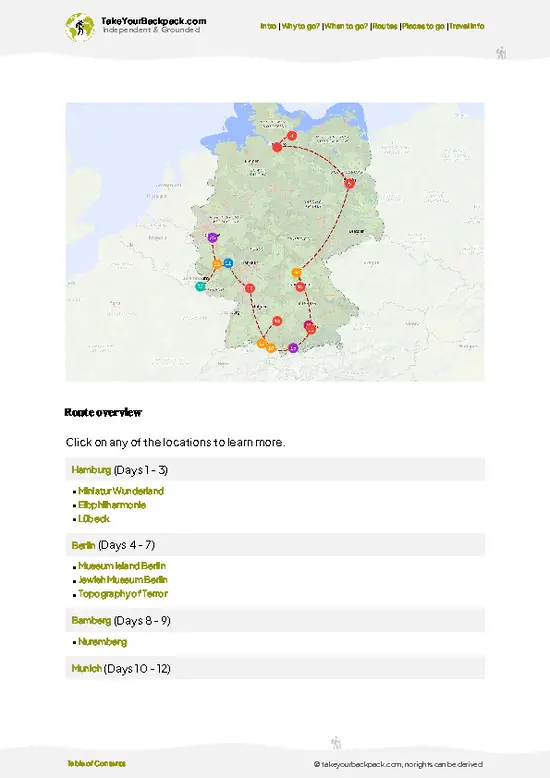
example page 0 from our offline Travel Guide for Germany
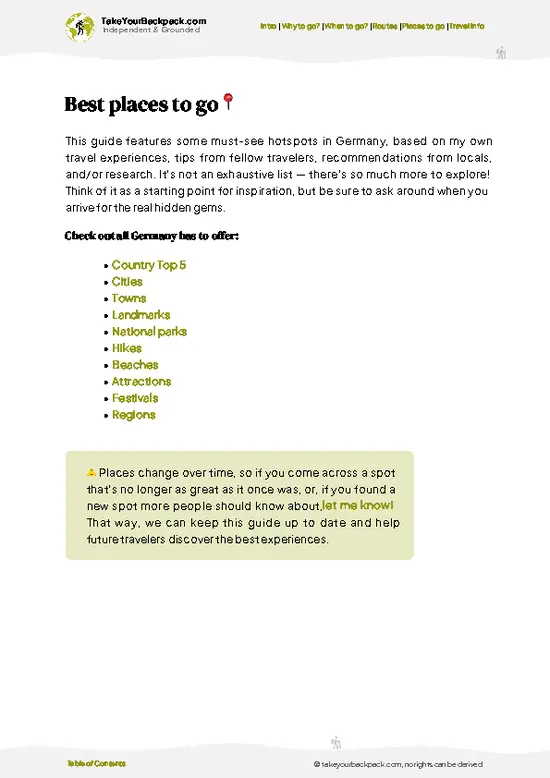
example page 1 from our offline Travel Guide for Germany
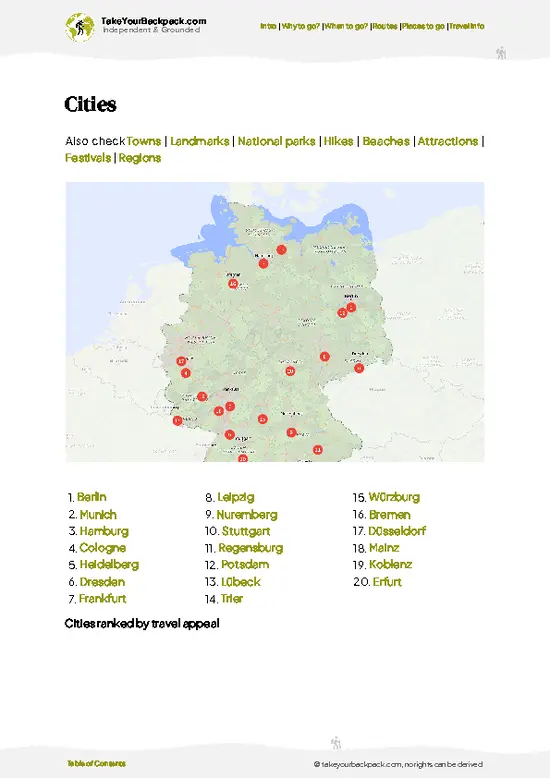
example page 2 from our offline Travel Guide for Germany
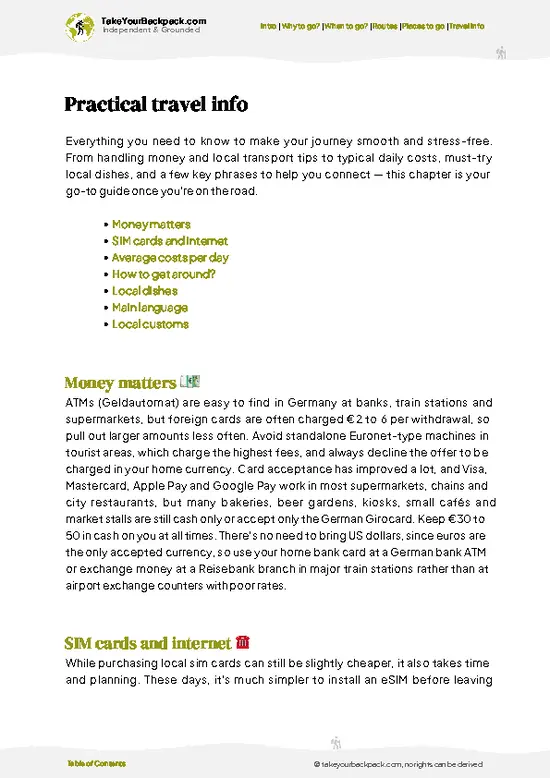
example page 3 from our offline Travel Guide for Germany
example page 4 from our offline Travel Guide for Germany
example page 5 from our offline Travel Guide for Germany
example page 6 from our offline Travel Guide for Germany
example page 7 from our offline Travel Guide for Germany
Loading the map 🌍
CLICK TO FILTER
cities
towns
landmarks
national parks
hikes
beaches
attractions
festivals
regions
SHOW COUNTRY’S BESTSHOW ALL

✨ Why go?
Ranked #12 attraction in Germany
What makes it a must-see attraction

The Städel Museum isn’t just another art stop on Germany’s map—it’s a heavyweight in Europe’s cultural ring. Sure, it’s not the kind of place you’ll find packed with selfie-stick wielders like the Brandenburg Gate, but that’s part of its charm. This museum demands your attention, not your Instagram likes. Inside, you’re staring down 700 years of European art history, from medieval altarpieces to cutting-edge contemporary works. It’s a deep dive into the evolution of creativity, not just a quick glance at a few famous paintings.

Backpackers who carve out time here aren’t just ticking a box—they’re investing in a milestone that sharpens their understanding of Germany’s artistic soul. The Städel’s collection is a masterclass in cultural significance, featuring heavy hitters like Rembrandt, Vermeer, … read more 👉
The Städel Museum isn’t just another art stop on Germany’s map—it’s a heavyweight in Europe’s cultural ring. Sure, it’s not the kind of place you’ll find packed with selfie-stick wielders like the Brandenburg Gate, but that’s part of its charm. This museum demands your attention, not your Instagram likes. Inside, you’re staring down 700 years of European art history, from medieval altarpieces to cutting-edge contemporary works. It’s a deep dive into the evolution of creativity, not just a quick glance at a few famous paintings.

Backpackers who carve out time here aren’t just ticking a box—they’re investing in a milestone that sharpens their understanding of Germany’s artistic soul. The Städel’s collection is a masterclass in cultural significance, featuring heavy hitters like Rembrandt, Vermeer, and Picasso. It’s a place where history isn’t just told; it’s felt through brushstrokes and centuries-old stories.

Yes, the entry fee isn’t pocket change for a budget traveler, but the payoff is massive. The adrenaline rush here comes from intellectual discovery, not physical exertion, making it a perfect counterbalance to Germany’s outdoor-heavy routes. If you want to claim a real cultural win on your trip, the Städel Museum is where you do it.

💡 HighlightsEssential experiences to have while visiting Städel Museum

The Rembrandt Room
Forget the Instagrammers clustering around the “Night Watch” in Amsterdam. The Städel’s Rembrandt room is a quieter, more contemplative experience. Here, you can actually get close enough to see the brushwork—Rembrandt’s “Blinding of Samson” is a masterclass in drama and violence, painted with the kind of raw energy that makes you feel the chaos. No velvet ropes, no selfie sticks in your face. Just you, Rembrandt, and a sense that you’re witnessing something genuinely wild for its time.


German Expressionism Collection
If you want to understand why German art matters, this is the crash course. Kirchner, Beckmann, and Nolde aren’t just names—they’re the reason modern art feels so electric and uncomfortable. These paintings are jagged, loud, and unapologetically weird. The … read more 👉
The Rembrandt Room
Forget the Instagrammers clustering around the “Night Watch” in Amsterdam. The Städel’s Rembrandt room is a quieter, more contemplative experience. Here, you can actually get close enough to see the brushwork—Rembrandt’s “Blinding of Samson” is a masterclass in drama and violence, painted with the kind of raw energy that makes you feel the chaos. No velvet ropes, no selfie sticks in your face. Just you, Rembrandt, and a sense that you’re witnessing something genuinely wild for its time.


German Expressionism Collection
If you want to understand why German art matters, this is the crash course. Kirchner, Beckmann, and Nolde aren’t just names—they’re the reason modern art feels so electric and uncomfortable. These paintings are jagged, loud, and unapologetically weird. The Städel doesn’t hide the darkness or the edge. You’ll see the anxiety of a country on the brink, painted in colors that punch you in the gut. It’s not pretty, but it’s unforgettable—and it’s a thousand times more interesting than another polite landscape.


Vermeer’s “The Geographer”
This is the kind of painting that makes you stop mid-stride. Vermeer’s “The Geographer” is one of those rare works where the light feels alive. You can almost smell the parchment and dust. The room is usually quiet, and you get a sense of intimacy that’s impossible in bigger, noisier museums. It’s a moment of calm precision in a building full of emotional chaos. If you want to see what technical genius looks like, this is it.


The Contemporary Wing
Most old-world museums tack on a modern wing as an afterthought. Not here. The Städel’s contemporary collection is bold, sometimes abrasive, and never boring. You’ll find Gerhard Richter’s color fields, Sigmar Polke’s experiments, and installations that actually make you stop and think instead of just rolling your eyes. The curators aren’t afraid to challenge you, and the space itself feels like a reset button after the intensity of the older galleries.


The Underground Extension
This is my personal favorite. The Städel’s underground extension is a feat of architecture that actually enhances the art. Skylights punch through the lawn above, sending shafts of daylight into a space that feels both futuristic and oddly serene. It’s the kind of place where you want to linger, not just because of what’s on the walls, but because the building itself is part of the experience. It’s proof that a museum can be both historic and forward-thinking without feeling like a theme park.


The Café and Garden
Here’s the real secret: the best art break in Frankfurt isn’t in a guidebook. The Städel’s café spills out into a garden that’s blissfully free of crowds. Locals actually come here to read, sketch, or just decompress. It’s the antidote to museum fatigue and a reminder that sometimes the best part of a world-class collection is the chance to sit, breathe, and let it all sink in.
Spotted a mistake or missing something? Contact us.

Things to do around Städel Museum

Ratings based on Tripadvisor reviews. When you book through this link, you support our work at no extra cost to you.

🌤️ When to go?Weather, crowds, and seasonal trade-offs

  • Weather & Temperature: Frankfurt’s climate means the Städel Museum is accessible year-round, but if you want to dodge the chill, aim for late spring (May-June) or early autumn (September-October). Temperatures hover around 15-22°C (59-72°F), perfect for combining museum visits with outdoor strolls along the Main River.
  • Daylight Hours: Longer days from April to September give you more time to explore the museum and the city without rushing. In winter (December-February), daylight shrinks to about 8 hours, making your visit feel compressed and the city less lively.
  • Crowds: The Städel is a magnet for tourists and locals alike, especially in summer (July-August) and during school holidays. Expect lines and packed galleries then. For a quieter, more contemplative experience, visit midweek in
… read more 👉
  • Weather & Temperature: Frankfurt’s climate means the Städel Museum is accessible year-round, but if you want to dodge the chill, aim for late spring (May-June) or early autumn (September-October). Temperatures hover around 15-22°C (59-72°F), perfect for combining museum visits with outdoor strolls along the Main River.
  • Daylight Hours: Longer days from April to September give you more time to explore the museum and the city without rushing. In winter (December-February), daylight shrinks to about 8 hours, making your visit feel compressed and the city less lively.
  • Crowds: The Städel is a magnet for tourists and locals alike, especially in summer (July-August) and during school holidays. Expect lines and packed galleries then. For a quieter, more contemplative experience, visit midweek in the shoulder seasons (March-April or September-November).
  • Seasonal Activities: Winter brings festive exhibitions and a cozy atmosphere, but also higher prices and more visitors around Christmas. Spring and autumn often feature special exhibits and art events that add depth beyond the permanent collection.
  • Price Fluctuations: Ticket prices are generally stable, but some special exhibitions can hike costs by 3-5 euros. Avoid weekends and holidays if you want to skip the premium crowds and potential surcharges.
Pro-tip: Hit the Städel on a weekday morning in late September—cool but not cold, fewer tourists, and the art feels like it’s just for you.


source: climatestotravel.comJANJanuary: fair for travelingFEBFebruary: fair for travelingMARMarch: highly recommended for travelingAPRApril: highly recommended for travelingMAYMay: excellent for travelingJUNJune: excellent for travelingJULJuly: good for travelingAUGAugust: good for travelingSEPSeptember: excellent for travelingOCTOctober: excellent for travelingNOVNovember: highly recommended for travelingDECDecember: fair for traveling
when-to-go

✈️ The backpacker research shortcutGermany Travel Guide

An offline-friendly backpacking guide with optimized travel routes, ranked highlights, transport advice, and the best areas to stay.
example page 0 from our offline Travel Guide for Germany
example page 1 from our offline Travel Guide for Germany
example page 2 from our offline Travel Guide for Germany
example page 3 from our offline Travel Guide for Germany
example page 4 from our offline Travel Guide for Germany
example page 5 from our offline Travel Guide for Germany
example page 6 from our offline Travel Guide for Germany
example page 7 from our offline Travel Guide for Germany
The digital guide (502 pages) contains:
✅ 135 highlights, ranked by travel appeal
✅ Optimized 7, 14 & 21-day travel routes
✅ Cities, national parks, landmarks, beaches
✅ How to get around
✅ Offline-friendly for travel without Wi-Fi
👉 Click to see all 30+ guide features

📅 Plan smarter in minutes, not weeks
✅ Month by month travel advice
✅ Festivals & national holidays
✅ Budget expectations

🗺️ Go to the right places, skip the overrated ones
✅ Honest pros & cons of destinations
✅ Top hikes, parks & viewpoints
✅ Lesser-known places most travelers miss
✅ Clear “worth it vs skip it” guidance

🛏️ Travel smoothly without rookie mistakes
✅ Best areas to stay
✅ Transport systems explained simply
✅ Common scams & safety advice
✅ SIM cards, money & practical tips

🌍 Understand the country, not just visit it
✅ Culture & traditions
✅ 52 Essential phrases & customs
✅ Festivals worth planning around
✅ Traveler-friendly historical context
✅ Insights that make places more meaningful

📱 Built for real travel conditions
✅ Fully downloadable PDF
✅ Works completely offline
✅ Optimized for phone use
✅ Useful in remote areas & buses
✅ Everything in one place
Stop searching, start planning
Get instant access to your full guide. 30‑day money-back guarantee.
+ Add another guide for just

By proceeding you agree to our terms.
Sent to your inbox immediately after payment • 100% Secure Checkout
Best Backpacking Travel Advisor 2025 tourism awardBest Backpacking
Travel Advisor
2025
What others say about Take Your Backpack Guides:
⭐⭐⭐⭐⭐
Fantastic, amazing amount of information!
⭐⭐⭐⭐⭐
My goodness this is amazing, it's what I've been looking for hats off too you!
⭐⭐⭐⭐⭐
I think this is absolutely BRILLIANT
⭐⭐⭐⭐
Very complete and informative. It's still missing places, but I gotta to commend you
⭐⭐⭐⭐⭐
This is truly amazing, thank you, can't wait to explore it with my kids!
⭐⭐⭐⭐⭐
Awesome resource, thank you!
⭐⭐⭐⭐⭐
This is amazing! Can't wait to explore the ones I haven't seen
⭐⭐⭐⭐
I love this! Well done, great idea.
⭐⭐⭐⭐⭐
Thanks for taking the time to make this gem!
⭐⭐⭐⭐⭐
This might be the best website I've ever seen.
⭐⭐⭐⭐⭐
Congratulations, and thank you so much for your work; it's incredibly valuable.
⭐⭐⭐⭐
In all seriousness I think you did a great job pointing out the important spots
⭐⭐⭐⭐⭐
10/10 very good
⭐⭐⭐⭐⭐
As someone who's only just starting to visit regularly this is awesome, thank you.
⭐⭐⭐⭐
Thank you very much! I'm going to visit my dad, it's going to be very useful!
⭐⭐⭐⭐⭐
This is really cool! We'll be travelling for the first time and this definitely come in handy.
⭐⭐⭐⭐⭐
You are now our minister of culture, congratulations 👨‍💼
⭐⭐⭐⭐⭐
Just wanted to tell you that this is a pearl! Going to follow your recommendations.
⭐⭐⭐⭐⭐
This is so cool. I'll definitely be using the resource for my travels soon.
⭐⭐⭐⭐⭐
This is very impressive! Good work.
⭐⭐⭐⭐⭐
This is an amazing and informative site. Very well done!

🛏️ Where to stay?Best areas and accommodation options

Forget the postcard-perfect image of the Städel Museum as a quiet sanctuary where you can soak in centuries of art undisturbed. Reality check: this place pulls crowds like a magnet, especially on weekends and holidays. The area around it isn’t a sleepy village but part of Frankfurt’s bustling Sachsenhausen district, known for its nightlife and riverside charm. For backpackers, this is a double-edged sword. You want to be close enough to stroll to the museum without hassle, but also somewhere safe and social where you can meet fellow travelers without breaking the bank.

Sachsenhausen is your best … read more 👉
Forget the postcard-perfect image of the Städel Museum as a quiet sanctuary where you can soak in centuries of art undisturbed. Reality check: this place pulls crowds like a magnet, especially on weekends and holidays. The area around it isn’t a sleepy village but part of Frankfurt’s bustling Sachsenhausen district, known for its nightlife and riverside charm. For backpackers, this is a double-edged sword. You want to be close enough to stroll to the museum without hassle, but also somewhere safe and social where you can meet fellow travelers without breaking the bank.

Sachsenhausen is your best bet. It’s lively but not sketchy, packed with affordable spots where solo backpackers hang out. The vibe here is authentic Frankfurt—think cobblestone streets, apple wine taverns, and a mix of locals and travelers swapping stories. Plus, it’s a short tram or bike ride to the museum, so you get the best of both worlds: culture by day, camaraderie by night. Skip the sterile tourist zones and dive into this neighborhood’s real pulse.

👛 Costs (as of 15 October 2026)Travel costs and budget guide for Städel Museum

The standard adult ticket for the Städel Museum costs €16. Reduced tickets, such as for students or seniors, are available for around €10. Special exhibitions may require an additional fee, typically around €4. Entry is free for children under 18. Audio guides or guided tours may cost extra, approximately €5 to €8.

source: staedelmuseum.de
⚠️ Prices can change and everyone travels differently, so take this as a rough guide. Hope it helps you plan your adventure!

FAQFrequently asked questions about Städel Museum

2 to 3 hours is sufficient to visit the Städel Museum to see its main collections and temporary exhibitions. The museum houses over 3,000 works spanning 700 years of art history, so more time may be needed for a thorough visit.
Yes, the Städel Museum is worth the entrance fee of around 16 euros for adults. It offers a comprehensive collection of European art from the Middle Ages to contemporary works, including pieces by Rembrandt, Vermeer, and Picasso.
You can get to the Städel Museum by taking tram lines 16 or 17 to the 'Schweizer Platz' stop, which is about a 5-minute walk from the museum. It is located on the south bank of the Main River in Frankfurt, easily accessible from the city center.
⚠️ Things can change over time, so always validate details locally before you go.

Other German attractions near Städel Museum

Explore more nearby:


💡 Not sure where to go next?
Create a personalized itinerary for Germany including Städel Museum and the places that fit your trip.

Generate my itinerary

👉 Discover all attractions

Or checkout all Germany has to offer (think cities, towns, villages, national parks, hikes, beaches, festivals)
Country photo of Germany

We 💚 feedbackSumming up the experience

The Städel Museum isn’t just another art stop in Frankfurt—it’s a deep dive into European art history with a collection that punches way above its weight. But heads up: it can get packed, especially on weekends, so plan your visit early or late to avoid the crowds. If you’re after more than just a quick selfie, this place rewards patience with masterpieces that stick with you long after you leave.

✈️ When did I visit Germany?
Being a neighbouring country of my home base, I visited Germany many times.

✍️ Help improve this page!
The information on this page is based on my own backpacking experience in Germany, supplemented with up-to-date research and feedback from other travelers. Travel details can change, so if you notice anything outdated or incomplete, feel free to let me know.


🙋‍♂️ Give feedback

👋 Meet the founderWho’s Behind Take Your Backpack?

Johan, backpacker and founder of TakeYourBackpackHi, I’m Johan (Netherlands 🇳🇱), the creator of TakeYourBackpack. Over the past 3 decades, I’ve backpacked through 90+ countries across six continents, gaining extensive experience with independent travel, long-term trips, and overland routes.

This site is built on a combination of firsthand travel experience and carefully curated insights from other backpackers. Many guides are based on places I’ve personally visited, while others bring together tips, observations, and practical advice shared by trusted travelers I’ve met along the way.

The goal is to provide realistic, experience-driven guidance — not generic itineraries — so you can explore destinations with better context, clearer expectations, and more confidence.