
×

Guam🇬🇺 | townsMangilaoUniversity hillside, Pago Bay rocks, red rice plates, roadside fruit stands | things to do and best time to go

Explore DededoExplore Talofofo

Backpacking in Mangilao
🌟 Highlighttown ranked #4
By Johan Kruseman 🇳🇱 | Updated October 16, 2026

Mangilao suits travelers who rent a car, study or surf the island’s quieter side, and want a local base with real grocery stores and plain restaurants. If you want a beach strip with nightlife and hostel mingling, you may find it less rewarding. It sits in the central-east of Guam, between Hagåtña and the Pacific coast, and the University of Guam campus is the heart of it. Buses are infrequent here because most residents drive, so a rental car or rideshare is the smarter move than waiting at stops. Evenings are slow and social scenes are small, so meet people through the campus, the Chamorro food stalls, and dive or surf shops nearby. Eat at the weekend markets rather than hotel restaurants, because that is where locals shop. Walk the University of Guam grounds at sunset, when the trade winds finally drop the heat and the lawns fill with students.

Discover everything you want to know in the 📖 Guam Travel Guide.


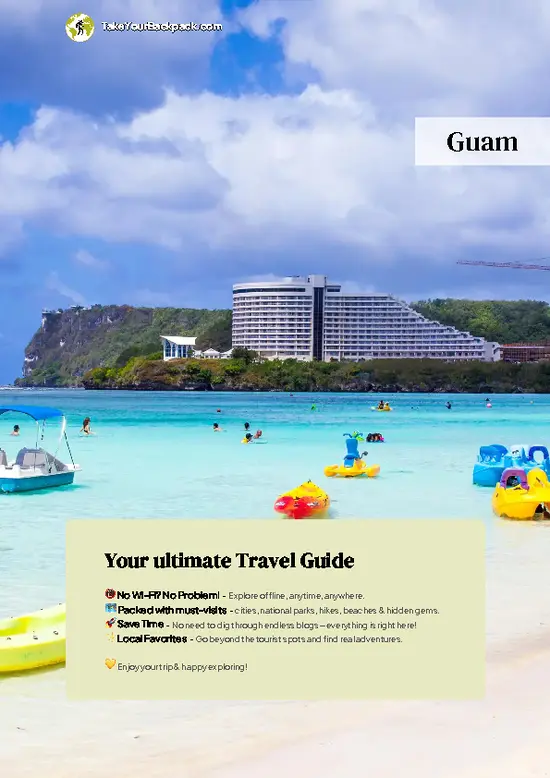
example page 0 from our offline Travel Guide for Guam
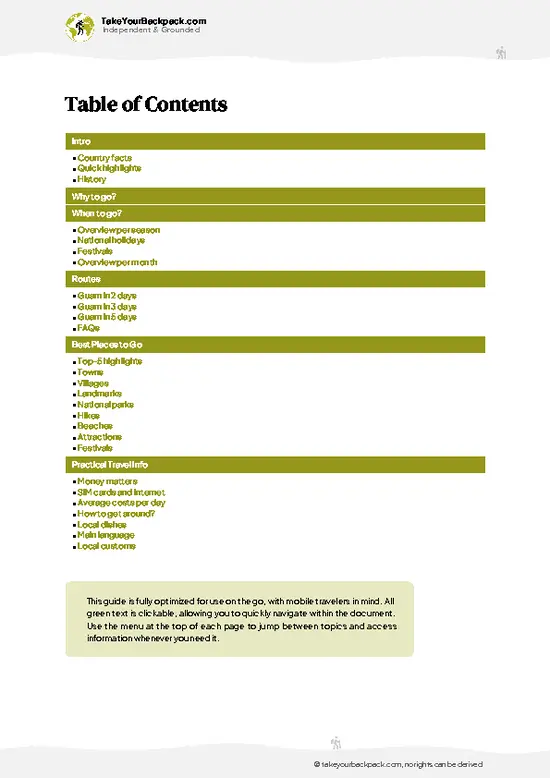
example page 1 from our offline Travel Guide for Guam
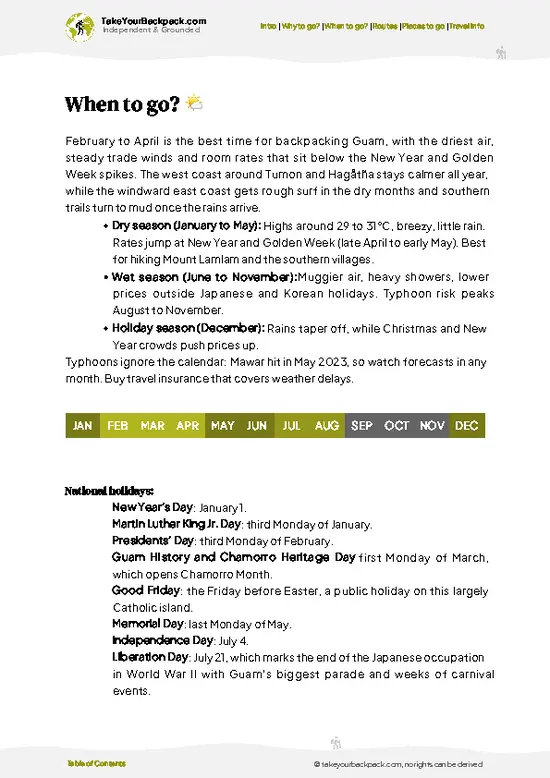
example page 2 from our offline Travel Guide for Guam
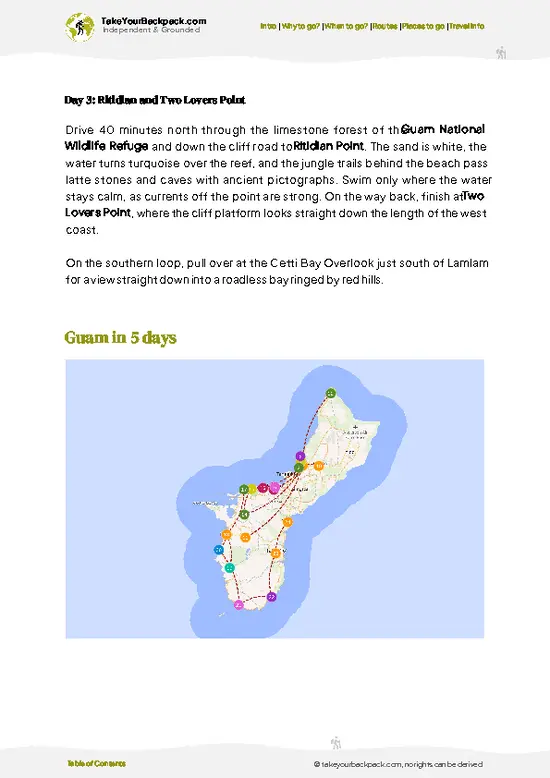
example page 3 from our offline Travel Guide for Guam
example page 4 from our offline Travel Guide for Guam
example page 5 from our offline Travel Guide for Guam
example page 6 from our offline Travel Guide for Guam
example page 7 from our offline Travel Guide for Guam
Loading the map 🌍
CLICK TO FILTER
towns
villages
landmarks
national parks
hikes
beaches
attractions
festivals
SHOW COUNTRY’S BESTSHOW ALL

✨ Why go?
Ranked #4 town in Guam
Why visitors keep coming back

Mangilao earns a stop as a local-life base on a route that otherwise runs through Tumon and Hagåtña tourism. You get ordinary Guam: families at the shops, students on the University of Guam campus, and Chamorro plates at casual eateries. Rooms and guesthouses here are few, so most backpackers stay a night or two, or use it for a longer stretch if they are studying, volunteering or working remotely. The Pago Bay side gives you quiet coast and fishing spots without resort crowds, and the island’s main roads put Tumon, Hagåtña and the south within a short drive. It is not a party town. Social life is low-key, built around cafés, campus events and cooking with new friends. Slow travelers, solo travelers who like space, and anyone building a budget-friendly island loop will get the most from it. … read more 👉
Mangilao earns a stop as a local-life base on a route that otherwise runs through Tumon and Hagåtña tourism. You get ordinary Guam: families at the shops, students on the University of Guam campus, and Chamorro plates at casual eateries. Rooms and guesthouses here are few, so most backpackers stay a night or two, or use it for a longer stretch if they are studying, volunteering or working remotely. The Pago Bay side gives you quiet coast and fishing spots without resort crowds, and the island’s main roads put Tumon, Hagåtña and the south within a short drive. It is not a party town. Social life is low-key, built around cafés, campus events and cooking with new friends. Slow travelers, solo travelers who like space, and anyone building a budget-friendly island loop will get the most from it. If you only have a weekend and want beaches and nightlife, spend it elsewhere.

💡 HighlightsPlaces and moments you shouldn't skip

  1. University of Guam campus and Marine Lab area: The best-known landmark here is the island’s main university, set on a green hillside. Wander the grounds and look at the small marine science presence on the property. Free to walk, about 1 hour, best in the late afternoon when it cools.
  2. Pago Bay shoreline: A quiet stretch of coast where locals fish and gather rather than tourists. Sit on the rocks and watch the Pacific roll in. Free, 1 hour, best at sunrise.
  3. Mangilao Chamorro food spots: Casual local eateries serve red rice, kelaguen and barbecue plates, the everyday food of Chamorro families. Expect about US$8 to 15 a plate, 45 minutes, best at lunch.
  4. Local weekend market stops: Roadside stands and stores sell tropical fruit, coconut candy and fresh produce. Prices are small, usually US$2 to 10,
… read more 👉
  1. University of Guam campus and Marine Lab area: The best-known landmark here is the island’s main university, set on a green hillside. Wander the grounds and look at the small marine science presence on the property. Free to walk, about 1 hour, best in the late afternoon when it cools.
  2. Pago Bay shoreline: A quiet stretch of coast where locals fish and gather rather than tourists. Sit on the rocks and watch the Pacific roll in. Free, 1 hour, best at sunrise.
  3. Mangilao Chamorro food spots: Casual local eateries serve red rice, kelaguen and barbecue plates, the everyday food of Chamorro families. Expect about US$8 to 15 a plate, 45 minutes, best at lunch.
  4. Local weekend market stops: Roadside stands and stores sell tropical fruit, coconut candy and fresh produce. Prices are small, usually US$2 to 10, 30 to 60 minutes, best in the morning before the heat.
  5. Neighborhood village churches and chapels: Small Catholic churches reflect the island’s Spanish-era heritage and strong Chamorro faith. Free, 20 to 30 minutes, best in the cooler early evening, and dress modestly.
Start with the Pago Bay shoreline at sunrise, because the light is soft, the air is coolest and the coast is empty. Day trips from Mangilao reach Hagåtña’s Plaza de España and Latte Stone Park, Tumon Bay, and the beaches and waterfalls toward Talofofo and Inarajan.
Spotted a mistake or missing something? Contact us.

Things to do near Mangilao

Ratings based on Tripadvisor reviews. When you book through this link, you support our work at no extra cost to you.

🏘️ NeighborhoodsUnderstanding the local layout

Mangilao is a university town strung along Route 10 and Route 15, so the smart move is to treat it as three pockets rather than one center.
  • University of Guam area: Students keep the cafes and cheap plates busy on weekdays, and the Micronesian Area Research Center and the campus museum are quiet, free-ish stops. It's walkable within the campus, but the roads around it are car-oriented, so go in the morning before the heat builds.
  • Route 10 and the village center: This is where you find the Chamorro-style bakeries, small markets and local plate lunches. Eat early, because the best spots sell out of the daily specials by early afternoon. Sidewalks are patchy, so use a bus for hops longer than a kilometer.
  • Pago Bay and the coast: Pago Bay is for sunrise and local fishing life rather than swimming,
… read more 👉
Mangilao is a university town strung along Route 10 and Route 15, so the smart move is to treat it as three pockets rather than one center.
  • University of Guam area: Students keep the cafes and cheap plates busy on weekdays, and the Micronesian Area Research Center and the campus museum are quiet, free-ish stops. It's walkable within the campus, but the roads around it are car-oriented, so go in the morning before the heat builds.
  • Route 10 and the village center: This is where you find the Chamorro-style bakeries, small markets and local plate lunches. Eat early, because the best spots sell out of the daily specials by early afternoon. Sidewalks are patchy, so use a bus for hops longer than a kilometer.
  • Pago Bay and the coast: Pago Bay is for sunrise and local fishing life rather than swimming, since the shoreline is rocky and the water is often murky. Go at first light, when it’s calm, and bring your own water because there is almost nothing open nearby.
  • Northern edge toward Tumon: Mangilao’s northern border puts you a short ride from Tumon nightlife. Since Mangilao itself closes up by about 9 pm, locals eat here, then ride out to Tumon for drinks and come back before the last buses.

⌛️ 1 daySeeing the highlights in 24 hours

The day works best with a car or rideshare, and an indoor break through the hottest early afternoon, because shade and walking distances are limited.
7:00 AM: Pago Bay shoreline Start where the coast is quiet and the air is cool. Walk the rocky edge, watch local fishermen and then drive a few minutes inland. It is worth it for sunrise without crowds.
9:00 AM: Local café or bakery breakfast Order a pastry and coffee near the campus, then talk with staff about what is on this weekend.
10:30 AM: University of Guam campus Stroll the shaded paths and lawns. Move slowly, as the heat builds quickly, then head for lunch.
12:30 PM: Chamorro lunch Choose a casual eatery for red rice, barbecue chicken and kelaguen. Eat inside, out of the sun.
2:00 PM: Rest break Return to your room or find an air-conditioned … read more 👉
The day works best with a car or rideshare, and an indoor break through the hottest early afternoon, because shade and walking distances are limited.
7:00 AM: Pago Bay shoreline Start where the coast is quiet and the air is cool. Walk the rocky edge, watch local fishermen and then drive a few minutes inland. It is worth it for sunrise without crowds.
9:00 AM: Local café or bakery breakfast Order a pastry and coffee near the campus, then talk with staff about what is on this weekend.
10:30 AM: University of Guam campus Stroll the shaded paths and lawns. Move slowly, as the heat builds quickly, then head for lunch.
12:30 PM: Chamorro lunch Choose a casual eatery for red rice, barbecue chicken and kelaguen. Eat inside, out of the sun.
2:00 PM: Rest break Return to your room or find an air-conditioned café and let the worst heat pass.
4:00 PM: Village church and neighborhood streets This is off the standard tourist route. Look at the small church, walk a few residential blocks and see where families gather. The light is softer and the pace gentler.
6:00 PM: Sunset on the east side Drive back toward the coast for an evening breeze and a quiet end to the day.

🌤️ When to go?When to go for the best experience

The dry months of December to June suit Mangilao best, with sunny days and lower humidity for walking the university grounds and Pago Bay.
  • Dry Season (December to June): Highs reach 29 to 31°C (84 to 88°F), with breezy trade winds and the clearest skies. Daylight lasts about 11 to 13 hours. Expect higher flight and room prices around Lunar New Year and Easter.
  • Wet Season (July to November): Daily showers push humidity up, with highs of 30 to 32°C (86 to 90°F) and nights near 25°C (77°F). Rooms are cheaper and sights quieter, but this is also typhoon season, so keep plans flexible.
  • Festival Weeks: Village fiestas and the university events calendar bring local crowds and free food in spring and early summer.
Book a refundable room if you travel between August and November.

source: climatestotravel.comJANJanuary: highly recommended for travelingFEBFebruary: excellent for travelingMARMarch: excellent for travelingAPRApril: excellent for travelingMAYMay: highly recommended for travelingJUNJune: fair for travelingJULJuly: fair for travelingAUGAugust: fair for travelingSEPSeptember: below average for travelingOCTOctober: below average for travelingNOVNovember: fair for travelingDECDecember: fair for traveling
when-to-go

✈️ The backpacker research shortcutGuam Travel Guide

An offline-friendly backpacking guide with optimized travel routes, ranked highlights, transport advice, and the best areas to stay.
example page 0 from our offline Travel Guide for Guam
example page 1 from our offline Travel Guide for Guam
example page 2 from our offline Travel Guide for Guam
example page 3 from our offline Travel Guide for Guam
example page 4 from our offline Travel Guide for Guam
example page 5 from our offline Travel Guide for Guam
example page 6 from our offline Travel Guide for Guam
example page 7 from our offline Travel Guide for Guam
The digital guide (135 pages) contains:
✅ 36 highlights, ranked by travel appeal
✅ Optimized 2, 3 & 5-day travel routes
✅ Cities, national parks, landmarks, beaches
✅ How to get around
✅ Offline-friendly for travel without Wi-Fi
👉 Click to see all 30+ guide features

📅 Plan smarter in minutes, not weeks
✅ Month by month travel advice
✅ Festivals & national holidays
✅ Budget expectations

🗺️ Go to the right places, skip the overrated ones
✅ Honest pros & cons of destinations
✅ Top hikes, parks & viewpoints
✅ Lesser-known places most travelers miss
✅ Clear “worth it vs skip it” guidance

🛏️ Travel smoothly without rookie mistakes
✅ Best areas to stay
✅ Transport systems explained simply
✅ Common scams & safety advice
✅ SIM cards, money & practical tips

🌍 Understand the country, not just visit it
✅ Culture & traditions
✅ Local customs
✅ Festivals worth planning around
✅ Traveler-friendly historical context
✅ Insights that make places more meaningful

📱 Built for real travel conditions
✅ Fully downloadable PDF
✅ Works completely offline
✅ Optimized for phone use
✅ Useful in remote areas & buses
✅ Everything in one place
Stop searching, start planning
Get instant access to your full guide. 30‑day money-back guarantee.
+ Add another guide for just

By proceeding you agree to our terms.
Sent to your inbox immediately after payment • 100% Secure Checkout
Best Backpacking Travel Advisor 2025 tourism awardBest Backpacking
Travel Advisor
2025
What others say about Take Your Backpack Guides:
⭐⭐⭐⭐⭐
Fantastic, amazing amount of information!
⭐⭐⭐⭐⭐
My goodness this is amazing, it's what I've been looking for hats off too you!
⭐⭐⭐⭐⭐
I think this is absolutely BRILLIANT
⭐⭐⭐⭐
Very complete and informative. It's still missing places, but I gotta to commend you
⭐⭐⭐⭐⭐
This is truly amazing, thank you, can't wait to explore it with my kids!
⭐⭐⭐⭐⭐
Awesome resource, thank you!
⭐⭐⭐⭐⭐
This is amazing! Can't wait to explore the ones I haven't seen
⭐⭐⭐⭐
I love this! Well done, great idea.
⭐⭐⭐⭐⭐
Thanks for taking the time to make this gem!
⭐⭐⭐⭐⭐
This might be the best website I've ever seen.
⭐⭐⭐⭐⭐
Congratulations, and thank you so much for your work; it's incredibly valuable.
⭐⭐⭐⭐
In all seriousness I think you did a great job pointing out the important spots
⭐⭐⭐⭐⭐
10/10 very good
⭐⭐⭐⭐⭐
As someone who's only just starting to visit regularly this is awesome, thank you.
⭐⭐⭐⭐
Thank you very much! I'm going to visit my dad, it's going to be very useful!
⭐⭐⭐⭐⭐
This is really cool! We'll be travelling for the first time and this definitely come in handy.
⭐⭐⭐⭐⭐
You are now our minister of culture, congratulations 👨‍💼
⭐⭐⭐⭐⭐
Just wanted to tell you that this is a pearl! Going to follow your recommendations.
⭐⭐⭐⭐⭐
This is so cool. I'll definitely be using the resource for my travels soon.
⭐⭐⭐⭐⭐
This is very impressive! Good work.
⭐⭐⭐⭐⭐
This is an amazing and informative site. Very well done!

🛏️ Where to stay?Best areas to stay in Guam

Tumon, a 15 to 20 minute drive from Mangilao, is where most budget travelers sleep, since Mangilao itself has few hostel beds. Tumon has the island’s main cluster of hostels and cheaper guesthouses, plus restaurants open late, the best bus links, and well-lit streets, though the main strip is noisy on weekends.
Mangilao is the quieter second option, with a few budget rooms and rentals near the university. It suits you if you have a car or want calm nights and local prices. Streets are dark and bus service stops early in the evening, so without wheels you’re stuck in for the night.
Book Tumon if … read more 👉
Tumon, a 15 to 20 minute drive from Mangilao, is where most budget travelers sleep, since Mangilao itself has few hostel beds. Tumon has the island’s main cluster of hostels and cheaper guesthouses, plus restaurants open late, the best bus links, and well-lit streets, though the main strip is noisy on weekends.
Mangilao is the quieter second option, with a few budget rooms and rentals near the university. It suits you if you have a car or want calm nights and local prices. Streets are dark and bus service stops early in the evening, so without wheels you’re stuck in for the night.
Book Tumon if you want to meet other travelers, and Mangilao if you’re studying, volunteering or staying longer and cooking for yourself.

🚌 Getting aroundHow to get around Mangilao

A ride on the Guam Regional Transit Authority (GRTA) bus costs about US$1 to 2 per trip, paid in cash with exact change, since drivers don’t make change. That is the cheapest way through Mangilao, but service is sparse, so plan around the timetable rather than hoping for a bus.
  • GRTA Bus: Routes along Route 10 and Route 15 connect Mangilao to Hagåtña, Tumon and the university. Buses run roughly every 30 to 60 minutes and mostly stop around early evening, so check the last departure before heading to Tumon at night. Day passes are cheaper than several single rides.
  • Walking: The campus and village center are walkable in 10 to 15 minutes, but gaps in sidewalks and the heat make longer walks tiring. Walk early and carry water.
  • Taxi and Rideshare: Taxis run about US$15 to 30 to Tumon or Hagåtña, and
… read more 👉
A ride on the Guam Regional Transit Authority (GRTA) bus costs about US$1 to 2 per trip, paid in cash with exact change, since drivers don’t make change. That is the cheapest way through Mangilao, but service is sparse, so plan around the timetable rather than hoping for a bus.
  • GRTA Bus: Routes along Route 10 and Route 15 connect Mangilao to Hagåtña, Tumon and the university. Buses run roughly every 30 to 60 minutes and mostly stop around early evening, so check the last departure before heading to Tumon at night. Day passes are cheaper than several single rides.
  • Walking: The campus and village center are walkable in 10 to 15 minutes, but gaps in sidewalks and the heat make longer walks tiring. Walk early and carry water.
  • Taxi and Rideshare: Taxis run about US$15 to 30 to Tumon or Hagåtña, and wait times can be long. Call ahead or use an app where available, and share with others to cut the fare.
  • Rental Car: Cars start at about US$40 to 70 a day and give you the flexibility Guam really expects. Split it among three or four people, drive on the right, and fill up before heading south, where stations thin out.

👛 Costs (as of 16 October 2026)Money, prices, and spending tips

Expect to spend about US$85 to 140 a day in Mangilao on a backpacker budget, and most of that is the bed and a car or rides.
CategoryBudget RangeLocal Reality
Dorm accommodationUS$35 to 55Beds are mostly in Tumon, so Mangilao stays cost more for privacy.
MealsUS$20 to 35Plate lunches and bakeries cost US$8 to 14, and groceries cut costs.
Local transportUS$10 to 25Buses are cheap but limited, and taxis add up fast.
Basic activities/entry feesUS$5 to 15Parks and viewpoints charge small fees, and beaches are free.
Miscellaneous expensesUS$10 to 15Water, sunscreen and snacks.
Total Daily BudgetUS$85 to 140Higher with a rental car.
Shop at a supermarket for breakfast and snacks to save US$10 or more a day.
⚠️ Prices can change and everyone travels differently, so take this as a rough guide. Hope it helps you plan your adventure!

🚌 Day tripsBest day trips from Mangilao

Mangilao sits in the middle of Guam, so most day trips are a 20 to 45 minute drive, and a rental car or shared taxi makes them far easier than buses.Hagåtña and Plaza de España: Guam’s small capital has the Dulce Nombre de Maria Cathedral, the Spanish plaza ruins and the Chamorro Village night market on Wednesday evenings. It takes about 20 minutes by car or 40 by bus, and a full day costs US$10 to 25 with food. Come on Wednesday, the market night.
👉 Explore HagåtñaRitidian Point: The wildlife refuge at the northern tip has a white-sand beach and limestone cliffs, about 45 minutes by car. Entry is free, it opens Wednesday to Sunday, and you need your own transport. Go early, since it closes in the late afternoon, and bring water.
👉 Explore Ritidian PointCocos Island and Southern Guam: Take the … read more 👉
Mangilao sits in the middle of Guam, so most day trips are a 20 to 45 minute drive, and a rental car or shared taxi makes them far easier than buses.Hagåtña and Plaza de España: Guam’s small capital has the Dulce Nombre de Maria Cathedral, the Spanish plaza ruins and the Chamorro Village night market on Wednesday evenings. It takes about 20 minutes by car or 40 by bus, and a full day costs US$10 to 25 with food. Come on Wednesday, the market night.
👉 Explore HagåtñaRitidian Point: The wildlife refuge at the northern tip has a white-sand beach and limestone cliffs, about 45 minutes by car. Entry is free, it opens Wednesday to Sunday, and you need your own transport. Go early, since it closes in the late afternoon, and bring water.
👉 Explore Ritidian PointCocos Island and Southern Guam: Take the road south to Merizo for the ferry to Cocos Island, around 1 hour 15 minutes away. Budget US$60 to 100 with the boat and snorkeling, and avoid the rainy months when the sea is rough. Book ahead.
Two Lovers Point: The cliff lookout above Tumon gives wide views and takes 25 minutes by car. Entry is about US$3 to 5. Go at sunrise or sunset, when the light is soft and crowds are thinner.
👉 Explore Two Lovers Point

🛡️ SafetyScams, Hazards, and Annoyances

Mangilao is calm and the main risks are practical ones. Leave nothing visible in a parked car at trailheads and beaches, since break-ins happen at tourist spots. Walk with a light, avoid unlit stretches of Route 10 at night, because drivers are fast and sidewalks stop without warning. Solo travelers are generally fine, but with sparse buses after dark, arrange a ride in advance rather than waiting at a stop. Swimming off Pago Bay is not advised because of rocks and currents, and ocean conditions around Guam can change quickly, so check flags before you wade in. Sun and dehydration cause more trouble than crime, so carry water and cover up. No widespread scams target visitors here.

FAQTraveler FAQ

Mangilao is more a base and a local stop than a headline destination. The University of Guam, the village bakeries and Pago Bay are pleasant for a half day, and Tumon and Hagåtña are within 20 to 25 minutes by car. Visit if you want to see everyday Chamorro life away from the resorts.
One day covers Mangilao itself, while two to three days let you add Hagåtña, Two Lovers Point and a southern trip. Plan on 4 to 5 days for all of Guam, including Ritidian and Cocos Island. A rental car at US$40 to 70 a day stretches your time.
Yes, Mangilao is easy to reach from Tumon or Hagåtña in 15 to 25 minutes by car or about 40 by bus. A day covers the university, village lunch and Pago Bay. Buses stop early in the evening, so plan your return before dark.
⚠️ Things can change over time, so always validate details locally before you go.

Other Guamanian towns near Mangilao

Explore more nearby:

  • Yona—Ylig Bay, river mouth, east-coast wind, wartime markers| 5 km away
  • Tumon—Reef-calm bay, Pleasure Island lanes, Two Lovers cliff, Gun Beach snorkeling| 8 km away
  • Dededo—Weekend flea market, plate lunches, Tanguisson shoreline, suburban plateau| 8 km away

💡 Not sure where to go next?
Create a personalized itinerary for Guam including Mangilao and the places that fit your trip.

Generate my itinerary

👉 Discover all towns

Or checkout all Guam has to offer (think cities, towns, villages, national parks, hikes, beaches, festivals)
Country photo of Guam

We 💚 feedbackSumming up the experience

Pair Mangilao with Hagåtña’s historic core on one side and Tumon’s beaches on the other, and treat it as the calm middle stop between them. I would skip trying to fill a full day here and instead sleep here, eat well and bring a rental car. Bring cash for roadside stands.

✍️ Help improve this page!
The information on this page is based on in-depth research, insights shared by experienced travelers, and feedback from the local travel community in Guam. While every effort is made to keep the information accurate and current, conditions can change — so if you spot anything incorrect or outdated, please get in touch.


🙋‍♂️ Give feedback

👋 Meet the founderWho’s Behind Take Your Backpack?

Johan, backpacker and founder of TakeYourBackpackHi, I’m Johan (Netherlands 🇳🇱), the creator of TakeYourBackpack. Over the past 3 decades, I’ve backpacked through 90+ countries across six continents, gaining extensive experience with independent travel, long-term trips, and overland routes.

This site is built on a combination of firsthand travel experience and carefully curated insights from other backpackers. Many guides are based on places I’ve personally visited, while others bring together tips, observations, and practical advice shared by trusted travelers I’ve met along the way.

The goal is to provide realistic, experience-driven guidance — not generic itineraries — so you can explore destinations with better context, clearer expectations, and more confidence.