×

Guam🇬🇺 | national parksPiti Bomb HolesLimestone sinkholes, Piti reef flat, parrotfish, high-tide snorkeling | things to do and best time to go

Explore Guam National Wildlife RefugeExplore Tumon Bay Marine Preserve

Backpacking in Piti Bomb Holes
👌 Worth visitingnational park ranked #4
By Johan Kruseman 🇳🇱 | Updated October 15, 2026

The “bomb holes” here were not made by bombs at all: they are natural sinkholes and collapsed limestone pools along the Piti shoreline, and the name stuck because of World War II craters nearby. Piti Bomb Holes sits on the west coast of Guam, just northeast of Apra Harbor and a short drive from Hagåtña. It is a marine preserve, so you snorkel, you do not hike, and the coral, parrotfish and the occasional turtle are the whole show. Parking is limited, so arrive early on weekdays before tour buses fill the small lot. Go at high tide with calm seas, because low tide leaves a rocky, scraping entry and murky water. Bring your own mask, reef-safe sunscreen and sturdy water shoes, since rentals nearby are thin. Snorkelers and divers on a budget will love it. Anyone wanting a long trail or a sandy beach day will not.

Discover everything you want to know in the 📖 Guam Travel Guide.


example page 0 from our offline Travel Guide for Guam
example page 1 from our offline Travel Guide for Guam
example page 2 from our offline Travel Guide for Guam
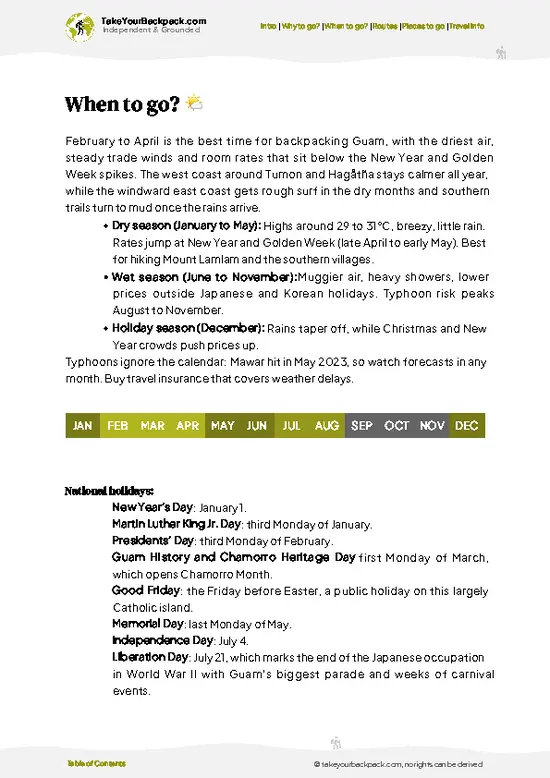
example page 3 from our offline Travel Guide for Guam
example page 4 from our offline Travel Guide for Guam
example page 5 from our offline Travel Guide for Guam
example page 6 from our offline Travel Guide for Guam
example page 7 from our offline Travel Guide for Guam
Loading the map 🌍
CLICK TO FILTER
towns
villages
landmarks
national parks
hikes
beaches
attractions
festivals
SHOW COUNTRY’S BESTSHOW ALL

✨ Why go?
Ranked #4 national park in Guam
What sets this place apart

Backpackers pick Piti for the simple reason that it is free, independent and wild enough to feel like a find. There is no tour requirement. You walk from the lot to the Piti Bomb Holes Marine Preserve, slip in from the rocks and swim out to coral gardens that start in knee-deep water and drop to deeper holes. Pack your own gear and you can spend hours here without paying a guide.

The second draw is the water itself. The cave-like sinkholes hold schools of fish that other, more crowded Guam beaches rarely see, and you can compare them with Tumon Bay in one afternoon. Self-guided travelers get the most out of it, because you set your own pace, pick your own entry point and leave when the tide or your energy turns. Pair it with a rental car, since public buses are sparse, and you can stack Piti … read more 👉
Backpackers pick Piti for the simple reason that it is free, independent and wild enough to feel like a find. There is no tour requirement. You walk from the lot to the Piti Bomb Holes Marine Preserve, slip in from the rocks and swim out to coral gardens that start in knee-deep water and drop to deeper holes. Pack your own gear and you can spend hours here without paying a guide.

The second draw is the water itself. The cave-like sinkholes hold schools of fish that other, more crowded Guam beaches rarely see, and you can compare them with Tumon Bay in one afternoon. Self-guided travelers get the most out of it, because you set your own pace, pick your own entry point and leave when the tide or your energy turns. Pair it with a rental car, since public buses are sparse, and you can stack Piti with other west coast stops in a single day without booking anything.

💡 HighlightsDon't-miss highlights and experiences

  1. Piti Bomb Holes Marine Preserve: the main attraction, a stretch of shoreline where limestone sinkholes open into clear pools, with coral, reef fish and sometimes turtles close to the rocks.
  2. The Main Sinkhole: the deepest hole, a blue circle in the reef flat where you can float over a sudden drop and watch fish gather along the walls.
  3. Shallow Coral Gardens: the reef flat beside the holes, where hard and soft coral grow in waist-deep water and are easy for beginner snorkelers to see.
  4. Parrotfish and Reef Fish Schools: large parrotfish, butterflyfish and damselfish crowd the edges of the preserve, and you can hear parrotfish crunching coral underwater.
  5. Turtle Spotting: green sea turtles sometimes cruise the outer reef, best seen quietly from a distance at high tide when the water is clear.
  6. Piti Shoreline
… read more 👉
  1. Piti Bomb Holes Marine Preserve: the main attraction, a stretch of shoreline where limestone sinkholes open into clear pools, with coral, reef fish and sometimes turtles close to the rocks.
  2. The Main Sinkhole: the deepest hole, a blue circle in the reef flat where you can float over a sudden drop and watch fish gather along the walls.
  3. Shallow Coral Gardens: the reef flat beside the holes, where hard and soft coral grow in waist-deep water and are easy for beginner snorkelers to see.
  4. Parrotfish and Reef Fish Schools: large parrotfish, butterflyfish and damselfish crowd the edges of the preserve, and you can hear parrotfish crunching coral underwater.
  5. Turtle Spotting: green sea turtles sometimes cruise the outer reef, best seen quietly from a distance at high tide when the water is clear.
  6. Piti Shoreline Viewpoint: a short walk along the rocks gives a look back at Apra Harbor and the green hills of the Piti side of the island, good for photos before or after your swim.
  7. Piti Channel: shore divers and snorkelers use the same coast to reach wider reef edges, a good step up once you know the holes.
Snorkeling the main sinkhole in the morning and the shoreline viewpoint right afterward fits neatly into a single half day.
Spotted a mistake or missing something? Contact us.

Things to do near Piti Bomb Holes

Ratings based on Tripadvisor reviews. When you book through this link, you support our work at no extra cost to you.

🌤️ When to go?Choosing the right time of year

  • Dry Season (December to June): Calm seas and the clearest water, with visibility often 30 m (100 ft) or more. Highs run 29 to 31°C (84 to 88°F), lows 23 to 25°C (73 to 77°F). Sunrise is near 6:15 a.m. and sunset near 6:15 p.m.
  • Wet Season (July to November): Daily downpours, humidity that clings, and the main typhoon risk. Temperatures stay similar, but swells can close shore entries and cloud the water. Rain showers often pass within an hour.
  • Crowds: Piti is a dive site, so numbers stay modest. Weekends bring local divers and snorkelers, and Japanese and Korean holiday weeks (Golden Week in late April, Obon in August) fill dive shops.
  • Prices: Dive packages and hotels climb over holiday weeks and the Christmas period. The wet months are the cheapest.
Go on a weekday morning, when the water is calmest … read more 👉
  • Dry Season (December to June): Calm seas and the clearest water, with visibility often 30 m (100 ft) or more. Highs run 29 to 31°C (84 to 88°F), lows 23 to 25°C (73 to 77°F). Sunrise is near 6:15 a.m. and sunset near 6:15 p.m.
  • Wet Season (July to November): Daily downpours, humidity that clings, and the main typhoon risk. Temperatures stay similar, but swells can close shore entries and cloud the water. Rain showers often pass within an hour.
  • Crowds: Piti is a dive site, so numbers stay modest. Weekends bring local divers and snorkelers, and Japanese and Korean holiday weeks (Golden Week in late April, Obon in August) fill dive shops.
  • Prices: Dive packages and hotels climb over holiday weeks and the Christmas period. The wet months are the cheapest.
Go on a weekday morning, when the water is calmest and parking by the Piti Bomb Holes pull-off is easy.


source: climatestotravel.comJANJanuary: highly recommended for travelingFEBFebruary: excellent for travelingMARMarch: excellent for travelingAPRApril: excellent for travelingMAYMay: excellent for travelingJUNJune: highly recommended for travelingJULJuly: fair for travelingAUGAugust: fair for travelingSEPSeptember: below average for travelingOCTOctober: fair for travelingNOVNovember: fair for travelingDECDecember: highly recommended for traveling
when-to-go

✈️ The backpacker research shortcutGuam Travel Guide

An offline-friendly backpacking guide with optimized travel routes, ranked highlights, transport advice, and the best areas to stay.
example page 0 from our offline Travel Guide for Guam
example page 1 from our offline Travel Guide for Guam
example page 2 from our offline Travel Guide for Guam
example page 3 from our offline Travel Guide for Guam
example page 4 from our offline Travel Guide for Guam
example page 5 from our offline Travel Guide for Guam
example page 6 from our offline Travel Guide for Guam
example page 7 from our offline Travel Guide for Guam
The digital guide (135 pages) contains:
✅ 36 highlights, ranked by travel appeal
✅ Optimized 2, 3 & 5-day travel routes
✅ Cities, national parks, landmarks, beaches
✅ How to get around
✅ Offline-friendly for travel without Wi-Fi
👉 Click to see all 30+ guide features

📅 Plan smarter in minutes, not weeks
✅ Month by month travel advice
✅ Festivals & national holidays
✅ Budget expectations

🗺️ Go to the right places, skip the overrated ones
✅ Honest pros & cons of destinations
✅ Top hikes, parks & viewpoints
✅ Lesser-known places most travelers miss
✅ Clear “worth it vs skip it” guidance

🛏️ Travel smoothly without rookie mistakes
✅ Best areas to stay
✅ Transport systems explained simply
✅ Common scams & safety advice
✅ SIM cards, money & practical tips

🌍 Understand the country, not just visit it
✅ Culture & traditions
✅ Local customs
✅ Festivals worth planning around
✅ Traveler-friendly historical context
✅ Insights that make places more meaningful

📱 Built for real travel conditions
✅ Fully downloadable PDF
✅ Works completely offline
✅ Optimized for phone use
✅ Useful in remote areas & buses
✅ Everything in one place
Stop searching, start planning
Get instant access to your full guide. 30‑day money-back guarantee.
+ Add another guide for just

By proceeding you agree to our terms.
Sent to your inbox immediately after payment • 100% Secure Checkout
Best Backpacking Travel Advisor 2025 tourism awardBest Backpacking
Travel Advisor
2025
What others say about Take Your Backpack Guides:
⭐⭐⭐⭐⭐
Fantastic, amazing amount of information!
⭐⭐⭐⭐⭐
My goodness this is amazing, it's what I've been looking for hats off too you!
⭐⭐⭐⭐⭐
I think this is absolutely BRILLIANT
⭐⭐⭐⭐
Very complete and informative. It's still missing places, but I gotta to commend you
⭐⭐⭐⭐⭐
This is truly amazing, thank you, can't wait to explore it with my kids!
⭐⭐⭐⭐⭐
Awesome resource, thank you!
⭐⭐⭐⭐⭐
This is amazing! Can't wait to explore the ones I haven't seen
⭐⭐⭐⭐
I love this! Well done, great idea.
⭐⭐⭐⭐⭐
Thanks for taking the time to make this gem!
⭐⭐⭐⭐⭐
This might be the best website I've ever seen.
⭐⭐⭐⭐⭐
Congratulations, and thank you so much for your work; it's incredibly valuable.
⭐⭐⭐⭐
In all seriousness I think you did a great job pointing out the important spots
⭐⭐⭐⭐⭐
10/10 very good
⭐⭐⭐⭐⭐
As someone who's only just starting to visit regularly this is awesome, thank you.
⭐⭐⭐⭐
Thank you very much! I'm going to visit my dad, it's going to be very useful!
⭐⭐⭐⭐⭐
This is really cool! We'll be travelling for the first time and this definitely come in handy.
⭐⭐⭐⭐⭐
You are now our minister of culture, congratulations 👨‍💼
⭐⭐⭐⭐⭐
Just wanted to tell you that this is a pearl! Going to follow your recommendations.
⭐⭐⭐⭐⭐
This is so cool. I'll definitely be using the resource for my travels soon.
⭐⭐⭐⭐⭐
This is very impressive! Good work.
⭐⭐⭐⭐⭐
This is an amazing and informative site. Very well done!

🛏️ Where to stay?Best areas and accommodation options

Most backpackers sleep in Tumon or Hagåtña, because there are no lodgings inside the Piti Bomb Holes area, which is a marine preserve with a small parking lot and nothing else. Piti village itself has a few small guesthouses and vacation rentals, plus a dive shop, and that is the closest you can get to the water. The best budget picks are in Tumon, about 25 minutes by car, where hostels and mid-range hotels sit within walking distance of restaurants, a grocery store and the bus stop. Hagåtña is about 15 minutes away and quieter, with fewer beds but more local eateries and the Chamorro Village … read more 👉
Most backpackers sleep in Tumon or Hagåtña, because there are no lodgings inside the Piti Bomb Holes area, which is a marine preserve with a small parking lot and nothing else. Piti village itself has a few small guesthouses and vacation rentals, plus a dive shop, and that is the closest you can get to the water. The best budget picks are in Tumon, about 25 minutes by car, where hostels and mid-range hotels sit within walking distance of restaurants, a grocery store and the bus stop. Hagåtña is about 15 minutes away and quieter, with fewer beds but more local eateries and the Chamorro Village night market on Wednesdays.
For a base near the coast, look at Asan and Agat. Vacation rentals there run cheaper than Tumon beach hotels and put you within a short drive of the Piti dive sites. No campgrounds operate near the preserve, and overnight camping on the shore is not permitted. Book ahead for Golden Week and Obon.
A rental car is the easiest way to move between lodging and the site. Bus service exists, but it is infrequent and a walk from the stop remains.

👛 Costs (as of 15 October 2026)Typical daily expenses

A day at Piti Bomb Holes runs about US$70 to 165 per person, driven mostly by lodging and whether you rent gear or dive with a shop.
CategoryBudget RangeLocal Reality
Entrance FeeUS$0No charge to enter the shoreline and marine preserve.
Accommodation (high season)US$35 to 80Hostel beds and budget rooms in Tumon, or a small rental in Piti or Agat.
Gear RentalUS$10 to 25Mask, snorkel and fins from a local shop. Tanks and weights cost more for certified divers.
Local TransportUS$10 to 30Shared rental car gas and parking costs. Buses are cheap but limited.
Food and SuppliesUS$15 to 30Plate lunches, groceries from Pay-Less or Cost-U-Less, and water for the shore.
Total Daily BudgetUS$70 to 165Add US$80 to 130 for a guided boat or shore dive.
⚠️ Prices can change and everyone travels differently, so take this as a rough guide. Hope it helps you plan your adventure!

🥾 TrailsHiking Piti Bomb Holes national park: highlights and difficulty

Piti Bomb Holes has no formal hiking trails, so the walking is short and wet. Most people park at the small lot, follow a short path to the water and move along the rocky shoreline by foot or fin.
  • Parking to the water: a few minutes on a short, rough path with uneven limestone, easy for most people but slippery when wet.
  • Shoreline walk: a slow scramble along the rock edge for 15 to 30 minutes between entry points, moderate because the rocks are sharp and sun-baked.
  • Snorkel loop: a swim of 1 to 2 hours across the reef flat and past the sinkholes, easy to moderate depending on tide and current.
  • Terrain:
… read more 👉
Piti Bomb Holes has no formal hiking trails, so the walking is short and wet. Most people park at the small lot, follow a short path to the water and move along the rocky shoreline by foot or fin.
  • Parking to the water: a few minutes on a short, rough path with uneven limestone, easy for most people but slippery when wet.
  • Shoreline walk: a slow scramble along the rock edge for 15 to 30 minutes between entry points, moderate because the rocks are sharp and sun-baked.
  • Snorkel loop: a swim of 1 to 2 hours across the reef flat and past the sinkholes, easy to moderate depending on tide and current.
  • Terrain: limestone ledges, tidal pools and sandy patches, so water shoes matter more than hiking boots.
  • Wildlife: parrotfish, butterflyfish, sea cucumbers, urchins and sometimes green turtles; keep your fins off the coral.
Getting there is easiest by rental car or taxi from Hagåtña or Tumon, since public buses run infrequently along this stretch. Entry to the preserve itself is free. The site stays quiet most weekday mornings but fills with tour groups and local families on weekends and holidays. Check tide and surf before you go, because rough water and low tide make the entry hard and the visibility poor. No facilities of note are at the water, so bring water and snacks.
⚠️ Hiking info can sometimes be outdated or inaccurate. Before you hit the trail, check the latest conditions with locals. If you do spot anything that's off, I'd love to hear from you, so I can update it for fellow travelers.

🛡️ SafetyTraveler Safety Guide

Piti Bomb Holes is a shore-entry snorkeling and diving site with straightforward access, and most problems come from the water, not the trail. Entry is over sharp, uneven limestone and coral rock, so wear booties or reef shoes and avoid flip-flops. Currents and surge pick up beyond the sheltered holes, especially after rain or during wet season swells, so stay inside the reef and check conditions with a local dive shop first. The sun is strong here, so use reef-safe sunscreen and a rash guard.
The sinkholes are fairly deep and the walls and floor are fragile, so keep your fins off the coral and do not stand on it. Marine life includes reef fish, sea urchins and the occasional lionfish, so look before touching. Dive with a buddy and carry a surface marker. Do not leave valuables visible in your … read more 👉
Piti Bomb Holes is a shore-entry snorkeling and diving site with straightforward access, and most problems come from the water, not the trail. Entry is over sharp, uneven limestone and coral rock, so wear booties or reef shoes and avoid flip-flops. Currents and surge pick up beyond the sheltered holes, especially after rain or during wet season swells, so stay inside the reef and check conditions with a local dive shop first. The sun is strong here, so use reef-safe sunscreen and a rash guard.
The sinkholes are fairly deep and the walls and floor are fragile, so keep your fins off the coral and do not stand on it. Marine life includes reef fish, sea urchins and the occasional lionfish, so look before touching. Dive with a buddy and carry a surface marker. Do not leave valuables visible in your parked car, since break-ins happen at Guam pull-offs. Bring water.

FAQFrequently asked questions about Piti Bomb Holes

Plan on half a day for Piti Bomb Holes and two to three days if you add the nearby Asan and Agat sites. A morning snorkel takes about 1.5 to 2 hours, and a dive another 1 to 2. Pair it with the War in the Pacific National Historical Park at Asan, about 10 minutes away, for a full day.
Without a car it is possible but slow. Guam’s buses run infrequently, and the stop near Piti leaves a walk to the pull-off. A taxi or rideshare from Tumon takes around 25 minutes and costs about US$40 to 60 one way. Dive shops in Piti and Tumon often arrange pickup with a booking.
No entrance fee or permit is needed to snorkel or shore dive at Piti Bomb Holes, since it is a public marine preserve. Divers pay only for gear rental or a guide, typically US$10 to 25 for snorkel gear and more for tanks. Fishing and collecting coral or marine life are prohibited inside the preserve.
⚠️ Things can change over time, so always validate details locally before you go.

Other Guamanian national parks near Piti Bomb Holes

Explore more nearby:


💡 Not sure where to go next?
Create a personalized itinerary for Guam including Piti Bomb Holes and the places that fit your trip.

Generate my itinerary

👉 Discover all national parks

Or checkout all Guam has to offer (think cities, towns, villages, national parks, hikes, beaches, festivals)
Country photo of Guam

We 💚 feedbackSumming up the experience

Piti suits budget snorkelers, shore divers and anyone who likes finding their own entry point rather than following a flag. It is quiet, a little rough and entirely free. I would bring water shoes and a mask, arrive early, and skip it on windy, low-tide days. Families who want sand and lifeguards should head elsewhere.

✍️ Help improve this page!
The information on this page is based on in-depth research, insights shared by experienced travelers, and feedback from the local travel community in Guam. While every effort is made to keep the information accurate and current, conditions can change — so if you spot anything incorrect or outdated, please get in touch.


🙋‍♂️ Give feedback

👋 Meet the founderWho’s Behind Take Your Backpack?

Johan, backpacker and founder of TakeYourBackpackHi, I’m Johan (Netherlands 🇳🇱), the creator of TakeYourBackpack. Over the past 3 decades, I’ve backpacked through 90+ countries across six continents, gaining extensive experience with independent travel, long-term trips, and overland routes.

This site is built on a combination of firsthand travel experience and carefully curated insights from other backpackers. Many guides are based on places I’ve personally visited, while others bring together tips, observations, and practical advice shared by trusted travelers I’ve met along the way.

The goal is to provide realistic, experience-driven guidance — not generic itineraries — so you can explore destinations with better context, clearer expectations, and more confidence.