×

Guernsey🇬🇬 | best hikesYour Guide to the 5 Best hikes in Guernsey

Hikes in Guernsey are short, coastal and easy to reach. The island is only about 14 by 8 km, so every trail is a bus ride from St Peter Port. The south coast has high cliffs and steep steps, while the north and west are flat, sandy and quieter. Independent travelers can walk at no cost, and weekday mornings are emptiest.

By Johan Kruseman 🇳🇱 | Updated October 19, 2026
Explore the best beaches in Guernsey

Why go?Why These hike Stand Out

Guernsey suits walkers because the whole island is compact, so coastal paths and country lanes are never far from a bus stop. The south is a high plateau that drops into cliffs, while the low north and west reward flat, easy walking. A mild, Gulf Stream-warmed climate keeps trails usable almost all year, and wildflowers bloom early. History is everywhere, from German occupation bunkers to old Napoleonic-era towers, so a walk often doubles as a history lesson. Know before you come that this is an expensive island, with Guernsey pounds at par with sterling, and that these are short day walks, not multi-day treks. Tides, sea mist and slippery steps matter more than distance, so pack a rain shell and grippy shoes.
How the List Was Created
The list of best hikes in Guernsey is created based on scenery, challenge, trail quality, landmarks, and overall enjoyment. If you feel a hike is missing in this list, please let us know.

When to go?Optimal Periods for Travel

Best months: May, June and September are the best months for hiking in Guernsey, with daytime highs of 15 to 20°C, long light and fewer crowds than midsummer. Spring brings cliff-top wildflowers, and September keeps the sea warm enough for a swim after a walk.Shoulder and peak seasons: July and August reach 19 to 22°C and are driest, but flights, ferries and rooms cost most, often 20 to 40 percent above spring rates. Book a month or more ahead for those weeks. April and October are cooler (10 to 15°C) and cheaper, though showers are frequent.Winter: November to February runs 5 to 9°C, with annual rainfall around 850 to 900 mm, mostly in autumn and winter. Some cafes, kiosks and seasonal boat services shorten hours or close, and the south coast turns muddy and windy. Daylight ends by about 4:30 pm in December, so start early.

hike hoppingSuggested Travel Strategies

How many days: A trip linking several hikes in Guernsey needs 3 to 5 days, or 5 to 6 if you add a day on Herm or Sark. The island is small, and buses from the St Peter Port hub reach most trailheads in 15 to 30 minutes.Grouping and direction: Group walks by coast rather than by trail. Spend one day on the cliffs of the south, another on the flatter north and west, and keep a spare day for a boat to the smaller islands. Work from east to west, so you finish with sunset on the Atlantic side. Herm is about 20 minutes by boat and Sark about 55 minutes.Common mistakes: Planning two big walks in one day is the usual error, since steep steps slow you down. Allow 2 to 4 hours per walk plus bus waits. Check tide times before any causeway or beach route, and keep a buffer day for fog or ferry cancellations. … read more 👉
How many days: A trip linking several hikes in Guernsey needs 3 to 5 days, or 5 to 6 if you add a day on Herm or Sark. The island is small, and buses from the St Peter Port hub reach most trailheads in 15 to 30 minutes.Grouping and direction: Group walks by coast rather than by trail. Spend one day on the cliffs of the south, another on the flatter north and west, and keep a spare day for a boat to the smaller islands. Work from east to west, so you finish with sunset on the Atlantic side. Herm is about 20 minutes by boat and Sark about 55 minutes.Common mistakes: Planning two big walks in one day is the usual error, since steep steps slow you down. Allow 2 to 4 hours per walk plus bus waits. Check tide times before any causeway or beach route, and keep a buffer day for fog or ferry cancellations. Pick one base in St Peter Port and use buses instead of moving every night.

The ListMust-Visit hikes in Guernsey

1 Guernsey Coastal Path

long-distance route, tidal bays, changing landscapes

Trace the island’s perimeter on foot, moving from sandy inlets to rocky promontories, with shifting views and varied terrain throughout.

2 Petit Bot to Moulin Huet

secluded bays, wooded valleys, granite outcrops

Descend through leafy glens to reach pebbled beaches, then climb again past sculpted rocks and painterly coastal scenes.

guernsey-hike-petit-bot-to-moulin-huet
© Google | Kudakwashe Mlambo

3 Lihou Island Walk

tidal causeway, salt marsh, offshore sanctuary

Time your crossing for low tide to reach a remote island, where seaweed beds and tidal pools attract waders and quiet exploration.

guernsey-hike-lihou-island-walk
© Google | Didier Crestetto

4 Pleinmont

wartime bunkers, windswept heath, dramatic promontory

Traverse exposed ground dotted with concrete relics and heather, pausing at the edge for wide Atlantic views and seabird colonies.

5 L’Ancresse Common

open heathland, Neolithic sites, sandy stretches

Roam across grassy expanses dotted with ancient stones, then detour to wide beaches where locals swim and play cricket.

Loading the map 🌍

Expert viewTips and Advice from Travelers

How many hikes: I advise 4 to 6 walks across a stay of 4 to 5 days. The island is small, so one walk per day leaves time for tides, weather and a pub lunch. More than that and you repeat the same coastal views.Prioritizing by style: First-timers and families should start with the flatter north and west, where paths are wide and the sand is soft. Confident walkers should put the south coast cliff paths first, because the steps and climbs there are the real exercise. History fans should choose routes that pass wartime fortifications and towers. If time is short, skip inland lanes, which are pretty but add little.Budget: Guernsey is not a cheap island. Expect £55 to 85 (US$70 to 110) a day, including a campsite or simple guesthouse bed, food and local bus fares of about £1 to 2 a ride. Camping … read more 👉
How many hikes: I advise 4 to 6 walks across a stay of 4 to 5 days. The island is small, so one walk per day leaves time for tides, weather and a pub lunch. More than that and you repeat the same coastal views.Prioritizing by style: First-timers and families should start with the flatter north and west, where paths are wide and the sand is soft. Confident walkers should put the south coast cliff paths first, because the steps and climbs there are the real exercise. History fans should choose routes that pass wartime fortifications and towers. If time is short, skip inland lanes, which are pretty but add little.Budget: Guernsey is not a cheap island. Expect £55 to 85 (US$70 to 110) a day, including a campsite or simple guesthouse bed, food and local bus fares of about £1 to 2 a ride. Camping runs about £10 to 20 (US$13 to 25) per person a night, while hotels in summer often start at £100 (US$127) for a double. Walking itself is free, with no permits or guides needed. Boats to Herm and Sark cost about £15 to 30 (US$19 to 38) return, and pub meals run £12 to 20 (US$15 to 25). A 4 to 5 day visit typically totals £250 to 450 (US$320 to 570), excluding the crossing from the mainland.Safety and etiquette: The main risks are cliff edges, slippery steps and fast tides. Stay on marked paths, keep clear of crumbling edges, and check tide tables before beach or causeway sections. Fog can roll in suddenly, so carry a charged phone and a waterproof jacket. Mobile signal is generally reliable, but dial 999 for coastguard and emergency help. Close farm gates, keep dogs on leads near livestock and nesting birds, and do not climb on wartime structures that are fenced off. Traffic on narrow lanes is slow but tight, so walk facing oncoming cars and use lane edges.

✈️ The backpacker research shortcutGuernsey Travel Guide

An offline-friendly backpacking guide with optimized travel routes, ranked highlights, transport advice, and the best areas to stay.
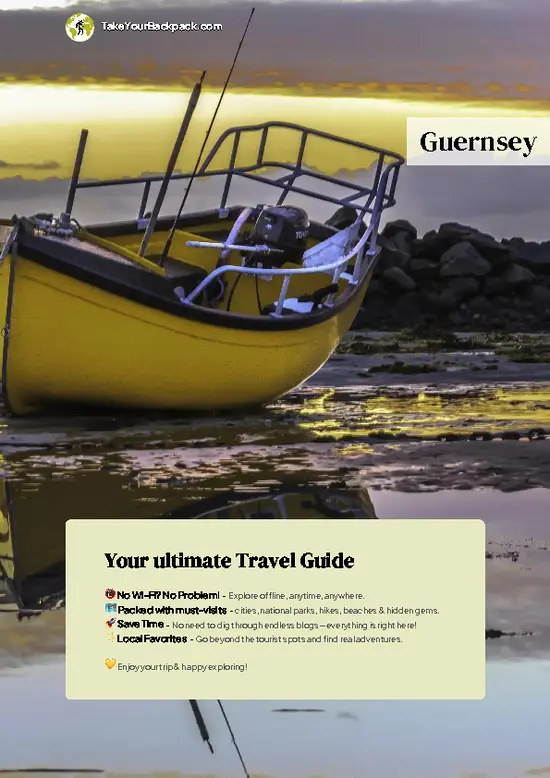
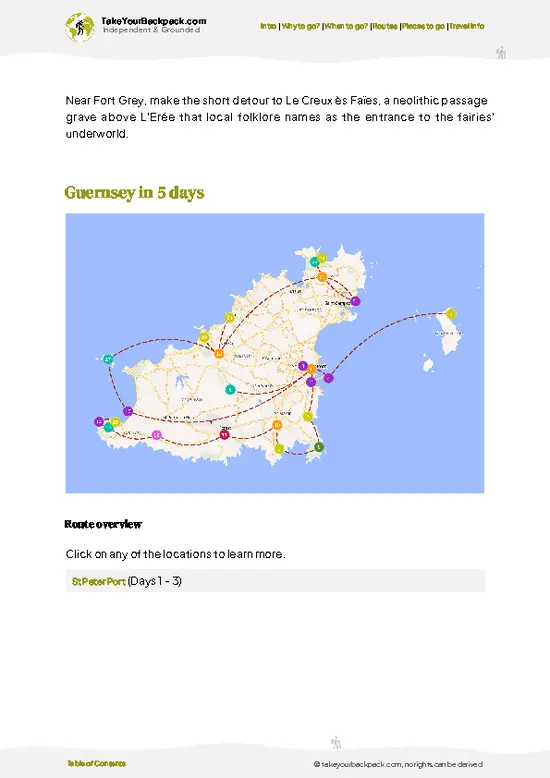
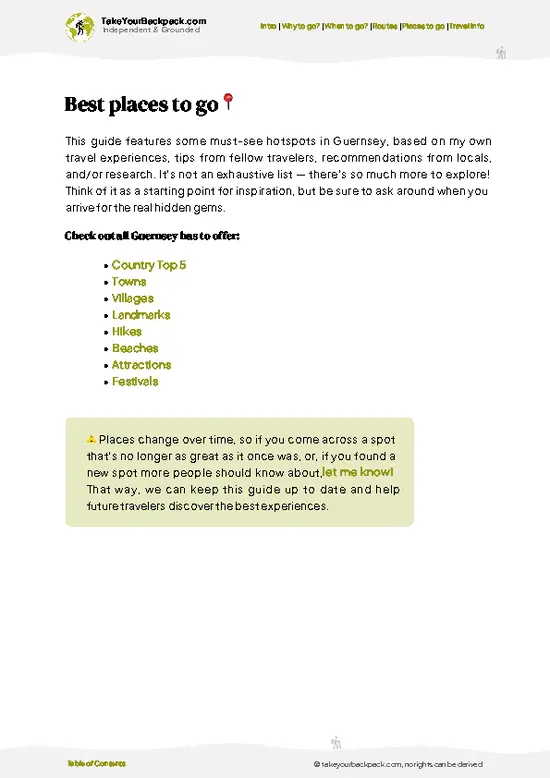
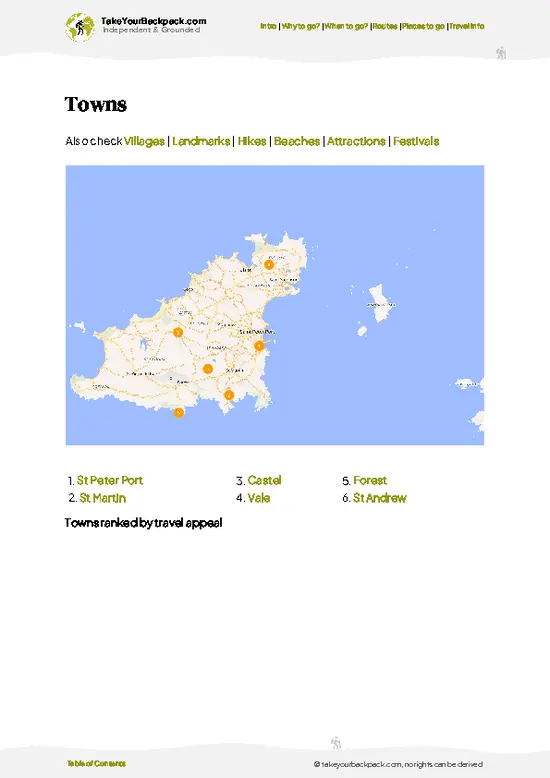
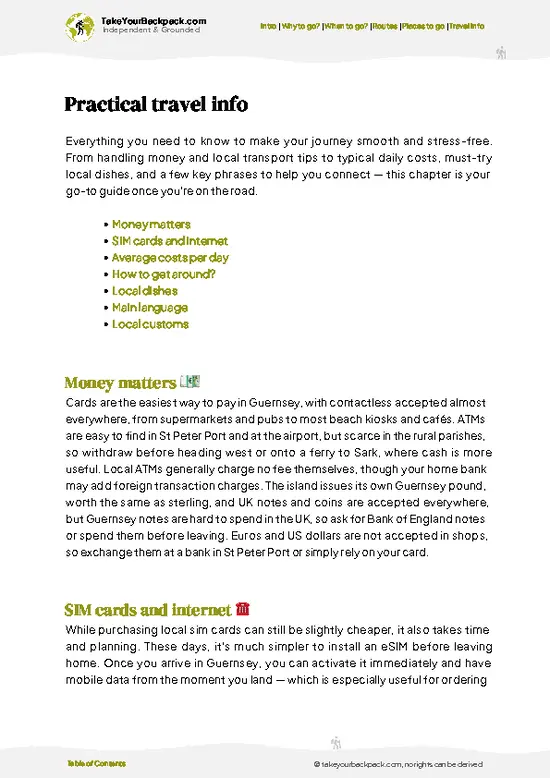
example page 0 from our offline Travel Guide for Guernsey
example page 1 from our offline Travel Guide for Guernsey
example page 2 from our offline Travel Guide for Guernsey
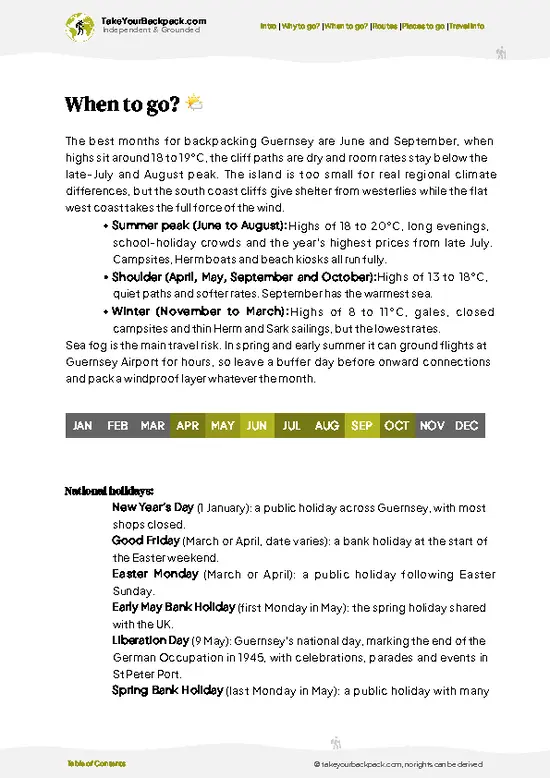
example page 3 from our offline Travel Guide for Guernsey
example page 4 from our offline Travel Guide for Guernsey
example page 5 from our offline Travel Guide for Guernsey
example page 6 from our offline Travel Guide for Guernsey
example page 7 from our offline Travel Guide for Guernsey
The digital guide (135 pages) contains:
✅ 36 highlights, ranked by travel appeal
✅ Optimized 2, 3 & 5-day travel routes
✅ Cities, national parks, landmarks, beaches
✅ How to get around
✅ Offline-friendly for travel without Wi-Fi
👉 Click to see all 30+ guide features

📅 Plan smarter in minutes, not weeks
✅ Month by month travel advice
✅ Festivals & national holidays
✅ Budget expectations

🗺️ Go to the right places, skip the overrated ones
✅ Honest pros & cons of destinations
✅ Top hikes, parks & viewpoints
✅ Lesser-known places most travelers miss
✅ Clear “worth it vs skip it” guidance

🛏️ Travel smoothly without rookie mistakes
✅ Best areas to stay
✅ Transport systems explained simply
✅ Common scams & safety advice
✅ SIM cards, money & practical tips

🌍 Understand the country, not just visit it
✅ Culture & traditions
✅ Local customs
✅ Festivals worth planning around
✅ Traveler-friendly historical context
✅ Insights that make places more meaningful

📱 Built for real travel conditions
✅ Fully downloadable PDF
✅ Works completely offline
✅ Optimized for phone use
✅ Useful in remote areas & buses
✅ Everything in one place
Stop searching, start planning
Get instant access to your full guide. 30‑day money-back guarantee.
+ Add another guide for just

By proceeding you agree to our terms.
Sent to your inbox immediately after payment • 100% Secure Checkout
Best Backpacking Travel Advisor 2025 tourism awardBest Backpacking
Travel Advisor
2025
What others say about Take Your Backpack Guides:
⭐⭐⭐⭐⭐
Fantastic, amazing amount of information!
⭐⭐⭐⭐⭐
My goodness this is amazing, it's what I've been looking for hats off too you!
⭐⭐⭐⭐⭐
I think this is absolutely BRILLIANT
⭐⭐⭐⭐
Very complete and informative. It's still missing places, but I gotta to commend you
⭐⭐⭐⭐⭐
This is truly amazing, thank you, can't wait to explore it with my kids!
⭐⭐⭐⭐⭐
Awesome resource, thank you!
⭐⭐⭐⭐⭐
This is amazing! Can't wait to explore the ones I haven't seen
⭐⭐⭐⭐
I love this! Well done, great idea.
⭐⭐⭐⭐⭐
Thanks for taking the time to make this gem!
⭐⭐⭐⭐⭐
This might be the best website I've ever seen.
⭐⭐⭐⭐⭐
Congratulations, and thank you so much for your work; it's incredibly valuable.
⭐⭐⭐⭐
In all seriousness I think you did a great job pointing out the important spots
⭐⭐⭐⭐⭐
10/10 very good
⭐⭐⭐⭐⭐
As someone who's only just starting to visit regularly this is awesome, thank you.
⭐⭐⭐⭐
Thank you very much! I'm going to visit my dad, it's going to be very useful!
⭐⭐⭐⭐⭐
This is really cool! We'll be travelling for the first time and this definitely come in handy.
⭐⭐⭐⭐⭐
You are now our minister of culture, congratulations 👨‍💼
⭐⭐⭐⭐⭐
Just wanted to tell you that this is a pearl! Going to follow your recommendations.
⭐⭐⭐⭐⭐
This is so cool. I'll definitely be using the resource for my travels soon.
⭐⭐⭐⭐⭐
This is very impressive! Good work.
⭐⭐⭐⭐⭐
This is an amazing and informative site. Very well done!

🛏️ Where to stay?Top Places to Consider Staying

Guernsey has no hostels, so budget travelers rely on campsites (roughly £10 to 15, about US$13 to 19, per person a night in summer) and small guesthouses or B&Bs from around £70 to 120 (US$90 to 150) a night. St Peter Port has the widest choice and puts you within walking distance of the harbor, ferries, restaurants and the island’s pubs, though it costs the most and its steep streets get busy at weekends. The west coast around Cobo and Vazon offers quiet sandy bays with very little nightlife, while St Sampson and the rural parishes in the north hold most of the campsites and are quiet, safe and cheaper, with town about a 15 to 25 minute bus ride away.

If you enjoy meeting fellow travelers, consider … read more 👉
Guernsey has no hostels, so budget travelers rely on campsites (roughly £10 to 15, about US$13 to 19, per person a night in summer) and small guesthouses or B&Bs from around £70 to 120 (US$90 to 150) a night. St Peter Port has the widest choice and puts you within walking distance of the harbor, ferries, restaurants and the island’s pubs, though it costs the most and its steep streets get busy at weekends. The west coast around Cobo and Vazon offers quiet sandy bays with very little nightlife, while St Sampson and the rural parishes in the north hold most of the campsites and are quiet, safe and cheaper, with town about a 15 to 25 minute bus ride away.

If you enjoy meeting fellow travelers, consider choosing hostels with high ratings for atmosphere. On the other hand, if you prefer having your own space, a hotel might be a better option.

GuernseyMore Places Across Guernsey

👋 Meet the founderWho’s Behind Take Your Backpack?

Johan, backpacker and founder of TakeYourBackpackHi, I’m Johan (Netherlands 🇳🇱), the creator of TakeYourBackpack. Over the past 3 decades, I’ve backpacked through 90+ countries across six continents, gaining extensive experience with independent travel, long-term trips, and overland routes.

This site is built on a combination of firsthand travel experience and carefully curated insights from other backpackers. Many guides are based on places I’ve personally visited, while others bring together tips, observations, and practical advice shared by trusted travelers I’ve met along the way.

The goal is to provide realistic, experience-driven guidance — not generic itineraries — so you can explore destinations with better context, clearer expectations, and more confidence.