
×

Japan🇯🇵 | national parksHakusan National Park
Sacred peak, alpine wetlands, wildflowers, deep snowfields | things to do and best time to go

Explore Tanzawa-Oyama Quasi-National ParkExplore Kirishima-Kinkowan National Park

Backpacking in Hakusan
👌 Worth visitingnational park ranked #17
By Johan Kruseman 🇳🇱 | last update: 14 April, 2026

Most people only realize after they leave that Hakusan is where you get Japan’s big-mountain feel without the big-mountain circus or price tag. Hakusan National Park sits in central Honshu, straddling Ishikawa, Gifu, Fukui, and Toyama, and it’s a solid choice if you want real hiking but quieter trails than the Alps or Fuji. Long ridgeline routes, alpine flowers, and bear habitat are the draw; access is decent by bus in season but awkward off-peak. No entrance fee, but huts and campsites aren’t cheap, and wild camping is tightly restricted. Compared with nearby Chubu-Sangaku, Hakusan feels more low-key and local, with fewer views that blow your mind on every turn, but also fewer selfie queues and a calmer, almost old-fashioned mountain vibe.

Discover everything you want to know in the 📖 Japan Travel Guide.
Loading the map 🌍
CLICK TO FILTER
city
town
village
unique site
national park
hike
beach
attraction
festival
region
SHOW COUNTRY‘S BESTSHOW ALL

✨ Why go?
Ranked #17 national park in Japan
What makes this national park worth exploring

Backpackers flock to Hakusan National Park for its blend of independent exploration and affordable accommodations. With a range of budget camping options and nearby hostels, you can stretch your yen while soaking in the stunning landscapes. The park offers a variety of trails, catering to both novice and seasoned hikers. You can choose from gentle walks to challenging ascents, all while enjoying the serenity of nature.

What sets Hakusan apart is its suitability for self-guided travelers. You won’t feel pressured to join a tour, allowing you to set your own pace and discover hidden spots. Just be mindful of the weather; conditions can change rapidly. This flexibility means you can save your energy and budget for the experiences that truly matter, like a quiet moment at a mountain lake or a breathtaking view from the summit.
Get the complete Travel Guide for Japan
Everything organized for offline planning — routes, highlights, costs & tips

See what’s inside 👉

Get the Travel Guide -
  • Mount Hakusan (the summit) — The park’s showpiece: a sacred peak rising to about 2,702 m with raw alpine scenery, dramatic ridgelines and wide summit views on clear days. It’s a proper mountaineer’s climb rather than a stroll, and the sense of place — religious history, exposed rock, and those late-summer wildflowers near the top — makes it my personal favorite for a day that feels earned.
  • Alpine meadows and summer wildflowers — In July-August the high meadows explode with color: primulas, gentians and low-growing alpine blooms carpet slopes and hollows. It’s great for easy, scenic walks and photography; early summer snowmelt also makes for lush, dripping landscapes.
  • High-altitude ponds and wetlands — Scattered tarns and marshy flats give the mountain its reflective moments: quiet pools
  • read more 👉
  • Mount Hakusan (the summit) — The park’s showpiece: a sacred peak rising to about 2,702 m with raw alpine scenery, dramatic ridgelines and wide summit views on clear days. It’s a proper mountaineer’s climb rather than a stroll, and the sense of place — religious history, exposed rock, and those late-summer wildflowers near the top — makes it my personal favorite for a day that feels earned.
  • Alpine meadows and summer wildflowers — In July-August the high meadows explode with color: primulas, gentians and low-growing alpine blooms carpet slopes and hollows. It’s great for easy, scenic walks and photography; early summer snowmelt also makes for lush, dripping landscapes.
  • High-altitude ponds and wetlands — Scattered tarns and marshy flats give the mountain its reflective moments: quiet pools mirror the ridges and are magnets for insects and songbirds. These spots feel intimate compared with the big panoramas and are lovely for sunrise or a silent break on the trail.
  • Primeval beech and mixed forests — The lower slopes hide old-growth beech and mixed woods that are cool, mossy and full of life. Trails through here feel ancient — good for mushroom season, birdwatching, and a real contrast to the bare, windy summit zones.
  • Tedori River gorge and waterfalls — Rivers born on Hakusan carve clear gorges, cascades and rocky pools downstream. These lower-elevation spots are easy side visits from trailheads and are perfect for cooling off after a hike or scouting photos of water and autumn color.
  • Wildlife watching — Look for Japanese serow and sika deer in the woods, and a range of alpine birds and butterflies higher up. Sightings aren’t guaranteed, but the mix of habitats in a compact area makes for good chances if you go quiet and early.
  • Onsen villages and mountain huts — Trailheads around the park link to small onsen towns and basic mountain huts, so you can follow a hard day’s hike with a hot soak and a local meal. Practical, communal, and exactly what a budget backpacker needs after a long ridge walk.
Spotted a mistake or missing something? Contact me.

🌤️ When to go?Choosing the right time of year


  • Weather: Spring and early autumn offer the most stable weather. Summers can be wet and humid, while winters bring heavy snow, limiting access.

  • Temperature: In summer, expect 15-25°C (59-77°F), comfortable for hiking. Winters drop below freezing, often -5 to -10°C (23-14°F), demanding serious gear.

  • Daylight Hours: Late spring to early autumn provides 12-14 hours of daylight, maximizing your trekking time without rushing.

  • Crowds: Peak season is July and August, when local hikers flood the trails. Visiting in May or September means fewer people and a quieter experience.

  • Seasonal Activities: Spring blooms and autumn foliage are the highlights. Winter sports are possible but require advanced planning and equipment.

  • Price Fluctuations: Accommodation and transport costs spike in summer.
  • read more 👉

  • Weather: Spring and early autumn offer the most stable weather. Summers can be wet and humid, while winters bring heavy snow, limiting access.

  • Temperature: In summer, expect 15-25°C (59-77°F), comfortable for hiking. Winters drop below freezing, often -5 to -10°C (23-14°F), demanding serious gear.

  • Daylight Hours: Late spring to early autumn provides 12-14 hours of daylight, maximizing your trekking time without rushing.

  • Crowds: Peak season is July and August, when local hikers flood the trails. Visiting in May or September means fewer people and a quieter experience.

  • Seasonal Activities: Spring blooms and autumn foliage are the highlights. Winter sports are possible but require advanced planning and equipment.

  • Price Fluctuations: Accommodation and transport costs spike in summer. Shoulder seasons offer better deals and more availability.


Pro-tip: Aim for late May or early October to dodge crowds, enjoy mild weather, and keep your budget intact—perfect for savoring Hakusan’s rugged charm without compromise.


source: climatestotravel.comJANJanuary: below average for travelingFEBFebruary: below average for travelingMARMarch: fair for travelingAPRApril: highly recommended for travelingMAYMay: excellent for travelingJUNJune: highly recommended for travelingJULJuly: good for travelingAUGAugust: good for travelingSEPSeptember: excellent for travelingOCTOctober: excellent for travelingNOVNovember: good for travelingDECDecember: below average for traveling
when-to-go

✈️ The ultimate backpacker shortcutJapan Travel Guide

Skip weeks of research and hit the road with confidence. Get 411 pages of proven routes, transport advice, and real safety insights—built for your phone and 100% offline-ready.
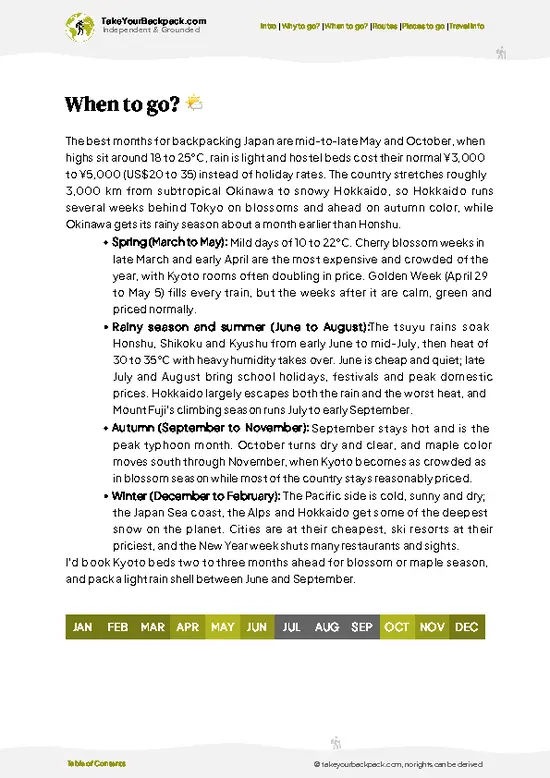
example page 0 from our offline Travel Guide for Japanexample page 1 from our offline Travel Guide for Japanexample page 2 from our offline Travel Guide for Japanexample page 3 from our offline Travel Guide for Japanexample page 4 from our offline Travel Guide for Japan
🎒 Your 411-page offline travel companion
7, 14 & 21-day routes paced for real travel
140 ranked highlights with honest skip-it advice
Logistics solved: Best areas to stay & transport
Safety blueprints: Common local scams to avoid
No Wi-Fi? No problem: Phone-optimized offline PDF
👉 See all 30+ guide features

📅 Plan smarter in minutes, not weeks
Realistic travel times & pacing
Best months per region
Festivals & national holidays
Budget expectations

🗺️ Go to the right places, skip the overrated ones
140 ranked highlights across the country
Hidden gems beyond the tourist trail
Honest pros & cons of destinations
Top hikes, parks & viewpoints
Lesser-known places most travelers miss
Clear “worth it vs skip it” guidance

🛏️ Travel smoothly without rookie mistakes
Best areas to stay
Transport systems explained simply
Local transport tradeoffs
Common scams & safety advice
SIM cards, money & practical tips
What to expect before arrival

🌍 Understand the country, not just visit it
Culture & traditions
52 Essential phrases & customs
Festivals worth planning around
Traveler-friendly historical context
Insights that make places more meaningful

📱 Built for real travel conditions
Fully downloadable PDF
Works completely offline
Optimized for phone use
Useful in remote areas & buses
Everything in one place
Save weeks of stressful planning
Get instant access to the full guide directly. 30-day money-back guarantee.


Sent to your inbox immediately after payment • 100% Secure Checkout
Best Backpacking Travel Advisor 2025 tourism awardBest Backpacking
Travel Advisor
2025
What others say about Take Your Backpack Guides:
⭐⭐⭐⭐⭐
Fantastic, amazing amount of information!
⭐⭐⭐⭐⭐
My goodness this is amazing, it's what I've been looking for hats off too you!
⭐⭐⭐⭐⭐
I think this is absolutely BRILLIANT
⭐⭐⭐⭐
Very complete and informative. It's still missing places, but I gotta to commend you
⭐⭐⭐⭐⭐
This is truly amazing, thank you, can't wait to explore it with my kids!
⭐⭐⭐⭐⭐
Awesome resource, thank you!
⭐⭐⭐⭐⭐
This is amazing! Can't wait to explore the ones I haven't seen
⭐⭐⭐⭐
I love this! Well done, great idea.
⭐⭐⭐⭐⭐
Thanks for taking the time to make this gem!
⭐⭐⭐⭐⭐
This might be the best website I've ever seen.
⭐⭐⭐⭐⭐
Congratulations, and thank you so much for your work; it's incredibly valuable.
⭐⭐⭐⭐
In all seriousness I think you did a great job pointing out the important spots
⭐⭐⭐⭐⭐
10/10 very good
⭐⭐⭐⭐⭐
As someone who's only just starting to visit regularly this is awesome, thank you.
⭐⭐⭐⭐
Thank you very much! I'm going to visit my dad, it's going to be very useful!
⭐⭐⭐⭐⭐
This is really cool! We'll be travelling for the first time and this definitely come in handy.
⭐⭐⭐⭐⭐
You are now our minister of culture, congratulations 👨‍💼
⭐⭐⭐⭐⭐
Just wanted to tell you that this is a pearl! Going to follow your recommendations.
⭐⭐⭐⭐⭐
This is so cool. I'll definitely be using the resource for my travels soon.
⭐⭐⭐⭐⭐
This is very impressive! Good work.
⭐⭐⭐⭐⭐
This is an amazing and informative site. Very well done!

🛏️ Where to stay?Best areas to stay in Japan

Hakusan National Park offers a few solid options for backpackers. Inside the park, the Hakusan Onsen area is a top pick. It features traditional ryokans where you can soak in hot springs after a long day of hiking. Expect to pay a bit more, but the experience is worth it.

If you prefer more budget-friendly options, head to Takayama or Kanazawa, both about an hour away. Takayama has guesthouses that cater to backpackers, while Kanazawa offers a mix of hostels and capsule hotels.

Be mindful of transportation costs; buses to the park can add up. Check schedules in advance to avoid long waits. … read more 👉
Hakusan National Park offers a few solid options for backpackers. Inside the park, the Hakusan Onsen area is a top pick. It features traditional ryokans where you can soak in hot springs after a long day of hiking. Expect to pay a bit more, but the experience is worth it.

If you prefer more budget-friendly options, head to Takayama or Kanazawa, both about an hour away. Takayama has guesthouses that cater to backpackers, while Kanazawa offers a mix of hostels and capsule hotels.

Be mindful of transportation costs; buses to the park can add up. Check schedules in advance to avoid long waits. Also, some trails may require permits, so plan ahead to avoid surprises. Prioritize your energy and budget for the experiences that truly matter, like those breathtaking mountain views.

👛 Costs (as of 11 December 2024)Money, prices, and spending tips

Visiting Hakusan National Park in Japan can be a rewarding experience, but it’s essential to be aware of the costs involved to avoid surprises.

Entry to the park is free, which is a great start. However, if you plan to use public transportation, budget around €10 to €20 (or $10 to $20) for a round trip from nearby cities like Takayama or Kanazawa. Buses to trailheads can vary, so check local schedules.

Accommodation options range widely. Expect to pay between €50 and €150 ($50 to $150) per night for guesthouses or ryokans. If you’re camping, fees are generally around €5 to €10 ($5 to $10) per night, but check for specific site regulations.

Food costs can add up. A meal at a local restaurant will typically set you back €8 to €15 ($8 to $15). If you’re packing your own meals, budget for groceries, … read more 👉
Visiting Hakusan National Park in Japan can be a rewarding experience, but it’s essential to be aware of the costs involved to avoid surprises.

Entry to the park is free, which is a great start. However, if you plan to use public transportation, budget around €10 to €20 (or $10 to $20) for a round trip from nearby cities like Takayama or Kanazawa. Buses to trailheads can vary, so check local schedules.

Accommodation options range widely. Expect to pay between €50 and €150 ($50 to $150) per night for guesthouses or ryokans. If you’re camping, fees are generally around €5 to €10 ($5 to $10) per night, but check for specific site regulations.

Food costs can add up. A meal at a local restaurant will typically set you back €8 to €15 ($8 to $15). If you’re packing your own meals, budget for groceries, which might run you about €30 ($30) for a few days’ worth of supplies.

Guided tours or activities, like climbing or nature walks, can range from €30 to €100 ($30 to $100) depending on the length and inclusions. Always confirm what’s included to avoid unexpected extras.

Finally, consider gear rental if you need it. Prices for hiking gear can vary, but expect around €20 to €50 ($20 to $50) for a day.

Plan carefully, and you’ll preserve your energy and budget for the moments that truly matter in this stunning park.


source: env.go.jp
⚠️ Prices can change and everyone travels differently, so take this as a rough guide. Hope it helps you plan your adventure!

🥾 TrailsScenic routes and wildlife spotting in Hakusan

Hakusan National Park is a gem for hikers, boasting stunning landscapes that range from lush forests to craggy peaks. The park’s centerpiece, Mount Hakusan, is a must-see, especially when it’s capped with snow. The terrain can be a mix of rocky paths and well-maintained trails, making it accessible yet challenging in spots. Wildlife is abundant; keep an eye out for Japanese macaques and various bird species that call this place home.

One of the popular trails is Hakusan Summit Trail. Here are the details:
  • Length: 10 km
  • Estimated Duration: 6-8 hours round trip
  • Difficulty Level: Moderate to Hard
  • Key
  • read more 👉
Hakusan National Park is a gem for hikers, boasting stunning landscapes that range from lush forests to craggy peaks. The park’s centerpiece, Mount Hakusan, is a must-see, especially when it’s capped with snow. The terrain can be a mix of rocky paths and well-maintained trails, making it accessible yet challenging in spots. Wildlife is abundant; keep an eye out for Japanese macaques and various bird species that call this place home.

One of the popular trails is Hakusan Summit Trail. Here are the details:
  • Length: 10 km
  • Estimated Duration: 6-8 hours round trip
  • Difficulty Level: Moderate to Hard
  • Key Features: Panoramic views from the summit, alpine flora, and occasional waterfalls
  • Terrain: Rocky paths, steep sections, and some areas with loose gravel

Getting to Hakusan National Park is pretty straightforward. You can hop on a train to the nearest station, then catch a bus to the trailheads. Just be aware that weekends can get crowded, especially in peak season. As for entrance fees, there’s usually no charge to enter the park, which is a nice bonus for budget travelers. Just remember to pack out what you pack in, and enjoy the fresh air!
⚠️ Hiking info can sometimes be outdated or inaccurate. Before you hit the trail, check the latest conditions with locals. If you do spot anything that's off, I'd love to hear from you, so I can update it for fellow travelers.

🛡️ SafetyScams, Hazards, and Annoyances

Hakusan National Park offers a generally manageable experience for backpackers, but a few realities can catch you off guard. Weather can shift quickly; be prepared for rain or sudden temperature drops, especially at higher altitudes. The trails vary in steepness, and some sections can be rocky or muddy, so sturdy footwear is essential.

Wildlife is present, including bears, but encounters are rare. If you do spot one, keep your distance and make noise to alert them to your presence.

Many first-timers underestimate the importance of pacing. Take your time, especially on ascents, and stay hydrated. A well-planned itinerary will help you enjoy the park’s beauty without unnecessary stress.

Other Japanese national parks near Hakusan

Explore more nearby:


👉 Discover all national parks

Or checkout all Japan has to offer (think cities, towns, villages, national parks, hikes, beaches, festivals)
Country photo of Japan
film
0
0
0a
Shiretoko
film
1
1
1a
Daisetsuzan
film
2
2
2a
Aso-Kuju
film
3
3
3a
Oze
film
4
4
4a
Setonaikai
film
5
5
5a
Kerama Shoto
film
6
6
6a
Hokkaido’s Shiretoko Peninsula

I 💚 feedbackParting advice and final tips

Hakusan National Park is a treasure for those who crave solitude in nature. The trails are less crowded, allowing you to connect deeply with the stunning landscapes. But be prepared: the weather can change on a dime. A sunny morning can turn into a downpour, so pack smart. Embrace the unpredictability; it’s part of the adventure.

✈️ When did I visit Japan?
As part of my 1.5 year travel around the world trip, I visited Japan in August 2015.

✍️ Help improve this page!
The information on this page is based on my own backpacking experience in Japan, supplemented with up-to-date research and feedback from other travelers. Travel details can change, so if you notice anything outdated or incomplete, feel free to let me know.


🙋‍♂️ Give feedback

👋 Meet the authorWho’s Behind Take Your Backpack?

Johan, backpacker and founder of TakeYourBackpackHi, I’m Johan (Netherlands 🇳🇱), the creator of TakeYourBackpack. Over the past decade, I’ve backpacked through 80+ countries across six continents, gaining extensive experience with independent travel, long-term trips, and overland routes.

This site is built on a combination of firsthand travel experience and carefully curated insights from other backpackers. Many guides are based on places I’ve personally visited, while others bring together tips, observations, and practical advice shared by trusted travelers I’ve met along the way.

The goal is to provide realistic, experience-driven guidance — not generic itineraries — so you can explore destinations with better context, clearer expectations, and more confidence.

Get Full Country Guide |
Instant download • 140 highlights • Full Offline guide