×

Kyrgyzstan🇰🇬 | national parksSary-Chelek Biosphere ReserveSary-Chelek lake, Chatkal range, alpine lakes, apple and walnut forest | things to do and best time to go

Explore Padysha-Ata Nature ReserveExplore Besh-Tash National Park

Backpacking in Sary-Chelek Biosphere Reserve
🏆 Top picknational park ranked #2
By Johan Kruseman 🇳🇱 | Updated October 15, 2026

Sary-Chelek is not a lake you can simply wander up to: the reserve’s core zone requires a permit, and the permit and fee are handled at the park office in the village of Arkyt, so arriving without sorting that out wastes a day. The reserve sits in the Chatkal Range of Jalal-Abad Region, in western Kyrgyzstan, roughly 6 to 8 hours by road from Osh or Bishkek’s far side of the mountains. Go early, hire a shared taxi or marshrutka to Kyzyl-Unkur or Arkyt, then push on by 4x4, because public transport thins out fast and a missed connection means an unplanned night. The reward is huge. Walnut forest, glassy turquoise water and quiet trails that beat the crowds of Ala-Archa or Song-Kol. I still recall the first cold gulp of lake water, so clear I could see my boots on the pebbles below. Budget for the 4x4 and bring cash, since there are no ATMs nearby. Hiking is gentle to moderate, wildlife is shy, and the mood is blissfully slow.

Discover everything you want to know in the 📖 Kyrgyzstan Travel Guide.


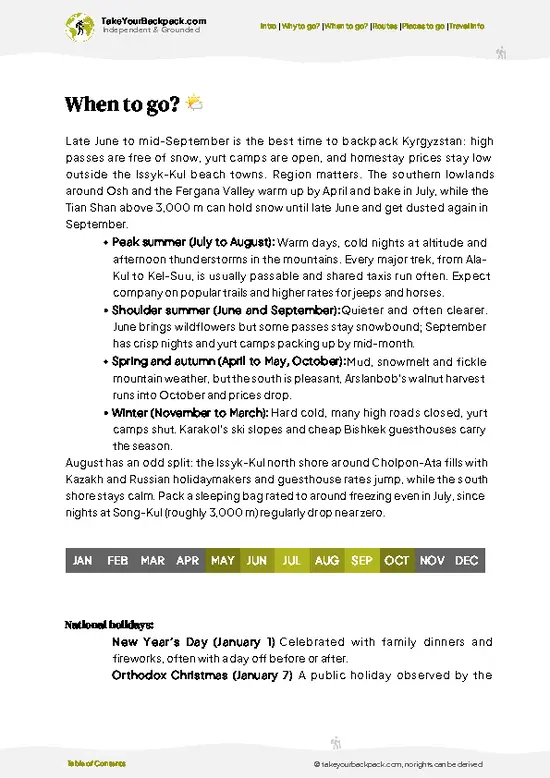
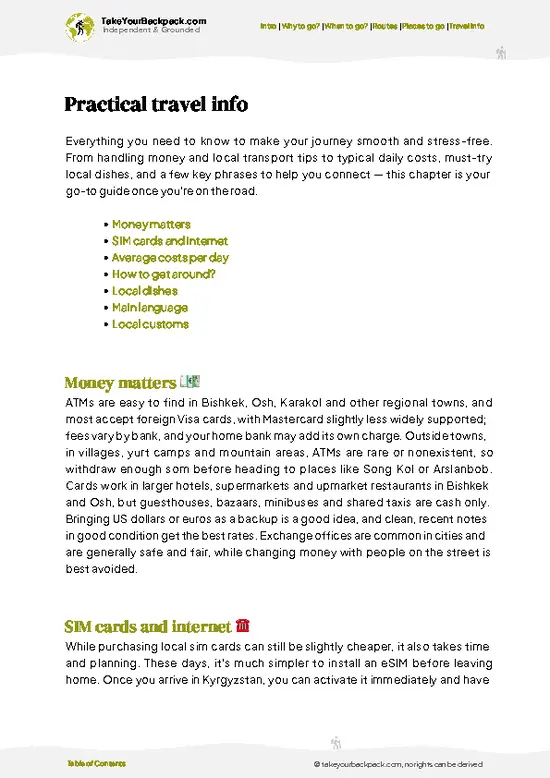
example page 0 from our offline Travel Guide for Kyrgyzstan
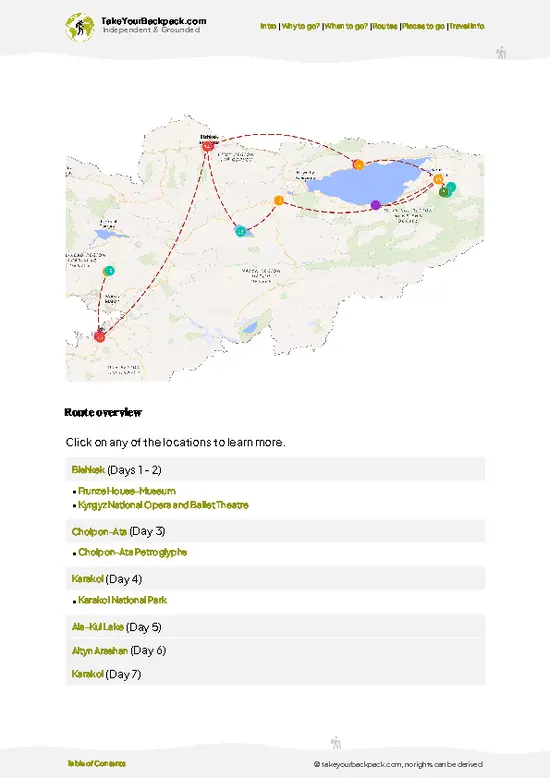
example page 1 from our offline Travel Guide for Kyrgyzstan
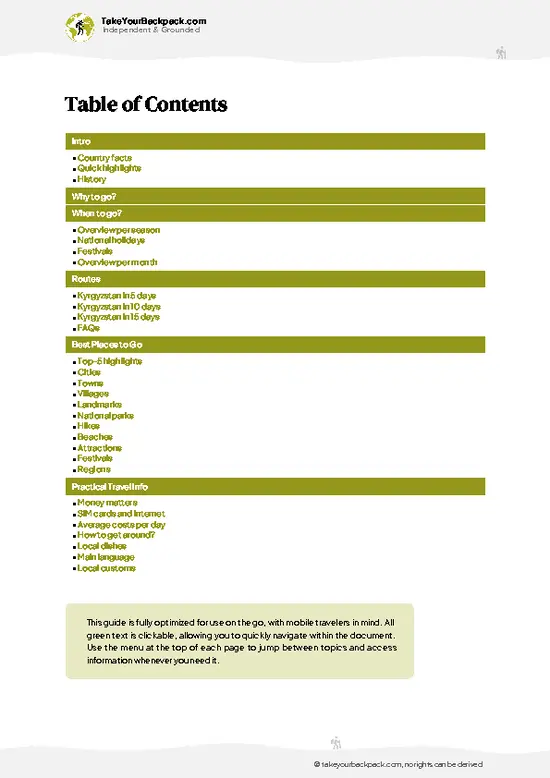
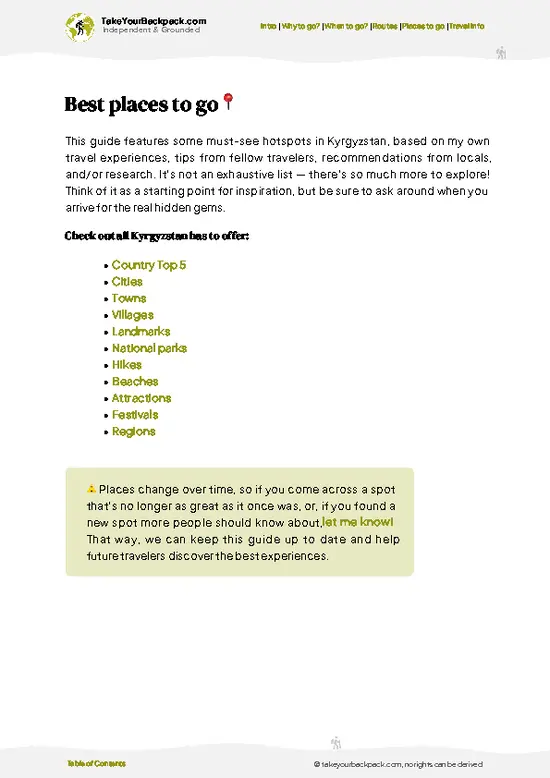
example page 2 from our offline Travel Guide for Kyrgyzstan
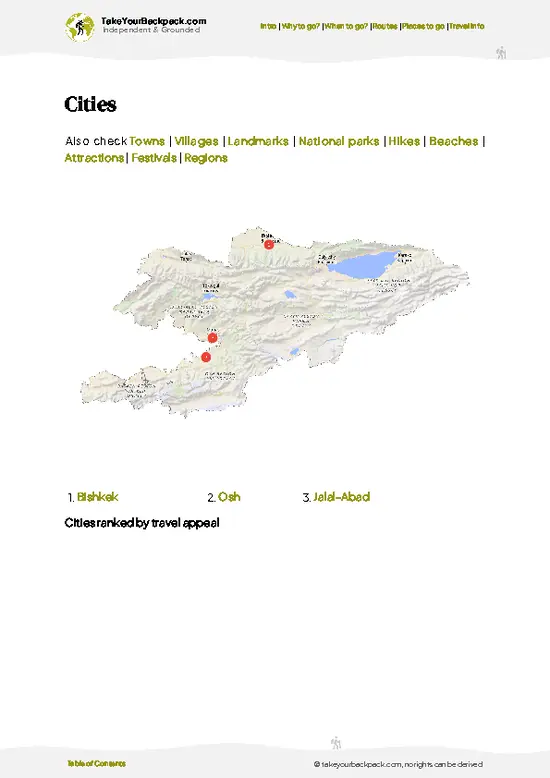
example page 3 from our offline Travel Guide for Kyrgyzstan
example page 4 from our offline Travel Guide for Kyrgyzstan
example page 5 from our offline Travel Guide for Kyrgyzstan
example page 6 from our offline Travel Guide for Kyrgyzstan
example page 7 from our offline Travel Guide for Kyrgyzstan
Loading the map 🌍
CLICK TO FILTER
cities
towns
villages
landmarks
national parks
hikes
beaches
attractions
festivals
regions
SHOW COUNTRY’S BESTSHOW ALL

✨ Why go?
Ranked #2 national park in Kyrgyzstan
Why visitors keep coming back

Backpackers pick Sary-Chelek for independent exploration in a place where tour buses simply do not arrive. The permit system keeps numbers low, so the lakeshore feels like yours by early morning. Budget travelers can camp in designated spots or use simple homestays and yurt camps in and around Arkit, which costs far less than a hotel in Issyk-Kul. The trail variety is compact but real: flat shoreline strolls, forest climbs and a longer push to high lakes, all doable in a day or two without a guide. It suits self-guided travelers who can read a map and carry supplies, though a driver for the rough access road is smart. Walnut-fruit forests make shoulder seasons gorgeous, with autumn color along the slopes. If you want a Kyrgyz park where you decide the pace, with no fixed itinerary, this is … read more 👉
Backpackers pick Sary-Chelek for independent exploration in a place where tour buses simply do not arrive. The permit system keeps numbers low, so the lakeshore feels like yours by early morning. Budget travelers can camp in designated spots or use simple homestays and yurt camps in and around Arkit, which costs far less than a hotel in Issyk-Kul. The trail variety is compact but real: flat shoreline strolls, forest climbs and a longer push to high lakes, all doable in a day or two without a guide. It suits self-guided travelers who can read a map and carry supplies, though a driver for the rough access road is smart. Walnut-fruit forests make shoulder seasons gorgeous, with autumn color along the slopes. If you want a Kyrgyz park where you decide the pace, with no fixed itinerary, this is the one. Bring a tent, a stove, and enough food, since village supplies thin out quickly.

💡 HighlightsPlaces and moments you shouldn't skip

  1. Lake Sary-Chelek: The centerpiece, about 7 kilometers long and more than 200 meters deep, formed when a landslide dammed the valley. Its color shifts from turquoise to deep green depending on light, and spruce-clad slopes frame it from every side.
  2. Iyri-Kol: A smaller, quieter lake reached on foot from the main lake area. It rewards you with solitude and a more intimate forest setting, and you will likely meet few other people on the path.
  3. Aram-Kol: Another high lake in the reserve’s chain of lakes, worth the extra effort if you have a second day. Expect meadow and forest scenery rather than crowds.
  4. Wild walnut and fruit forests: The reserve protects patches of wild walnut, apple and other fruit trees at lower elevations. Autumn is best, when leaves turn gold and you smell fallen fruit on the
… read more 👉
  1. Lake Sary-Chelek: The centerpiece, about 7 kilometers long and more than 200 meters deep, formed when a landslide dammed the valley. Its color shifts from turquoise to deep green depending on light, and spruce-clad slopes frame it from every side.
  2. Iyri-Kol: A smaller, quieter lake reached on foot from the main lake area. It rewards you with solitude and a more intimate forest setting, and you will likely meet few other people on the path.
  3. Aram-Kol: Another high lake in the reserve’s chain of lakes, worth the extra effort if you have a second day. Expect meadow and forest scenery rather than crowds.
  4. Wild walnut and fruit forests: The reserve protects patches of wild walnut, apple and other fruit trees at lower elevations. Autumn is best, when leaves turn gold and you smell fallen fruit on the trail.
  5. Wildlife in the high zone: The reserve shelters Siberian ibex, brown bear and lynx, plus many birds. You are far more likely to hear and see birds than large mammals, so bring binoculars and walk quietly at dawn.
I would pick Lake Sary-Chelek first, because every other trail begins from its shore, and seeing it at sunrise gives you the reference point for the whole reserve.
Spotted a mistake or missing something? Contact us.

🌤️ When to go?Seasonal considerations and timing

The best window for Sary-Chelek is June to September, when roads are open and lake water is clear enough to show its turquoise color.
  • Late Spring (May to early June): Daytime highs run 14 to 22°C (57 to 72°F), nights near freezing at altitude. Meadows are green, but rain turns the access road to mud and some trails stay snowy.
  • Summer (late June to August): Highs reach 22 to 28°C (72 to 82°F) at the lake, cooler higher up. Days are long, with roughly 14 to 15 hours of light. This is peak season, so homestays and the permit queue fill up on weekends.
  • Autumn (September to mid-October): Highs of 12 to 20°C (54 to 68°F), cold nights, and walnut and maple forests turning yellow. Crowds thin out and prices ease.
  • Winter (November to April): Temperatures drop well below 0°C (32°F), snow blocks the road,
… read more 👉
The best window for Sary-Chelek is June to September, when roads are open and lake water is clear enough to show its turquoise color.
  • Late Spring (May to early June): Daytime highs run 14 to 22°C (57 to 72°F), nights near freezing at altitude. Meadows are green, but rain turns the access road to mud and some trails stay snowy.
  • Summer (late June to August): Highs reach 22 to 28°C (72 to 82°F) at the lake, cooler higher up. Days are long, with roughly 14 to 15 hours of light. This is peak season, so homestays and the permit queue fill up on weekends.
  • Autumn (September to mid-October): Highs of 12 to 20°C (54 to 68°F), cold nights, and walnut and maple forests turning yellow. Crowds thin out and prices ease.
  • Winter (November to April): Temperatures drop well below 0°C (32°F), snow blocks the road, and most guesthouses close. Not practical for backpackers.
Book your permit and transport a few days ahead for July and August weekends, and aim for weekdays.


source: climatestotravel.comJANJanuary: below average for travelingFEBFebruary: below average for travelingMARMarch: fair for travelingAPRApril: fair for travelingMAYMay: highly recommended for travelingJUNJune: excellent for travelingJULJuly: highly recommended for travelingAUGAugust: highly recommended for travelingSEPSeptember: excellent for travelingOCTOctober: good for travelingNOVNovember: fair for travelingDECDecember: below average for traveling
when-to-go

✈️ The backpacker research shortcutKyrgyzstan Travel Guide

An offline-friendly backpacking guide with optimized travel routes, ranked highlights, transport advice, and the best areas to stay.
example page 0 from our offline Travel Guide for Kyrgyzstan
example page 1 from our offline Travel Guide for Kyrgyzstan
example page 2 from our offline Travel Guide for Kyrgyzstan
example page 3 from our offline Travel Guide for Kyrgyzstan
example page 4 from our offline Travel Guide for Kyrgyzstan
example page 5 from our offline Travel Guide for Kyrgyzstan
example page 6 from our offline Travel Guide for Kyrgyzstan
example page 7 from our offline Travel Guide for Kyrgyzstan
The digital guide (242 pages) contains:
✅ 73 highlights, ranked by travel appeal
✅ Optimized 5, 10 & 15-day travel routes
✅ Cities, national parks, landmarks, beaches
✅ How to get around
✅ Offline-friendly for travel without Wi-Fi
👉 Click to see all 30+ guide features

📅 Plan smarter in minutes, not weeks
✅ Month by month travel advice
✅ Festivals & national holidays
✅ Budget expectations

🗺️ Go to the right places, skip the overrated ones
✅ Honest pros & cons of destinations
✅ Top hikes, parks & viewpoints
✅ Lesser-known places most travelers miss
✅ Clear “worth it vs skip it” guidance

🛏️ Travel smoothly without rookie mistakes
✅ Best areas to stay
✅ Transport systems explained simply
✅ Common scams & safety advice
✅ SIM cards, money & practical tips

🌍 Understand the country, not just visit it
✅ Culture & traditions
✅ 52 Essential phrases & customs
✅ Festivals worth planning around
✅ Traveler-friendly historical context
✅ Insights that make places more meaningful

📱 Built for real travel conditions
✅ Fully downloadable PDF
✅ Works completely offline
✅ Optimized for phone use
✅ Useful in remote areas & buses
✅ Everything in one place
Stop searching, start planning
Get instant access to your full guide. 30‑day money-back guarantee.
+ Add another guide for just

By proceeding you agree to our terms.
Sent to your inbox immediately after payment • 100% Secure Checkout
Best Backpacking Travel Advisor 2025 tourism awardBest Backpacking
Travel Advisor
2025
What others say about Take Your Backpack Guides:
⭐⭐⭐⭐⭐
Fantastic, amazing amount of information!
⭐⭐⭐⭐⭐
My goodness this is amazing, it's what I've been looking for hats off too you!
⭐⭐⭐⭐⭐
I think this is absolutely BRILLIANT
⭐⭐⭐⭐
Very complete and informative. It's still missing places, but I gotta to commend you
⭐⭐⭐⭐⭐
This is truly amazing, thank you, can't wait to explore it with my kids!
⭐⭐⭐⭐⭐
Awesome resource, thank you!
⭐⭐⭐⭐⭐
This is amazing! Can't wait to explore the ones I haven't seen
⭐⭐⭐⭐
I love this! Well done, great idea.
⭐⭐⭐⭐⭐
Thanks for taking the time to make this gem!
⭐⭐⭐⭐⭐
This might be the best website I've ever seen.
⭐⭐⭐⭐⭐
Congratulations, and thank you so much for your work; it's incredibly valuable.
⭐⭐⭐⭐
In all seriousness I think you did a great job pointing out the important spots
⭐⭐⭐⭐⭐
10/10 very good
⭐⭐⭐⭐⭐
As someone who's only just starting to visit regularly this is awesome, thank you.
⭐⭐⭐⭐
Thank you very much! I'm going to visit my dad, it's going to be very useful!
⭐⭐⭐⭐⭐
This is really cool! We'll be travelling for the first time and this definitely come in handy.
⭐⭐⭐⭐⭐
You are now our minister of culture, congratulations 👨‍💼
⭐⭐⭐⭐⭐
Just wanted to tell you that this is a pearl! Going to follow your recommendations.
⭐⭐⭐⭐⭐
This is so cool. I'll definitely be using the resource for my travels soon.
⭐⭐⭐⭐⭐
This is very impressive! Good work.
⭐⭐⭐⭐⭐
This is an amazing and informative site. Very well done!

🛏️ Where to stay?Best areas to stay in Kyrgyzstan

The most practical base is a homestay or basic guesthouse near the lake, with Arkyt village and Kyzyl-Unkur offering lower prices outside the reserve.
Inside the reserve, you can stay in a handful of simple lodgings near the lake’s entrance area, including rustic cabins and guesthouses run by the reserve or by local families. Beds are basic, bathrooms are shared, and meals (usually bread, soup, eggs, jam and tea) are often included or cooked on request. Camping is possible in designated areas near the lake and on the way to Lake Iyri-Kol and Lake Bakaly-Köl, though you need your reserve permit … read more 👉
The most practical base is a homestay or basic guesthouse near the lake, with Arkyt village and Kyzyl-Unkur offering lower prices outside the reserve.
Inside the reserve, you can stay in a handful of simple lodgings near the lake’s entrance area, including rustic cabins and guesthouses run by the reserve or by local families. Beds are basic, bathrooms are shared, and meals (usually bread, soup, eggs, jam and tea) are often included or cooked on request. Camping is possible in designated areas near the lake and on the way to Lake Iyri-Kol and Lake Bakaly-Köl, though you need your reserve permit and must follow ranger rules on fires and waste.
Outside the reserve, Arkyt is the closest village with homestays, and you can arrange a shared taxi or 4x4 from there. Kyzyl-Unkur and Kazarman offer further options, mainly family-run guesthouses. Larger towns with more choice are Jalal-Abad and Tashkömür, and many travelers connect from Bishkek or Osh via Jalal-Abad.
In summer, message your host ahead of time, since few places have reliable signal, and bring cash in som because there are no ATMs near the lake.

👛 Costs (as of 15 October 2026)Money, prices, and spending tips

A visit to Sary-Chelek typically costs USD 30 to 55 per day for a backpacker, with the reserve permit and transport making up most of the spending.
CategoryBudget RangeLocal Reality
Entrance and permitUSD 3 to 8 per dayReserve entry fees are charged to foreigners, and a border-zone permit may be required. Rates vary, so carry cash in som.
AccommodationUSD 10 to 25 per nightHomestays and basic guesthouses are the norm. Camping costs less, often USD 2 to 6 per tent in designated spots.
MealsUSD 6 to 14 per dayHomestay breakfast and dinner are simple and filling. Pack snacks from Jalal-Abad or Arkyt, since shops near the lake are limited.
Local transportUSD 8 to 25 per dayShared taxis run from Jalal-Abad to Arkyt, then a private 4x4 covers the last stretch. Splitting a car between several people lowers
… read more 👉
A visit to Sary-Chelek typically costs USD 30 to 55 per day for a backpacker, with the reserve permit and transport making up most of the spending.
CategoryBudget RangeLocal Reality
Entrance and permitUSD 3 to 8 per dayReserve entry fees are charged to foreigners, and a border-zone permit may be required. Rates vary, so carry cash in som.
AccommodationUSD 10 to 25 per nightHomestays and basic guesthouses are the norm. Camping costs less, often USD 2 to 6 per tent in designated spots.
MealsUSD 6 to 14 per dayHomestay breakfast and dinner are simple and filling. Pack snacks from Jalal-Abad or Arkyt, since shops near the lake are limited.
Local transportUSD 8 to 25 per dayShared taxis run from Jalal-Abad to Arkyt, then a private 4x4 covers the last stretch. Splitting a car between several people lowers the cost a lot.
Boat or guideUSD 0 to 20Optional. Guides and horse rental are available for the higher lakes, priced by the day.
Prices rise in July and August, and cash is needed almost everywhere because ATMs are far from the reserve.
⚠️ Prices can change and everyone travels differently, so take this as a rough guide. Hope it helps you plan your adventure!

🥾 TrailsExploring Sary-Chelek Biosphere Reserve: trails, terrain, and views

Hiking at Sary-Chelek is modest in scale but varied: flat lakeside walking, forested ascents, and longer climbs toward high lakes. The terrain mixes spruce and juniper forest, meadow, boulder fields, and muddy sections after rain. Wildlife sightings are mostly birds, though ibex and even bears live in the high zone. Trails are rough, sparsely marked, and signage is limited, so download an offline map before arriving.
Lake Sary-Chelek shore walk
  • Length: roughly 4 to 8 kilometers depending on how far you go along the shore
  • Duration: 2 to 4 hours
  • Difficulty: Easy
  • Key features: Turquoise water, spruce
… read more 👉
Hiking at Sary-Chelek is modest in scale but varied: flat lakeside walking, forested ascents, and longer climbs toward high lakes. The terrain mixes spruce and juniper forest, meadow, boulder fields, and muddy sections after rain. Wildlife sightings are mostly birds, though ibex and even bears live in the high zone. Trails are rough, sparsely marked, and signage is limited, so download an offline map before arriving.
Lake Sary-Chelek shore walk
  • Length: roughly 4 to 8 kilometers depending on how far you go along the shore
  • Duration: 2 to 4 hours
  • Difficulty: Easy
  • Key features: Turquoise water, spruce forest, picnic spots and dawn reflections
  • Terrain: Mostly flat dirt path with some muddy patches
Iyri-Kol trail
  • Length: roughly 8 to 12 kilometers return from the main lake area
  • Duration: 3 to 5 hours
  • Difficulty: Moderate
  • Key features: Quiet smaller lake, forest scenery, a good chance of solitude
  • Terrain: Forest path with some ascent, roots and stones
Aram-Kol hike
  • Length: longer than Iyri-Kol, plan for a full day
  • Duration: 6 to 8 hours return
  • Difficulty: Moderate to challenging
  • Key features: High meadow, mountain views, very few visitors
  • Terrain: Steeper slopes, loose rock and variable trail conditions
Getting there by public transport is slow. Marshrutkas and shared taxis run toward Jalal-Abad and Kerben, but the final stretch to Arkit usually needs a local shared taxi or a private driver, and from Arkit you still need a ride to the lake. From Bishkek, plan 10 to 12 hours. Crowds stay light except on summer weekends, when local groups arrive for picnics. An entrance and permit payment is made at the reserve office, with extra charges for camping, so bring cash in som, since cards and ATMs are unreliable here. Carry your passport.
⚠️ Hiking info can sometimes be outdated or inaccurate. Before you hit the trail, check the latest conditions with locals. If you do spot anything that's off, I'd love to hear from you, so I can update it for fellow travelers.

🛡️ SafetyTraveler Safety Guide

Sary-Chelek is a straightforward reserve for hikers with sensible preparation, and the main issues are weather, rough roads and permits.
Mountain weather shifts fast. A sunny morning can turn into cold rain or a thunderstorm by afternoon, and nights stay chilly even in July, so carry a warm layer, a rain shell and a proper sleeping bag. Trails to the higher lakes are rocky and can be slippery after rain, so wear boots with grip and start early. Navigation is easiest with an offline map, since signal is patchy and markings are sparse. Stream crossings can rise in late spring and after storms.
Brown bears and wolves live in the reserve but rarely trouble visitors. Store food away from your tent, keep your camp clean, and make noise on forest trails. Rangers are the best source of current conditions. … read more 👉
Sary-Chelek is a straightforward reserve for hikers with sensible preparation, and the main issues are weather, rough roads and permits.
Mountain weather shifts fast. A sunny morning can turn into cold rain or a thunderstorm by afternoon, and nights stay chilly even in July, so carry a warm layer, a rain shell and a proper sleeping bag. Trails to the higher lakes are rocky and can be slippery after rain, so wear boots with grip and start early. Navigation is easiest with an offline map, since signal is patchy and markings are sparse. Stream crossings can rise in late spring and after storms.
Brown bears and wolves live in the reserve but rarely trouble visitors. Store food away from your tent, keep your camp clean, and make noise on forest trails. Rangers are the best source of current conditions. Bring your passport for the permit, and expect to pay at the checkpoint.

FAQFrequently asked questions about Sary-Chelek Biosphere Reserve

Plan on 2 to 3 days at Sary-Chelek, not counting travel. One day covers the lake and a shore walk, a second lets you hike to Iyri-Kol, and a third suits the longer Aram-Kol climb. From Bishkek the journey is roughly 10 to 12 hours each way, so adding a night in Jalal-Abad or Arkit helps.
Yes, but it takes patience. Shared taxis and marshrutkas connect Bishkek, Jalal-Abad and Kerben, and from there you must find a local ride to Arkit, usually 2 to 3 hours depending on the road. From Arkit to the lake you will likely need a taxi or private driver. Hitching is possible in summer but unreliable.
Yes, a permit and entrance payment are required, and you buy them at the reserve office near Arkit rather than online. Expect to pay a few hundred som per person, roughly 300 to 600 som, plus extra for camping or vehicles. Bring cash in som and your passport, since staff check ID and card payment is not available.
⚠️ Things can change over time, so always validate details locally before you go.

Other Kyrgyz national parks near Sary-Chelek Biosphere Reserve

Explore more nearby:


💡 Not sure where to go next?
Create a personalized itinerary for Kyrgyzstan including Sary-Chelek Biosphere Reserve and the places that fit your trip.

Generate my itinerary

👉 Discover all national parks

Or checkout all Kyrgyzstan has to offer (think cities, towns, villages, national parks, hikes, beaches, festivals)
Country photo of Kyrgyzstan

We 💚 feedbackSumming up the experience

Sary-Chelek is worth it for the dawn hour alone, when the lake is glass and the only sound is a distant woodpecker. That quiet comes at a price, though. Getting here eats a full day, the last leg depends on drivers and luck, and the trails are short compared with Kyrgyzstan’s big treks. If you want big summits and quick logistics, choose elsewhere.

✈️ When did I visit Kyrgyzstan?
I started my 1.5 year travel around the world trip in June 2015 in Kyrgyzstan.

✍️ Help improve this page!
The information on this page is based on my own backpacking experience in Kyrgyzstan, supplemented with up-to-date research and feedback from other travelers. Travel details can change, so if you notice anything outdated or incomplete, feel free to let me know.


🙋‍♂️ Give feedback

👋 Meet the founderWho’s Behind Take Your Backpack?

Johan, backpacker and founder of TakeYourBackpackHi, I’m Johan (Netherlands 🇳🇱), the creator of TakeYourBackpack. Over the past 3 decades, I’ve backpacked through 90+ countries across six continents, gaining extensive experience with independent travel, long-term trips, and overland routes.

This site is built on a combination of firsthand travel experience and carefully curated insights from other backpackers. Many guides are based on places I’ve personally visited, while others bring together tips, observations, and practical advice shared by trusted travelers I’ve met along the way.

The goal is to provide realistic, experience-driven guidance — not generic itineraries — so you can explore destinations with better context, clearer expectations, and more confidence.