×

Liechtenstein🇱🇮 | festivalsFasnachtGuggamusik bands, carved wooden masks, confetti, village balls | things to do and best time to go

Explore Vaduz Christmas MarketExplore FL1.LIFE

Backpacking in Fasnacht
👍 Recommendedfestival ranked #4

📅 Next: February 2027
By Johan Kruseman 🇳🇱 | Updated November 6, 2026

Fasnacht suits travelers who like small-town folk traditions, brass bands and costumed chaos more than polished headline acts. If you want big-name DJs or all-night camping, you may find it less rewarding, because the scale here is modest and much of the fun is local. The carnival season is celebrated across Liechtenstein, with its most visible events in Schaan, Vaduz, Triesen and Balzers in the Rhine valley, close to the Swiss border. Expect Guggamusik bands playing deliberately off-key, grotesque wooden masks, confetti underfoot and children tossing sweets from floats. Parades, costume balls and street parties cluster in the weeks before Lent, building to a weekend and the days around Shrove Tuesday. Crowds are mostly families, teenagers and friendly locals who will happily pull you into a conga line. Bring a costume or just a silly hat, it helps. Check which village hosts the parade on your weekend, then arrive early to claim a spot.

Part of Backpacking in Liechtenstein: all 25 places on one map, with routes and the best time to go.
Discover everything you want to know in the 📖 Liechtenstein Travel Guide.
Loading the map 🌍
CLICK TO FILTER
towns
villages
landmarks
hikes
attractions
festivals
regions
SHOW COUNTRY’S BESTSHOW ALL

✨ Why go?
Ranked #4 festival in Liechtenstein
Why Fasnacht should be on your travel list

Fasnacht gives you a rare window into Liechtenstein beyond castles and hiking trails. Winter is quiet in this country, so a street full of brass bands and masked revelers feels like a secret handed over, and the tiny size means you stand beside locals rather than behind barriers. The Guggamusik bands are the heart of it. These loud, brass-and-drum groups wear elaborate costumes and often keep parading and playing through the evening, so you hear them before you see them. You can join in the drinking and singing at village pubs and tents where strangers get adopted quickly. It also fits neatly into a winter loop through Switzerland and Austria, since the Swiss and Vorarlberg carnival towns run on similar dates and the borders are a short hop away. Prices are friendlier than the famous carnivals … read more 👉
Fasnacht gives you a rare window into Liechtenstein beyond castles and hiking trails. Winter is quiet in this country, so a street full of brass bands and masked revelers feels like a secret handed over, and the tiny size means you stand beside locals rather than behind barriers. The Guggamusik bands are the heart of it. These loud, brass-and-drum groups wear elaborate costumes and often keep parading and playing through the evening, so you hear them before you see them. You can join in the drinking and singing at village pubs and tents where strangers get adopted quickly. It also fits neatly into a winter loop through Switzerland and Austria, since the Swiss and Vorarlberg carnival towns run on similar dates and the borders are a short hop away. Prices are friendlier than the famous carnivals of Basel or Cologne, and nobody checks whether you know the words.

💡 HighlightsEssential experiences to have while celebrating the Fasnacht

  1. Guggamusik parades: Brass and percussion bands march in matching, often absurd costumes and play pop tunes with gleeful wrongness. Stand near a corner where they pause and the sound bounces off the buildings.
  2. Costume and mask traditions: Look for hand-carved wooden masks and ragged patchwork outfits representing local figures, witches and devils. Many are made by clubs and families, and some are decades old.
  3. Children’s parade: Smaller kids dress up and ride floats or walk the route, throwing candy into the crowd. It is the gentlest, most family-focused event and a good way to meet locals.
  4. Fasnacht balls and pub nights: Dance halls and village pubs fill with costumed guests, band sets and late-night singing. Wear something you can sweat in, and arrive in costume to get the full welcome.
  5. Confetti
… read more 👉
  1. Guggamusik parades: Brass and percussion bands march in matching, often absurd costumes and play pop tunes with gleeful wrongness. Stand near a corner where they pause and the sound bounces off the buildings.
  2. Costume and mask traditions: Look for hand-carved wooden masks and ragged patchwork outfits representing local figures, witches and devils. Many are made by clubs and families, and some are decades old.
  3. Children’s parade: Smaller kids dress up and ride floats or walk the route, throwing candy into the crowd. It is the gentlest, most family-focused event and a good way to meet locals.
  4. Fasnacht balls and pub nights: Dance halls and village pubs fill with costumed guests, band sets and late-night singing. Wear something you can sweat in, and arrive in costume to get the full welcome.
  5. Confetti and sweets in the streets: By the end of a parade day the pavement is carpeted in colored paper, and locals pass round local pastries and warm drinks. Hot sausages and mulled wine keep the cold out between acts.
Watching the parades from the roadside costs nothing, while balls and tents usually charge a modest entry, and Fasnacht street life is the cheapest way to enjoy the season.
Spotted a mistake or missing something? Contact us.

🌤️ When to go?When is the celebration of Fasnacht?

Fasnacht in Liechtenstein runs in the days before Ash Wednesday, so the date moves each year between early February and early March, with the main action in Vaduz, Schaan, Balzers and Triesen over roughly a week.
  • Best day: Go on the Saturday or Sunday, when the costumed parades and Guggenmusik brass bands take over the streets and the Fasnachtsumzug crowds are at their liveliest.
  • Weather: Expect around -2 to 7°C (28 to 45°F), with possible snow or cold rain and short daylight. Bring thermal layers, waterproof shoes and a hat you don’t mind getting confetti in.
  • Booking: Reserve beds three to four weeks ahead, especially in Vaduz, where rooms can cost 20 to 40 percent more on parade weekends.
  • Crowds: Arrive by bus or train to Schaan-Vaduz before midday, since roads near the parade routes close,
… read more 👉
Fasnacht in Liechtenstein runs in the days before Ash Wednesday, so the date moves each year between early February and early March, with the main action in Vaduz, Schaan, Balzers and Triesen over roughly a week.
  • Best day: Go on the Saturday or Sunday, when the costumed parades and Guggenmusik brass bands take over the streets and the Fasnachtsumzug crowds are at their liveliest.
  • Weather: Expect around -2 to 7°C (28 to 45°F), with possible snow or cold rain and short daylight. Bring thermal layers, waterproof shoes and a hat you don’t mind getting confetti in.
  • Booking: Reserve beds three to four weeks ahead, especially in Vaduz, where rooms can cost 20 to 40 percent more on parade weekends.
  • Crowds: Arrive by bus or train to Schaan-Vaduz before midday, since roads near the parade routes close, and leave after the last parties or take a late bus to avoid the evening crush.
The best timing is the main parade weekend, arriving by late morning with your bed already booked.


source: climatestotravel.comJANJanuary: not recommended for travelingFEBFebruary: excellent for travelingMARMarch: not recommended for travelingAPRApril: not recommended for travelingMAYMay: not recommended for travelingJUNJune: not recommended for travelingJULJuly: not recommended for travelingAUGAugust: not recommended for travelingSEPSeptember: not recommended for travelingOCTOctober: not recommended for travelingNOVNovember: not recommended for travelingDECDecember: not recommended for traveling

✈️ The backpacker research shortcutLiechtenstein Travel Guide

What the free pages can't give you: ready-made routes, every place ranked, and it works offline. All in 1 guide.
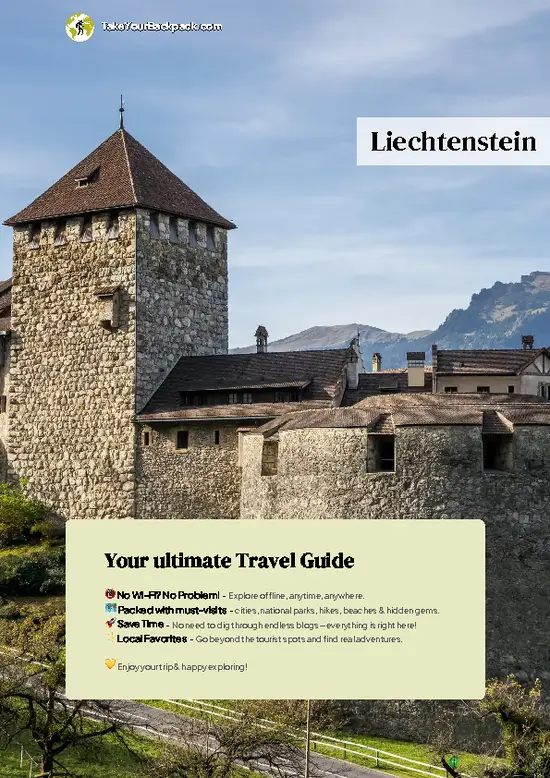
example page 0 from our offline Travel Guide for Liechtenstein
example page 1 from our offline Travel Guide for Liechtenstein
example page 2 from our offline Travel Guide for Liechtenstein
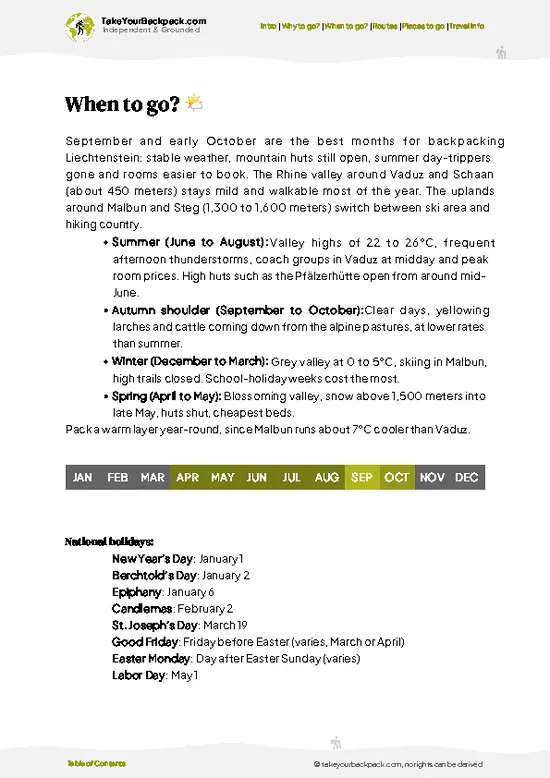
example page 3 from our offline Travel Guide for Liechtenstein
example page 4 from our offline Travel Guide for Liechtenstein
example page 5 from our offline Travel Guide for Liechtenstein
example page 6 from our offline Travel Guide for Liechtenstein
example page 7 from our offline Travel Guide for Liechtenstein
The digital guide (106 pages) contains:-page digital guide:
✅ Ready-made 2, 3 & 5-day routes
✅ All 25 places ranked, so you skip the overrated ones
✅ Works offline, all in 1 guide
✅ Cities, national parks, landmarks, beaches
✅ How to get around
👉 Click to see all 30+ guide features

📅 Plan smarter in minutes, not weeks
✅ Month by month travel advice
✅ Festivals & national holidays
✅ Budget expectations

🗺️ Go to the right places, skip the overrated ones
✅ Honest pros & cons of destinations
✅ Top hikes, parks & viewpoints
✅ Lesser-known places most travelers miss
✅ Clear “worth it vs skip it” guidance

🛏️ Travel smoothly without rookie mistakes
✅ Best areas to stay
✅ Transport systems explained simply
✅ Common scams & safety advice
✅ SIM cards, money & practical tips

🌍 Understand the country, not just visit it
✅ Culture & traditions
✅ 52 Essential phrases & customs
✅ Festivals worth planning around
✅ Traveler-friendly historical context
✅ Insights that make places more meaningful

📱 Built for real travel conditions
✅ Fully downloadable PDF
✅ Works completely offline
✅ Optimized for phone use
✅ Useful in remote areas & buses
✅ All in 1 guide
Stop searching, start planning
Get instant access to your full guide. 30‑day money-back guarantee.


By proceeding you agree to our terms.
Sent to your inbox immediately after payment • 100% Secure Checkout
Best Backpacking Travel Advisor 2025 tourism awardBest Backpacking
Travel Advisor
2025
What others say about Take Your Backpack Guides:
⭐⭐⭐⭐⭐
Fantastic, amazing amount of information!
⭐⭐⭐⭐⭐
My goodness this is amazing, it's what I've been looking for hats off too you!
⭐⭐⭐⭐⭐
I think this is absolutely BRILLIANT
⭐⭐⭐⭐
Very complete and informative. It's still missing places, but I gotta to commend you
⭐⭐⭐⭐⭐
This is truly amazing, thank you, can't wait to explore it with my kids!
⭐⭐⭐⭐⭐
Awesome resource, thank you!
⭐⭐⭐⭐⭐
This is amazing! Can't wait to explore the ones I haven't seen
⭐⭐⭐⭐
I love this! Well done, great idea.
⭐⭐⭐⭐⭐
Thanks for taking the time to make this gem!
⭐⭐⭐⭐⭐
This might be the best website I've ever seen.
⭐⭐⭐⭐⭐
Congratulations, and thank you so much for your work; it's incredibly valuable.
⭐⭐⭐⭐
In all seriousness I think you did a great job pointing out the important spots
⭐⭐⭐⭐⭐
10/10 very good
⭐⭐⭐⭐⭐
As someone who's only just starting to visit regularly this is awesome, thank you.
⭐⭐⭐⭐
Thank you very much! I'm going to visit my dad, it's going to be very useful!
⭐⭐⭐⭐⭐
This is really cool! We'll be travelling for the first time and this definitely come in handy.
⭐⭐⭐⭐⭐
You are now our minister of culture, congratulations 👨‍💼
⭐⭐⭐⭐⭐
Just wanted to tell you that this is a pearl! Going to follow your recommendations.
⭐⭐⭐⭐⭐
This is so cool. I'll definitely be using the resource for my travels soon.
⭐⭐⭐⭐⭐
This is very impressive! Good work.
⭐⭐⭐⭐⭐
This is an amazing and informative site. Very well done!

🛏️ Where to stay?How to pick the right area

Schaan is the smartest base for backpackers, because it has the main train station on the Austrian line, frequent buses to every Fasnacht venue and a calmer feel than the capital. Vaduz sits only a few minutes away by bus, so you can walk home from the parade and pubs without paying capital prices. Beds are limited in the country, and the choice is small.

Vaduz itself is the pick if you want to step out of your door into the parade route, and it is the safest area for late nights, with well-lit streets and little trouble even during the celebrations. It is quieter and pricier, though, and social … read more 👉
Schaan is the smartest base for backpackers, because it has the main train station on the Austrian line, frequent buses to every Fasnacht venue and a calmer feel than the capital. Vaduz sits only a few minutes away by bus, so you can walk home from the parade and pubs without paying capital prices. Beds are limited in the country, and the choice is small.

Vaduz itself is the pick if you want to step out of your door into the parade route, and it is the safest area for late nights, with well-lit streets and little trouble even during the celebrations. It is quieter and pricier, though, and social options are few.

Buchs in Switzerland and Feldkirch in Austria are the budget escape routes. Both are across the border, a short train or bus ride from Schaan, and both have more hostels, cheaper beds and livelier bars where solo travelers swap plans easily. Sargans is another cheaper option with fast trains. Most people shuttle in for the day and return by the last bus or train, so check timetables before the evening parties start.

👛 Costs (as of 6 November 2026)Money, prices, and spending tips

A day at Fasnacht in Liechtenstein runs about €78 to 160 for an independent traveler, with the bed taking most of it. The carnival parades and street parties in Schaan, Vaduz and Triesen are free to watch, so spending goes on beds, beer and food. Prices are in euros, though Liechtenstein uses Swiss francs and many stalls accept euros or cards.
CategoryBudget RangeLocal Reality
Festival tickets€0 to 15Fasnacht street parades are free to watch. Some Guggenmusik evenings and costume balls in village halls charge an entrance fee, and a carnival badge from a local club is sometimes sold for a few euros.
Accommodation€45 to 80 (high season)Liechtenstein has very few budget beds, and carnival weekends fill them. Many travelers sleep in Swiss or Austrian towns nearby, where a dorm or simple room is cheaper.
… read more 👉
A day at Fasnacht in Liechtenstein runs about €78 to 160 for an independent traveler, with the bed taking most of it. The carnival parades and street parties in Schaan, Vaduz and Triesen are free to watch, so spending goes on beds, beer and food. Prices are in euros, though Liechtenstein uses Swiss francs and many stalls accept euros or cards.
CategoryBudget RangeLocal Reality
Festival tickets€0 to 15Fasnacht street parades are free to watch. Some Guggenmusik evenings and costume balls in village halls charge an entrance fee, and a carnival badge from a local club is sometimes sold for a few euros.
Accommodation€45 to 80 (high season)Liechtenstein has very few budget beds, and carnival weekends fill them. Many travelers sleep in Swiss or Austrian towns nearby, where a dorm or simple room is cheaper.
Local transport€3 to 10LIEmobil buses link Schaan, Vaduz and the villages, and both a single bus ticket and a day ticket are available. Trains from Switzerland or Austria stop at Schaan-Vaduz station.
Food & drinks€25 to 40Sausages and fries at stalls cost around €6 to 10, and a beer is typically €5 to 7. Sit-down meals in restaurants cost noticeably more than in neighboring countries.
Miscellaneous expenses€5 to 15Face paint, a simple costume piece, confetti or a luggage locker. Carry some cash for small stalls.
Total Daily Budget€78 to 160Roughly €95 to 125 for most travelers who sleep nearby and eat from stalls.


source: tourismus.li
⚠️ Prices can change and everyone travels differently, so take this as a rough guide. Hope it helps you plan your adventure!

🍲 FoodWhat to Eat & Drink

Expect hearty, warming food at the stalls and in the tents: Bratwurst with a crusty roll, Raclette scraped onto potatoes, and Käsknöpfle, the Liechtenstein cheese noodles served with stewed apple sauce. Look for Ribel, a corn porridge, and sweet Fasnachtschüechli, thin fried pastries dusted with sugar that vanish by the handful.

For drinks, go for mulled wine to fight the February chill, and local beer from the Liechtensteiner Brauhaus in Schaan. Wines from the princely vineyards in Vaduz are a worthwhile sip, and schnapps often circulates among the costumed groups.

Portions are generous, so sharing a plate with a friend works well, and lines move fast around parade time but swell right after the procession passes. Keep cash in your pocket for small stands, since cards are not always accepted, … read more 👉
Expect hearty, warming food at the stalls and in the tents: Bratwurst with a crusty roll, Raclette scraped onto potatoes, and Käsknöpfle, the Liechtenstein cheese noodles served with stewed apple sauce. Look for Ribel, a corn porridge, and sweet Fasnachtschüechli, thin fried pastries dusted with sugar that vanish by the handful.

For drinks, go for mulled wine to fight the February chill, and local beer from the Liechtensteiner Brauhaus in Schaan. Wines from the princely vineyards in Vaduz are a worthwhile sip, and schnapps often circulates among the costumed groups.

Portions are generous, so sharing a plate with a friend works well, and lines move fast around parade time but swell right after the procession passes. Keep cash in your pocket for small stands, since cards are not always accepted, and bring small coins for the deposit cups. Prices are Swiss-level, so one big warm meal and a few drinks go a long way. Joining a table in a tent is normal and easy, and a nod and a Prost usually starts the conversation.

FAQTraveler FAQ

Fasnacht in Liechtenstein takes place in the days leading up to Ash Wednesday, so it falls between early February and early March, depending on Easter. Main events run over roughly a week, with parades in Vaduz, Schaan, Balzers and Triesen, and the busiest days are the weekend before Ash Wednesday. Check the exact dates with the local tourism office before booking.
Attending Fasnacht costs little for the events themselves, since street parades are free and evening parties charge about €10 to 15. Your real spending goes on food, drinks and a bed, which together come to roughly €70 to 130 per day. Staying across the border in Buchs or Feldkirch can cut costs considerably.
Fasnacht does not require tickets for the main parades, which you can watch from the street without booking. Evening balls and tent parties sometimes sell tickets in advance and can fill up, so buy them a week or two ahead if you want a seat. Beds, however, should be booked three to four weeks early, as lodging in Vaduz and Schaan runs short on the parade weekend.
⚠️ Things can change over time, so always validate details locally before you go.

Other Liechtensteiner festivals near Fasnacht

Explore more nearby:


💡 Not sure where to go next?
Create a personalized itinerary for Liechtenstein including Fasnacht and the places that fit your trip.

Generate my itinerary

👉 Discover all festivals

Or checkout all Liechtenstein has to offer (think cities, towns, villages, national parks, hikes, beaches, festivals)
Country photo of Liechtenstein

We 💚 feedbackKey takeaways before you go

Fasnacht in Liechtenstein is easy to underestimate because the big parades are not the whole story. Most first-timers overlook the Guggamusik bands: brass-and-drum groups in handmade masks who play impromptu sets in village squares and pubs, often long after the official program ends. I would plan one evening with no fixed schedule, follow the loudest brass, and bring earplugs and cash for the beer tents.

✍️ Help improve this page!
The information on this page is based on in-depth research, insights shared by experienced travelers, and feedback from the local travel community in Liechtenstein. While every effort is made to keep the information accurate and current, conditions can change — so if you spot anything incorrect or outdated, please get in touch.


🙋‍♂️ Give feedback

👋 Meet the founderWho’s Behind Take Your Backpack?

Johan, backpacker and founder of TakeYourBackpackHi, I’m Johan (Netherlands 🇳🇱), the creator of TakeYourBackpack. Over the past 30 years, I’ve backpacked through 88 countries across six continents, gaining extensive experience with independent travel, long-term trips, and overland routes.

This site is built on a combination of firsthand travel experience and carefully curated insights from other backpackers. Many guides are based on places I’ve personally visited, while others bring together tips, observations, and practical advice shared by trusted travelers I’ve met along the way.

The goal is to provide realistic, experience-driven guidance — not generic itineraries — so you can explore destinations with better context, clearer expectations, and more confidence.