×

Liechtenstein🇱🇮 | attractionsLiechtenstein National MuseumPrincipality origins, Rhine valley archaeology, emigration stories, Städtle old-and-new building | things to do and best time to go

Explore Kunstmuseum LiechtensteinExplore Postmuseum Liechtenstein

Backpacking in Liechtenstein National Museum
🌟 Highlightattraction ranked #2
By Johan Kruseman 🇳🇱 | Updated November 6, 2026

The Liechtenstein National Museum sits about two minutes’ walk from the tourist office on Vaduz’s main street, where you can buy the souvenir passport stamp, so you can do both in one lap. The museum is in the center of Liechtenstein’s capital, on the pedestrian Städtle. Crowds are rarely a problem. Even on a summer afternoon you tend to have the rooms to yourself, and the best time is soon after opening, before the tour groups drift in from the street. It costs less than most museums in neighboring Switzerland, though the whole visit takes only a couple of hours. What makes it worth the stop is how clearly it explains the country: how a tiny, poor farming valley turned into a sovereign state with a prince, a banking sector and a tiny army-free population. The old building and its modern extension also make good company. Unlike the Kunstmuseum Liechtenstein nearby, which shows international modern art in a dark concrete cube, this museum is all about the country’s own story.

Part of Backpacking in Liechtenstein: all 25 places on one map, with routes and the best time to go.
Discover everything you want to know in the 📖 Liechtenstein Travel Guide.
Loading the map 🌍
CLICK TO FILTER
towns
villages
landmarks
hikes
attractions
festivals
regions
SHOW COUNTRY’S BESTSHOW ALL

✨ Why go?
Ranked #2 attraction in Liechtenstein
Why visitors keep coming back

The Liechtenstein National Museum is the quickest way to understand why this country exists at all. Walking the streets of Vaduz, you see banks, villas and a castle on the hill, but little explains how a principality of roughly 160 square kilometers survived while larger neighbors vanished into bigger states. The museum fills that gap with objects, documents and photographs, so the castle above town stops being a postcard and starts making sense.

For a backpacker, it is also a rare rainy-day option in a country where most of the appeal is outdoors. If the weather closes in over the Rhine valley and the Städtle is soaked, you can spend a quiet hour or two indoors without it feeling like filler.

The third reason is context for the rest of your route. Once you know the story of the 1719 creation … read more 👉
The Liechtenstein National Museum is the quickest way to understand why this country exists at all. Walking the streets of Vaduz, you see banks, villas and a castle on the hill, but little explains how a principality of roughly 160 square kilometers survived while larger neighbors vanished into bigger states. The museum fills that gap with objects, documents and photographs, so the castle above town stops being a postcard and starts making sense.

For a backpacker, it is also a rare rainy-day option in a country where most of the appeal is outdoors. If the weather closes in over the Rhine valley and the Städtle is soaked, you can spend a quiet hour or two indoors without it feeling like filler.

The third reason is context for the rest of your route. Once you know the story of the 1719 creation of the principality and the later move of the princely family to Vaduz, the hiking trails, the vineyards below the castle and the border crossings into Switzerland and Austria all read differently.

💡 HighlightsThe experiences that define the visit

  1. Cultural history exhibition: The core of the museum follows the country from early settlement through the rise of the principality to the modern state. Objects and documents turn the dates into something you can picture, including how poor and rural life was for most residents for centuries.
  2. The story of the principality: This is the thread that explains why Liechtenstein is a country. It covers the purchase of the Vaduz and Schellenberg lands by the princely family and the eventual elevation to an imperial principality in 1719.
  3. Archaeology collection: Finds from the valley show that people lived here long before any prince arrived. The Rhine valley was a corridor between Alpine passes, and the artifacts back that up.
  4. Natural history section: Displays on Alpine wildlife and the mountain landscape
… read more 👉
  1. Cultural history exhibition: The core of the museum follows the country from early settlement through the rise of the principality to the modern state. Objects and documents turn the dates into something you can picture, including how poor and rural life was for most residents for centuries.
  2. The story of the principality: This is the thread that explains why Liechtenstein is a country. It covers the purchase of the Vaduz and Schellenberg lands by the princely family and the eventual elevation to an imperial principality in 1719.
  3. Archaeology collection: Finds from the valley show that people lived here long before any prince arrived. The Rhine valley was a corridor between Alpine passes, and the artifacts back that up.
  4. Natural history section: Displays on Alpine wildlife and the mountain landscape give you a field guide to what you might meet on the trails above Vaduz, from the valley floor to the ridge line.
  5. Everyday life and emigration: Tools, clothes and household items show how families farmed, crafted and made do. They also reflect why many people left the valley in hard times before industry arrived.
  6. The historic building and its extension: The old structure on the Städtle has been joined by a modern addition. Notice how the two meet, and look for the views back out onto the pedestrian street.
  7. Städtle setting: The museum is a few steps from the Kunstmuseum, the tourist office and cafés, so you can pair it with a stamp for your passport and a coffee on the same street.
For a first visit, start with the cultural history exhibition at the Liechtenstein National Museum, since it gives the clearest picture of the country in the least time.
Spotted a mistake or missing something? Contact us.

Things to do around Liechtenstein National Museum

Ratings based on Tripadvisor reviews. When you book through this link, you support our work at no extra cost to you.

🌤️ When to go?When to go for the best experience

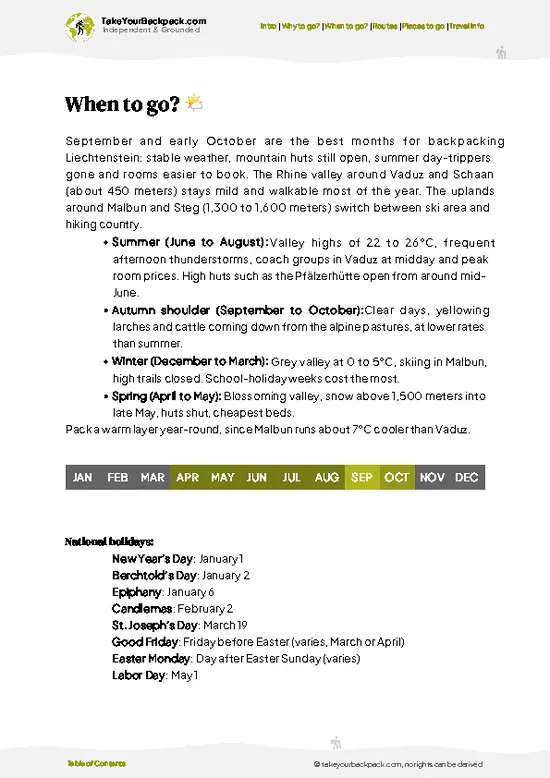
  • Summer (June to August): Daytime highs sit around 22 to 26°C (72 to 79°F) and daylight runs past 15 hours, so you can combine the museum with a hike up to Gutenberg Castle or a walk through Vaduz without rushing. Tour groups thicken and beds cost the most.
  • Autumn (September to November): Highs fall from about 20°C (68°F) to 7°C (45°F). September is crisp and clear, and the Rhine Valley foliage turns by mid-October. Crowds thin out quickly.
  • Winter (December to February): Temperatures hover between -3 and 4°C (27 to 39°F), with short days of roughly 8 to 9 hours of light. A museum visit suits a snowy afternoon, and the Christmas market on the Städtle brings a brief bump in visitors. Ski season pushes prices up in the mountain villages, not in Vaduz.
  • Spring (March to May): Highs climb from 9 to
… read more 👉
  • Summer (June to August): Daytime highs sit around 22 to 26°C (72 to 79°F) and daylight runs past 15 hours, so you can combine the museum with a hike up to Gutenberg Castle or a walk through Vaduz without rushing. Tour groups thicken and beds cost the most.
  • Autumn (September to November): Highs fall from about 20°C (68°F) to 7°C (45°F). September is crisp and clear, and the Rhine Valley foliage turns by mid-October. Crowds thin out quickly.
  • Winter (December to February): Temperatures hover between -3 and 4°C (27 to 39°F), with short days of roughly 8 to 9 hours of light. A museum visit suits a snowy afternoon, and the Christmas market on the Städtle brings a brief bump in visitors. Ski season pushes prices up in the mountain villages, not in Vaduz.
  • Spring (March to May): Highs climb from 9 to 19°C (48 to 66°F) with frequent showers. Rooms are easier to find and cheaper, and meadows start to green in April.
Aim for September, when the weather is dry, daylight is still generous and the lodging rates ease off.


source: climatestotravel.comJANJanuary: fair for travelingFEBFebruary: fair for travelingMARMarch: good for travelingAPRApril: highly recommended for travelingMAYMay: excellent for travelingJUNJune: highly recommended for travelingJULJuly: highly recommended for travelingAUGAugust: highly recommended for travelingSEPSeptember: excellent for travelingOCTOctober: excellent for travelingNOVNovember: good for travelingDECDecember: fair for traveling
liechtenstein-attraction-liechtenstein-national-museum
© Google |

✈️ The backpacker research shortcutLiechtenstein Travel Guide

What the free pages can't give you: ready-made routes, every place ranked, and it works offline. All in 1 guide.
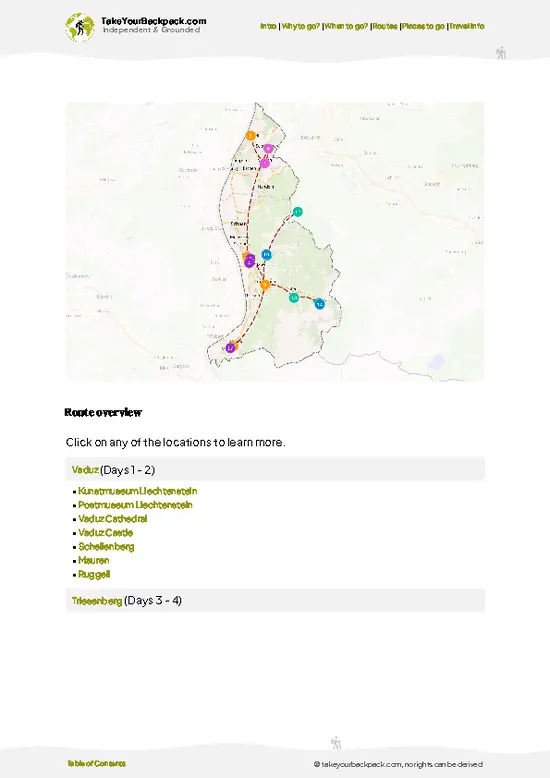
example page 0 from our offline Travel Guide for Liechtenstein
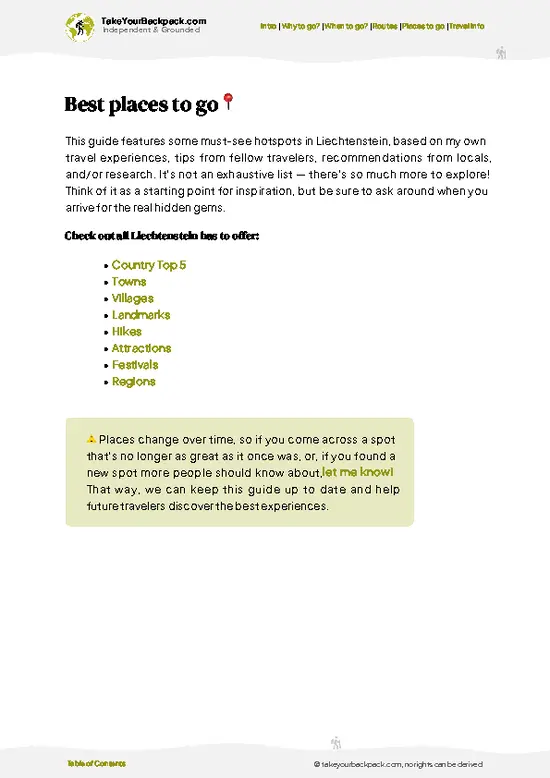
example page 1 from our offline Travel Guide for Liechtenstein
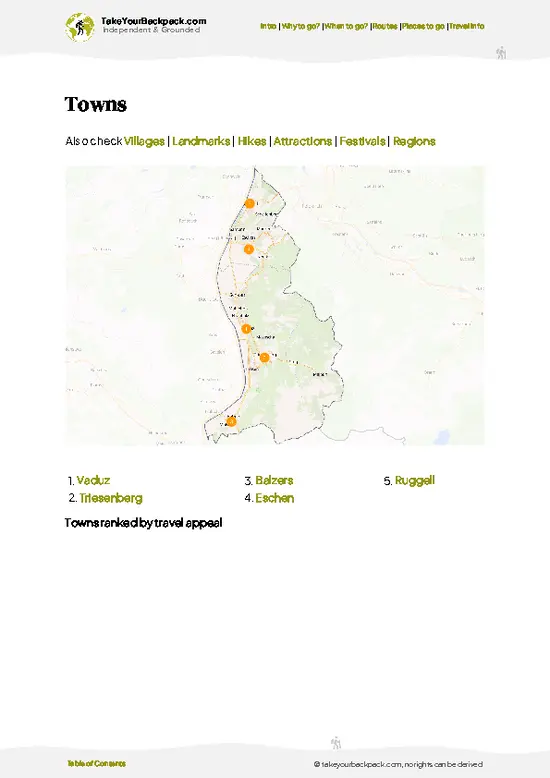
example page 2 from our offline Travel Guide for Liechtenstein
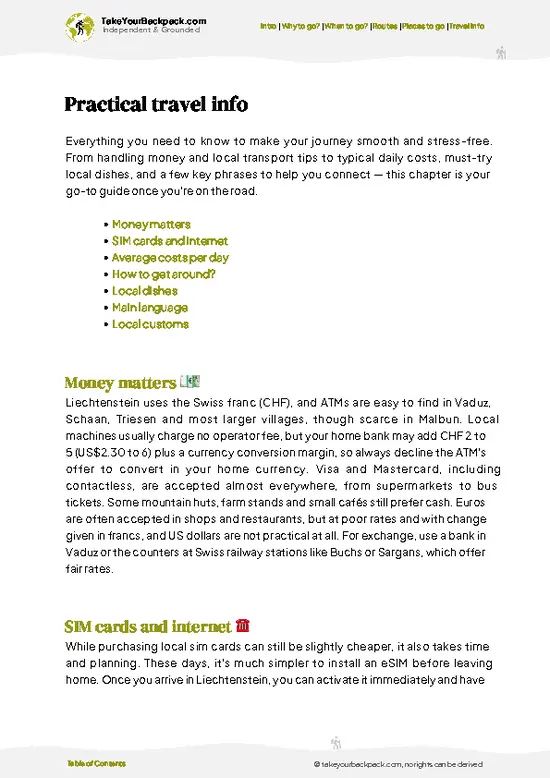
example page 3 from our offline Travel Guide for Liechtenstein
example page 4 from our offline Travel Guide for Liechtenstein
example page 5 from our offline Travel Guide for Liechtenstein
example page 6 from our offline Travel Guide for Liechtenstein
example page 7 from our offline Travel Guide for Liechtenstein
The digital guide (106 pages) contains:-page digital guide:
✅ Ready-made 2, 3 & 5-day routes
✅ All 25 places ranked, so you skip the overrated ones
✅ Works offline, all in 1 guide
✅ Cities, national parks, landmarks, beaches
✅ How to get around
👉 Click to see all 30+ guide features

📅 Plan smarter in minutes, not weeks
✅ Month by month travel advice
✅ Festivals & national holidays
✅ Budget expectations

🗺️ Go to the right places, skip the overrated ones
✅ Honest pros & cons of destinations
✅ Top hikes, parks & viewpoints
✅ Lesser-known places most travelers miss
✅ Clear “worth it vs skip it” guidance

🛏️ Travel smoothly without rookie mistakes
✅ Best areas to stay
✅ Transport systems explained simply
✅ Common scams & safety advice
✅ SIM cards, money & practical tips

🌍 Understand the country, not just visit it
✅ Culture & traditions
✅ 52 Essential phrases & customs
✅ Festivals worth planning around
✅ Traveler-friendly historical context
✅ Insights that make places more meaningful

📱 Built for real travel conditions
✅ Fully downloadable PDF
✅ Works completely offline
✅ Optimized for phone use
✅ Useful in remote areas & buses
✅ All in 1 guide
Stop searching, start planning
Get instant access to your full guide. 30‑day money-back guarantee.


By proceeding you agree to our terms.
Sent to your inbox immediately after payment • 100% Secure Checkout
Best Backpacking Travel Advisor 2025 tourism awardBest Backpacking
Travel Advisor
2025
What others say about Take Your Backpack Guides:
⭐⭐⭐⭐⭐
Fantastic, amazing amount of information!
⭐⭐⭐⭐⭐
My goodness this is amazing, it's what I've been looking for hats off too you!
⭐⭐⭐⭐⭐
I think this is absolutely BRILLIANT
⭐⭐⭐⭐
Very complete and informative. It's still missing places, but I gotta to commend you
⭐⭐⭐⭐⭐
This is truly amazing, thank you, can't wait to explore it with my kids!
⭐⭐⭐⭐⭐
Awesome resource, thank you!
⭐⭐⭐⭐⭐
This is amazing! Can't wait to explore the ones I haven't seen
⭐⭐⭐⭐
I love this! Well done, great idea.
⭐⭐⭐⭐⭐
Thanks for taking the time to make this gem!
⭐⭐⭐⭐⭐
This might be the best website I've ever seen.
⭐⭐⭐⭐⭐
Congratulations, and thank you so much for your work; it's incredibly valuable.
⭐⭐⭐⭐
In all seriousness I think you did a great job pointing out the important spots
⭐⭐⭐⭐⭐
10/10 very good
⭐⭐⭐⭐⭐
As someone who's only just starting to visit regularly this is awesome, thank you.
⭐⭐⭐⭐
Thank you very much! I'm going to visit my dad, it's going to be very useful!
⭐⭐⭐⭐⭐
This is really cool! We'll be travelling for the first time and this definitely come in handy.
⭐⭐⭐⭐⭐
You are now our minister of culture, congratulations 👨‍💼
⭐⭐⭐⭐⭐
Just wanted to tell you that this is a pearl! Going to follow your recommendations.
⭐⭐⭐⭐⭐
This is so cool. I'll definitely be using the resource for my travels soon.
⭐⭐⭐⭐⭐
This is very impressive! Good work.
⭐⭐⭐⭐⭐
This is an amazing and informative site. Very well done!

🛏️ Where to stay?Choosing the right base

Vaduz is the best place to sleep for the Liechtenstein National Museum, because the museum sits on the Städtle, the main pedestrian street, and everything else you will want is within a ten-minute walk. Be realistic about the scene, though. Liechtenstein has no party hostel culture, so Vaduz is quiet, extremely safe and best for travelers who want an early night and a clean bed. The nearest youth hostel is in neighboring Schaan, a short bus ride away, and it is where most solo budget travelers end up. You will meet other hikers and cyclists there rather than a bar crowd.

If you want more life … read more 👉
Vaduz is the best place to sleep for the Liechtenstein National Museum, because the museum sits on the Städtle, the main pedestrian street, and everything else you will want is within a ten-minute walk. Be realistic about the scene, though. Liechtenstein has no party hostel culture, so Vaduz is quiet, extremely safe and best for travelers who want an early night and a clean bed. The nearest youth hostel is in neighboring Schaan, a short bus ride away, and it is where most solo budget travelers end up. You will meet other hikers and cyclists there rather than a bar crowd.

If you want more life and lower prices, sleep across the Rhine in Buchs (Switzerland) or Sargans. Buchs has a station with rail links to Zurich, and a bus to Vaduz takes about 15 to 20 minutes. Feldkirch in Austria, roughly 30 minutes by bus, has more cafés, student bars and cheaper rooms, and suits anyone traveling on a tight budget. Schaan, the next town north of Vaduz, is the transport hub and has a few mid-priced guesthouses, but little atmosphere after dark. Book ahead in July and August, since Vaduz has only a limited number of beds.

👛 Costs (as of 6 November 2026)What things cost and how to budget

A day around the Liechtenstein National Museum in Vaduz costs roughly €69 to 114 for a backpacker, with the €11 adult ticket (CHF 10) as the smallest line in the budget.
CategoryBudget RangeLocal Reality
Museum entry€11Adult ticket to the Liechtenstein National Museum, housed in a former princely tavern dating to 1438. Pay in Swiss francs, which Liechtenstein uses, or by card.
Accommodation (high season)€40 to 60A dorm bed or simple guesthouse room in Vaduz or just over the border in Switzerland. Prices ease in winter.
Accommodation (low season)€30 to 45Quieter months from November to March bring lower rates.
Food€15 to 25Supermarket picnic items, a bakery lunch and a simple café meal. Restaurant mains in Vaduz are pricey.
Local transport€3 to 8LIEmobil buses link Vaduz with the rest of the country.
… read more 👉
A day around the Liechtenstein National Museum in Vaduz costs roughly €69 to 114 for a backpacker, with the €11 adult ticket (CHF 10) as the smallest line in the budget.
CategoryBudget RangeLocal Reality
Museum entry€11Adult ticket to the Liechtenstein National Museum, housed in a former princely tavern dating to 1438. Pay in Swiss francs, which Liechtenstein uses, or by card.
Accommodation (high season)€40 to 60A dorm bed or simple guesthouse room in Vaduz or just over the border in Switzerland. Prices ease in winter.
Accommodation (low season)€30 to 45Quieter months from November to March bring lower rates.
Food€15 to 25Supermarket picnic items, a bakery lunch and a simple café meal. Restaurant mains in Vaduz are pricey.
Local transport€3 to 8LIEmobil buses link Vaduz with the rest of the country. A single bus ticket and a day ticket are available. The museum sits in the walkable center.
Extras€0 to 10Coffee, a postage stamp souvenir or a visit to the nearby stamp museum.
Total Daily Budget€69 to 114Per person, per day, in high season.


source: landesmuseum.li
⚠️ Prices can change and everyone travels differently, so take this as a rough guide. Hope it helps you plan your adventure!

FAQCommon questions from travelers

Plan 1 to 2 hours inside the Liechtenstein National Museum, which covers the country's history, nature and culture across several floors. Vaduz's compact center means you can add the nearby art museum and the castle viewpoint in the same half day. A full day in town is more than enough.
For about €11 (CHF 10), the Liechtenstein National Museum is a solid pick for 1 to 2 hours if you like local history. The building itself is a former princely tavern from 1438, and the exhibits explain how this tiny principality came to exist. Rainy days make it an especially good use of the ticket.
Take a train to Sargans or Buchs in Switzerland, then a LIEmobil bus into Vaduz, a ride of roughly 20 to 30 minutes. The Liechtenstein National Museum stands in the pedestrian center of Vaduz, a short walk from the central bus stop. From Zurich the whole trip takes about 1.5 to 2 hours.
⚠️ Things can change over time, so always validate details locally before you go.

Other Liechtensteiner attractions near Liechtenstein National Museum

Explore more nearby:


💡 Not sure where to go next?
Create a personalized itinerary for Liechtenstein including Liechtenstein National Museum and the places that fit your trip.

Generate my itinerary

👉 Discover all attractions

Or checkout all Liechtenstein has to offer (think cities, towns, villages, national parks, hikes, beaches, festivals)
Country photo of Liechtenstein

We 💚 feedbackKey takeaways before you go

The Liechtenstein National Museum suits curious travelers who like to know why a place is the way it is, and anyone who needs a dry stop on a wet day. Skip it if you only want views. I would go early, then walk up toward the castle trail with the story fresh in your head.

✍️ Help improve this page!
The information on this page is based on in-depth research, insights shared by experienced travelers, and feedback from the local travel community in Liechtenstein. While every effort is made to keep the information accurate and current, conditions can change — so if you spot anything incorrect or outdated, please get in touch.


🙋‍♂️ Give feedback

👋 Meet the founderWho’s Behind Take Your Backpack?

Johan, backpacker and founder of TakeYourBackpackHi, I’m Johan (Netherlands 🇳🇱), the creator of TakeYourBackpack. Over the past 30 years, I’ve backpacked through 88 countries across six continents, gaining extensive experience with independent travel, long-term trips, and overland routes.

This site is built on a combination of firsthand travel experience and carefully curated insights from other backpackers. Many guides are based on places I’ve personally visited, while others bring together tips, observations, and practical advice shared by trusted travelers I’ve met along the way.

The goal is to provide realistic, experience-driven guidance — not generic itineraries — so you can explore destinations with better context, clearer expectations, and more confidence.