×

Luxembourg🇱🇺 | best national parksThe Must-See 3 national parks in Luxembourg

Luxembourg has no national parks in the strict sense. Its protected landscapes are three natural parks in the north and east, and the differences between them shape a trip. The Ardennes-style north is wetter, emptier and cheaper to sleep in. The sandstone east draws the most walkers. Because public transport is free nationwide, independent travel is easy, but lodging stays expensive.

By Johan Kruseman 🇳🇱 | Updated October 18, 2026
Explore the best hikes in Luxembourg

Why go?Understanding Their Importance

Luxembourg is one of Europe’s smallest countries, so its protected land works at village scale rather than wilderness scale. Natural parks here include farms, towns and working forests, with managed trails instead of staffed entrance gates. That explains why entry is free and why you will meet few rangers but plenty of waymarks.

Geology splits the country in two. The northern Oesling is hard Ardennes slate and schist: high, damp plateaus with deep river valleys. The southern and eastern Gutland is softer sandstone and limestone, which erodes into gorges and rock corridors. Expect dense, well-signed trail networks rather than remote backcountry. Prices are high by European standards, so the main planning question is where you sleep, not how you reach the trailheads.
Behind the Scenes of Selection
The list of best national parks in Luxembourg is created based on landscapes, wildlife, adventure opportunities, facilities, and overall experience. If you feel a national park is missing in this list, please let us know.

When to go?Optimal Periods for Travel

Best months: May to September is the best window, because daytime highs run roughly 17 to 24°C, trails are dry and daylight lasts past 9 pm in midsummer. June and September give the best balance of stable weather and lighter weekend traffic.

Shoulder seasons and winter: April and October bring 8 to 15°C and brighter forest color in October, but the clay and sandstone trails turn slick after rain. Annual rainfall is about 800 to 1,000 mm, and the northern Oesling gets more of it and runs a few degrees colder than the east. Winter highs sit near 0 to 5°C, with frost and occasional snow on the northern plateaus. Many campsites close from roughly November to March, and some seasonal hostels shut as well.

Crowds and prices: July, August and school-holiday weekends are busiest in the east, where lodging … read more 👉
Best months: May to September is the best window, because daytime highs run roughly 17 to 24°C, trails are dry and daylight lasts past 9 pm in midsummer. June and September give the best balance of stable weather and lighter weekend traffic.

Shoulder seasons and winter: April and October bring 8 to 15°C and brighter forest color in October, but the clay and sandstone trails turn slick after rain. Annual rainfall is about 800 to 1,000 mm, and the northern Oesling gets more of it and runs a few degrees colder than the east. Winter highs sit near 0 to 5°C, with frost and occasional snow on the northern plateaus. Many campsites close from roughly November to March, and some seasonal hostels shut as well.

Crowds and prices: July, August and school-holiday weekends are busiest in the east, where lodging can cost 20 to 40 percent more. Midweek stays cut both crowds and cost.

national park hoppingOptimizing Your Multi-Stop Itinerary

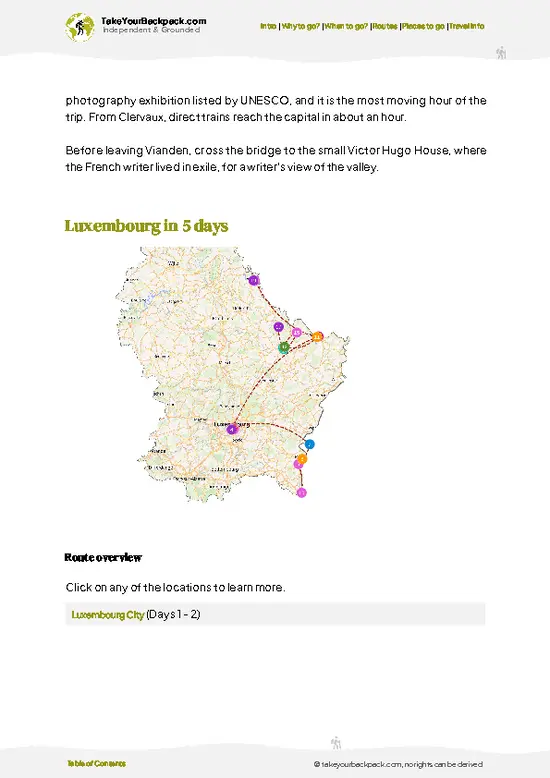
How many days: A trip combining several natural parks in Luxembourg needs 4 to 6 days, because the distances are short but the trails are slow underfoot.

Grouping and direction: The east and the north sit on opposite sides of the country, but Diekirch and Ettelbruck work as the central transport hub linking them. Starting in the east near Echternach and moving north and west suits the bus network, which funnels through those central towns. Allow 1 to 2 days per stop, and 1 to 2 hours by bus between regions, including a change.

Common planning mistakes: The first mistake is judging by the map: 40 km can take two buses, and Sunday and evening service is thin. Check timetables on mobiltaet.lu the day before. The second is overpacking the schedule with 25 km hiking days. Stay near 12 to 18 km, because … read more 👉
How many days: A trip combining several natural parks in Luxembourg needs 4 to 6 days, because the distances are short but the trails are slow underfoot.

Grouping and direction: The east and the north sit on opposite sides of the country, but Diekirch and Ettelbruck work as the central transport hub linking them. Starting in the east near Echternach and moving north and west suits the bus network, which funnels through those central towns. Allow 1 to 2 days per stop, and 1 to 2 hours by bus between regions, including a change.

Common planning mistakes: The first mistake is judging by the map: 40 km can take two buses, and Sunday and evening service is thin. Check timetables on mobiltaet.lu the day before. The second is overpacking the schedule with 25 km hiking days. Stay near 12 to 18 km, because steep valley sides add effort a flat map hides. Use one base per region instead of moving daily.

The ListMust-Visit national parks in Luxembourg

1 Mëllerdall Nature Park

sandstone cliffs, labyrinthine gorges, ancient woodland

Navigate narrow rock passages and shaded forests, where striking geological formations create a landscape ideal for adventurous hiking and exploration.

luxembourg-national-park-mellerdall-nature-park
© Google |

2 Upper Sûre Nature Park

reservoir lake, wildflower meadows, quiet villages

Swim or paddle in clear waters, wander through peaceful fields, and experience rural life in small hamlets scattered around the Upper Sûre Nature Park lake.

3 Our Nature Park

wooded ridges, medieval castles, cross-border trails

Hike through dense forests and discover hilltop ruins while tracing the winding border between Luxembourg and Germany, with panoramic valley views.

luxembourg-national-park-our-nature-park
© Google | Marcel Koch
Loading the map 🌍

Expert viewWhat You Should Know

How many to visit: Plan on two of the three natural parks, three only if you have 6 or more days. Each takes 1 to 2 days to walk properly, and moving between them costs half a day of buses, so a third rarely adds enough to justify the transfer.

Which kind for your style: Choose the sandstone east if you want dramatic rock corridors, and accept the crowds. Choose the northern Oesling for quiet river valleys, lake shores and cheaper beds. First-timers do best in the east, where waymarking is dense and villages are close. Experienced walkers get more solitude north.

Budget: Entry to every natural park is free, and all public transport is free for residents and visitors alike, a rare saving that offsets high prices. Realistic daily spend is €50 to 90 (about US$55 to 100). Camping runs €12 to 25 … read more 👉
How many to visit: Plan on two of the three natural parks, three only if you have 6 or more days. Each takes 1 to 2 days to walk properly, and moving between them costs half a day of buses, so a third rarely adds enough to justify the transfer.

Which kind for your style: Choose the sandstone east if you want dramatic rock corridors, and accept the crowds. Choose the northern Oesling for quiet river valleys, lake shores and cheaper beds. First-timers do best in the east, where waymarking is dense and villages are close. Experienced walkers get more solitude north.

Budget: Entry to every natural park is free, and all public transport is free for residents and visitors alike, a rare saving that offsets high prices. Realistic daily spend is €50 to 90 (about US$55 to 100). Camping runs €12 to 25 a night, hostel dorms €25 to 40, and a supermarket lunch €6 to 10. A restaurant dinner costs €18 to 30. Optional guided walks or geopark activities add roughly €10 to 25 per visit. Luxembourg uses the euro, so no currency conversion is needed on the ground.

Safety and etiquette: Risks are modest. Wet sandstone and roots cause most injuries, so wear shoes with real tread, even in dry-looking weather. Ticks are common in grass and bracken from spring to autumn, so check your skin each evening. Emergency number 112 works nationwide, and mobile coverage is good in valleys and patchy on a few plateau stretches.

Wild camping is not allowed, so book campsites or hostels ahead for summer weekends. Stay on marked paths, keep dogs on leashes, and take your trash out. Greet locals with “Moien”, and expect service in Luxembourgish, French, German and often English.

✈️ The backpacker research shortcutLuxembourg Travel Guide

An offline-friendly backpacking guide with optimized travel routes, ranked highlights, transport advice, and the best areas to stay.
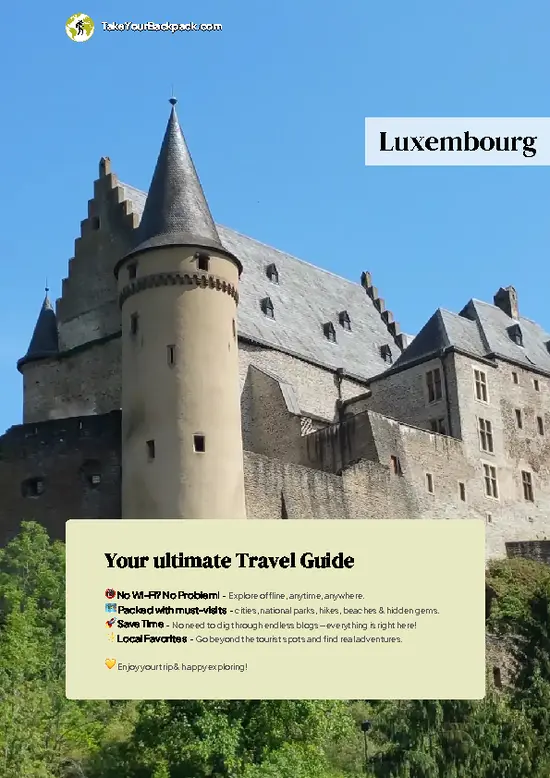
example page 0 from our offline Travel Guide for Luxembourg
example page 1 from our offline Travel Guide for Luxembourg
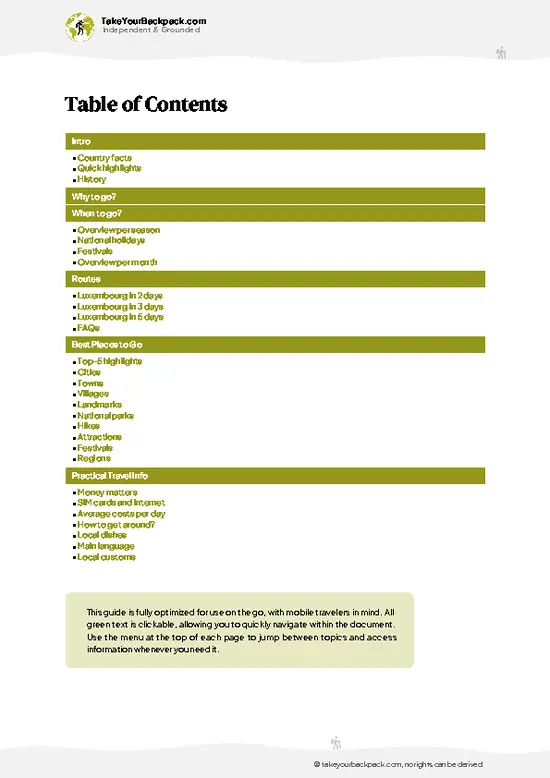
example page 2 from our offline Travel Guide for Luxembourg
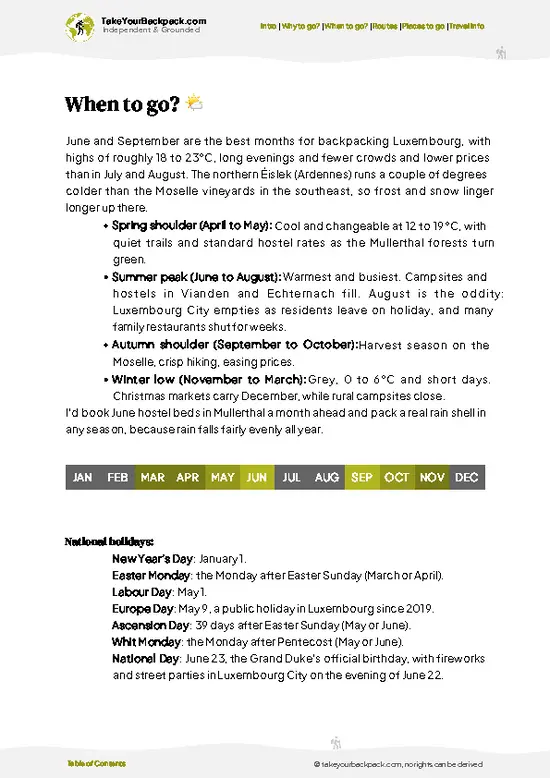
example page 3 from our offline Travel Guide for Luxembourg
example page 4 from our offline Travel Guide for Luxembourg
example page 5 from our offline Travel Guide for Luxembourg
example page 6 from our offline Travel Guide for Luxembourg
example page 7 from our offline Travel Guide for Luxembourg
The digital guide (153 pages) contains:
✅ 36 highlights, ranked by travel appeal
✅ Optimized 2, 3 & 5-day travel routes
✅ Cities, national parks, landmarks, beaches
✅ How to get around
✅ Offline-friendly for travel without Wi-Fi
👉 Click to see all 30+ guide features

📅 Plan smarter in minutes, not weeks
✅ Month by month travel advice
✅ Festivals & national holidays
✅ Budget expectations

🗺️ Go to the right places, skip the overrated ones
✅ Honest pros & cons of destinations
✅ Top hikes, parks & viewpoints
✅ Lesser-known places most travelers miss
✅ Clear “worth it vs skip it” guidance

🛏️ Travel smoothly without rookie mistakes
✅ Best areas to stay
✅ Transport systems explained simply
✅ Common scams & safety advice
✅ SIM cards, money & practical tips

🌍 Understand the country, not just visit it
✅ Culture & traditions
✅ 52 Essential phrases & customs
✅ Festivals worth planning around
✅ Traveler-friendly historical context
✅ Insights that make places more meaningful

📱 Built for real travel conditions
✅ Fully downloadable PDF
✅ Works completely offline
✅ Optimized for phone use
✅ Useful in remote areas & buses
✅ Everything in one place
Stop searching, start planning
Get instant access to your full guide. 30‑day money-back guarantee.
+ Add another guide for just

By proceeding you agree to our terms.
Sent to your inbox immediately after payment • 100% Secure Checkout
Best Backpacking Travel Advisor 2025 tourism awardBest Backpacking
Travel Advisor
2025
What others say about Take Your Backpack Guides:
⭐⭐⭐⭐⭐
Fantastic, amazing amount of information!
⭐⭐⭐⭐⭐
My goodness this is amazing, it's what I've been looking for hats off too you!
⭐⭐⭐⭐⭐
I think this is absolutely BRILLIANT
⭐⭐⭐⭐
Very complete and informative. It's still missing places, but I gotta to commend you
⭐⭐⭐⭐⭐
This is truly amazing, thank you, can't wait to explore it with my kids!
⭐⭐⭐⭐⭐
Awesome resource, thank you!
⭐⭐⭐⭐⭐
This is amazing! Can't wait to explore the ones I haven't seen
⭐⭐⭐⭐
I love this! Well done, great idea.
⭐⭐⭐⭐⭐
Thanks for taking the time to make this gem!
⭐⭐⭐⭐⭐
This might be the best website I've ever seen.
⭐⭐⭐⭐⭐
Congratulations, and thank you so much for your work; it's incredibly valuable.
⭐⭐⭐⭐
In all seriousness I think you did a great job pointing out the important spots
⭐⭐⭐⭐⭐
10/10 very good
⭐⭐⭐⭐⭐
As someone who's only just starting to visit regularly this is awesome, thank you.
⭐⭐⭐⭐
Thank you very much! I'm going to visit my dad, it's going to be very useful!
⭐⭐⭐⭐⭐
This is really cool! We'll be travelling for the first time and this definitely come in handy.
⭐⭐⭐⭐⭐
You are now our minister of culture, congratulations 👨‍💼
⭐⭐⭐⭐⭐
Just wanted to tell you that this is a pearl! Going to follow your recommendations.
⭐⭐⭐⭐⭐
This is so cool. I'll definitely be using the resource for my travels soon.
⭐⭐⭐⭐⭐
This is very impressive! Good work.
⭐⭐⭐⭐⭐
This is an amazing and informative site. Very well done!

🛏️ Where to stay?Best Places to Stay in Luxembourg

But Luxembourg has few true hostels, mostly in a nationwide youth hostel network, so dorm beds run about €35 to €50 a night and book up early in summer, while budget hotels in the capital rarely go below €90 to €120 for a double. In Luxembourg City, Gare has the most affordable rooms and the best train and tram links, though its main streets feel scruffy after dark, while Grund and Pfaffenthal sit in the valley below the old town with riverside pubs and quiet nights (plus steep climbs or the free elevators to get back up). Ville Haute puts you steps from the main sights at higher prices, and Kirchberg on the tram line is calm and often discounted on weekends but short on evening life.

If you … read more 👉
But Luxembourg has few true hostels, mostly in a nationwide youth hostel network, so dorm beds run about €35 to €50 a night and book up early in summer, while budget hotels in the capital rarely go below €90 to €120 for a double. In Luxembourg City, Gare has the most affordable rooms and the best train and tram links, though its main streets feel scruffy after dark, while Grund and Pfaffenthal sit in the valley below the old town with riverside pubs and quiet nights (plus steep climbs or the free elevators to get back up). Ville Haute puts you steps from the main sights at higher prices, and Kirchberg on the tram line is calm and often discounted on weekends but short on evening life.

If you enjoy meeting fellow travelers, consider choosing hostels with high ratings for atmosphere. On the other hand, if you prefer having your own space, a hotel might be a better option.

LuxembourgExplore Luxembourg

👋 Meet the founderWho’s Behind Take Your Backpack?

Johan, backpacker and founder of TakeYourBackpackHi, I’m Johan (Netherlands 🇳🇱), the creator of TakeYourBackpack. Over the past 3 decades, I’ve backpacked through 90+ countries across six continents, gaining extensive experience with independent travel, long-term trips, and overland routes.

This site is built on a combination of firsthand travel experience and carefully curated insights from other backpackers. Many guides are based on places I’ve personally visited, while others bring together tips, observations, and practical advice shared by trusted travelers I’ve met along the way.

The goal is to provide realistic, experience-driven guidance — not generic itineraries — so you can explore destinations with better context, clearer expectations, and more confidence.