
×

Madagascar🇲🇬 | festivalsHira Gasy FestivalRival troupe contests, kabary oratory, brass and drums, matching costumes | things to do and best time to go

Explore Donia FestivalExplore Santabary Festival

Backpacking in Hira Gasy
👍 Recommendedfestival ranked #6
By Johan Kruseman 🇳🇱 | Updated October 22, 2026

The first thing I heard was the brass, a blaring, slightly off-key wall of trumpets and drums rolling across a dusty field, with a troupe in bright lamba wraps already mid-song while kids clung to the fence. That was my arrival at the Hira Gasy Festival, in the central highlands of Madagascar, on the road east of Antananarivo toward Moramanga. Hira gasy is Malagasy village opera: rival troupes trade choreographed dance, call-and-response singing and long, witty speeches (kabary) about morality and community. Audiences are mostly local families, farmers and elders, with few foreigners, so you stand on packed red earth among people who judge every verse. Expect woodsmoke, roasted corn, loud commentary and no stage lighting. Events run for a day or two of nonstop performance. You come for music you cannot hear anywhere else, and leave with a rooster crowing over a fading trumpet.

Discover everything you want to know in the 📖 Madagascar Travel Guide.


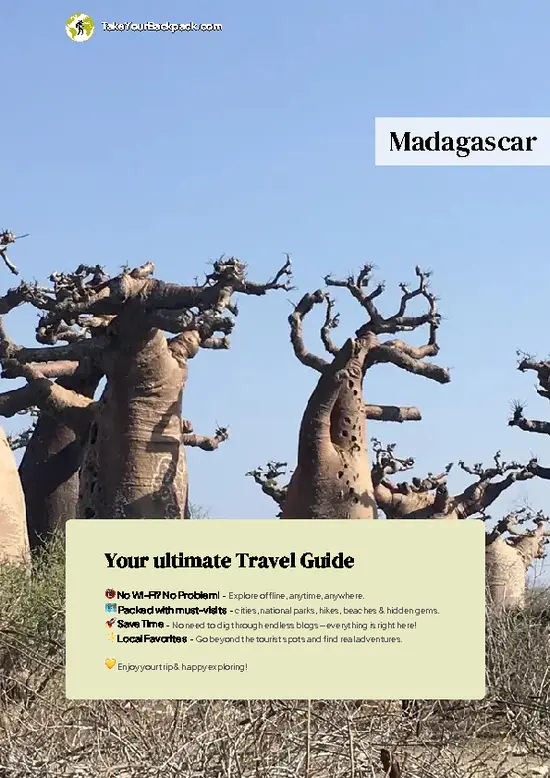
example page 0 from our offline Travel Guide for Madagascar
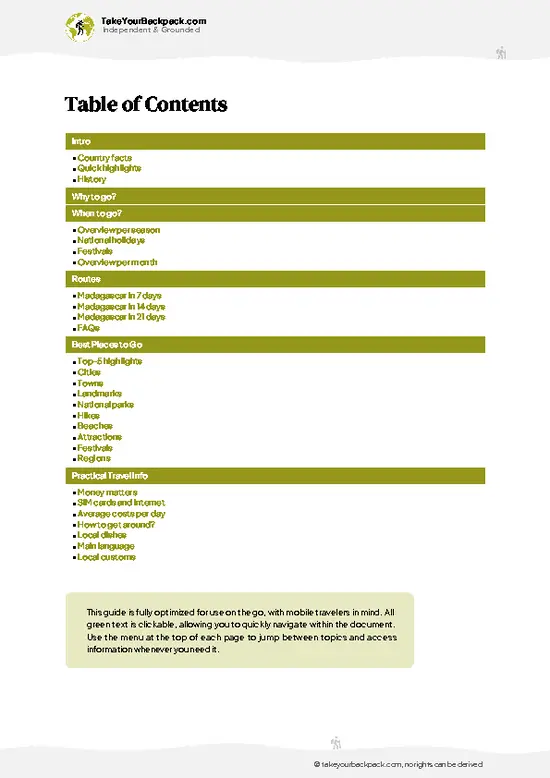
example page 1 from our offline Travel Guide for Madagascar
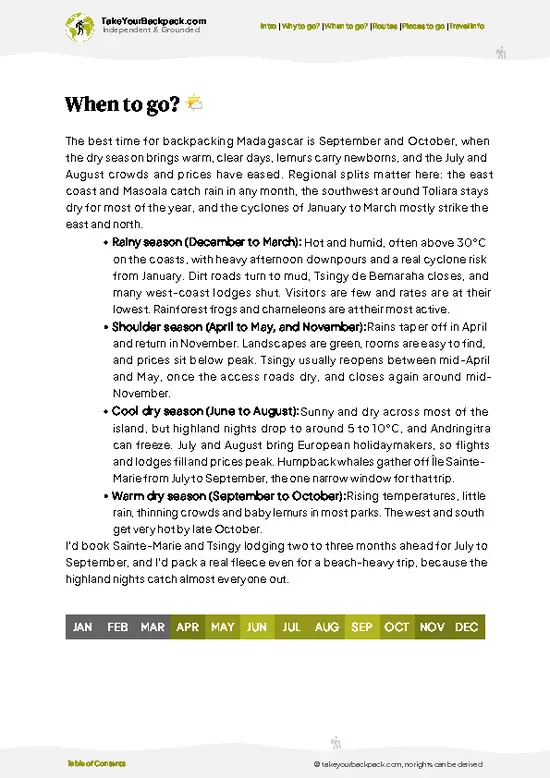
example page 2 from our offline Travel Guide for Madagascar
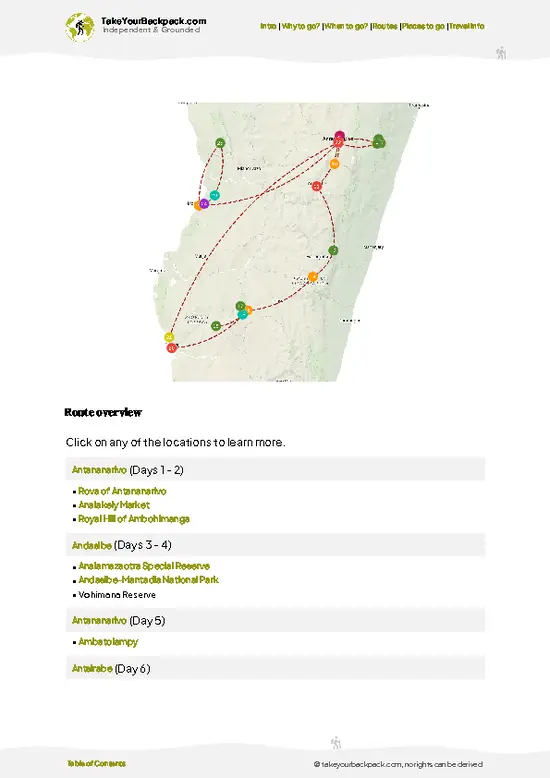
example page 3 from our offline Travel Guide for Madagascar
example page 4 from our offline Travel Guide for Madagascar
example page 5 from our offline Travel Guide for Madagascar
example page 6 from our offline Travel Guide for Madagascar
example page 7 from our offline Travel Guide for Madagascar
Loading the map 🌍
CLICK TO FILTER
cities
towns
landmarks
national parks
hikes
beaches
attractions
festivals
regions
SHOW COUNTRY’S BESTSHOW ALL

✨ Why go?
Ranked #6 festival in Madagascar
Why Hira Gasy should be on your travel list

Backpackers plan around Hira Gasy because it puts you inside a Malagasy gathering rather than in front of a staged show. Troupes of 20 to 40 performers arrive from different villages, and the rival-troupe format means you watch two groups try to outdo each other with song, dance and sharp-tongued speeches. The crowd judges loudly, and you will be pulled into the commentary whether you speak Malagasy or not.

The second reason is how it fits a highlands route. Performances happen in village courtyards and open fields, so you end up in places few visitors reach, often sharing food with families who treat a foreigner as an honored guest. A Sunday afternoon session is the classic setup, and it can run from midday until dusk. Arrive early, bring small bills for tips to the troupe, and let a local … read more 👉
Backpackers plan around Hira Gasy because it puts you inside a Malagasy gathering rather than in front of a staged show. Troupes of 20 to 40 performers arrive from different villages, and the rival-troupe format means you watch two groups try to outdo each other with song, dance and sharp-tongued speeches. The crowd judges loudly, and you will be pulled into the commentary whether you speak Malagasy or not.

The second reason is how it fits a highlands route. Performances happen in village courtyards and open fields, so you end up in places few visitors reach, often sharing food with families who treat a foreigner as an honored guest. A Sunday afternoon session is the classic setup, and it can run from midday until dusk. Arrive early, bring small bills for tips to the troupe, and let a local friend or guide explain the proverbs in the speeches. You leave with a clearer feel for highland life than any museum offers.

💡 HighlightsDon't-miss highlights and experiences

  1. The rival troupe contest: two troupes perform in turn on an open ground, trading songs and dances, and the audience decides who won. The tension is real and the heckling is joyful.
  2. The kabary speech: the troupe leader delivers a long oration packed with proverbs, jokes and moral advice. Even without the language, the rhythm and the crowd’s reaction carry the meaning.
  3. The costumes: matching outfits in bright colors, with women in lamba wraps and men in hats and waistcoats, make each troupe instantly recognizable. Look for the ones who rehearse their entrance like a parade.
  4. The live brass and drum band: trumpets, drums, violins and accordions set the pace, a sound shaped by highland and colonial-era influences. It is loud, brassy and impossible to stand still through.
  5. The courtyard crowd and street
… read more 👉
  1. The rival troupe contest: two troupes perform in turn on an open ground, trading songs and dances, and the audience decides who won. The tension is real and the heckling is joyful.
  2. The kabary speech: the troupe leader delivers a long oration packed with proverbs, jokes and moral advice. Even without the language, the rhythm and the crowd’s reaction carry the meaning.
  3. The costumes: matching outfits in bright colors, with women in lamba wraps and men in hats and waistcoats, make each troupe instantly recognizable. Look for the ones who rehearse their entrance like a parade.
  4. The live brass and drum band: trumpets, drums, violins and accordions set the pace, a sound shaped by highland and colonial-era influences. It is loud, brassy and impossible to stand still through.
  5. The courtyard crowd and street food: families bring mats, vendors sell grilled skewers, peanuts and sweet snacks, and the whole afternoon turns into a community picnic. Sitting among locals is half the show.
For a first visit, start with the rival troupe contest, because it shows you the music, the speeches and the crowd all at once.
Spotted a mistake or missing something? Contact us.

Things to do near Hira Gasy Festival

Ratings based on Tripadvisor reviews. When you book through this link, you support our work at no extra cost to you.

🌤️ When to go?When is the celebration of Hira Gasy Festival?

Hira Gasy performances run on Sundays from roughly May to October, usually starting around midday and lasting until late afternoon, in villages and open fields around Antananarivo and the central highlands, with Ambohimanga and the outskirts of the capital among the easiest places to catch one.
  • Best day: Sunday is the only day that matters. Arrive by 11am, since troupes warm up with parades and the speeches (kabary) that open each show.
  • Weather: Highland winters are dry and cool, 5 to 10°C (41 to 50°F) at dawn, rising to 20 to 24°C (68 to 75°F) by afternoon. Bring a fleece, a rain shell for stray drizzle, sunscreen and a hat.
  • Booking: Village shows need no tickets. Book Antananarivo beds a week ahead on busy weekends, and expect little price change.
  • Crowds: Leave the capital before 9am, because
… read more 👉
Hira Gasy performances run on Sundays from roughly May to October, usually starting around midday and lasting until late afternoon, in villages and open fields around Antananarivo and the central highlands, with Ambohimanga and the outskirts of the capital among the easiest places to catch one.
  • Best day: Sunday is the only day that matters. Arrive by 11am, since troupes warm up with parades and the speeches (kabary) that open each show.
  • Weather: Highland winters are dry and cool, 5 to 10°C (41 to 50°F) at dawn, rising to 20 to 24°C (68 to 75°F) by afternoon. Bring a fleece, a rain shell for stray drizzle, sunscreen and a hat.
  • Booking: Village shows need no tickets. Book Antananarivo beds a week ahead on busy weekends, and expect little price change.
  • Crowds: Leave the capital before 9am, because Sunday traffic thickens around markets. Head back before dusk, when shared taxi-brousses fill up.
Check the venue with your guesthouse on Friday, since troupes move between villages.


source: climatestotravel.comJANJanuary: not recommended for travelingFEBFebruary: not recommended for travelingMARMarch: not recommended for travelingAPRApril: not recommended for travelingMAYMay: highly recommended for travelingJUNJune: highly recommended for travelingJULJuly: highly recommended for travelingAUGAugust: highly recommended for travelingSEPSeptember: highly recommended for travelingOCTOctober: highly recommended for travelingNOVNovember: not recommended for travelingDECDecember: not recommended for traveling

✈️ The backpacker research shortcutMadagascar Travel Guide

An offline-friendly backpacking guide with optimized travel routes, ranked highlights, transport advice, and the best areas to stay.
example page 0 from our offline Travel Guide for Madagascar
example page 1 from our offline Travel Guide for Madagascar
example page 2 from our offline Travel Guide for Madagascar
example page 3 from our offline Travel Guide for Madagascar
example page 4 from our offline Travel Guide for Madagascar
example page 5 from our offline Travel Guide for Madagascar
example page 6 from our offline Travel Guide for Madagascar
example page 7 from our offline Travel Guide for Madagascar
The digital guide (301 pages) contains:
✅ 96 highlights, ranked by travel appeal
✅ Optimized 7, 14 & 21-day travel routes
✅ Cities, national parks, landmarks, beaches
✅ How to get around
✅ Offline-friendly for travel without Wi-Fi
👉 Click to see all 30+ guide features

📅 Plan smarter in minutes, not weeks
✅ Month by month travel advice
✅ Festivals & national holidays
✅ Budget expectations

🗺️ Go to the right places, skip the overrated ones
✅ Honest pros & cons of destinations
✅ Top hikes, parks & viewpoints
✅ Lesser-known places most travelers miss
✅ Clear “worth it vs skip it” guidance

🛏️ Travel smoothly without rookie mistakes
✅ Best areas to stay
✅ Transport systems explained simply
✅ Common scams & safety advice
✅ SIM cards, money & practical tips

🌍 Understand the country, not just visit it
✅ Culture & traditions
✅ 52 Essential phrases & customs
✅ Festivals worth planning around
✅ Traveler-friendly historical context
✅ Insights that make places more meaningful

📱 Built for real travel conditions
✅ Fully downloadable PDF
✅ Works completely offline
✅ Optimized for phone use
✅ Useful in remote areas & buses
✅ Everything in one place
Stop searching, start planning
Get instant access to your full guide. 30‑day money-back guarantee.
+ Add another guide for just

By proceeding you agree to our terms.
Sent to your inbox immediately after payment • 100% Secure Checkout
Best Backpacking Travel Advisor 2025 tourism awardBest Backpacking
Travel Advisor
2025
What others say about Take Your Backpack Guides:
⭐⭐⭐⭐⭐
Fantastic, amazing amount of information!
⭐⭐⭐⭐⭐
My goodness this is amazing, it's what I've been looking for hats off too you!
⭐⭐⭐⭐⭐
I think this is absolutely BRILLIANT
⭐⭐⭐⭐
Very complete and informative. It's still missing places, but I gotta to commend you
⭐⭐⭐⭐⭐
This is truly amazing, thank you, can't wait to explore it with my kids!
⭐⭐⭐⭐⭐
Awesome resource, thank you!
⭐⭐⭐⭐⭐
This is amazing! Can't wait to explore the ones I haven't seen
⭐⭐⭐⭐
I love this! Well done, great idea.
⭐⭐⭐⭐⭐
Thanks for taking the time to make this gem!
⭐⭐⭐⭐⭐
This might be the best website I've ever seen.
⭐⭐⭐⭐⭐
Congratulations, and thank you so much for your work; it's incredibly valuable.
⭐⭐⭐⭐
In all seriousness I think you did a great job pointing out the important spots
⭐⭐⭐⭐⭐
10/10 very good
⭐⭐⭐⭐⭐
As someone who's only just starting to visit regularly this is awesome, thank you.
⭐⭐⭐⭐
Thank you very much! I'm going to visit my dad, it's going to be very useful!
⭐⭐⭐⭐⭐
This is really cool! We'll be travelling for the first time and this definitely come in handy.
⭐⭐⭐⭐⭐
You are now our minister of culture, congratulations 👨‍💼
⭐⭐⭐⭐⭐
Just wanted to tell you that this is a pearl! Going to follow your recommendations.
⭐⭐⭐⭐⭐
This is so cool. I'll definitely be using the resource for my travels soon.
⭐⭐⭐⭐⭐
This is very impressive! Good work.
⭐⭐⭐⭐⭐
This is an amazing and informative site. Very well done!

🛏️ Where to stay?How to pick the right area

Antananarivo is the base to pick, because Hira Gasy shows happen in villages within a short drive of the capital and almost every budget traveler passes through it anyway.
The Analakely and Isoraka districts are the most practical. Isoraka has the densest cluster of backpacker guesthouses, small cafés and restaurants, and it is walkable in daylight, so it is easy to meet other travelers over breakfast and split a taxi or a driver for Sunday. Analakely sits close to the train station area and the big market, handy for early starts, but it is noisier and you should take a taxi after dark.
Ambohimanga, … read more 👉
Antananarivo is the base to pick, because Hira Gasy shows happen in villages within a short drive of the capital and almost every budget traveler passes through it anyway.
The Analakely and Isoraka districts are the most practical. Isoraka has the densest cluster of backpacker guesthouses, small cafés and restaurants, and it is walkable in daylight, so it is easy to meet other travelers over breakfast and split a taxi or a driver for Sunday. Analakely sits close to the train station area and the big market, handy for early starts, but it is noisier and you should take a taxi after dark.
Ambohimanga, about 20 minutes north by road, offers a quieter option in simple lodgings if you want to walk to a nearby show on Sunday morning. It has fewer travelers, so it suits those happy to be self-sufficient.
Avoid arriving in the dark at any area without a booked bed. Ask your guesthouse host to arrange a trusted taxi, and ask them which village is hosting a troupe that weekend. Hosts often know performers personally and can point you to the best show.

👛 Costs (as of 22 October 2026)Travel costs and budget guide for Hira Gasy

A day at a Hira Gasy costs roughly US$20 to 54 including a Sunday trip from Antananarivo, since the performances themselves are free or close to it.
CategoryBudget RangeLocal Reality
Festival ticketsUS$0 to 2Village shows are open air. Donations or a small contribution to the troupe are welcome.
AccommodationUS$10 to 25Dorm or basic private room in Antananarivo, higher for rooms with private bathrooms.
Local transportUS$3 to 10Taxi-brousse or minibus to nearby villages costs US$0.50 to 2 each way. A taxi or driver for the day costs more.
Food & drinksUS$5 to 12Street snacks cost US$0.10 to 0.50 each, and a sit-down meal of rice and zebu costs US$2 to 5.
Miscellaneous expensesUS$2 to 5Tips for guides, water, sunscreen, and small gifts for performers or hosts.
Total Daily BudgetUS$20 to 54Mid-range
… read more 👉
A day at a Hira Gasy costs roughly US$20 to 54 including a Sunday trip from Antananarivo, since the performances themselves are free or close to it.
CategoryBudget RangeLocal Reality
Festival ticketsUS$0 to 2Village shows are open air. Donations or a small contribution to the troupe are welcome.
AccommodationUS$10 to 25Dorm or basic private room in Antananarivo, higher for rooms with private bathrooms.
Local transportUS$3 to 10Taxi-brousse or minibus to nearby villages costs US$0.50 to 2 each way. A taxi or driver for the day costs more.
Food & drinksUS$5 to 12Street snacks cost US$0.10 to 0.50 each, and a sit-down meal of rice and zebu costs US$2 to 5.
Miscellaneous expensesUS$2 to 5Tips for guides, water, sunscreen, and small gifts for performers or hosts.
Total Daily BudgetUS$20 to 54Mid-range of US$25 to 45 is realistic for most independent travelers.
⚠️ Prices can change and everyone travels differently, so take this as a rough guide. Hope it helps you plan your adventure!

🍲 FoodEating & Drinking in Hira Gasy

Food at a Hira Gasy is village food, sold by neighbors from the edges of the field rather than by professional vendors.
Expect mofo gasy, golden rice-flour cakes fried on the spot, and mokary, sweet coconut rice pancakes cooked in cast-iron molds over charcoal. Koba, a dense peanut and sugar cake wrapped in banana leaf, is the snack to carry in your pocket for the long afternoon. Some families sell vary sosoa, watery rice porridge, or skewers of grilled zebu (masikita) with chili paste.
For drinks, look for ranovola, the toasted rice water, plus sodas and bottled water. Toaka gasy, the local rum, circulates, and betsabetsa, fermented sugarcane drink, is common in rural areas. Take small sips if you are not used to it.
Bring cash in small ariary notes, because stalls have no card readers and change … read more 👉
Food at a Hira Gasy is village food, sold by neighbors from the edges of the field rather than by professional vendors.
Expect mofo gasy, golden rice-flour cakes fried on the spot, and mokary, sweet coconut rice pancakes cooked in cast-iron molds over charcoal. Koba, a dense peanut and sugar cake wrapped in banana leaf, is the snack to carry in your pocket for the long afternoon. Some families sell vary sosoa, watery rice porridge, or skewers of grilled zebu (masikita) with chili paste.
For drinks, look for ranovola, the toasted rice water, plus sodas and bottled water. Toaka gasy, the local rum, circulates, and betsabetsa, fermented sugarcane drink, is common in rural areas. Take small sips if you are not used to it.
Bring cash in small ariary notes, because stalls have no card readers and change is scarce. Prices are a few hundred to a couple of thousand ariary per item (roughly US$0.10 to 0.50). Lines are informal, so hold out your money and smile. Share your food with the people sitting next to you and they will often share theirs back.

FAQTraveler FAQ

Hira Gasy performances take place on Sundays, mostly between May and October, when the highland weather is dry. Shows usually start around midday and run into the late afternoon. Villages around Antananarivo and Ambohimanga host them most often.
Attending costs very little, since village performances are free or ask only a small contribution of around US$1 to 2. Your main expenses are a bed in Antananarivo at US$10 to 25 and transport at US$3 to 10 for the round trip. Plan on US$25 to 45 per day in total.
No, you do not need tickets in advance for village Hira Gasy shows, which are open-air and free to join. The only thing to book ahead is a bed in Antananarivo, ideally a week before on busy weekends. Ask your guesthouse by Friday which village is hosting, then arrive by 11am on Sunday.
⚠️ Things can change over time, so always validate details locally before you go.

Other Malagasy festivals near Hira Gasy

Explore more nearby:

  • Madajazzcar Festival—Institut Français courtyard, jazz-valiha fusion, late jams, Analakely snacks| 1 km away
  • Za Festival—Malagasy-language sets, Rova ridge, Analakely market, Isoraka cafés| 5 km away
  • Fisemana—Fisemana village, hiragasy troupes, valiha strings, roadside mofo gasy| 8 km away

💡 Not sure where to go next?
Create a personalized itinerary for Madagascar including Hira Gasy and the places that fit your trip.

Generate my itinerary

👉 Discover all festivals

Or checkout all Madagascar has to offer (think cities, towns, villages, national parks, hikes, beaches, festivals)
Country photo of Madagascar

We 💚 feedbackFinal thoughts on celebrating the Hira Gasy

Most first-timers watch the dancers, but the real skill sits with the troupe leader’s speech, where proverbs and teasing hold the whole performance together. I would find someone who speaks Malagasy to whisper the jokes. Even a few translated lines change the afternoon. Bring cash for tips and plan to stay until the final act.

✈️ When did I visit Madagascar?
Madagascar I went backpacking in October 2019. With a friend I rented a 4WD and drove around the southern part of Madagascar.

✍️ Help improve this page!
The information on this page is based on my own backpacking experience in Madagascar, supplemented with up-to-date research and feedback from other travelers. Travel details can change, so if you notice anything outdated or incomplete, feel free to let me know.


🙋‍♂️ Give feedback

👋 Meet the founderWho’s Behind Take Your Backpack?

Johan, backpacker and founder of TakeYourBackpackHi, I’m Johan (Netherlands 🇳🇱), the creator of TakeYourBackpack. Over the past 3 decades, I’ve backpacked through 90+ countries across six continents, gaining extensive experience with independent travel, long-term trips, and overland routes.

This site is built on a combination of firsthand travel experience and carefully curated insights from other backpackers. Many guides are based on places I’ve personally visited, while others bring together tips, observations, and practical advice shared by trusted travelers I’ve met along the way.

The goal is to provide realistic, experience-driven guidance — not generic itineraries — so you can explore destinations with better context, clearer expectations, and more confidence.