×

Malta🇲🇹 | best national parksExplore the 7 Best national parks in Malta

Malta has no wilderness parks in the Yellowstone sense. What you get are small nature parks, reserves and protected coastal tracts, mostly free to enter and rarely more than an hour from a bus stop. The northwest is quietest on weekdays, Gozo is slower and greener, and the south coast has cliffs with almost no shade. For backpacking, that means cheap, easy days, so start early.

By Johan Kruseman 🇳🇱 | Updated October 18, 2026
Explore the best hikes in Malta

Why go?Why These national park Stand Out

Malta is the smallest and most densely populated country in the EU, so protected land here comes in fragments, not vast tracts. Centuries of terraced farming and fortification mean wild areas sit beside field walls, watchtowers and ancient temples, and a good half-day often mixes birdlife with history.

The climate shapes everything. Summers are dry and the garrigue turns straw-colored, while the land greens up after the autumn rains. Shade is scarce year-round.

Know this before you commit: there are no multi-day treks, no huts, and wild camping is not permitted. Public buses reach most areas, so you can stay in one base and make day trips. If you want empty wilderness, pick another country. If you want short, rewarding coastal walks, Malta delivers.
Evaluating the Top Choices
The list of best national parks in Malta is created based on landscapes, wildlife, adventure opportunities, facilities, and overall experience. If you feel a national park is missing in this list, please let us know.

When to go?Best Time to Visit Malta for national parks

Best months and why: April to early June and late September to October are best, because daytime highs sit around 20 to 29°C and the heat that makes midday walking miserable has not arrived or has already eased. March is also good for wildflowers, though sea winds can make it feel cooler.Summer and winter: July and August bring highs of 31 to 35°C, occasional sirocco days, and almost no rain. Walk before 9 a.m. or after 5 p.m., and expect dorm beds and ferries to cost noticeably more, often 30 to 50 percent above spring rates. Winter highs are 13 to 17°C, and most of the 400 to 600 mm of annual rain falls between October and February. Trails get muddy, and Gozo’s hills are at their greenest. Bring a windproof layer, and expect quieter paths and cheaper rooms.

national park hoppingHow to Combine national parks Into One Trip

How many days and in what order: A trip linking several protected areas needs 4 to 6 days, and the best order is south to north, ending on Gozo. Base yourself near Valletta or Sliema for the first days, then shift to the northwest around Mellieħa or Għajn Tuffieħa. Cross to Gozo last, since the ferry from Ċirkewwa takes about 25 minutes and the Mġarr terminal connects by bus to Victoria within 20 minutes.Pacing and mistakes: Allow half a day per stop, or a full day where you plan a longer coastal walk. Buses from Valletta to the north take 60 to 90 minutes, so plan one region per day. Travelers often cram two regions into one day and arrive at midday in full sun. Do the walking early, and save transfers for the afternoon. Check the last bus before heading out along cliffs, as services thin out after about 8 p.m.

The ListThe Best national parks of Malta

1 Il-Majjistral Nature and History Park

archaeological sites, open landscapes, coastal walks

Trace ancient remains across open terrain, combining natural scenery with glimpses of Malta’s layered human history.

malta-national-park-il-majjistral-nature-and-history-park
© Google |

2 Dwejra

coastal cliffs, inland sea, geological formations

Stand above dramatic limestone formations and gaze out to sea, then descend to explore tidal pools and unique rock landscapes.

3 Buskett

woodland, shaded trails, citrus groves

Wander under mature trees and through cultivated groves, where cool shade and bird calls create a rare Maltese forest experience.

malta-national-park-buskett
© Google | Simon

4 Għadira Nature Reserve

wetland, migratory birds, observation hides

Watch seasonal flocks rest in shallow lagoons, using quiet hides to spot rare species and observe delicate wetland habitats.

malta-national-park-ghadira-nature-reserve
© Google | Denise Aquilina

5 Salina Nature Reserve

salt pans, wading birds, saline habitat

Observe traditional salt harvesting areas, where shallow pools attract feeding birds and highlight the island’s salt-making heritage.

6 L-Aħrax tal-Mellieħa

pine forest, sea views, rugged headland

Follow forest tracks to panoramic cliffs, where the scent of pine and open sea breezes mark the island’s northern edge.

malta-national-park-l-ahrax-tal-mellieha
© Google |

7 Is-Simar Nature Reserve

reed beds, freshwater pools, bird sanctuary

Pause at quiet pools surrounded by reeds, where careful restoration supports breeding birds and tranquil moments for visitors.

malta-national-park-is-simar-nature-reserve
© Google | Pascal Aloisio
Loading the map 🌍

Expert viewInsights from Locals and Experts

How many to visit: Three or four is the right number. Each protected area here takes a half day at most, so seeing more than that just repeats the same limestone, sea and garrigue, and you pay for it in sunburn and bus waiting. Four gives you one coastal, one wetland or reserve, one Gozo and one heritage-linked stop without fatigue.Which kind for which style: If you travel on a tight budget, prioritize the free open-air coastal parks and reserves. They cost nothing to enter and you only pay for the bus, around €2 to 2.50 a ride, or about €21 for a weekly unlimited card. Heritage sites with ticketed visitor centers run roughly €6 to 12, and they give the best shade, toilets and cold air, so one is worth it on a hot day. Guided walks with local nature groups cost about €10 to 25 and are worth … read more 👉
How many to visit: Three or four is the right number. Each protected area here takes a half day at most, so seeing more than that just repeats the same limestone, sea and garrigue, and you pay for it in sunburn and bus waiting. Four gives you one coastal, one wetland or reserve, one Gozo and one heritage-linked stop without fatigue.Which kind for which style: If you travel on a tight budget, prioritize the free open-air coastal parks and reserves. They cost nothing to enter and you only pay for the bus, around €2 to 2.50 a ride, or about €21 for a weekly unlimited card. Heritage sites with ticketed visitor centers run roughly €6 to 12, and they give the best shade, toilets and cold air, so one is worth it on a hot day. Guided walks with local nature groups cost about €10 to 25 and are worth paying for only if you want birds or plants identified, as paths are easy to follow alone. Boat trips to small islands cost €10 to 25 return, but they are crowded and pricey in July and August, so skip them in peak weekends and go on a weekday in May or October.Budget: Plan on €35 to 60 a day in shoulder season, including a dorm bed at €20 to 35, bus fares and a bakery lunch of pastizzi at under €1 each. Summer pushes beds to €35 to 50.Safety and etiquette: Heat is the main danger, so carry 2 liters of water per person and a hat, because shade and shops are rare on coastal paths. Stay well back from cliff edges, as the rock crumbles and there are few barriers. In autumn and winter, hunting and bird trapping take place in the countryside on certain days, so wear bright clothing and keep to marked paths. Do not pick plants, climb on ancient walls or fly drones near reserves. In villages, cover shoulders and knees before entering a church, and keep your voice down near chapels along the walks.

✈️ The backpacker research shortcutMalta Travel Guide

An offline-friendly backpacking guide with optimized travel routes, ranked highlights, transport advice, and the best areas to stay.
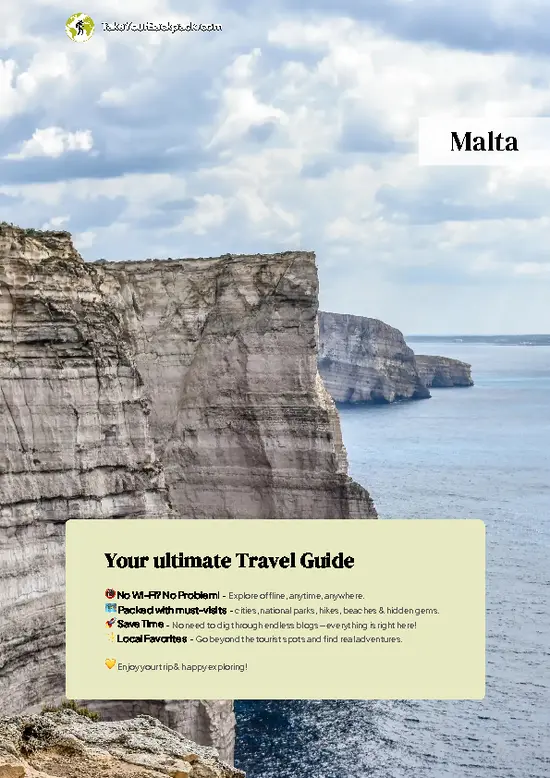
example page 0 from our offline Travel Guide for Malta
example page 1 from our offline Travel Guide for Malta
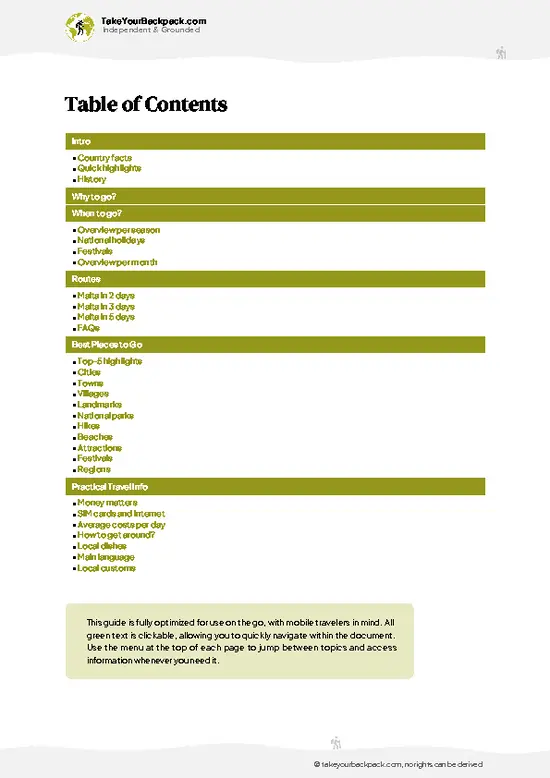
example page 2 from our offline Travel Guide for Malta
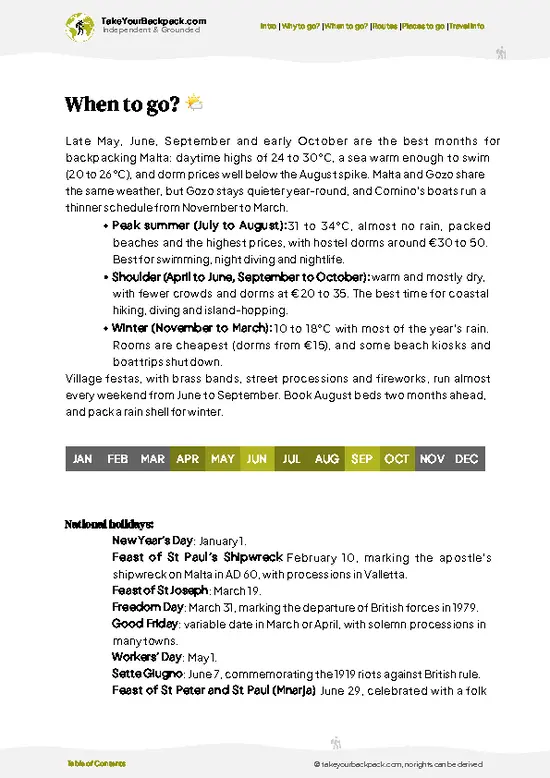
example page 3 from our offline Travel Guide for Malta
example page 4 from our offline Travel Guide for Malta
example page 5 from our offline Travel Guide for Malta
example page 6 from our offline Travel Guide for Malta
example page 7 from our offline Travel Guide for Malta
The digital guide (213 pages) contains:
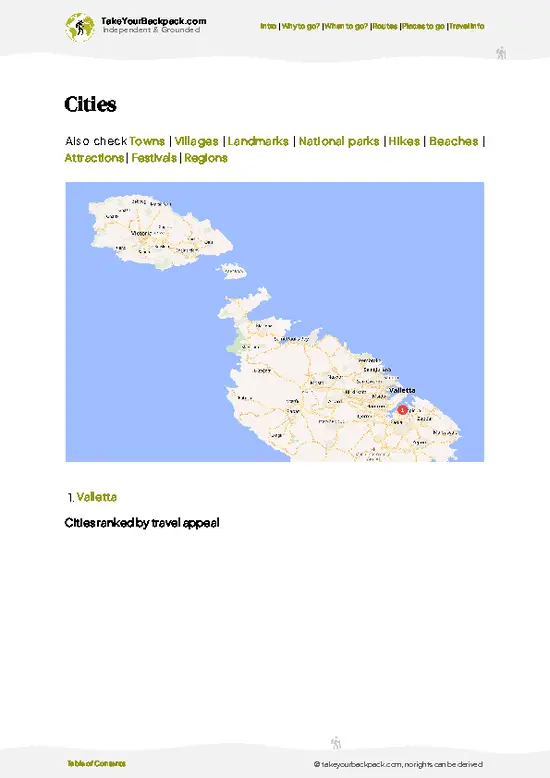
✅ 52 highlights, ranked by travel appeal
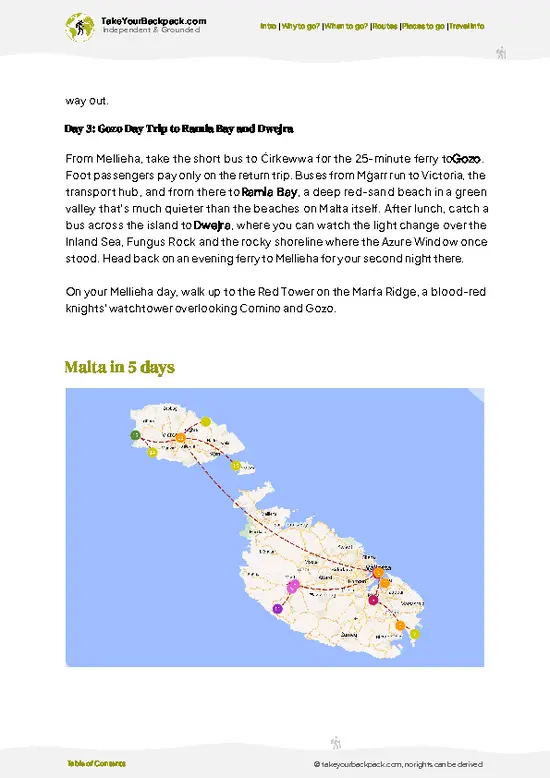
✅ Optimized 2, 3 & 5-day travel routes
✅ Cities, national parks, landmarks, beaches
✅ How to get around
✅ Offline-friendly for travel without Wi-Fi
👉 Click to see all 30+ guide features

📅 Plan smarter in minutes, not weeks
✅ Month by month travel advice
✅ Festivals & national holidays
✅ Budget expectations

🗺️ Go to the right places, skip the overrated ones
✅ Honest pros & cons of destinations
✅ Top hikes, parks & viewpoints
✅ Lesser-known places most travelers miss
✅ Clear “worth it vs skip it” guidance

🛏️ Travel smoothly without rookie mistakes
✅ Best areas to stay
✅ Transport systems explained simply
✅ Common scams & safety advice
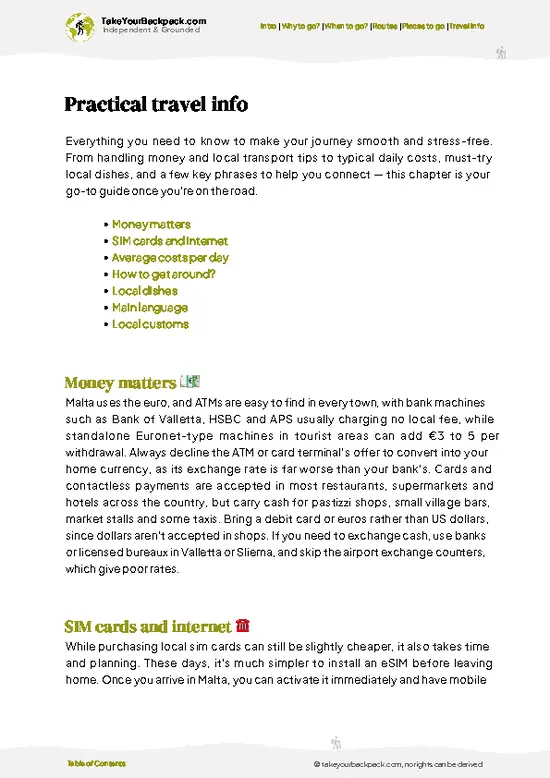
✅ SIM cards, money & practical tips

🌍 Understand the country, not just visit it
✅ Culture & traditions
✅ 52 Essential phrases & customs
✅ Festivals worth planning around
✅ Traveler-friendly historical context
✅ Insights that make places more meaningful

📱 Built for real travel conditions
✅ Fully downloadable PDF
✅ Works completely offline
✅ Optimized for phone use
✅ Useful in remote areas & buses
✅ Everything in one place
Stop searching, start planning
Get instant access to your full guide. 30‑day money-back guarantee.
+ Add another guide for just

By proceeding you agree to our terms.
Sent to your inbox immediately after payment • 100% Secure Checkout
Best Backpacking Travel Advisor 2025 tourism awardBest Backpacking
Travel Advisor
2025
What others say about Take Your Backpack Guides:
⭐⭐⭐⭐⭐
Fantastic, amazing amount of information!
⭐⭐⭐⭐⭐
My goodness this is amazing, it's what I've been looking for hats off too you!
⭐⭐⭐⭐⭐
I think this is absolutely BRILLIANT
⭐⭐⭐⭐
Very complete and informative. It's still missing places, but I gotta to commend you
⭐⭐⭐⭐⭐
This is truly amazing, thank you, can't wait to explore it with my kids!
⭐⭐⭐⭐⭐
Awesome resource, thank you!
⭐⭐⭐⭐⭐
This is amazing! Can't wait to explore the ones I haven't seen
⭐⭐⭐⭐
I love this! Well done, great idea.
⭐⭐⭐⭐⭐
Thanks for taking the time to make this gem!
⭐⭐⭐⭐⭐
This might be the best website I've ever seen.
⭐⭐⭐⭐⭐
Congratulations, and thank you so much for your work; it's incredibly valuable.
⭐⭐⭐⭐
In all seriousness I think you did a great job pointing out the important spots
⭐⭐⭐⭐⭐
10/10 very good
⭐⭐⭐⭐⭐
As someone who's only just starting to visit regularly this is awesome, thank you.
⭐⭐⭐⭐
Thank you very much! I'm going to visit my dad, it's going to be very useful!
⭐⭐⭐⭐⭐
This is really cool! We'll be travelling for the first time and this definitely come in handy.
⭐⭐⭐⭐⭐
You are now our minister of culture, congratulations 👨‍💼
⭐⭐⭐⭐⭐
Just wanted to tell you that this is a pearl! Going to follow your recommendations.
⭐⭐⭐⭐⭐
This is so cool. I'll definitely be using the resource for my travels soon.
⭐⭐⭐⭐⭐
This is very impressive! Good work.
⭐⭐⭐⭐⭐
This is an amazing and informative site. Very well done!

🛏️ Where to stay?Where to Stay in Malta

Malta has a solid hostel scene, with dorm beds typically running €18 to €40 a night depending on season, plus plenty of budget guesthouses and private rooms. Most hostels cluster in St Julian’s and neighboring Paceville, the island’s nightlife hub, where you get the cheapest beds and the biggest social crowd but also loud weekends and late-night street noise, while nearby Sliema and Gżira are calmer, safe, and well connected by bus and ferry to Valletta. Valletta itself puts you within walking distance of the main sights and gets quiet after dark, though beds there cost more, and St Paul’s Bay (including Buġibba) offers cheaper rooms and a quieter seaside base at the cost of longer bus rides … read more 👉
Malta has a solid hostel scene, with dorm beds typically running €18 to €40 a night depending on season, plus plenty of budget guesthouses and private rooms. Most hostels cluster in St Julian’s and neighboring Paceville, the island’s nightlife hub, where you get the cheapest beds and the biggest social crowd but also loud weekends and late-night street noise, while nearby Sliema and Gżira are calmer, safe, and well connected by bus and ferry to Valletta. Valletta itself puts you within walking distance of the main sights and gets quiet after dark, though beds there cost more, and St Paul’s Bay (including Buġibba) offers cheaper rooms and a quieter seaside base at the cost of longer bus rides to the capital.

If you enjoy meeting fellow travelers, consider choosing hostels with high ratings for atmosphere. On the other hand, if you prefer having your own space, a hotel might be a better option.

MaltaMore of Malta

👋 Meet the founderWho’s Behind Take Your Backpack?

Johan, backpacker and founder of TakeYourBackpackHi, I’m Johan (Netherlands 🇳🇱), the creator of TakeYourBackpack. Over the past 3 decades, I’ve backpacked through 90+ countries across six continents, gaining extensive experience with independent travel, long-term trips, and overland routes.

This site is built on a combination of firsthand travel experience and carefully curated insights from other backpackers. Many guides are based on places I’ve personally visited, while others bring together tips, observations, and practical advice shared by trusted travelers I’ve met along the way.

The goal is to provide realistic, experience-driven guidance — not generic itineraries — so you can explore destinations with better context, clearer expectations, and more confidence.