×

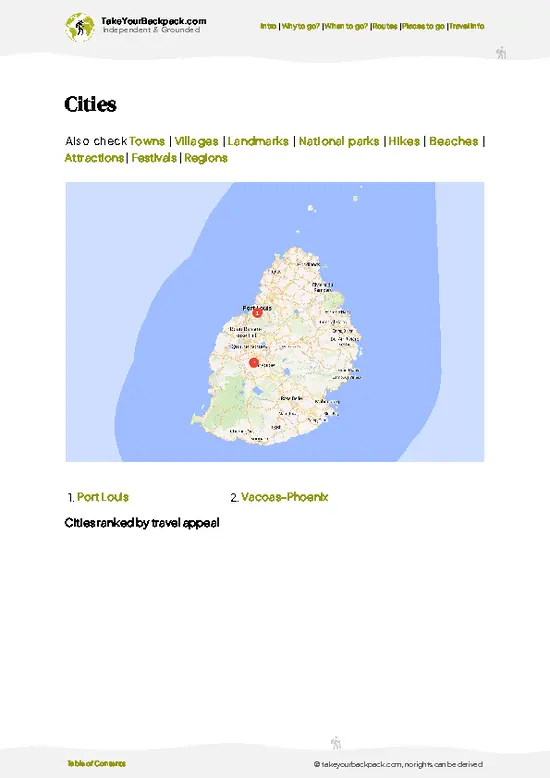
Mauritius🇲🇺 | citiesPort LouisAapravasi Ghat, Central Market, dholl puri, Blue Penny stamps, harbor quarter | things to do and best time to go

Explore Grand GaubeExplore Vacoas-Phoenix

Backpacking in Port Louis
🏆 Top pickcity ranked #1
By Johan Kruseman 🇳🇱 | Updated November 2, 2026

Not long ago Port Louis was a place you crossed on the way to a beach, a traffic-choked commercial hub that emptied at dusk and gave visitors little reason to linger. Today the waterfront is polished, the old Creole, Indian and Chinese quarters are easier to read, and the capital rewards a full day. It sits on the northwest coast of Mauritius, squeezed between the harbor and a wall of jagged mountains. It suits curious travelers who like markets, street food and history, and it will bore anyone chasing sand, since there is no swimming beach here. Spend the weekday mornings in the center, because offices and stalls run full tilt until mid-afternoon, then thin out fast, and Sundays go almost silent. Skip the glassy office towers and the mall. Go instead for the dholl puri vendors near the market, who fold hot, soft flatbread around yellow split-pea filling and hand it over in paper for next to nothing.

Part of Backpacking in Mauritius: all 65 places on one map, with routes and the best time to go.
Discover everything you want to know in the 📖 Mauritius Travel Guide.
Loading the map 🌍
CLICK TO FILTER
cities
towns
villages
landmarks
national parks
hikes
beaches
attractions
festivals
regions
SHOW COUNTRY’S BESTSHOW ALL

✨ Why go?
Ranked #1 city in Mauritius
What sets this place apart

Port Louis earns its place on a Mauritius route as the one city on the island where daily life, rather than resort life, is on show. A large cluster of sights, markets and old quarters sits within an easy walk of each other, so you can cover a lot on foot in a single day without hiring a driver. Food is the other draw. Stalls and small canteens serve dholl puri and gato piment alongside Chinese noodles and Creole curries, and a full lunch costs less here than anywhere along the coast. Hostel choice is thin, and most backpackers sleep up north or by the beach and come in for the day. That works because the capital is the island's transport hub: the Victoria Square and Immigration Square bus terminals send buses to nearly every corner of Mauritius. Treat it as a long day stop, not a base. Nightlife … read more 👉
Port Louis earns its place on a Mauritius route as the one city on the island where daily life, rather than resort life, is on show. A large cluster of sights, markets and old quarters sits within an easy walk of each other, so you can cover a lot on foot in a single day without hiring a driver. Food is the other draw. Stalls and small canteens serve dholl puri and gato piment alongside Chinese noodles and Creole curries, and a full lunch costs less here than anywhere along the coast. Hostel choice is thin, and most backpackers sleep up north or by the beach and come in for the day. That works because the capital is the island's transport hub: the Victoria Square and Immigration Square bus terminals send buses to nearly every corner of Mauritius. Treat it as a long day stop, not a base. Nightlife is minimal, and after dark the center feels deserted, which is a good reason to be back at your beach bed by evening.

💡 HighlightsPlaces and moments you shouldn't skip

  1. Aapravasi Ghat: The UNESCO-listed landing depot where indentured laborers from India first stepped ashore in the 1800s. Only a few stone walls, steps and a ruined hospital remain, but the small interpretation center explains the scale of the story well. Go in the morning before the heat. Entry is usually free or a few dollars, and an hour is plenty.
  2. Central Market: The two-hall bazaar where locals buy spices, vanilla, tea, herbs, fruit and cheap souvenirs. Go before 10 am, when it is liveliest, and try a cold alouda drink or a dholl puri from the stalls out front. Browsing is free, food costs US$1 to 3, and an hour works.
  3. Caudan Waterfront: A restored harbor quarter of shops, cafes and a casino, and the easiest place to rest between sights. The craft market and the harbor views are the reasons
… read more 👉
  1. Aapravasi Ghat: The UNESCO-listed landing depot where indentured laborers from India first stepped ashore in the 1800s. Only a few stone walls, steps and a ruined hospital remain, but the small interpretation center explains the scale of the story well. Go in the morning before the heat. Entry is usually free or a few dollars, and an hour is plenty.
  2. Central Market: The two-hall bazaar where locals buy spices, vanilla, tea, herbs, fruit and cheap souvenirs. Go before 10 am, when it is liveliest, and try a cold alouda drink or a dholl puri from the stalls out front. Browsing is free, food costs US$1 to 3, and an hour works.
  3. Caudan Waterfront: A restored harbor quarter of shops, cafes and a casino, and the easiest place to rest between sights. The craft market and the harbor views are the reasons to come. It is free to walk around, and late afternoon is pleasant when the sun drops behind the hills. Allow one to two hours.
  4. Blue Penny Museum: Home to the 1847 Post Office stamps, among the most famous in the world, plus maps and paintings tracing the island's colonial past. It is small and air-conditioned, so it works well at midday. Tickets run around US$6, and an hour is enough.
  5. Fort Adelaide (La Citadelle): A hilltop British fort from the early 1800s with cannons and a wide view over the harbor, the racecourse and the mountains. Late afternoon gives the best light. It is free, the climb takes about 20 minutes, and you should allow an hour in total.
  6. Jummah Mosque and Chinatown: The white-and-green mosque from the 1800s has carved wooden details and a calm courtyard. Visitors are welcome outside prayer times, with covered shoulders and knees, and entry is free. The surrounding lanes of Chinatown hold old shophouses, a pagoda and tiny noodle spots. Give it one to two hours.
  7. Champ de Mars Racecourse: Among the oldest horse racing tracks in the Southern Hemisphere, with Saturday meetings in the cooler months. Standing tickets cost roughly US$2 to 5, and the crowd is the real show. Plan on two to three hours on a race day. On other days you can still admire the grandstand from outside.
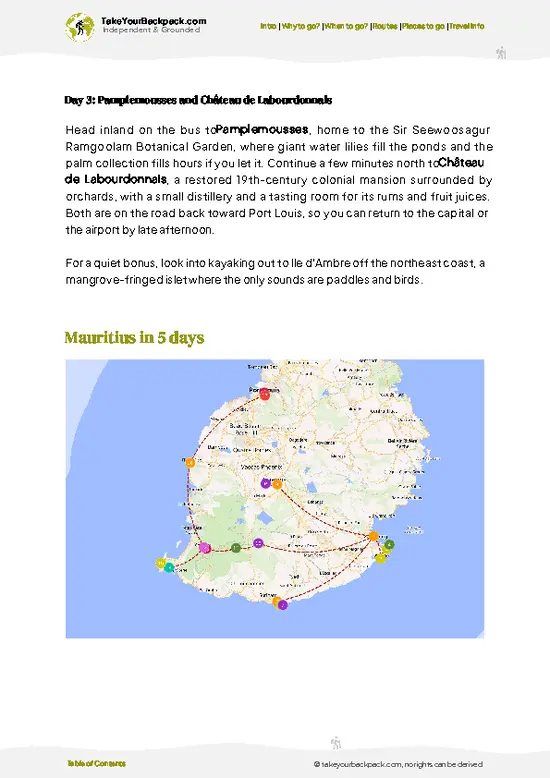
Beyond the city, Port Louis puts you within reach of the Pamplemousses botanical garden with its giant water lilies, the sugar museum L'Aventure du Sucre, the beach town of Grand Baie, and the Trou aux Cerfs crater in Curepipe, all of which work well as day trips.
For a first visit, Aapravasi Ghat gives you the clearest picture of why this city and this island look the way they do.
Spotted a mistake or missing something? Contact us.

Things to do in Port Louis

Ratings based on Tripadvisor reviews. When you book through this link, you support our work at no extra cost to you.

🏘️ NeighborhoodsUnderstanding the local layout

Port Louis is compact, and the parts worth your time sit within a 15-minute walk of each other, so you can cover most of it in a day if you start early.
  • Caudan Waterfront is the polished edge of town, with a promenade, shops, a casino and cafés facing the harbor. It is the easiest place to sit down with a coffee, and the Blue Penny Museum here holds the famous 1847 stamps. Come late afternoon when the heat eases. It is pleasant, but not where you will find the local flavor.
  • Central Market and Farquhar Street is where I would spend my first morning. Stalls sell spices, vanilla, tropical fruit, and fabric, and the food vendors nearby do dholl puri and fried snacks. Go before 10 am, because crowds and heat build fast. Bargain lightly and ignore the first price on souvenirs.
  • Chinatown is a few small
… read more 👉
Port Louis is compact, and the parts worth your time sit within a 15-minute walk of each other, so you can cover most of it in a day if you start early.
  • Caudan Waterfront is the polished edge of town, with a promenade, shops, a casino and cafés facing the harbor. It is the easiest place to sit down with a coffee, and the Blue Penny Museum here holds the famous 1847 stamps. Come late afternoon when the heat eases. It is pleasant, but not where you will find the local flavor.
  • Central Market and Farquhar Street is where I would spend my first morning. Stalls sell spices, vanilla, tropical fruit, and fabric, and the food vendors nearby do dholl puri and fried snacks. Go before 10 am, because crowds and heat build fast. Bargain lightly and ignore the first price on souvenirs.
  • Chinatown is a few small streets of old shopfronts, Chinese grocers, and dumpling counters. It is quiet on Sundays, but weekday lunchtimes are lively. Visit the Jummah Mosque on the edge for a look at the carved facades.
  • Line Barracks and the Citadel area is a good place for a climb. Fort Adelaide gives you the best view over the harbor and rooftops, and a breeze that the lower streets lack. Go an hour before dusk, and head down before dark.
  • Aapravasi Ghat is a small World Heritage site on the waterfront, tied to the history of indentured laborers. It takes 30 to 45 minutes and is moving, so I would not skip it.
Skip the outer industrial districts. Almost everything here shuts down after 5 pm on weekdays and on Sundays, so plan your days accordingly.

⌛️ 1 dayHow to make the most of one day

8:00 AM: Central Market (Bazar Central)
Start here because the stalls are at their liveliest before the heat builds and the tour groups arrive. Walk the covered aisles for dholl puri from a street vendor (about US$0.50 to 1), then look at the piles of spices, vanilla pods and dried herbs. Alowda, a sweet spiced drink sold by vendors, is worth a cup. Allow an hour, then walk ten minutes toward the waterfront.

9:30 AM: Caudan Waterfront
The harbor promenade is the easy, shaded part of town for a coffee and a look at moored boats. Step into the Blue Penny Museum here (around US$10 to 12) to see the famous 1847 Post Office stamps and old maps of the island. Plan 1 to 1.5 hours. From here, walk east along the harbor road and then up through the old streets.

11:30 AM: Chinatown (Rue Royale and Rue … read more 👉
8:00 AM: Central Market (Bazar Central)
Start here because the stalls are at their liveliest before the heat builds and the tour groups arrive. Walk the covered aisles for dholl puri from a street vendor (about US$0.50 to 1), then look at the piles of spices, vanilla pods and dried herbs. Alowda, a sweet spiced drink sold by vendors, is worth a cup. Allow an hour, then walk ten minutes toward the waterfront.

9:30 AM: Caudan Waterfront
The harbor promenade is the easy, shaded part of town for a coffee and a look at moored boats. Step into the Blue Penny Museum here (around US$10 to 12) to see the famous 1847 Post Office stamps and old maps of the island. Plan 1 to 1.5 hours. From here, walk east along the harbor road and then up through the old streets.

11:30 AM: Chinatown (Rue Royale and Rue du Rempart)
This compact quarter has Chinese grocers, dumpling shops and the Jummah Mosque, a white and green building from the 1850s with a quiet courtyard (modest dress needed, free entry, remove your shoes). Eat lunch at a small shop selling steamed bao or fried noodles for roughly US$2 to 4. Afterward, flag down a local bus or walk uphill, about 25 minutes, toward the citadel.

2:00 PM: Fort Adelaide (La Citadelle)
The British built this hilltop fort in the 1830s, and it is the best free viewpoint in the city. Climb the stone ramparts for views over the harbor, the racecourse and the jagged Pouce and Moka mountain ridges behind. Go with a bottle of water, since there is little shade. Spend about 45 minutes. The Champ de Mars racecourse is visible below; head down toward it.

3:30 PM: Champ de Mars Racecourse and Père Laval Shrine
The racecourse, one of the oldest in the Southern Hemisphere, dates to 1812, and you can often glimpse the track and stands from the fence on non-race days. For the lesser-known stop, take a short bus or taxi ride to the Père Laval shrine at Sainte-Croix, where Mauritians of many faiths come to pray to the 19th-century priest. The tomb is free to visit and the atmosphere is calm and personal. Allow an hour.

5:30 PM: Return to the Waterfront
Buses leave mostly before dark, so finish with a drink on the Caudan promenade as the offices empty, then catch your onward bus from the nearby Victoria or Immigration Square station.

🌤️ When to go?Best time to visit Port Louis

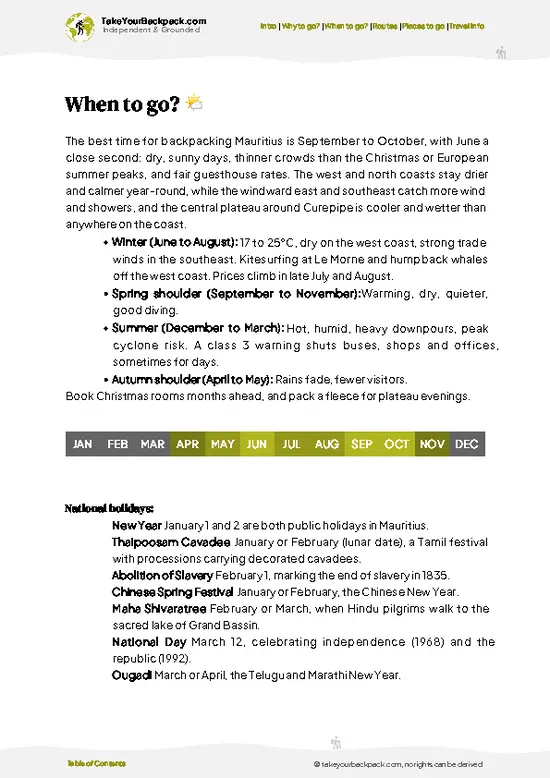
Port Louis is best from May to December, when it is drier and less humid than the summer months.
  • Summer (November to April): Hot and sticky, with highs of 29 to 33°C (84 to 91°F) and frequent downpours. Cyclone season peaks from January to March, so watch forecasts. Long days give about 13 hours of light, but the city feels airless at midday. Flight and hotel prices spike around Christmas and New Year.
  • Winter (June to September): Cooler and drier, with highs of 24 to 27°C (75 to 81°F) and lows near 17 to 19°C (63 to 66°F). Daylight lasts about 11 hours. Walking the market and the hill to Fort Adelaide is far more comfortable now. Expect moderate crowds and fair prices.
  • Shoulder Months (May, October, November): Warm, mostly dry, and quieter, with good rates on rooms.
  • Events: Cavadee, Maha Shivaratri
… read more 👉
Port Louis is best from May to December, when it is drier and less humid than the summer months.
  • Summer (November to April): Hot and sticky, with highs of 29 to 33°C (84 to 91°F) and frequent downpours. Cyclone season peaks from January to March, so watch forecasts. Long days give about 13 hours of light, but the city feels airless at midday. Flight and hotel prices spike around Christmas and New Year.
  • Winter (June to September): Cooler and drier, with highs of 24 to 27°C (75 to 81°F) and lows near 17 to 19°C (63 to 66°F). Daylight lasts about 11 hours. Walking the market and the hill to Fort Adelaide is far more comfortable now. Expect moderate crowds and fair prices.
  • Shoulder Months (May, October, November): Warm, mostly dry, and quieter, with good rates on rooms.
  • Events: Cavadee, Maha Shivaratri and Divali bring processions and street activity, though dates shift yearly.
Plan city walking for the morning, since shops close early and the afternoon sun is harsh.


source: climatestotravel.comJANJanuary: fair for travelingFEBFebruary: fair for travelingMARMarch: fair for travelingAPRApril: highly recommended for travelingMAYMay: excellent for travelingJUNJune: excellent for travelingJULJuly: excellent for travelingAUGAugust: excellent for travelingSEPSeptember: highly recommended for travelingOCTOctober: highly recommended for travelingNOVNovember: highly recommended for travelingDECDecember: fair for traveling
when-to-go

✈️ The backpacker research shortcutMauritius Travel Guide

What the free pages can't give you: ready-made routes, every place ranked, and it works offline. All in 1 guide.
example page 0 from our offline Travel Guide for Mauritius
example page 1 from our offline Travel Guide for Mauritius
example page 2 from our offline Travel Guide for Mauritius
example page 3 from our offline Travel Guide for Mauritius
example page 4 from our offline Travel Guide for Mauritius
example page 5 from our offline Travel Guide for Mauritius
example page 6 from our offline Travel Guide for Mauritius
example page 7 from our offline Travel Guide for Mauritius
The digital guide (208 pages) contains:
✅ Ready-made 2, 3 & 5-day routes
✅ All 65 places ranked, so you skip the overrated ones
✅ Works offline, all in 1 guide
✅ Cities, national parks, landmarks, beaches
✅ How to get around
👉 Click to see all 30+ guide features

📅 Plan smarter in minutes, not weeks
✅ Month by month travel advice
✅ Festivals & national holidays
✅ Budget expectations

🗺️ Go to the right places, skip the overrated ones
✅ Honest pros & cons of destinations
✅ Top hikes, parks & viewpoints
✅ Lesser-known places most travelers miss
✅ Clear “worth it vs skip it” guidance

🛏️ Travel smoothly without rookie mistakes
✅ Best areas to stay
✅ Transport systems explained simply
✅ Common scams & safety advice
✅ SIM cards, money & practical tips

🌍 Understand the country, not just visit it
✅ Culture & traditions
✅ 52 Essential phrases & customs
✅ Festivals worth planning around
✅ Traveler-friendly historical context
✅ Insights that make places more meaningful

📱 Built for real travel conditions
✅ Fully downloadable PDF
✅ Works completely offline
✅ Optimized for phone use
✅ Useful in remote areas & buses
✅ All in 1 guide
Stop searching, start planning
Get instant access to your full guide. 30‑day money-back guarantee.
+ Add another guide for just

By proceeding you agree to our terms.
Sent to your inbox immediately after payment • 100% Secure Checkout
Best Backpacking Travel Advisor 2025 tourism awardBest Backpacking
Travel Advisor
2025
What others say about Take Your Backpack Guides:
⭐⭐⭐⭐⭐
Fantastic, amazing amount of information!
⭐⭐⭐⭐⭐
My goodness this is amazing, it's what I've been looking for hats off too you!
⭐⭐⭐⭐⭐
I think this is absolutely BRILLIANT
⭐⭐⭐⭐
Very complete and informative. It's still missing places, but I gotta to commend you
⭐⭐⭐⭐⭐
This is truly amazing, thank you, can't wait to explore it with my kids!
⭐⭐⭐⭐⭐
Awesome resource, thank you!
⭐⭐⭐⭐⭐
This is amazing! Can't wait to explore the ones I haven't seen
⭐⭐⭐⭐
I love this! Well done, great idea.
⭐⭐⭐⭐⭐
Thanks for taking the time to make this gem!
⭐⭐⭐⭐⭐
This might be the best website I've ever seen.
⭐⭐⭐⭐⭐
Congratulations, and thank you so much for your work; it's incredibly valuable.
⭐⭐⭐⭐
In all seriousness I think you did a great job pointing out the important spots
⭐⭐⭐⭐⭐
10/10 very good
⭐⭐⭐⭐⭐
As someone who's only just starting to visit regularly this is awesome, thank you.
⭐⭐⭐⭐
Thank you very much! I'm going to visit my dad, it's going to be very useful!
⭐⭐⭐⭐⭐
This is really cool! We'll be travelling for the first time and this definitely come in handy.
⭐⭐⭐⭐⭐
You are now our minister of culture, congratulations 👨‍💼
⭐⭐⭐⭐⭐
Just wanted to tell you that this is a pearl! Going to follow your recommendations.
⭐⭐⭐⭐⭐
This is so cool. I'll definitely be using the resource for my travels soon.
⭐⭐⭐⭐⭐
This is very impressive! Good work.
⭐⭐⭐⭐⭐
This is an amazing and informative site. Very well done!

🛏️ Where to stay?Best areas to stay in Mauritius

Most backpackers do not sleep in Port Louis itself, because the center empties after dark and budget beds are scarce, so the best choice is usually a nearby town with better options and a short bus ride in.
Your best bet is Rose Hill or the neighboring Beau Bassin, about 20 to 30 minutes from the capital by bus or Metro Express. You will find guesthouses and simple rooms for roughly US$20 to 40 a night, local eateries, and frequent transport links into town until the evening. The streets are busy by day and calm at night, though a few stretches are dim, so keep to the main roads after dark. Rose … read more 👉
Most backpackers do not sleep in Port Louis itself, because the center empties after dark and budget beds are scarce, so the best choice is usually a nearby town with better options and a short bus ride in.
Your best bet is Rose Hill or the neighboring Beau Bassin, about 20 to 30 minutes from the capital by bus or Metro Express. You will find guesthouses and simple rooms for roughly US$20 to 40 a night, local eateries, and frequent transport links into town until the evening. The streets are busy by day and calm at night, though a few stretches are dim, so keep to the main roads after dark. Rose Hill also sits on the Metro line, which skips the worst of the rush-hour traffic.
The second option is a guesthouse or small hotel in the capital's edges near the Caudan area, if you want to be on foot for early market visits. Choices are limited and a bit pricier, often US$35 to 60 for a basic double, but you can walk to the sights and the main bus stations. The district is quiet after offices close, and noise is usually low except for traffic on main roads.
If you want a hostel scene, beach towns like Grand Baie or Flic en Flac have more dorm beds and social spaces, and both are a direct bus ride from the capital. Book ahead from December to February, when rooms sell out and prices rise.

🚌 Getting aroundHow to get from A to B

Port Louis is easy to walk across in the compact center, between the market, Caudan Waterfront, Chinatown, and Aapravasi Ghat, but walking stops making sense once you head to Fort Adelaide in the midday heat or toward the outer suburbs. Traffic is the real challenge, especially on weekday mornings and late afternoons, when the roads in and out clog badly. The bus system is cheap and extensive, and it connects the city to nearly everywhere on the island. Plan around the rush hours and you will move easily.
  • Walking: Free and the best way to see the center. Streets are flat in the core, but pavements can be crowded near the market. Go early before 10 am for shade and space, and wear a hat.
  • Local buses: Fares run about US$0.35 to 1.50 depending on distance, and nearly every route starts at either
… read more 👉
Port Louis is easy to walk across in the compact center, between the market, Caudan Waterfront, Chinatown, and Aapravasi Ghat, but walking stops making sense once you head to Fort Adelaide in the midday heat or toward the outer suburbs. Traffic is the real challenge, especially on weekday mornings and late afternoons, when the roads in and out clog badly. The bus system is cheap and extensive, and it connects the city to nearly everywhere on the island. Plan around the rush hours and you will move easily.
  • Walking: Free and the best way to see the center. Streets are flat in the core, but pavements can be crowded near the market. Go early before 10 am for shade and space, and wear a hat.
  • Local buses: Fares run about US$0.35 to 1.50 depending on distance, and nearly every route starts at either Victoria Square or Immigration Square stations. Buses run from around 5:30 am to about 7 pm, with fewer services on Sundays and after dark. Cash only, so carry small coins. Ask the conductor to confirm the stop, since signage is thin. Express buses to Grand Baie, Flic en Flac, or Mahébourg run along the main roads and are the best bargain for the longer rides.
  • Metro Express: The light rail line runs from Port Louis through Rose Hill to Curepipe, with fares around US$0.40 to 1. It is clean, air-conditioned, quick, and avoids road traffic, so it is useful if your accommodation is in Rose Hill or Quatre Bornes. Trains run roughly from 5:30 am until about 8 pm.
  • Taxis: Metered or negotiated, and a short city ride costs about US$4 to 8. Agree on the price before you get in if the meter is not running. Taxis are useful for evenings, when buses thin out, and for reaching the hilltop fort.
  • Rental car: From about US$30 to 45 a day, but parking in the center is limited and traffic is slow, so I would collect a car only when leaving the city. Driving is on the left.
For a budget traveler, a mix of walking in the center and buses or the Metro for longer hops is the right balance, with a taxi saved for late nights.

👛 Costs (as of 2 November 2026)How expensive it really is

Port Louis costs about US$38 a day for a backpacker who sleeps in a nearby budget guesthouse, eats local street food, and uses public transport. Mauritius is more expensive than much of Asia, but basic food and buses are cheap, and accommodation is the largest cost.
CategoryBudget RangeLocal Reality
Dorm or budget bed (high season)US$15 to 22Dorms are scarce in the capital itself, so most travelers sleep in nearby towns or beach areas.
Dorm or budget bed (off-season)US$10 to 16Rates fall from May to October, outside the Christmas rush.
MealsUS$6 to 12Street food and market lunches are cheap, while sit-down restaurants cost more.
Local transportUS$1 to 3City buses cost US$0.35 to 1.50 a ride.
City transport passUS$1 to 3A rechargeable card for buses and the Metro Express saves coins and queues.
Basic
… read more 👉
Port Louis costs about US$38 a day for a backpacker who sleeps in a nearby budget guesthouse, eats local street food, and uses public transport. Mauritius is more expensive than much of Asia, but basic food and buses are cheap, and accommodation is the largest cost.
CategoryBudget RangeLocal Reality
Dorm or budget bed (high season)US$15 to 22Dorms are scarce in the capital itself, so most travelers sleep in nearby towns or beach areas.
Dorm or budget bed (off-season)US$10 to 16Rates fall from May to October, outside the Christmas rush.
MealsUS$6 to 12Street food and market lunches are cheap, while sit-down restaurants cost more.
Local transportUS$1 to 3City buses cost US$0.35 to 1.50 a ride.
City transport passUS$1 to 3A rechargeable card for buses and the Metro Express saves coins and queues.
Basic activities and entry feesUS$3 to 10Most museums and heritage sites are inexpensive, and walking the market is free.
MiscellaneousUS$3 to 6Water, SIM data, and small snacks.
Total Daily BudgetUS$38A realistic figure for one day in high season.
To save money, eat lunch at market stalls and take buses rather than taxis, which can cut your daily costs by a third.


source: mauritiusnow.com
⚠️ Prices can change and everyone travels differently, so take this as a rough guide. Hope it helps you plan your adventure!

🚌 Day tripsExploring the surroundings

Port Louis works well as a base for day trips, since the main bus stations connect to almost every corner of the island and most trips take under two hours each way.Pamplemousses Botanical Garden: Giant water lilies, spice trees, and old giant tortoises fill this garden, which sits about 30 minutes north by bus for under US$1. Entry is around US$7 to 10, and a full visit takes two to three hours. Go in the morning, as the afternoon heat is heavy. First-timers often skip the water lily pond, which is the highlight.
👉 Explore Pamplemousses Botanical GardenGrand Baie: The island's liveliest beach town is about an hour north by express bus, for roughly US$1 to 2. You can swim, walk the coast, and eat cheaply at the roadside stalls, then ride back before dark. Budget US$15 to 25 with lunch. Weekdays … read more 👉
Port Louis works well as a base for day trips, since the main bus stations connect to almost every corner of the island and most trips take under two hours each way.Pamplemousses Botanical Garden: Giant water lilies, spice trees, and old giant tortoises fill this garden, which sits about 30 minutes north by bus for under US$1. Entry is around US$7 to 10, and a full visit takes two to three hours. Go in the morning, as the afternoon heat is heavy. First-timers often skip the water lily pond, which is the highlight.
👉 Explore Pamplemousses Botanical GardenGrand Baie: The island's liveliest beach town is about an hour north by express bus, for roughly US$1 to 2. You can swim, walk the coast, and eat cheaply at the roadside stalls, then ride back before dark. Budget US$15 to 25 with lunch. Weekdays are calmer than weekends, and the water is best from May to December. Many travelers underestimate the traffic on the return trip, so leave by 4 pm.
👉 Explore Grand BaieChamarel and the Seven Colored Earths: Colored dunes, a waterfall, and views over the southwest make this a fine day out, though there is no direct bus, so you need a tour, a taxi, or a rental car. Expect about 1.5 to 2 hours each way, and US$10 to 15 entry for the dunes. Go in the morning for clearer light, and avoid wet days when the park gets muddy.
👉 Explore ChamarelLe Morne Brabant: This mountain at the southwest tip is a World Heritage site, with a lagoon, kitesurfers, and a long public beach below it. The trip takes around 1.5 to 2 hours by bus with a change, for about US$2 to 4. Bring water and shade, because the beach has little cover. A guide is advisable for the hike up the mountain.
👉 Explore Le Morne Brabant

🍲 FoodLocal Flavors for Backpackers

Port Louis is the best place on the island for street food, and the Creole, Indian, and Chinese mix shows up in every bite. The signature snack is dholl puri, a thin flatbread filled with ground yellow split peas and folded around curry, chutney, and pickled vegetables. In the capital it is sold from small stalls near the market and costs about US$0.40 to 1. Add gato piment, crunchy chili-spiced lentil fritters, and boulettes, steamed dumplings in broth, often served from Chinatown counters. For a quick bite, try farata wraps or fried gajak, a general term for savory snacks.
Drink alouda, a sweet chilled milk drink with basil seeds, jelly, and vanilla, sold from carts near the market. It cools you down on a hot walk. Fresh sugarcane juice and coconut water are also common. For beer, local Phoenix … read more 👉
Port Louis is the best place on the island for street food, and the Creole, Indian, and Chinese mix shows up in every bite. The signature snack is dholl puri, a thin flatbread filled with ground yellow split peas and folded around curry, chutney, and pickled vegetables. In the capital it is sold from small stalls near the market and costs about US$0.40 to 1. Add gato piment, crunchy chili-spiced lentil fritters, and boulettes, steamed dumplings in broth, often served from Chinatown counters. For a quick bite, try farata wraps or fried gajak, a general term for savory snacks.
Drink alouda, a sweet chilled milk drink with basil seeds, jelly, and vanilla, sold from carts near the market. It cools you down on a hot walk. Fresh sugarcane juice and coconut water are also common. For beer, local Phoenix is the standard, and rum shows up in many bars.
Most of the best eating is at market stalls, small bakeries, and basic lunch spots in Chinatown and around Farquhar Street. Many close by mid-afternoon on weekdays and are shut on Sundays, so eat lunch early. Caudan Waterfront has cafés and restaurants with sit-down meals, at higher prices and with fewer local flavors. Street food is the best value, with a full snack lunch around US$2 to 4.

🛡️ SafetySafety Tips and Common Scams in Port Louis

Port Louis is broadly safe for backpackers during the day, and most problems are small ones. Pickpocketing happens in the crowded market and at bus stations, so carry your phone and wallet in a front pocket or zipped bag. The center empties after about 6 pm on weekdays and almost completely on Sundays, and the quiet streets around the market, the bus stations, and parts of the waterfront feel less comfortable after dark. Use a taxi at night rather than walking, even for a short distance. Solo travelers, including women, generally do fine in daytime, though you may get attention or persistent calls from stall holders. A firm no and keeping walking works. Street touts sometimes offer overpriced tours or taxis, so agree on a fare before you set off. Keep valuables out of sight, and do not leave belongings visible in a parked car.

FAQFrequently asked questions about Port Louis

One full day covers Port Louis itself, and two days lets you add a trip to Pamplemousses Botanical Garden, about 30 minutes north by bus. Start at the Central Market before 10 am, then visit Aapravasi Ghat and Fort Adelaide. Most travelers combine the capital with beaches elsewhere, so a total of 5 to 7 days on the island works well.
Port Louis is generally safe for solo backpackers during the day, and the main risks are pickpocketing in crowded markets and bus stations. The center empties after about 6 pm and on Sundays, so take a taxi (around US$4 to 8) rather than walking at night. Keep your phone and wallet in a front pocket, and agree on taxi fares before you set off.
Port Louis is known for its Central Market, street food such as dholl puri, and the Caudan Waterfront. It also holds the Aapravasi Ghat World Heritage site, the Blue Penny Museum with the 1847 stamps, and Fort Adelaide's views over the harbor. It is the island's capital and business hub, with a mix of Creole, Indian, and Chinese culture.
⚠️ Things can change over time, so always validate details locally before you go.

Ideas for continuing your journey

Port Louis isn’t the only highlight in Mauritius. Explore all what Mauritius has to offer.
Country photo of Mauritius

We 💚 feedbackParting advice and final tips

Port Louis deserves one full day, and I would not give it two unless you are a history nerd or market addict. Come on a weekday, since Sundays shut most of it down, and plan your last bus out of the center before the streets empty. Bring small notes for the market stalls and a light scarf for the mosque, then save the second afternoon for the beach.

✍️ Help improve this page!
The information on this page is based on in-depth research, insights shared by experienced travelers, and feedback from the local travel community in Mauritius. While every effort is made to keep the information accurate and current, conditions can change — so if you spot anything incorrect or outdated, please get in touch.


🙋‍♂️ Give feedback

👋 Meet the founderWho’s Behind Take Your Backpack?

Johan, backpacker and founder of TakeYourBackpackHi, I’m Johan (Netherlands 🇳🇱), the creator of TakeYourBackpack. Over the past 25 years, I’ve backpacked through 88 countries across six continents, gaining extensive experience with independent travel, long-term trips, and overland routes.

This site is built on a combination of firsthand travel experience and carefully curated insights from other backpackers. Many guides are based on places I’ve personally visited, while others bring together tips, observations, and practical advice shared by trusted travelers I’ve met along the way.

The goal is to provide realistic, experience-driven guidance — not generic itineraries — so you can explore destinations with better context, clearer expectations, and more confidence.