×

Mayotte🇾🇹 | best landmarksExplore the Best landmarks in Mayotte

Mayotte is a French island in the Comoros archipelago, and its landmarks are volcanic and lagoon-bound rather than monumental. Expect black basalt shores, mangrove mud, ylang-ylang sweetness and the call to prayer over tin roofs. The south has quiet beaches and lemur forest, the north has sheer lookouts, and Mamoudzou brings heat and traffic. Independent travelers need patience with transport and tides.

By Johan Kruseman 🇳🇱 | Updated October 23, 2026
Explore the best national parks in Mayotte

Why go?Understanding Their Importance

Mayotte’s landmarks are shaped by geology first. The island is volcanic, ringed by one of the world’s largest enclosed lagoons, so many sites are natural, reached by boat, trail or a walk across tidal flats. Culture adds a second layer: Shimaore and Kibushi villages, Islamic traditions and the legacy of the sultans sit under French administration, which means euro prices, paved main roads and decent signage in places, but few formal monuments or museums. The climate is hot and humid, so slopes turn slick and sun is fierce by 9 a.m. Before choosing Mayotte for its landmarks, know that public transport is limited, many sites depend on tides and weather, and travel advisories on security in some districts deserve a check. Come for landscapes with local stories attached, not for a checklist of ruins.
Why These Made the Cut
The list of best unique sites in Mayotte is created based on history or culture, wow factor, atmosphere, quirks, and memorability. If you feel a unique site is missing in this list, please let us know.

When to go?Optimal Periods for Travel

Best months: the dry season: The best months for landmarks in Mayotte are May to October, when the dry season brings clearer skies, lower humidity and calmer lagoon crossings. Daytime highs sit around 25 to 29°C, mornings feel cool, and trails stay firm underfoot with rainfall far lower than in summer. Water visibility is at its sharpest from roughly June to September, though the southeast trade winds can chop the open sea.Shoulder months and the rains: April and November are shoulder months, with warm air near 30°C, building humidity and the odd afternoon downpour. From December to March the rainy season hits hard: heat can push past 30°C, rainfall can reach several hundred millimeters a month, clay paths turn to slick red mud and cyclones are possible. Boat trips get canceled, and rivers … read more 👉
Best months: the dry season: The best months for landmarks in Mayotte are May to October, when the dry season brings clearer skies, lower humidity and calmer lagoon crossings. Daytime highs sit around 25 to 29°C, mornings feel cool, and trails stay firm underfoot with rainfall far lower than in summer. Water visibility is at its sharpest from roughly June to September, though the southeast trade winds can chop the open sea.Shoulder months and the rains: April and November are shoulder months, with warm air near 30°C, building humidity and the odd afternoon downpour. From December to March the rainy season hits hard: heat can push past 30°C, rainfall can reach several hundred millimeters a month, clay paths turn to slick red mud and cyclones are possible. Boat trips get canceled, and rivers swell. Prices change little by season, but flights from mainland France cost more during French school holidays, notably July and August and around Christmas.

unique site hoppingHow to Combine landmarks Into One Trip

How many days to allow: A trip combining several landmarks in Mayotte needs 5 to 7 days, because slow roads and tides absorb more time than distances suggest. The island is only about 40 kilometers long, yet a drive from Mamoudzou to the south or far north can take 1 to 2 hours in traffic.Grouping regions and direction: Cluster by area: the south together, the north together, and Petite-Terre separately, reached by the barge from Mamoudzou in about 20 minutes. Starting in the center-east and finishing in the south works well, since a rental car can stay in one zone each day. Allow 2 to 4 hours per stop, or a half day for anything tide-dependent.Planning mistakes: Travelers often cram three distant sites into one day, then lose hours at the Mamoudzou bottleneck, which jams from about 6 to 9 … read more 👉
How many days to allow: A trip combining several landmarks in Mayotte needs 5 to 7 days, because slow roads and tides absorb more time than distances suggest. The island is only about 40 kilometers long, yet a drive from Mamoudzou to the south or far north can take 1 to 2 hours in traffic.Grouping regions and direction: Cluster by area: the south together, the north together, and Petite-Terre separately, reached by the barge from Mamoudzou in about 20 minutes. Starting in the center-east and finishing in the south works well, since a rental car can stay in one zone each day. Allow 2 to 4 hours per stop, or a half day for anything tide-dependent.Planning mistakes: Travelers often cram three distant sites into one day, then lose hours at the Mamoudzou bottleneck, which jams from about 6 to 9 a.m. and again late afternoon. Leave the capital early, check tide tables and barge hours, and keep a spare buffer day for rain or sea conditions.

The ListTop landmarks of Mayotte

1 Lac Dziani

Green crater lake, salty floating water, rim path, Petite-Terre

Walk the volcanic crater rim above a cyanobacteria-green lake, float in its dense salty water, then rinse off at a calm lagoon beach nearby.

mayotte-unique-site-lac-dziani
© Google |
Loading the map 🌍

Expert viewInsights from Locals and Experts

How many to visit: Plan on 5 to 8 landmarks over a week. Roads are narrow and winding, heat saps energy by midday, and each stop tends to need a half day for tides, boat waits or humid hikes. Fewer, slower visits mean you actually smell the ylang-ylang, hear the cicadas and see the lagoon turn from jade to ink at dusk.Which kind to prioritize: Nature-led travelers should favor lagoon and volcanic sites, which are the island’s strongest suit. Culture-minded travelers should add village and mosque-adjacent places visited respectfully, with a local guide who can explain what you see. Short on time? Pick one sea-based and one land-based site and skip the rest. You come away with contrast instead of a blur.What it costs: Mayotte uses the euro and is pricier than neighboring islands. Budget about … read more 👉
How many to visit: Plan on 5 to 8 landmarks over a week. Roads are narrow and winding, heat saps energy by midday, and each stop tends to need a half day for tides, boat waits or humid hikes. Fewer, slower visits mean you actually smell the ylang-ylang, hear the cicadas and see the lagoon turn from jade to ink at dusk.Which kind to prioritize: Nature-led travelers should favor lagoon and volcanic sites, which are the island’s strongest suit. Culture-minded travelers should add village and mosque-adjacent places visited respectfully, with a local guide who can explain what you see. Short on time? Pick one sea-based and one land-based site and skip the rest. You come away with contrast instead of a blur.What it costs: Mayotte uses the euro and is pricier than neighboring islands. Budget about €60 to 100 a day for a lean independent trip, covering a dorm or guesthouse bed at €25 to 50, street food or small restaurant meals at €8 to 15, and local transport. Many natural landmarks are free, while guided hikes run about €20 to 50 and lagoon boat outings roughly €40 to 90. A rental car costs €35 to 60 a day and often saves hours compared with taxis and the irregular collective vans.Safety and etiquette: Mayotte is overwhelmingly Muslim, so cover shoulders and knees in villages, ask before photographing people, and avoid public displays of affection. During Ramadan, eat discreetly in daytime. Petty theft and occasional road blockades or tension in some districts are real, so check current advice, avoid walking after dark and do not leave valuables in a parked car. Respect sacred and ancestral sites, stay on marked trails, and never touch turtles or coral. Sun is intense, so carry 2 to 3 liters of water per person and start hikes at first light, when the air is cool and the views clear.Guides: A local guide’s fee usually pays back in tide knowledge, safer crossings and stories you will not find on a sign.

✈️ The backpacker research shortcutMayotte Travel Guide

An offline-friendly backpacking guide with optimized travel routes, ranked highlights, transport advice, and the best areas to stay.
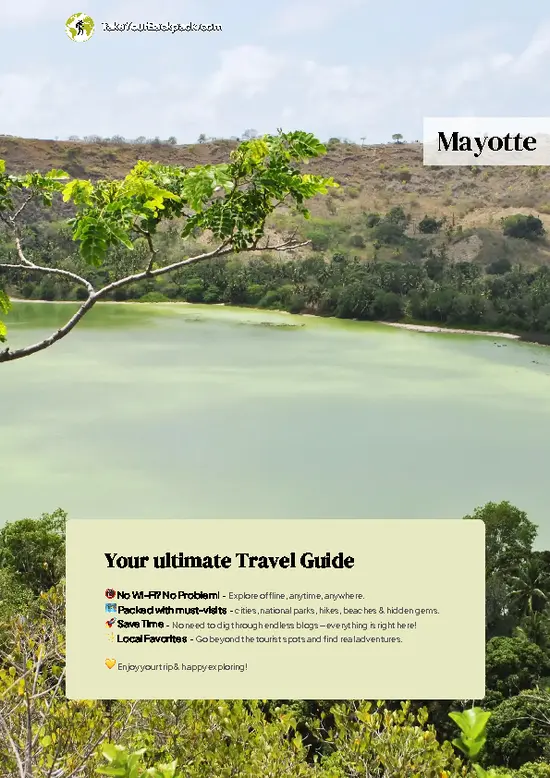
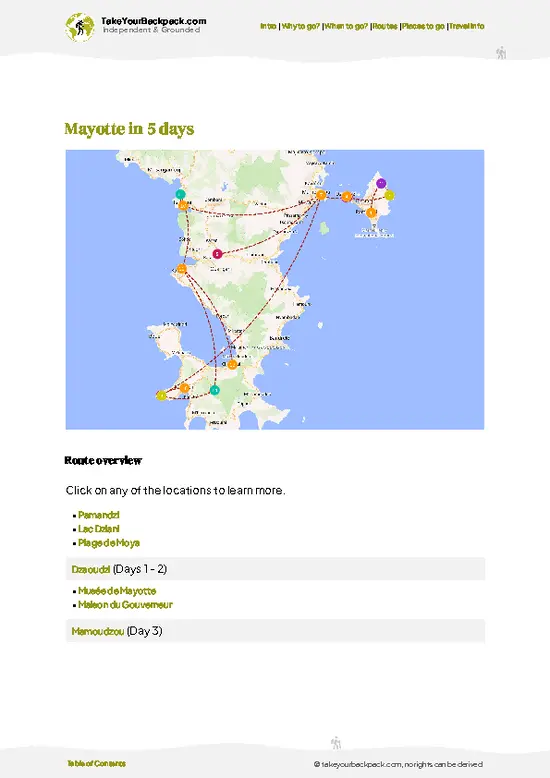
example page 0 from our offline Travel Guide for Mayotte
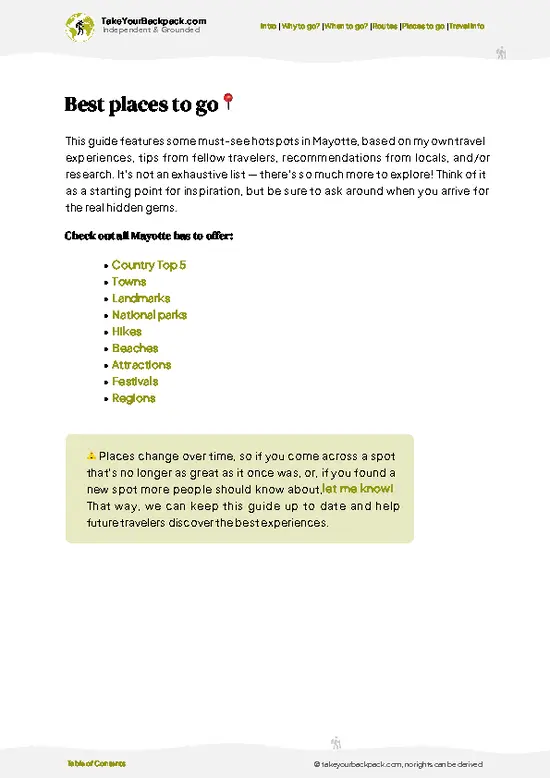
example page 1 from our offline Travel Guide for Mayotte
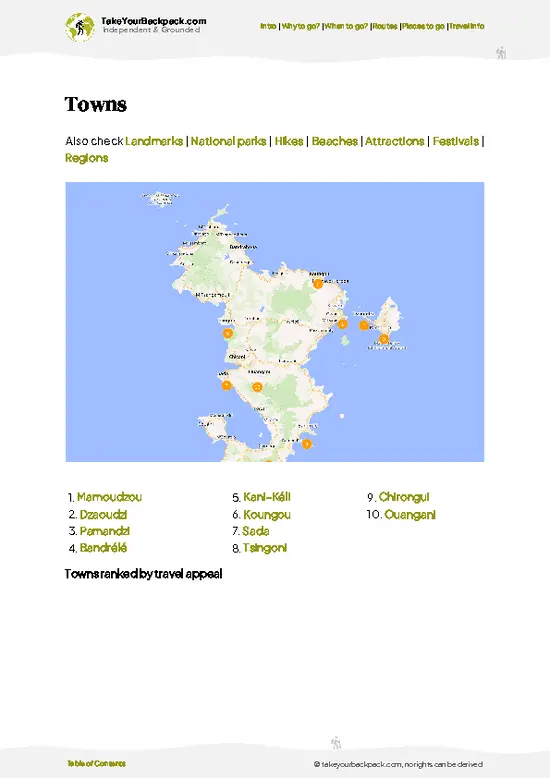
example page 2 from our offline Travel Guide for Mayotte
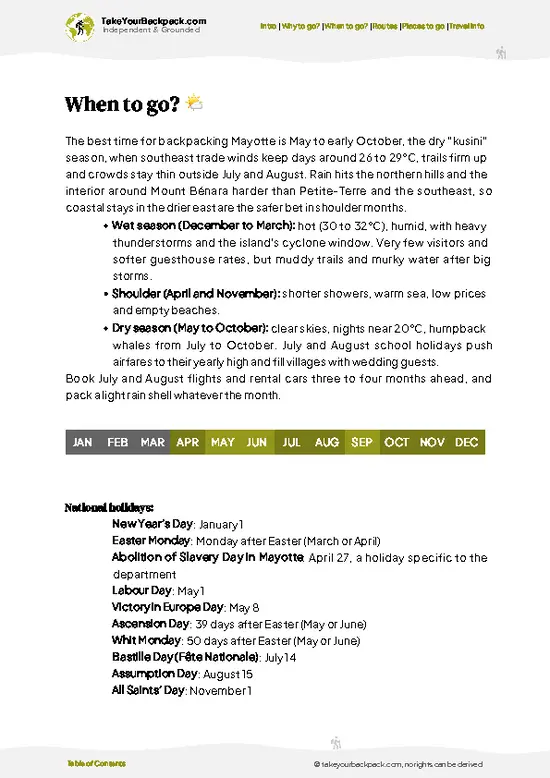
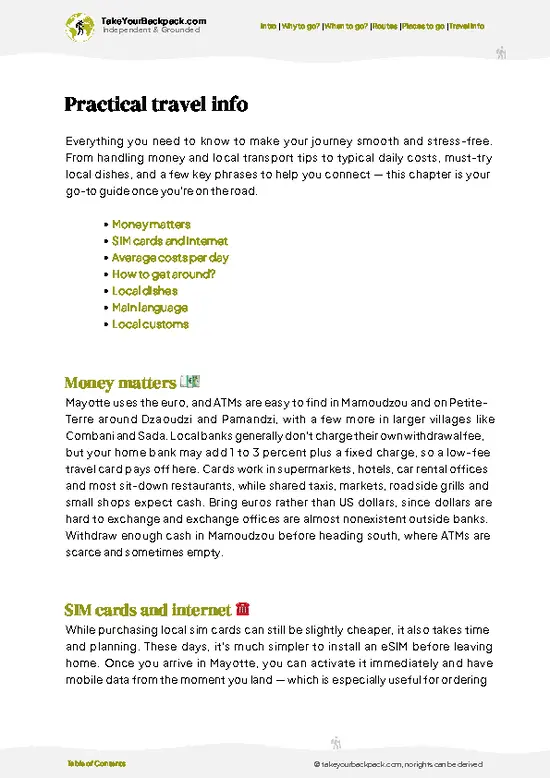
example page 3 from our offline Travel Guide for Mayotte
example page 4 from our offline Travel Guide for Mayotte
example page 5 from our offline Travel Guide for Mayotte
example page 6 from our offline Travel Guide for Mayotte
example page 7 from our offline Travel Guide for Mayotte
The digital guide (129 pages) contains:
✅ 27 highlights, ranked by travel appeal
✅ Optimized 2, 3 & 5-day travel routes
✅ Cities, national parks, landmarks, beaches
✅ How to get around
✅ Offline-friendly for travel without Wi-Fi
👉 Click to see all 30+ guide features

📅 Plan smarter in minutes, not weeks
✅ Month by month travel advice
✅ Festivals & national holidays
✅ Budget expectations

🗺️ Go to the right places, skip the overrated ones
✅ Honest pros & cons of destinations
✅ Top hikes, parks & viewpoints
✅ Lesser-known places most travelers miss
✅ Clear “worth it vs skip it” guidance

🛏️ Travel smoothly without rookie mistakes
✅ Best areas to stay
✅ Transport systems explained simply
✅ Common scams & safety advice
✅ SIM cards, money & practical tips

🌍 Understand the country, not just visit it
✅ Culture & traditions
✅ 52 Essential phrases & customs
✅ Festivals worth planning around
✅ Traveler-friendly historical context
✅ Insights that make places more meaningful

📱 Built for real travel conditions
✅ Fully downloadable PDF
✅ Works completely offline
✅ Optimized for phone use
✅ Useful in remote areas & buses
✅ Everything in one place
Stop searching, start planning
Get instant access to your full guide. 30‑day money-back guarantee.
+ Add another guide for just

By proceeding you agree to our terms.
Sent to your inbox immediately after payment • 100% Secure Checkout
Best Backpacking Travel Advisor 2025 tourism awardBest Backpacking
Travel Advisor
2025
What others say about Take Your Backpack Guides:
⭐⭐⭐⭐⭐
Fantastic, amazing amount of information!
⭐⭐⭐⭐⭐
My goodness this is amazing, it's what I've been looking for hats off too you!
⭐⭐⭐⭐⭐
I think this is absolutely BRILLIANT
⭐⭐⭐⭐
Very complete and informative. It's still missing places, but I gotta to commend you
⭐⭐⭐⭐⭐
This is truly amazing, thank you, can't wait to explore it with my kids!
⭐⭐⭐⭐⭐
Awesome resource, thank you!
⭐⭐⭐⭐⭐
This is amazing! Can't wait to explore the ones I haven't seen
⭐⭐⭐⭐
I love this! Well done, great idea.
⭐⭐⭐⭐⭐
Thanks for taking the time to make this gem!
⭐⭐⭐⭐⭐
This might be the best website I've ever seen.
⭐⭐⭐⭐⭐
Congratulations, and thank you so much for your work; it's incredibly valuable.
⭐⭐⭐⭐
In all seriousness I think you did a great job pointing out the important spots
⭐⭐⭐⭐⭐
10/10 very good
⭐⭐⭐⭐⭐
As someone who's only just starting to visit regularly this is awesome, thank you.
⭐⭐⭐⭐
Thank you very much! I'm going to visit my dad, it's going to be very useful!
⭐⭐⭐⭐⭐
This is really cool! We'll be travelling for the first time and this definitely come in handy.
⭐⭐⭐⭐⭐
You are now our minister of culture, congratulations 👨‍💼
⭐⭐⭐⭐⭐
Just wanted to tell you that this is a pearl! Going to follow your recommendations.
⭐⭐⭐⭐⭐
This is so cool. I'll definitely be using the resource for my travels soon.
⭐⭐⭐⭐⭐
This is very impressive! Good work.
⭐⭐⭐⭐⭐
This is an amazing and informative site. Very well done!

🛏️ Where to stay?Best Stay Options in Mayotte

Mayotte has no backpacker hostels in the usual sense, so budget travel here means guesthouses, rural gîtes and rooms in private homes, typically €40 to €70 a night for a double. Mamoudzou has the most options and puts you at the barge terminal and bus stops, but it is loud, traffic-choked and best avoided on foot after dark, while Petite-Terre (Dzaoudzi and Pamandzi) is calmer, close to the airport and Moya beach, and has a few bars around the waterfront. The south around Kani-Kéli and N’Gouja is the quietest choice and the best for beaches and turtle snorkeling, though you will need a rental car because evening transport is close to nonexistent.

If you enjoy meeting fellow travelers, consider … read more 👉
Mayotte has no backpacker hostels in the usual sense, so budget travel here means guesthouses, rural gîtes and rooms in private homes, typically €40 to €70 a night for a double. Mamoudzou has the most options and puts you at the barge terminal and bus stops, but it is loud, traffic-choked and best avoided on foot after dark, while Petite-Terre (Dzaoudzi and Pamandzi) is calmer, close to the airport and Moya beach, and has a few bars around the waterfront. The south around Kani-Kéli and N’Gouja is the quietest choice and the best for beaches and turtle snorkeling, though you will need a rental car because evening transport is close to nonexistent.

If you enjoy meeting fellow travelers, consider choosing hostels with high ratings for atmosphere. On the other hand, if you prefer having your own space, a hotel might be a better option.

MayotteWhere to Go Next

👋 Meet the founderWho’s Behind Take Your Backpack?

Johan, backpacker and founder of TakeYourBackpackHi, I’m Johan (Netherlands 🇳🇱), the creator of TakeYourBackpack. Over the past 3 decades, I’ve backpacked through 90+ countries across six continents, gaining extensive experience with independent travel, long-term trips, and overland routes.

This site is built on a combination of firsthand travel experience and carefully curated insights from other backpackers. Many guides are based on places I’ve personally visited, while others bring together tips, observations, and practical advice shared by trusted travelers I’ve met along the way.

The goal is to provide realistic, experience-driven guidance — not generic itineraries — so you can explore destinations with better context, clearer expectations, and more confidence.