×

Moldova🇲🇩 | festivalsMărțișorRed-white cord, March 1 charms, Ștefan cel Mare stalls | things to do and best time to go

Explore National Wine DayExplore Ethno Jazz Festival

Backpacking in Mărțișor
🏆 Top pickfestival ranked #3

📅 Next: March 2027
By Johan Kruseman 🇳🇱 | Updated November 5, 2026

Decades ago, Mărțișor meant a state-run Soviet-era music gala and a red-and-white string pinned on every coat. Today it is still both, only looser: concert halls hold classical and pop evenings, while the streets fill with handmade trinkets. The festival sits in Chișinău, in Moldova’s capital, and runs across the first days of March, the stretch when winter slush is still gray underfoot but the air has turned softer. Expect cold hands, steaming mugs of mulled wine, the smell of wet pavement and cut tulips, and the clack of heels on tiled arcades. The crowd is mostly local families, students and office workers, with few foreign backpackers, which keeps it friendly and unhurried. Stalls cluster along the central boulevard, and most concerts are ticketed at modest prices. Start a first day by buying a string near the main avenue, then walk to the flower sellers and finish with an evening concert.

Part of Backpacking in Moldova: all 66 places on one map, with routes and the best time to go.
Discover everything you want to know in the 📖 Moldova Travel Guide.
Loading the map 🌍
CLICK TO FILTER
cities
towns
villages
landmarks
national parks
hikes
attractions
festivals
SHOW COUNTRY’S BESTSHOW ALL

✨ Why go?
Ranked #3 festival in Moldova
Why visitors keep coming back

Mărțișor gives you Moldova at its most local, in a month when the country is otherwise quiet. Nobody here is performing for tourists. People hand each other red-and-white strings on March 1 as a wish for health, and as a foreigner you will receive one within an hour of arriving. That small exchange opens more conversations than a week of hostel common rooms. The festival also gives a red-and-white string worn until the first blossoms or storks appear to carry with you for the rest of the trip, which makes a better souvenir than anything bought at an airport.

It works well as an opening note for a longer route. Early March is cheap season, so beds are easy to find, and the wine cellars and countryside monasteries are still open for the days after. Pair it with the Mărțișor International Music … read more 👉
Mărțișor gives you Moldova at its most local, in a month when the country is otherwise quiet. Nobody here is performing for tourists. People hand each other red-and-white strings on March 1 as a wish for health, and as a foreigner you will receive one within an hour of arriving. That small exchange opens more conversations than a week of hostel common rooms. The festival also gives a red-and-white string worn until the first blossoms or storks appear to carry with you for the rest of the trip, which makes a better souvenir than anything bought at an airport.

It works well as an opening note for a longer route. Early March is cheap season, so beds are easy to find, and the wine cellars and countryside monasteries are still open for the days after. Pair it with the Mărțișor International Music Festival programming in Chișinău if you want an evening indoors with proper acoustics, then head out of town as the weather warms. It is a festival you attend by walking around, so you need no camping gear and no fixed schedule.

💡 HighlightsKey sights and experiences for travelers

  1. The red-and-white mărțișor string: The core of the whole festival is a twisted red and white cord with a small charm, given on March 1 and worn on the lapel or wrist. Red stands for life and white for purity. Tradition says you tie it to a blossoming fruit tree once spring arrives. Taking part costs almost nothing and instantly puts you inside the ritual.
  2. Artisan stalls along Ștefan cel Mare Boulevard: Makers set up tables of felt, beadwork, embroidered pins and ceramic pieces, so the choice goes far beyond mass-produced plastic. Pick stalls where the maker is present and talks about the pattern. Prices vary by material, and bargaining is not really part of the culture.
  3. Mărțișor International Music Festival concerts: The festival began in the 1960s and still runs a program of classical, opera
… read more 👉
  1. The red-and-white mărțișor string: The core of the whole festival is a twisted red and white cord with a small charm, given on March 1 and worn on the lapel or wrist. Red stands for life and white for purity. Tradition says you tie it to a blossoming fruit tree once spring arrives. Taking part costs almost nothing and instantly puts you inside the ritual.
  2. Artisan stalls along Ștefan cel Mare Boulevard: Makers set up tables of felt, beadwork, embroidered pins and ceramic pieces, so the choice goes far beyond mass-produced plastic. Pick stalls where the maker is present and talks about the pattern. Prices vary by material, and bargaining is not really part of the culture.
  3. Mărțișor International Music Festival concerts: The festival began in the 1960s and still runs a program of classical, opera and popular music in the capital’s main halls, including the National Palace. Performers change each edition, but the format of a long evening with orchestras and soloists stays. Tickets are inexpensive by European standards.
  4. Mărțișor exhibitions at the National Museum of Ethnography and Natural History: Museums put historic mărțișoare on display, from early cord-and-coin versions to Soviet-era pieces. It is the quickest way to understand how a village charm turned into a national symbol. Allow about an hour, and note that wall text is mostly in Romanian.
  5. Flower sellers at the Central Market: The days around March 8 turn the market’s outer rows into a wall of tulips, mimosa and snowdrops, with women buying armfuls for each other. It is loud, fragrant and cold underfoot, and a good spot to see the social side of the holiday. Sweets and pickles stalls are close by for a snack.
Mărțișor works best when you pair the artisan stalls on Ștefan cel Mare Boulevard with the Central Market flower rows in one morning, then save the concert for the evening.
Spotted a mistake or missing something? Contact us.

Things to do near Mărțișor

Ratings based on Tripadvisor reviews. When you book through this link, you support our work at no extra cost to you.

🌤️ When to go?When is the celebration of Mărțișor?

Mărțișor runs from March 1 to March 10 every year, with the main celebrations in Chișinău (National Museum of Ethnography and Natural History, Central Park areas and the pedestrian streets around Ștefan cel Mare Boulevard), and the date never moves.
  • Best days: March 1 is the day to be there, when people hand out red-and-white woven tassels and the city fills with craft stalls. The Mărțișor festival craft fair and concerts bring the most energy in the first three days. March 8 is quieter and more family-centered.
  • Weather: Expect 0 to 10°C (32 to 50°F), with cold mornings, patchy rain or wet snow and about 11 hours of daylight. Pack a waterproof jacket, a warm layer and shoes with grip.
  • Booking: Book beds in Chișinău two to three weeks ahead for March 1 and the weekend nearby. Prices rise only
… read more 👉
Mărțișor runs from March 1 to March 10 every year, with the main celebrations in Chișinău (National Museum of Ethnography and Natural History, Central Park areas and the pedestrian streets around Ștefan cel Mare Boulevard), and the date never moves.
  • Best days: March 1 is the day to be there, when people hand out red-and-white woven tassels and the city fills with craft stalls. The Mărțișor festival craft fair and concerts bring the most energy in the first three days. March 8 is quieter and more family-centered.
  • Weather: Expect 0 to 10°C (32 to 50°F), with cold mornings, patchy rain or wet snow and about 11 hours of daylight. Pack a waterproof jacket, a warm layer and shoes with grip.
  • Booking: Book beds in Chișinău two to three weeks ahead for March 1 and the weekend nearby. Prices rise only modestly, around 10 to 20 percent.
  • Crowds: Arrive in the morning before stalls fill, and leave Chișinău by road or minibus before the early evening rush.
Arrive on March 1 or the nearest weekend for the fullest program.


source: climatestotravel.comJANJanuary: not recommended for travelingFEBFebruary: not recommended for travelingMARMarch: excellent for travelingAPRApril: not recommended for travelingMAYMay: not recommended for travelingJUNJune: not recommended for travelingJULJuly: not recommended for travelingAUGAugust: not recommended for travelingSEPSeptember: not recommended for travelingOCTOctober: not recommended for travelingNOVNovember: not recommended for travelingDECDecember: not recommended for traveling

✈️ The backpacker research shortcutMoldova Travel Guide

What the free pages can't give you: ready-made routes, every place ranked, and it works offline. All in 1 guide.
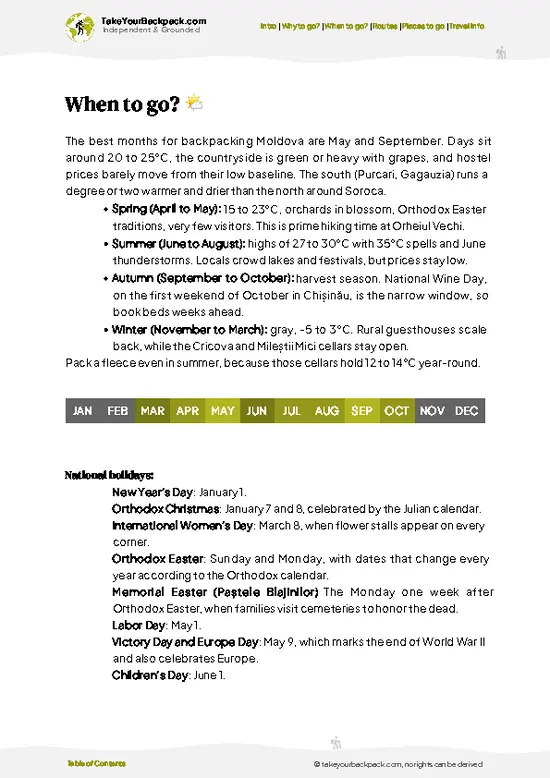
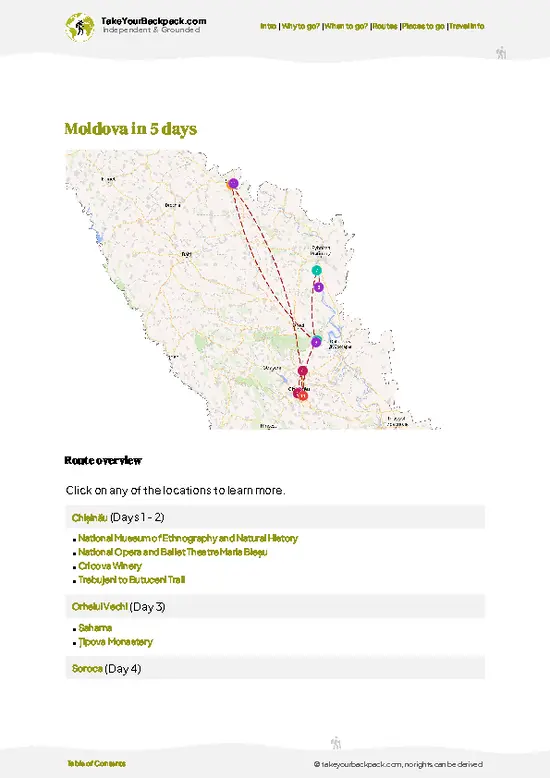
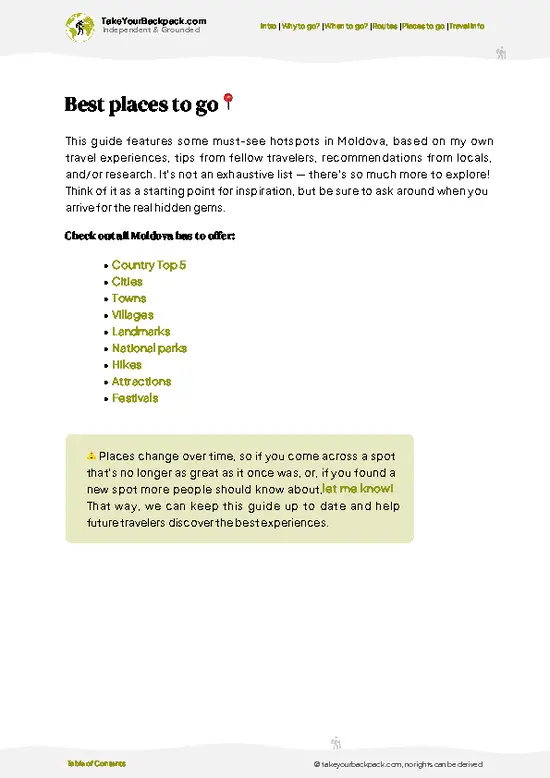
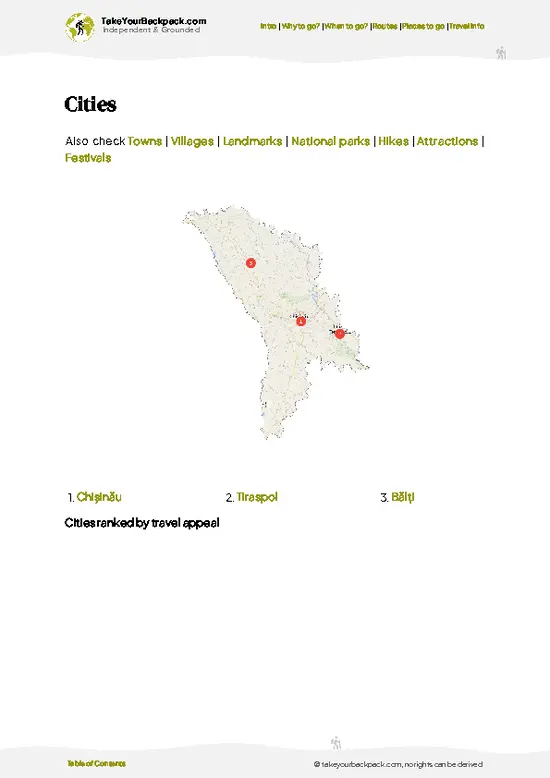
example page 0 from our offline Travel Guide for Moldova
example page 1 from our offline Travel Guide for Moldova
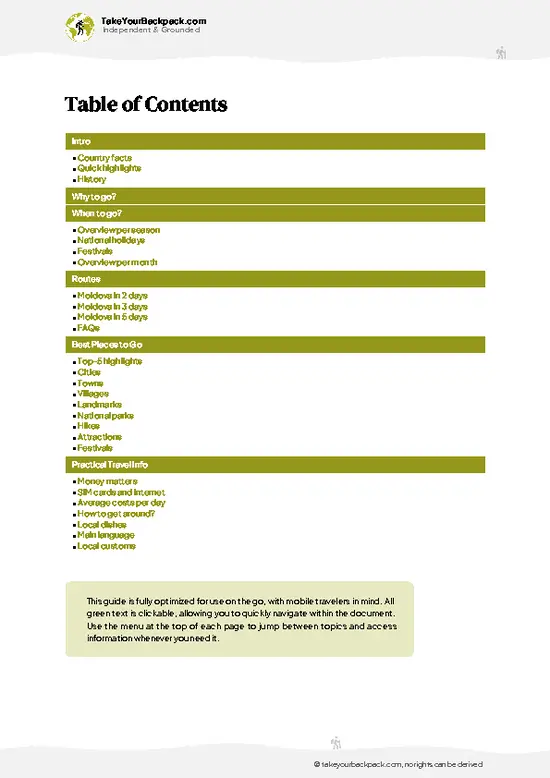
example page 2 from our offline Travel Guide for Moldova
example page 3 from our offline Travel Guide for Moldova
example page 4 from our offline Travel Guide for Moldova
example page 5 from our offline Travel Guide for Moldova
example page 6 from our offline Travel Guide for Moldova
example page 7 from our offline Travel Guide for Moldova
The digital guide (210 pages) contains:-page digital guide:
✅ Ready-made 2, 3 & 5-day routes
✅ All 66 places ranked, so you skip the overrated ones
✅ Works offline, all in 1 guide
✅ Cities, national parks, landmarks, beaches
✅ How to get around
👉 Click to see all 30+ guide features

📅 Plan smarter in minutes, not weeks
✅ Month by month travel advice
✅ Festivals & national holidays
✅ Budget expectations

🗺️ Go to the right places, skip the overrated ones
✅ Honest pros & cons of destinations
✅ Top hikes, parks & viewpoints
✅ Lesser-known places most travelers miss
✅ Clear “worth it vs skip it” guidance

🛏️ Travel smoothly without rookie mistakes
✅ Best areas to stay
✅ Transport systems explained simply
✅ Common scams & safety advice
✅ SIM cards, money & practical tips

🌍 Understand the country, not just visit it
✅ Culture & traditions
✅ 52 Essential phrases & customs
✅ Festivals worth planning around
✅ Traveler-friendly historical context
✅ Insights that make places more meaningful

📱 Built for real travel conditions
✅ Fully downloadable PDF
✅ Works completely offline
✅ Optimized for phone use
✅ Useful in remote areas & buses
✅ All in 1 guide
Stop searching, start planning
Get instant access to your full guide. 30‑day money-back guarantee.


By proceeding you agree to our terms.
Sent to your inbox immediately after payment • 100% Secure Checkout
Best Backpacking Travel Advisor 2025 tourism awardBest Backpacking
Travel Advisor
2025
What others say about Take Your Backpack Guides:
⭐⭐⭐⭐⭐
Fantastic, amazing amount of information!
⭐⭐⭐⭐⭐
My goodness this is amazing, it's what I've been looking for hats off too you!
⭐⭐⭐⭐⭐
I think this is absolutely BRILLIANT
⭐⭐⭐⭐
Very complete and informative. It's still missing places, but I gotta to commend you
⭐⭐⭐⭐⭐
This is truly amazing, thank you, can't wait to explore it with my kids!
⭐⭐⭐⭐⭐
Awesome resource, thank you!
⭐⭐⭐⭐⭐
This is amazing! Can't wait to explore the ones I haven't seen
⭐⭐⭐⭐
I love this! Well done, great idea.
⭐⭐⭐⭐⭐
Thanks for taking the time to make this gem!
⭐⭐⭐⭐⭐
This might be the best website I've ever seen.
⭐⭐⭐⭐⭐
Congratulations, and thank you so much for your work; it's incredibly valuable.
⭐⭐⭐⭐
In all seriousness I think you did a great job pointing out the important spots
⭐⭐⭐⭐⭐
10/10 very good
⭐⭐⭐⭐⭐
As someone who's only just starting to visit regularly this is awesome, thank you.
⭐⭐⭐⭐
Thank you very much! I'm going to visit my dad, it's going to be very useful!
⭐⭐⭐⭐⭐
This is really cool! We'll be travelling for the first time and this definitely come in handy.
⭐⭐⭐⭐⭐
You are now our minister of culture, congratulations 👨‍💼
⭐⭐⭐⭐⭐
Just wanted to tell you that this is a pearl! Going to follow your recommendations.
⭐⭐⭐⭐⭐
This is so cool. I'll definitely be using the resource for my travels soon.
⭐⭐⭐⭐⭐
This is very impressive! Good work.
⭐⭐⭐⭐⭐
This is an amazing and informative site. Very well done!

🛏️ Where to stay?Best areas and accommodation options

Chișinău city center is the place to stay, specifically the streets around Ștefan cel Mare Boulevard and the Central Market. Most Mărțișor events, craft stalls and concerts happen within a 10 to 15 minute walk of here, so you can skip taxis in the cold and wet March weather. The area is lit well into the evening, busy with locals, and the most popular with solo backpackers, which makes meeting other travelers easy.
The pedestrian zone near Eugen Doga Street and the Cathedral Park side is the best option for socializing. Cafés, wine bars and small restaurants stay open late, and you will find other … read more 👉
Chișinău city center is the place to stay, specifically the streets around Ștefan cel Mare Boulevard and the Central Market. Most Mărțișor events, craft stalls and concerts happen within a 10 to 15 minute walk of here, so you can skip taxis in the cold and wet March weather. The area is lit well into the evening, busy with locals, and the most popular with solo backpackers, which makes meeting other travelers easy.
The pedestrian zone near Eugen Doga Street and the Cathedral Park side is the best option for socializing. Cafés, wine bars and small restaurants stay open late, and you will find other travelers there who can team up for day trips to Orheiul Vechi or the Cricova wine cellars. Dorm beds are the budget choice, and you can expect to pay about €8 to 15 a night.
The Botanica and Râșcani districts are cheaper, with beds from about €6 to 10, and a trolleybus or minibus ride of 15 to 25 minutes takes you into the center. They are calmer and more residential, which suits a quiet night, but they have fewer places to meet people.
Avoid the far outer edges of the city, where late-night return trips in winter are less convenient. Stay central, keep your valuables close in crowded market areas, and walk back along the main boulevard after dark.

👛 Costs (as of 5 November 2026)Typical daily expenses

Mărțișor costs about €38 to 45 a day for an independent traveler in Chișinău, based on a mid-range dorm bed, street food and local transport.
CategoryBudget RangeLocal Reality
Festival tickets€0 to 5Street events and craft fairs on the central boulevard are free. Some concerts and museum programs charge a small entry fee.
Accommodation€8 to 15 (dorm), €25 to 40 (private room)Prices rise slightly around March 1 and the weekend nearby. Central dorms fill first.
Local transport€0.30 to 3Trolleybus and bus rides cost about €0.20 to 0.30, minibuses (rutierele) slightly more, and short taxi rides €2 to 3. Pay in cash.
Food & drinks€10 to 20Pies and street snacks cost €0.50 to 3, a sit-down meal €5 to 10, and a glass of wine €1.50 to 3.
Miscellaneous expenses€3 to 10Handmade mărțișor tassels and pins
… read more 👉
Mărțișor costs about €38 to 45 a day for an independent traveler in Chișinău, based on a mid-range dorm bed, street food and local transport.
CategoryBudget RangeLocal Reality
Festival tickets€0 to 5Street events and craft fairs on the central boulevard are free. Some concerts and museum programs charge a small entry fee.
Accommodation€8 to 15 (dorm), €25 to 40 (private room)Prices rise slightly around March 1 and the weekend nearby. Central dorms fill first.
Local transport€0.30 to 3Trolleybus and bus rides cost about €0.20 to 0.30, minibuses (rutierele) slightly more, and short taxi rides €2 to 3. Pay in cash.
Food & drinks€10 to 20Pies and street snacks cost €0.50 to 3, a sit-down meal €5 to 10, and a glass of wine €1.50 to 3.
Miscellaneous expenses€3 to 10Handmade mărțișor tassels and pins cost €0.50 to 5 each, and larger craft pieces can reach €10 or more.
Total Daily Budget€38 to 45Based on a central dorm bed, street food, local transport and a few souvenirs.
⚠️ Prices can change and everyone travels differently, so take this as a rough guide. Hope it helps you plan your adventure!

🍲 FoodEating & Drinking in Mărțișor

Festival food in Chișinău is built around the stalls near Ștefan cel Mare Boulevard and the Central Market, where you can graze for an afternoon. Look for plăcinte, the flaky pies filled with cheese, potato, pumpkin or cabbage, which come hot and cost about €0.50 to 1.50 each. Mămăligă, the cornmeal porridge, turns up with sheep’s cheese (brânză) and sour cream, and it is the dish that tastes most like home cooking here.
For something warm, order sarmale, cabbage rolls stuffed with pork and rice, usually about €2 to 4 a portion. Sweet stalls sell cozonac and honey cakes, and vendors often press a free taste into your hand if you linger.
On the drink side, Moldovan wine is the draw. Pour by the glass at wine tents for about €1.50 to 3, and try a local red like Fetească Neagră or a white Fetească … read more 👉
Festival food in Chișinău is built around the stalls near Ștefan cel Mare Boulevard and the Central Market, where you can graze for an afternoon. Look for plăcinte, the flaky pies filled with cheese, potato, pumpkin or cabbage, which come hot and cost about €0.50 to 1.50 each. Mămăligă, the cornmeal porridge, turns up with sheep’s cheese (brânză) and sour cream, and it is the dish that tastes most like home cooking here.
For something warm, order sarmale, cabbage rolls stuffed with pork and rice, usually about €2 to 4 a portion. Sweet stalls sell cozonac and honey cakes, and vendors often press a free taste into your hand if you linger.
On the drink side, Moldovan wine is the draw. Pour by the glass at wine tents for about €1.50 to 3, and try a local red like Fetească Neagră or a white Fetească Albă. Hot mulled wine fights off the March chill, and divin, the local brandy, appears in small shots.
Pay in cash (Moldovan lei) at nearly every stall, since card readers are rare among the smaller sellers, and bring small notes. Lines form fast around the best pie stands, so go before noon. Portions are generous, so share a plate and sample more. Accept a sip or bite when offered, because refusing can seem curt.

FAQCommon questions from travelers

Mărțișor takes place every year from March 1 to March 10, and the date never changes. The main events are in Chișinău, around Ștefan cel Mare Boulevard and the city’s museums and parks. March 1 is the busiest day, when the red-and-white tassels are handed out.
Attending Mărțișor costs very little, with most street events and craft fairs free and some concerts or museum programs charging about €0 to 5. A daily budget in Chișinău runs roughly €38 to 45, including a dorm bed at €8 to 15. Handmade tassels cost about €0.50 to 5 each.
Mărțișor does not require advance tickets, since the street fairs, stalls and outdoor celebrations in Chișinău are open to everyone. Only certain concerts or museum programs may charge a small entry fee that you can pay on the day. Book your bed two to three weeks ahead for March 1 and the nearby weekend, when central dorms fill.
⚠️ Things can change over time, so always validate details locally before you go.

Other Moldovan festivals near Mărțișor

Explore more nearby:

  • National Wine Day—Great National Assembly Square, October pours, grape must| 0 km away
  • Ethno Jazz Festival—Cimbalom and sax, late jam clubs, capital concert halls| 1 km away
  • Martenitza—red and white threads, spring tokens, handmade charms| 2 km away

💡 Not sure where to go next?
Create a personalized itinerary for Moldova including Mărțișor and the places that fit your trip.

Generate my itinerary

👉 Discover all festivals

Or checkout all Moldova has to offer (think cities, towns, villages, national parks, hikes, beaches, festivals)
Country photo of Moldova

We 💚 feedbackParting advice and final tips

Mărțișor trips go wrong when travelers grab the first plastic trinket and treat the festival as a single event with one stage. Do it the other way. Walk the boulevard stalls twice, buy from a maker who can name the pattern, and check concert listings in the capital for one evening. Bring gloves, because early March mornings are properly cold.

✍️ Help improve this page!
The information on this page is based on in-depth research, insights shared by experienced travelers, and feedback from the local travel community in Moldova. While every effort is made to keep the information accurate and current, conditions can change — so if you spot anything incorrect or outdated, please get in touch.


🙋‍♂️ Give feedback

👋 Meet the founderWho’s Behind Take Your Backpack?

Johan, backpacker and founder of TakeYourBackpackHi, I’m Johan (Netherlands 🇳🇱), the creator of TakeYourBackpack. Over the past 30 years, I’ve backpacked through 88 countries across six continents, gaining extensive experience with independent travel, long-term trips, and overland routes.

This site is built on a combination of firsthand travel experience and carefully curated insights from other backpackers. Many guides are based on places I’ve personally visited, while others bring together tips, observations, and practical advice shared by trusted travelers I’ve met along the way.

The goal is to provide realistic, experience-driven guidance — not generic itineraries — so you can explore destinations with better context, clearer expectations, and more confidence.