
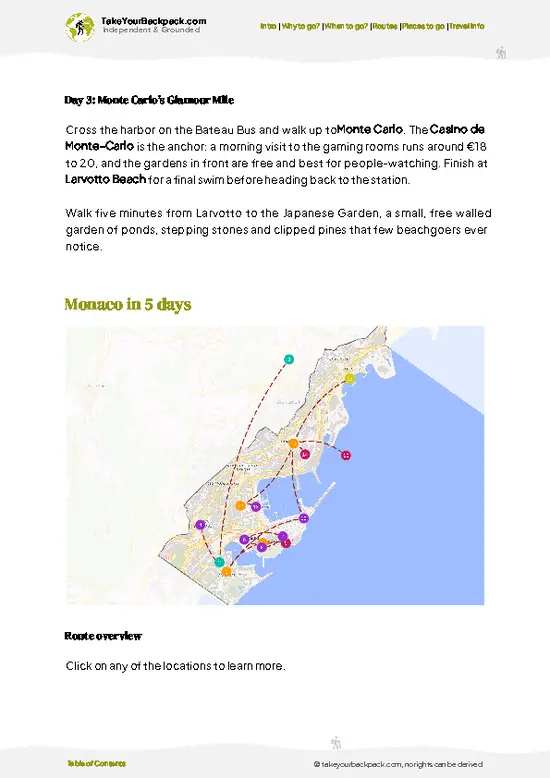
- Prince’s Palace (Palais Princier) — The symbolic heart of Monaco-Ville: a living royal residence with ornate state apartments, frescoed rooms and battlemented terraces that give you that classic “on top of the rock” feeling. Tours run seasonally and visiting the palace lets you see both Grimaldi history and a great coastal panorama.
- Place du Palais and the Changing of the Guard — The square in front of the palace is where locals and visitors gather for the daily changing of the guard (usually around 11:55). It’s short, photogenic, and gives a real feel for ceremonial life in a tiny principality.
- Saint Nicholas Cathedral (Cathédrale de Monaco) — Stately 19th-century stone cathedral where Monaco’s princes and princesses are buried (including Grace Kelly). Quiet inside, with impressive mosaics
- Prince’s Palace (Palais Princier) — The symbolic heart of Monaco-Ville: a living royal residence with ornate state apartments, frescoed rooms and battlemented terraces that give you that classic “on top of the rock” feeling. Tours run seasonally and visiting the palace lets you see both Grimaldi history and a great coastal panorama.
- Place du Palais and the Changing of the Guard — The square in front of the palace is where locals and visitors gather for the daily changing of the guard (usually around 11:55). It’s short, photogenic, and gives a real feel for ceremonial life in a tiny principality.
- Saint Nicholas Cathedral (Cathédrale de Monaco) — Stately 19th-century stone cathedral where Monaco’s princes and princesses are buried (including Grace Kelly). Quiet inside, with impressive mosaics and a straightforward way to connect the present-day principality with its religious and dynastic past.
- Oceanographic Museum (Musée Océanographique) — A dramatic cliffside museum and aquarium founded in 1910, famous for classic display tanks, historic models and Jacques Cousteau associations. The building and rooftop terraces are as much of a draw as the marine life.
- Jardins Saint-Martin (Saint-Martin Gardens) — Terraced Mediterranean gardens clinging to the rock, with palm patios, shaded paths and Roman-era remains tucked into the landscaping. Perfect for a slow wander and uninterrupted sea views without the casino crowds.
- Fort Antoine (Théâtre du Fort Antoine) — A tiny 18th-century fort converted into an open-air theatre; you’ll get history, occasional performances and one of the best low-key viewpoints over the harbour. Shows are seasonal, but the site itself is worth the climb.
- Musée du Vieux Monaco (Old Monaco Museum) — A small, focused museum that explains everyday life in old Monaco: fishing, festivals, photos and local artifacts. It’s compact, informative and gives real context to the narrow streets you’re exploring.
- Musée Napoléonien (Napoleon Museum) — A niche collection of Napoleonic-era memorabilia and period objects that shows Monaco’s ties to wider European history. It’s small but full of character; check opening hours before you go.
- Chapelle Sainte-Dévote — A humble, atmospheric chapel honoring Monaco’s patron saint, the focus of the principality’s oldest religious traditions and the annual Sainte-Dévote ceremony. Intimate and evocative—good for a reflective stop.
- Le Rocher ramparts, lanes and viewpoints (the Old Town streets) — The reason to actually be in Monaco-Ville: medieval alleys, hidden plaques, little cafés and stone stairways that reward slow exploration. Walk the ramparts and terraces for continuous sea views and a real feel for the old fortified town.
Spotted a mistake or missing something? Contact us.

Shore excursion to Eze, Monaco & Monte-Carlo from Villefranche

Private Walking Tour Monaco Historic Cultural Heritage

MONACO Shore Excursion : Private Tour French Riviera Highlights

Private Walking Tour Monaco Cultural Heritage Experience

Waterfront and Old Town Private Photoshoot in Monaco

Discover 3 countries in 1 Day: Italian Markets, Menton and Monaco

Seacoast View & Monaco – Monte Carlo Full Day Private Tour

TOP Monaco : Private Guided Tour with your mobile

Historic Monaco: From Princely Palace to Casino Square


 Best Backpacking
 Hi, I’m Johan (Netherlands 🇳🇱), the creator of TakeYourBackpack. Over the past 3 decades, I’ve backpacked through 90+ countries across six continents, gaining extensive experience with independent travel, long-term trips, and overland routes.