×

Philippines🇵🇭 | hikesMt. Pulagsea of clouds, dwarf bamboo, cold summit nights | things to do and best time to go

Explore Mt. MayonExplore Taal Volcano

Backpacking in Mt. Pulag
🏆 Top pickhike ranked #1
By Johan Kruseman 🇳🇱 | Updated May 18, 2026

Everyone shows up to Mt. Pulag expecting an easy “tourist sunrise hike.” It isn’t. The cold bites, the altitude nags, and the wind on the summit can slap you awake harder than your alarm. Mt. Pulag sits in the Cordillera range of Northern Luzon, straddling Benguet and Ifugao, and it’s one of those mountains that looks gentle from photos but demands respect once your boots hit the soil. The classic Ambangeg trail is relatively short and non-technical, but the climb still grinds, especially in the thin air above 2,900 meters. You move from pine forest to mossy jungle to that famous grassland “sea of clouds,” and when the sky cooperates, the payoff at the top feels huge. It’s easier to reach by bus and jeepney than most Philippine peaks, which makes it busier and less wild than, say, Mt. Ugo or Mt. Napulauan—but also more accessible if you’re leveling up from dayhikes.

Discover everything you want to know in the 📖 Philippines Travel Guide.
Best time to go: October - April
Duration: 2 to 3 days
Distance: 16 to 24 kilometers
Total ascent: 1,200 meters
Loading the map 🌍
CLICK TO FILTER
city
town
unique site
national park
hike
beach
attraction
festival
region
SHOW COUNTRY’S BESTSHOW ALL

✨ Why go?
Ranked #1 hike in Philippines
Why visitors keep coming back

The hike to Mt. Pulag is a rite of passage for backpackers in the Philippines, and for good reason. The scenery-to-effort ratio is off the charts. You’ll find yourself surrounded by a sea of clouds, with the sun rising over the grasslands and pine forests, painting the sky in hues you didn’t know existed.

Getting there is a breeze. Public transport options are abundant, with buses whisking you from Manila to the jump-off point in Bokod. The cost? Minimal. You can tackle this adventure without breaking the bank, making it a perfect fit for budget-conscious travelers.

What’s great is the flexibility in distances. Whether you’re a seasoned trekker or a newbie, you can choose your route, from a leisurely stroll to a more challenging ascent. This adaptability makes it easy to slot into a longer … read more 👉
The hike to Mt. Pulag is a rite of passage for backpackers in the Philippines, and for good reason. The scenery-to-effort ratio is off the charts. You’ll find yourself surrounded by a sea of clouds, with the sun rising over the grasslands and pine forests, painting the sky in hues you didn’t know existed.

Getting there is a breeze. Public transport options are abundant, with buses whisking you from Manila to the jump-off point in Bokod. The cost? Minimal. You can tackle this adventure without breaking the bank, making it a perfect fit for budget-conscious travelers.

What’s great is the flexibility in distances. Whether you’re a seasoned trekker or a newbie, you can choose your route, from a leisurely stroll to a more challenging ascent. This adaptability makes it easy to slot into a longer backpacking itinerary, allowing you to explore other stunning spots in the region.

After the climb, the reward is palpable: a cold beer shared with fellow adventurers while you soak in the breathtaking views. That moment, that camaraderie, makes every step worth it.
Get the complete Travel Guide for Philippines
Everything organized for offline planning — routes, highlights, costs & tips

See what’s inside 👉

Get the Travel Guide -

💡 HighlightsMust-see experiences and standout moments

  1. Sea of Clouds & Sunrise (the classic Pulag moment — my personal favorite): Climbing through pre-dawn darkness to watch the sun lift a thick blanket of clouds beneath you is the kind of view that turns every tired step into a grin. The clouds fill the valleys like an ocean and the light across the Cordillera peaks is cinematic — nothing else in the Philippines gives that same “standing above the sky” feeling.
  2. Summit Plateau and Dwarf Bamboo Grasslands: The top opens into wide, rolling meadows of low bamboo and tussock grass that look almost tundra-like. It’s unusually open for a tropical mountain, so you get 360° vistas and a weirdly peaceful, windswept landscape that’s rare in Southeast Asia.
  3. Mossy (Cloud) Forest: Lower down you pass into an old-growth mossy forest where trunks and branches
read more 👉
  1. Sea of Clouds & Sunrise (the classic Pulag moment — my personal favorite): Climbing through pre-dawn darkness to watch the sun lift a thick blanket of clouds beneath you is the kind of view that turns every tired step into a grin. The clouds fill the valleys like an ocean and the light across the Cordillera peaks is cinematic — nothing else in the Philippines gives that same “standing above the sky” feeling.
  2. Summit Plateau and Dwarf Bamboo Grasslands: The top opens into wide, rolling meadows of low bamboo and tussock grass that look almost tundra-like. It’s unusually open for a tropical mountain, so you get 360° vistas and a weirdly peaceful, windswept landscape that’s rare in Southeast Asia.
  3. Mossy (Cloud) Forest: Lower down you pass into an old-growth mossy forest where trunks and branches are draped in green and epiphytes hang everywhere. It feels primeval — damp, aromatic, and full of weird plant life — and it’s a major contrast to the open summit, which is why the trail is so visually rewarding.
  4. Night Sky and Milky Way: High elevation plus very low light pollution = an excellent show. On clear nights the Milky Way is vivid, planets pop, and the starfield feels close enough to reach. It’s a big reason people camp on Pulag instead of doing a day trip.
  5. Local Guides, Culture & Mountain Community: Pulag treks are run by local towns and mountain guides, so you’ll meet people with long traditions on the mountain — they share stories, trail lore, and practical know-how. The community-based trail management also shows why responsible trekking matters; the experience is part nature, part local culture, and that combo is pretty special.
Spotted a mistake or missing something? Contact us.

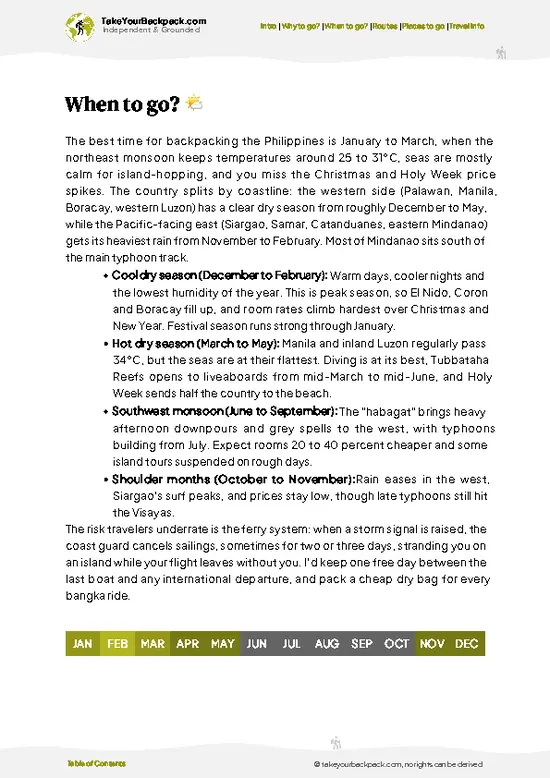
🌤️ When to go?Seasonal considerations and timing


  • Topic: Weather – The dry season from November to April is your best bet. Rain clouds pack up after October, leaving trails firm and visibility sharp. Avoid the wet months (June to September) when slippery paths and thick fog turn the climb into a slog.

  • Topic: Temperature – Nights can dip to a biting 2°C (36°F) in the coldest months, especially December and January. Daytime temps hover around a cool 15°C (59°F), perfect for sweating it out without overheating. Dress in layers; the summit’s chill hits hard.

  • Topic: Daylight Hours – Expect roughly 11 to 12 hours of daylight during the prime hiking months. Start early to maximize your trek and catch the sunrise from the peak—an experience that wipes away every ounce of fatigue.

  • Topic: Crowds – Peak season means more hikers, especially
read more 👉

  • Topic: Weather – The dry season from November to April is your best bet. Rain clouds pack up after October, leaving trails firm and visibility sharp. Avoid the wet months (June to September) when slippery paths and thick fog turn the climb into a slog.

  • Topic: Temperature – Nights can dip to a biting 2°C (36°F) in the coldest months, especially December and January. Daytime temps hover around a cool 15°C (59°F), perfect for sweating it out without overheating. Dress in layers; the summit’s chill hits hard.

  • Topic: Daylight Hours – Expect roughly 11 to 12 hours of daylight during the prime hiking months. Start early to maximize your trek and catch the sunrise from the peak—an experience that wipes away every ounce of fatigue.

  • Topic: Crowds – Peak season means more hikers, especially weekends and holidays. Weekdays offer a quieter trail, letting you savor the raw wilderness without elbowing through groups.

  • Topic: Seasonal Activities – The dry months coincide with local festivals and mountain clean-ups, adding cultural flavor and a chance to connect with fellow trekkers and locals alike.

  • Topic: Price Fluctuations – Expect higher rates for guides and accommodations during peak season. Booking in the shoulder months (November or April) can save you some pesos without sacrificing trail conditions.


Pro-tip: Time your hike to hit the summit just before dawn—nothing beats the cold bite and the sky exploding with color after a night spent chasing the stars.


source: climatestotravel.comJANJanuary: excellent for travelingFEBFebruary: excellent for travelingMARMarch: excellent for travelingAPRApril: highly recommended for travelingMAYMay: fair for travelingJUNJune: below average for travelingJULJuly: below average for travelingAUGAugust: below average for travelingSEPSeptember: below average for travelingOCTOctober: good for travelingNOVNovember: highly recommended for travelingDECDecember: excellent for traveling
when-to-go

✈️ The backpacker research shortcutPhilippines Travel Guide

An offline-friendly backpacking guide with optimized travel routes, ranked highlights, transport advice, and the best areas to stay.
example page 0 from our offline Travel Guide for Philippinesexample page 1 from our offline Travel Guide for Philippinesexample page 2 from our offline Travel Guide for Philippinesexample page 3 from our offline Travel Guide for Philippinesexample page 4 from our offline Travel Guide for Philippinesexample page 5 from our offline Travel Guide for Philippinesexample page 6 from our offline Travel Guide for Philippinesexample page 7 from our offline Travel Guide for Philippines
The digital guide (505 pages) contains:
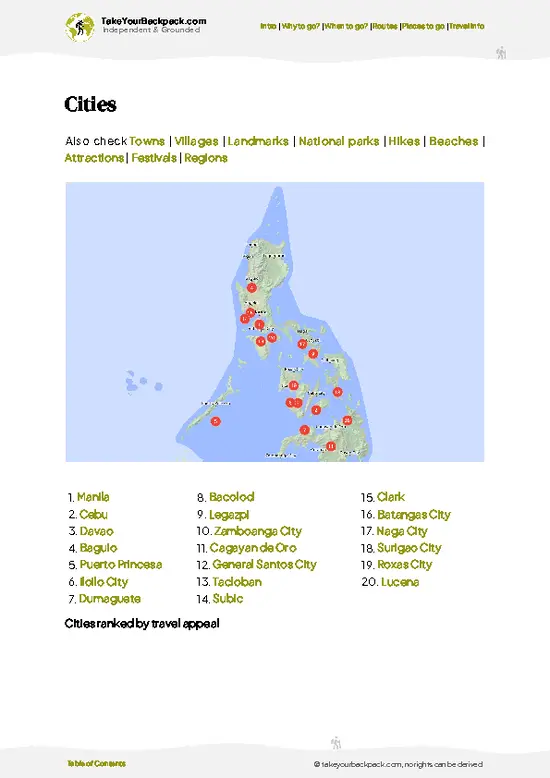
144 highlights, ranked by travel appeal
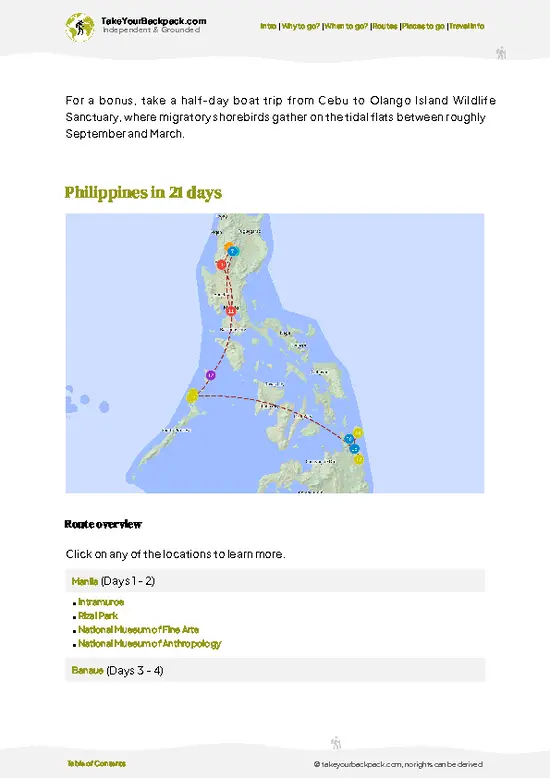
Optimized 7, 14 & 21-day travel routes
Cities, national parks, beaches, historical sites, ...
How to get around
Offline-friendly for travel without Wi-Fi
👉 Click to see all 30+ guide features

📅 Plan smarter in minutes, not weeks
Month by month travel advice
Festivals & national holidays
Budget expectations

🗺️ Go to the right places, skip the overrated ones
Honest pros & cons of destinations
Top hikes, parks & viewpoints
Lesser-known places most travelers miss
Clear “worth it vs skip it” guidance

🛏️ Travel smoothly without rookie mistakes
Best areas to stay
Transport systems explained simply
Common scams & safety advice
SIM cards, money & practical tips

🌍 Understand the country, not just visit it
Culture & traditions
52 Essential phrases & customs
Festivals worth planning around
Traveler-friendly historical context
Insights that make places more meaningful

📱 Built for real travel conditions
Fully downloadable PDF
Works completely offline
Optimized for phone use
Useful in remote areas & buses
Everything in one place
Save weeks of stressful planning
Get instant access to the full guide directly. 30-day money-back guarantee.


Sent to your inbox immediately after payment • 100% Secure Checkout
Best Backpacking Travel Advisor 2025 tourism awardBest Backpacking
Travel Advisor
2025
What others say about Take Your Backpack Guides:
⭐⭐⭐⭐⭐
Fantastic, amazing amount of information!
⭐⭐⭐⭐⭐
My goodness this is amazing, it's what I've been looking for hats off too you!
⭐⭐⭐⭐⭐
I think this is absolutely BRILLIANT
⭐⭐⭐⭐
Very complete and informative. It's still missing places, but I gotta to commend you
⭐⭐⭐⭐⭐
This is truly amazing, thank you, can't wait to explore it with my kids!
⭐⭐⭐⭐⭐
Awesome resource, thank you!
⭐⭐⭐⭐⭐
This is amazing! Can't wait to explore the ones I haven't seen
⭐⭐⭐⭐
I love this! Well done, great idea.
⭐⭐⭐⭐⭐
Thanks for taking the time to make this gem!
⭐⭐⭐⭐⭐
This might be the best website I've ever seen.
⭐⭐⭐⭐⭐
Congratulations, and thank you so much for your work; it's incredibly valuable.
⭐⭐⭐⭐
In all seriousness I think you did a great job pointing out the important spots
⭐⭐⭐⭐⭐
10/10 very good
⭐⭐⭐⭐⭐
As someone who's only just starting to visit regularly this is awesome, thank you.
⭐⭐⭐⭐
Thank you very much! I'm going to visit my dad, it's going to be very useful!
⭐⭐⭐⭐⭐
This is really cool! We'll be travelling for the first time and this definitely come in handy.
⭐⭐⭐⭐⭐
You are now our minister of culture, congratulations 👨‍💼
⭐⭐⭐⭐⭐
Just wanted to tell you that this is a pearl! Going to follow your recommendations.
⭐⭐⭐⭐⭐
This is so cool. I'll definitely be using the resource for my travels soon.
⭐⭐⭐⭐⭐
This is very impressive! Good work.
⭐⭐⭐⭐⭐
This is an amazing and informative site. Very well done!

🛏️ Where to stay?Best areas to stay in Philippines

If you enjoy meeting fellow travelers, consider choosing hostels with high ratings for atmosphere. On the other hand, if you prefer having your own space, a hotel might be a better option.

🥾 Hike detailsTrail overview: what to expect on the hike

Total Distance: The hike to the summit of Mt. Pulag is roughly 8 kilometers (about 5 miles) one way, making it a total of around 16 kilometers (10 miles) for a round trip.

Estimated Duration: Typically, hikers take about 6 to 8 hours to reach the summit, depending on your pace and how many breaks you take. The descent usually takes around 4 to 6 hours.

Difficulty Level: This trail is considered moderate to challenging, mainly due to its elevation gain and some steep sections. If you’re used to hiking, you’ll likely find it doable, but it can be tough for beginners.

Starting Point: The trailhead … read more 👉
Total Distance: The hike to the summit of Mt. Pulag is roughly 8 kilometers (about 5 miles) one way, making it a total of around 16 kilometers (10 miles) for a round trip.

Estimated Duration: Typically, hikers take about 6 to 8 hours to reach the summit, depending on your pace and how many breaks you take. The descent usually takes around 4 to 6 hours.

Difficulty Level: This trail is considered moderate to challenging, mainly due to its elevation gain and some steep sections. If you’re used to hiking, you’ll likely find it doable, but it can be tough for beginners.

Starting Point: The trailhead is at the Ambangeg barangay. To get there via public transport, take a bus from Manila to Baguio City. From Baguio, hop on a jeepney to Kabayan, and then another jeepney to the Ambangeg barangay. It’s a bit of a journey, but the scenery along the way is worth it.

Major Landmarks Along the Route:
  • Ridge View: A stunning viewpoint where you can catch panoramic views of the surrounding mountains.
  • Camp 1: A good resting spot with some basic facilities; it’s a popular checkpoint for many hikers.
  • Summit: The highest point of Mt. Pulag, often covered in a sea of clouds during the early morning. It’s breathtaking!

Type of Terrain and Scenery: Expect a mix of dirt paths, rocky sections, and some grassy areas. The trail can be muddy, especially after rain, so sturdy shoes are a must. The scenery varies from pine forests to open grasslands, and you’ll get to enjoy some incredible views of the Cordillera mountain range.

Typical Vegetation and Wildlife: The area is rich in biodiversity. You’ll find pine trees, various grasses, and unique flora like the endemic dwarf bamboo. Wildlife includes birds like the Philippine eagle and some small mammals, but they can be elusive. Keep your eyes peeled, and you might spot some interesting critters!
⚠️ Hiking info can sometimes be outdated or inaccurate. Before you hit the trail, check the latest conditions with locals. If you do spot anything that's off, I'd love to hear from you, so I can update it for fellow travelers.

🛡️ SafetyScams, Hazards, and Annoyances

The hike up Mt. Pulag is a thrilling challenge, but it’s not without its quirks. Weather can shift on a dime. One moment, you’re basking in the sun; the next, clouds roll in, bringing a chill. Dress in layers and be ready to adapt. The altitude can catch you off guard, so pace yourself. Take breaks to catch your breath and soak in the views.

The terrain varies. Some sections are steep and rocky, demanding focus on your footing. Navigation is straightforward, but keep an eye on trail markers to avoid wandering off. River crossings can be slick, especially after rain, so tread carefully.

Wildlife encounters are rare but possible. If you spot a Philippine Eagle or a curious monkey, admire from a distance. Respect their space; you’re a guest in their home.

Preparation is key. First-timers often … read more 👉
The hike up Mt. Pulag is a thrilling challenge, but it’s not without its quirks. Weather can shift on a dime. One moment, you’re basking in the sun; the next, clouds roll in, bringing a chill. Dress in layers and be ready to adapt. The altitude can catch you off guard, so pace yourself. Take breaks to catch your breath and soak in the views.

The terrain varies. Some sections are steep and rocky, demanding focus on your footing. Navigation is straightforward, but keep an eye on trail markers to avoid wandering off. River crossings can be slick, especially after rain, so tread carefully.

Wildlife encounters are rare but possible. If you spot a Philippine Eagle or a curious monkey, admire from a distance. Respect their space; you’re a guest in their home.

Preparation is key. First-timers often underestimate the cold at night. A good sleeping bag and warm layers will make all the difference. Embrace the journey, and when you reach the summit, the breathtaking panorama will make every step worthwhile.

Other Filipino hikes near Mt. Pulag

Explore more nearby:

  • Kibungan Circuit—remote villages, pine forests, deep gorges| 24 km away
  • Mt. Ugo—open ridgelines, pine woodlands, mountain hamlets| 32 km away
  • Banaue Rice Terraces—stepped paddies, Ifugao culture, stone pathways| 45 km away

👉 Discover all hikes

Or checkout all Philippines has to offer (think cities, towns, villages, national parks, hikes, beaches, festivals)
Country photo of Philippines

We 💚 feedbackIs it worth it?

Climbing Mt. Pulag is like stepping into a dreamscape, where the sea of clouds swallows you whole at sunrise. That moment—when the sun breaks through—is pure magic. But let’s keep it real: the weather can be unpredictable. You might face cold winds or rain, so pack accordingly. Embrace the challenge; it’s part of the adventure. The reward? A breathtaking view that makes every step worth it.

✈️ When did I visit Philippines?
Philippines being one of my favorites, due to the people and their mentality. I visited it first in 2010 and came back in January 2016 as part of my 1.5 year world trip.

✍️ Help improve this page!
The information on this page is based on my own backpacking experience in Philippines, supplemented with up-to-date research and feedback from other travelers. Travel details can change, so if you notice anything outdated or incomplete, feel free to let me know.


🙋‍♂️ Give feedback

👋 Meet the founderWho’s Behind Take Your Backpack?

Johan, backpacker and founder of TakeYourBackpackHi, I’m Johan (Netherlands 🇳🇱), the creator of TakeYourBackpack. Over the past decade, I’ve backpacked through 80+ countries across six continents, gaining extensive experience with independent travel, long-term trips, and overland routes.

This site is built on a combination of firsthand travel experience and carefully curated insights from other backpackers. Many guides are based on places I’ve personally visited, while others bring together tips, observations, and practical advice shared by trusted travelers I’ve met along the way.

The goal is to provide realistic, experience-driven guidance — not generic itineraries — so you can explore destinations with better context, clearer expectations, and more confidence.

Get full country guide •
Instant download • 144 highlights • Full Offline guide