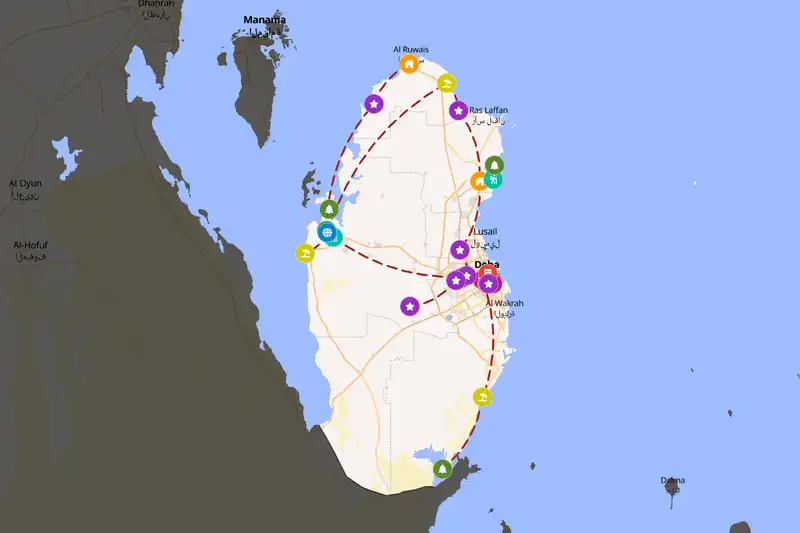
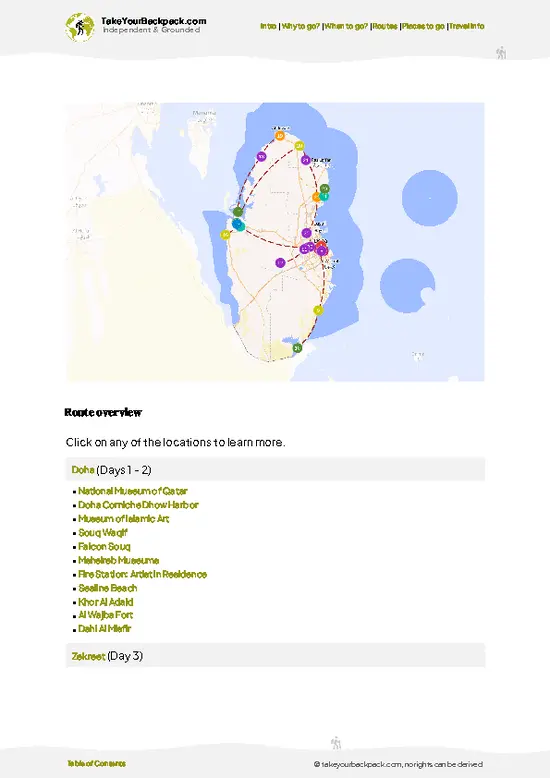
Five days in Qatar gives you time to see how far the country stretches beyond Doha’s skyline. This route suits travelers who want museums and souqs, then open desert, a night of camping on the west coast and a slow loop through the north’s forts, rock carvings and mangroves. The pace is steady. The longest drive is split over two days, so no single stint behind the wheel runs much past 2 hours. In Doha you ride the Metro’s Gold, Red and Green lines. The run to the Inland Sea is done on a booked 4x4 tour. From Day 3 you need a rental car, at roughly QAR 120 to 200 (US$33 to 55) a day, because buses serve the towns but not the scattered sites.
Days 1-2: Doha, Msheireb and the Inland Sea
Open at the
National Museum of Qatar right at 9am, before the tour groups arrive. Jean Nouvel’s interlocking discs are modeled on desert rose crystals, and the galleries trace the peninsula from its geology through pearling and Bedouin life to the oil era. The restored palace of Sheikh Abdullah bin Jassim sits …
read more 👉Five days in Qatar gives you time to see how far the country stretches beyond Doha’s skyline. This route suits travelers who want museums and souqs, then open desert, a night of camping on the west coast and a slow loop through the north’s forts, rock carvings and mangroves. The pace is steady. The longest drive is split over two days, so no single stint behind the wheel runs much past 2 hours. In Doha you ride the Metro’s Gold, Red and Green lines. The run to the Inland Sea is done on a booked 4x4 tour. From Day 3 you need a rental car, at roughly QAR 120 to 200 (US$33 to 55) a day, because buses serve the towns but not the scattered sites.
Days 1-2: Doha, Msheireb and the Inland Sea
Open at the National Museum of Qatar right at 9am, before the tour groups arrive. Jean Nouvel’s interlocking discs are modeled on desert rose crystals, and the galleries trace the peninsula from its geology through pearling and Bedouin life to the oil era. The restored palace of Sheikh Abdullah bin Jassim sits at the center. From there, walk the curve of the Corniche to the Doha Corniche Dhow Harbor, where wooden boats still tie up below the towers, and continue to the Museum of Islamic Art (QAR 50, about US$14) for its manuscripts, carpets and metalwork. Spend the cooler evening in Souq Waqif and the Souq Waqif Falcon Souq, where hooded birds perch on shop counters and buyers haggle over prices that can run into five figures.
Day 2 starts in the Msheireb Museums, four restored heritage houses. Bin Jelmood House, which deals frankly with slavery and its legacy in the Gulf, is the one I would not skip. A short taxi ride brings you to Fire Station: Artist in Residence, a former civil defense building turned into studios and galleries, ideal for an hour before lunch. Most desert tours collect you from your hotel around 2pm. They head south past Mesaieed, let the tire pressure down at Sealine Beach, then roller-coaster over the dunes to the Inland Sea (Khor Al Adaid), a tidal inlet where the Saudi shoreline sits across the water. Shared half-day trips run about QAR 250 to 450 (US$69 to 124), and you are back in Doha by 8 or 9pm.Day 3: West to Zekreet
Collect the car and leave the city on the Dukhan side. First stop is Al Wajba Fort on Doha’s western fringe, a small whitewashed fort where Qatari forces defeated an Ottoman force in the late 19th century. Then detour into the central desert for Dahl Al Misfir, a limestone cave whose gypsum walls give off a faint glow when sunlight hits them. Wear decent shoes, since the descent is steep and dusty.
The afternoon belongs to Zekreet. The Zekreet Rock Formations are wind-carved limestone pillars topped with wide caps, scattered across flat desert. Nearby, the Ras Abrouq Peninsula holds Film City, a mock Arab village built as a set, and Richard Serra’s East-West/West-East, four steel plates more than 14 meters tall spread over about a kilometer inside Ras Abrouq Nature Reserve. Cool off in the shallow water at Dukhan Beach before sunset. Camping here is only allowed in the winter camping season with a permit, so either register in advance or book an overnight camp through a Doha operator. There are no shops, so bring all your water and food.Day 4: Al Zubarah to Al Khor
Drive north for about an hour through Al Reem Biosphere Reserve, a broad sweep of gravel plain and acacia scrub, to Al Zubarah Fort. The square fort dates from 1938. The real reason to come is the excavated pearling town beside it, a UNESCO World Heritage Site whose low coral-stone walls outline streets, houses and a market from the 18th and 19th centuries. Arrive early, because there is no shade on the ruins.
Lunch on grilled hammour at Al Ruwais, a working fishing harbor at the northern tip, then swing down the east coast. Fuwairit Beach has clean sand and a lagoon. Parts of it close in spring and summer while hawksbill turtles nest, so check before you go. A few minutes inland, the Al Jassasiya Rock Carvings cover low limestone outcrops with hundreds of petroglyphs, including cup marks and outlines of boats. They are easiest to read in the low light of late afternoon. Spend the night in Al Khor, where the waterfront fish market is worth a walk after dark.Day 5: Mangroves, Barzan and Education City
Be at Al Thakira Mangroves by 7 or 8am, ideally on a rising tide, and rent a kayak for roughly QAR 100 to 150 (US$27 to 41) to paddle the channels among grey mangroves and wading herons. Next door, Purple Island is reached on foot along a causeway. The flat island once produced purple dye from crushed sea snails, and it is a quiet hour’s walk. On the drive south, stop at Barzan Towers in Umm Salal Mohammed, two restored watchtowers whose roof gives a wide view over farms and new suburbs. End in Education City with the Qatar National Library, a vast tilted hall of white shelving with a heritage library sunk into its floor, and Mathaf: Arab Museum of Modern Art next door, before you drop the car at the airport.
If you have a spare hour on the north coast, the roofless coral-stone houses and mosque of the abandoned fishing village of Al Jumail, just west of Al Ruwais, are the quietest ruins in the country.v2.webp)
 Best Backpacking