×

Saint Barthélemy🇧🇱 | attractionsSwedish Clock TowerStone clock tower, harbor overlook, red-roof views, Swedish street names | things to do and best time to go

Explore Wall House MuseumExplore Anse de Grande Saline

Backpacking in Swedish Clock Tower
👍 Recommendedattraction ranked #2
By Johan Kruseman 🇳🇱 | Updated October 22, 2026

The clock above you ticks off the quarter hour while a rooster crosses the lane below, and a few yachts creak at their moorings in the harbor just beyond the wall. That is the whole show at the Swedish Clock Tower, which stands in Gustavia, Saint Barthélemy’s capital, on the hill above the port. It is small, a stone-and-whitewash relic of the Swedish era, and it takes five minutes to understand. Don’t build a day around it. Its value is as a marker of the island’s Scandinavian past, and the view over the harbor and red roofs is better than the tower itself. The climb is short, crowds are thin, and there is no ticket to pay for, so the cost is only your time. Spend it on the surrounding streets, where Swedish street names and old stone buildings say more than any plaque. A first day could start here with the harbor view, then drift downhill to the waterfront for coffee and the nearby museum.

Discover everything you want to know in the 📖 Saint Barthélemy Travel Guide.


example page 0 from our offline Travel Guide for Saint Barthélemy
example page 1 from our offline Travel Guide for Saint Barthélemy
example page 2 from our offline Travel Guide for Saint Barthélemy
example page 3 from our offline Travel Guide for Saint Barthélemy
example page 4 from our offline Travel Guide for Saint Barthélemy
example page 5 from our offline Travel Guide for Saint Barthélemy
example page 6 from our offline Travel Guide for Saint Barthélemy
example page 7 from our offline Travel Guide for Saint Barthélemy
Loading the map 🌍
CLICK TO FILTER
towns
landmarks
hikes
beaches
attractions
festivals
regions
SHOW COUNTRY’S BESTSHOW ALL

✨ Why go?
Ranked #2 attraction in Saint Barthélemy
What makes it a must-see attraction

The Swedish Clock Tower is one of the few places in Gustavia where the island’s Swedish era from 1784 to 1878 is visible without a museum label. Most visitors pass through town on the way to beaches and restaurants, and French street signs and Caribbean pastel can hide the fact that Sweden ran this place for almost a century. The tower, together with the street names, the harbor layout and the old fort positions, makes that history readable on foot.
It also costs you nothing. There is no queue, no entry fee and no schedule, so you can fit it between a morning swim and an afternoon coffee. If you are crossing the island on a tight route, it is a quick way to understand why Gustavia has a Scandinavian-sounding name, taken from King Gustav III, and why the town was built as a free port. Pair it … read more 👉
The Swedish Clock Tower is one of the few places in Gustavia where the island’s Swedish era from 1784 to 1878 is visible without a museum label. Most visitors pass through town on the way to beaches and restaurants, and French street signs and Caribbean pastel can hide the fact that Sweden ran this place for almost a century. The tower, together with the street names, the harbor layout and the old fort positions, makes that history readable on foot.
It also costs you nothing. There is no queue, no entry fee and no schedule, so you can fit it between a morning swim and an afternoon coffee. If you are crossing the island on a tight route, it is a quick way to understand why Gustavia has a Scandinavian-sounding name, taken from King Gustav III, and why the town was built as a free port. Pair it with the territorial museum and the harbor-front ruins and you have a proper, low-effort introduction to the island’s actual past.

💡 HighlightsTop highlights of Swedish Clock Tower

  1. Swedish Clock Tower: the reason you came. It is compact and easy to photograph, and its position above the town gives you a clear reference point for the harbor layout and the old street grid.
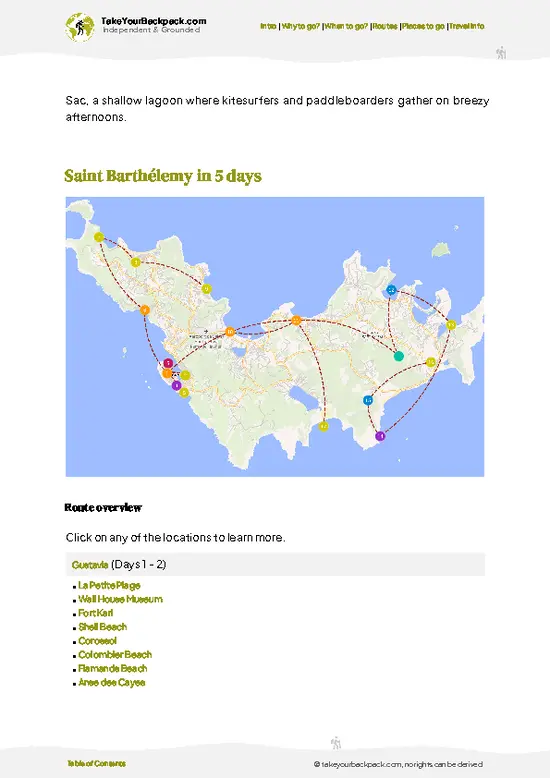
  2. Wall House Museum (Musée Territorial): set in a restored harbor-side building at La Pointe, it covers Swedish and French rule, island life and early settlement, with old maps, photographs and everyday objects.
  3. Fort Gustav: the hilltop ruins hold old cannons, a lighthouse and an open view over the harbor, the airport approach and the sea. It is a short, easy climb that works best in the cooler part of the day.
  4. Fort Karl: less visited than Fort Gustav, with the remains of its walls above the shore. It helps you picture how the Swedes guarded the free port.
  5. Gustavia Harbor (Quai du Général de Gaulle): a working
… read more 👉
  1. Swedish Clock Tower: the reason you came. It is compact and easy to photograph, and its position above the town gives you a clear reference point for the harbor layout and the old street grid.
  2. Wall House Museum (Musée Territorial): set in a restored harbor-side building at La Pointe, it covers Swedish and French rule, island life and early settlement, with old maps, photographs and everyday objects.
  3. Fort Gustav: the hilltop ruins hold old cannons, a lighthouse and an open view over the harbor, the airport approach and the sea. It is a short, easy climb that works best in the cooler part of the day.
  4. Fort Karl: less visited than Fort Gustav, with the remains of its walls above the shore. It helps you picture how the Swedes guarded the free port.
  5. Gustavia Harbor (Quai du Général de Gaulle): a working waterfront where superyachts tie up beside fishing boats. Walking it costs nothing, and the rigging, rope and diesel give it more texture than the boutiques behind it.
  6. Anglican Church of Gustavia: a small stone church from the nineteenth century, a reminder that the Swedish period brought in English-speaking settlers and merchants as well as Swedes.
  7. Shell Beach: a calm cove at the edge of town, strewn with tiny shells, where you can rinse off after a morning of walking. It is the easiest swim from the clock tower.
All of this fits into a relaxed half day, and the Swedish Clock Tower itself needs only about ten to fifteen minutes.
Spotted a mistake or missing something? Contact us.

🌤️ When to go?Choosing the right time of year

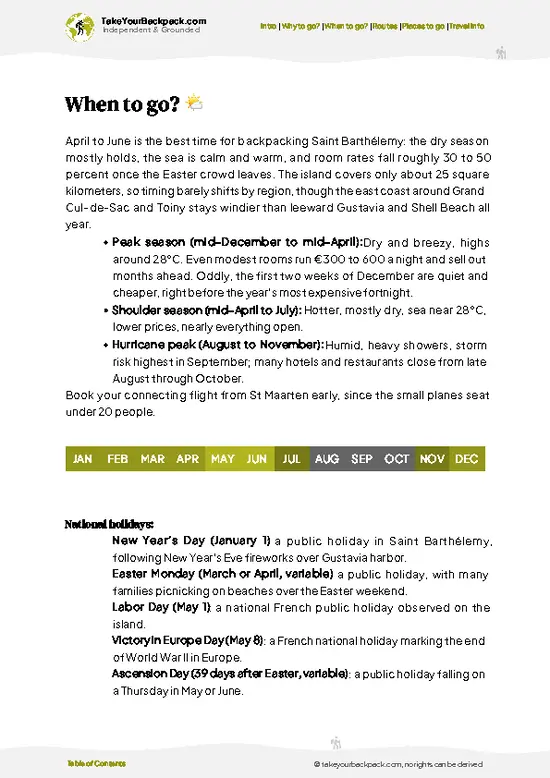
  • Dry Season (December to April): Peak months bring the least rain and steady trade winds, with highs of 28 to 30°C (82 to 86°F) and nights near 23°C (73°F). Days run about 11 to 12 hours, and the walk up to the tower in Gustavia is pleasant before midday. Hotel and villa rates peak, and Christmas to New Year costs the most.
  • Shoulder Months (May, June and November): Showers are short and the heat is easing in, with 29 to 31°C (84 to 88°F). Streets in Gustavia are quiet, and many prices drop by a quarter to a third.
  • Wet and Hurricane Season (July to October): Humid, 30 to 32°C (86 to 90°F), with heavy downpours. September is the peak for storms, and some restaurants and shops close for weeks. Flights and rooms are cheapest, but plans can change fast.
  • Cruise Days: Ships dock in Gustavia mostly in
… read more 👉
  • Dry Season (December to April): Peak months bring the least rain and steady trade winds, with highs of 28 to 30°C (82 to 86°F) and nights near 23°C (73°F). Days run about 11 to 12 hours, and the walk up to the tower in Gustavia is pleasant before midday. Hotel and villa rates peak, and Christmas to New Year costs the most.
  • Shoulder Months (May, June and November): Showers are short and the heat is easing in, with 29 to 31°C (84 to 88°F). Streets in Gustavia are quiet, and many prices drop by a quarter to a third.
  • Wet and Hurricane Season (July to October): Humid, 30 to 32°C (86 to 90°F), with heavy downpours. September is the peak for storms, and some restaurants and shops close for weeks. Flights and rooms are cheapest, but plans can change fast.
  • Cruise Days: Ships dock in Gustavia mostly in the dry season, and the waterfront is crowded from about 10am to 4pm.
Visit the tower early in the morning or late afternoon, when the harbor is calm and the light is soft.


source: climatestotravel.comJANJanuary: excellent for travelingFEBFebruary: excellent for travelingMARMarch: excellent for travelingAPRApril: highly recommended for travelingMAYMay: highly recommended for travelingJUNJune: fair for travelingJULJuly: fair for travelingAUGAugust: fair for travelingSEPSeptember: fair for travelingOCTOctober: fair for travelingNOVNovember: highly recommended for travelingDECDecember: excellent for traveling
saint-barthelemy-attraction-swedish-clock-tower
© Google |

✈️ The backpacker research shortcutSaint Barthélemy Travel Guide

An offline-friendly backpacking guide with optimized travel routes, ranked highlights, transport advice, and the best areas to stay.
example page 0 from our offline Travel Guide for Saint Barthélemy
example page 1 from our offline Travel Guide for Saint Barthélemy
example page 2 from our offline Travel Guide for Saint Barthélemy
example page 3 from our offline Travel Guide for Saint Barthélemy
example page 4 from our offline Travel Guide for Saint Barthélemy
example page 5 from our offline Travel Guide for Saint Barthélemy
example page 6 from our offline Travel Guide for Saint Barthélemy
example page 7 from our offline Travel Guide for Saint Barthélemy
The digital guide (107 pages) contains:
✅ 22 highlights, ranked by travel appeal
✅ Optimized 2, 3 & 5-day travel routes
✅ Cities, national parks, landmarks, beaches
✅ How to get around
✅ Offline-friendly for travel without Wi-Fi
👉 Click to see all 30+ guide features

📅 Plan smarter in minutes, not weeks
✅ Month by month travel advice
✅ Festivals & national holidays
✅ Budget expectations

🗺️ Go to the right places, skip the overrated ones
✅ Honest pros & cons of destinations
✅ Top hikes, parks & viewpoints
✅ Lesser-known places most travelers miss
✅ Clear “worth it vs skip it” guidance

🛏️ Travel smoothly without rookie mistakes
✅ Best areas to stay
✅ Transport systems explained simply
✅ Common scams & safety advice
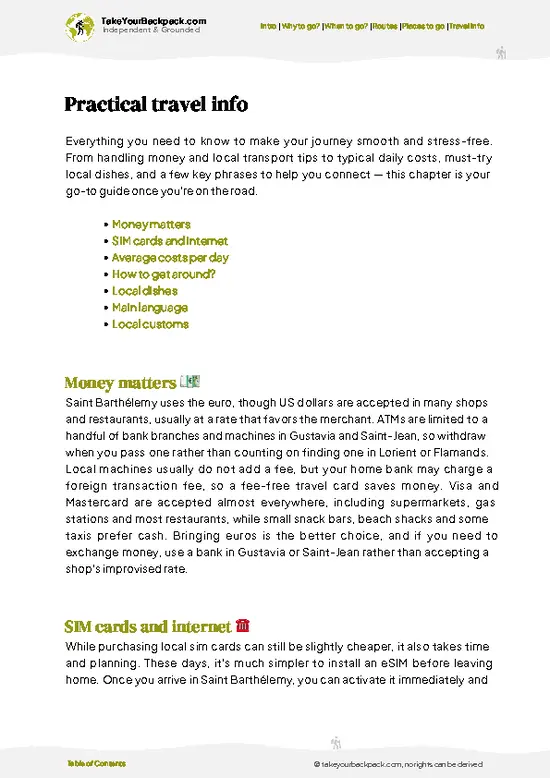
✅ SIM cards, money & practical tips

🌍 Understand the country, not just visit it
✅ Culture & traditions
✅ 52 Essential phrases & customs
✅ Festivals worth planning around
✅ Traveler-friendly historical context
✅ Insights that make places more meaningful

📱 Built for real travel conditions
✅ Fully downloadable PDF
✅ Works completely offline
✅ Optimized for phone use
✅ Useful in remote areas & buses
✅ Everything in one place
Stop searching, start planning
Get instant access to your full guide. 30‑day money-back guarantee.
+ Add another guide for just

By proceeding you agree to our terms.
Sent to your inbox immediately after payment • 100% Secure Checkout
Best Backpacking Travel Advisor 2025 tourism awardBest Backpacking
Travel Advisor
2025
What others say about Take Your Backpack Guides:
⭐⭐⭐⭐⭐
Fantastic, amazing amount of information!
⭐⭐⭐⭐⭐
My goodness this is amazing, it's what I've been looking for hats off too you!
⭐⭐⭐⭐⭐
I think this is absolutely BRILLIANT
⭐⭐⭐⭐
Very complete and informative. It's still missing places, but I gotta to commend you
⭐⭐⭐⭐⭐
This is truly amazing, thank you, can't wait to explore it with my kids!
⭐⭐⭐⭐⭐
Awesome resource, thank you!
⭐⭐⭐⭐⭐
This is amazing! Can't wait to explore the ones I haven't seen
⭐⭐⭐⭐
I love this! Well done, great idea.
⭐⭐⭐⭐⭐
Thanks for taking the time to make this gem!
⭐⭐⭐⭐⭐
This might be the best website I've ever seen.
⭐⭐⭐⭐⭐
Congratulations, and thank you so much for your work; it's incredibly valuable.
⭐⭐⭐⭐
In all seriousness I think you did a great job pointing out the important spots
⭐⭐⭐⭐⭐
10/10 very good
⭐⭐⭐⭐⭐
As someone who's only just starting to visit regularly this is awesome, thank you.
⭐⭐⭐⭐
Thank you very much! I'm going to visit my dad, it's going to be very useful!
⭐⭐⭐⭐⭐
This is really cool! We'll be travelling for the first time and this definitely come in handy.
⭐⭐⭐⭐⭐
You are now our minister of culture, congratulations 👨‍💼
⭐⭐⭐⭐⭐
Just wanted to tell you that this is a pearl! Going to follow your recommendations.
⭐⭐⭐⭐⭐
This is so cool. I'll definitely be using the resource for my travels soon.
⭐⭐⭐⭐⭐
This is very impressive! Good work.
⭐⭐⭐⭐⭐
This is an amazing and informative site. Very well done!

🛏️ Where to stay?Best areas and accommodation options

Gustavia is the best base for the Swedish Clock Tower, which sits on the hill above the harbor and is a short walk from almost every street in town. Staying here means you can walk to the tower, the waterfront restaurants, the supermarkets and the ferry quay without paying for taxis, which is the biggest money saver on an island where rides add up fast. Rooms are limited and priced high, so book early for December to April. The harbor streets are safe, well lit and busy in the evening, and solo travelers can meet others at the waterfront bars and along the quay.

The Lorient and Saint-Jean areas … read more 👉
Gustavia is the best base for the Swedish Clock Tower, which sits on the hill above the harbor and is a short walk from almost every street in town. Staying here means you can walk to the tower, the waterfront restaurants, the supermarkets and the ferry quay without paying for taxis, which is the biggest money saver on an island where rides add up fast. Rooms are limited and priced high, so book early for December to April. The harbor streets are safe, well lit and busy in the evening, and solo travelers can meet others at the waterfront bars and along the quay.

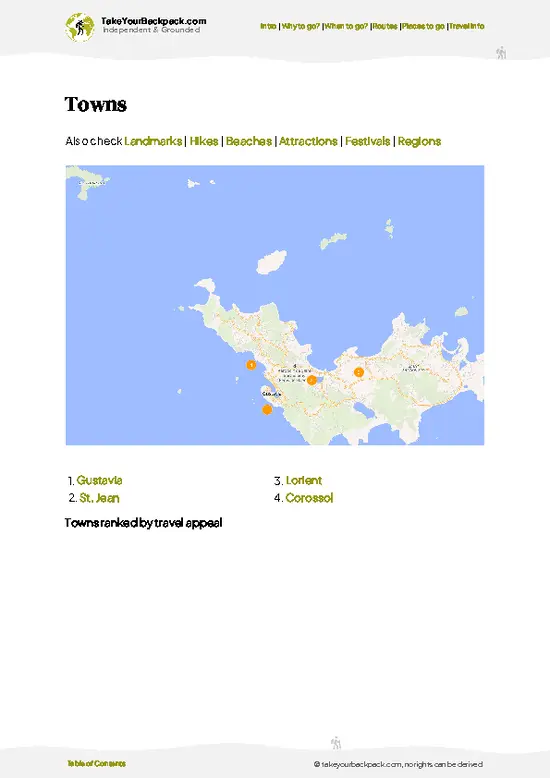
The Lorient and Saint-Jean areas are the next best choices, and they suit travelers who want a beach in the morning and Gustavia in the afternoon. Saint-Jean is on the north coast, near the airport, with beaches, small guesthouses, and a handful of casual places to eat and drink. Staying there means a short taxi ride or a hike over the hill to reach the tower. Lorient is quieter, with a village feel and a beach, and it is a good fit if you prefer a calmer night. Rental cars and scooters are the usual way to move between areas, and shared villas or apartments can bring the cost per person down if you split them in a group.

👛 Costs (as of 22 October 2026)Travel costs and budget guide for Swedish Clock Tower

Swedish Clock Tower costs nothing to visit, so a realistic backpacker day in Gustavia runs about €150 to 190 with a bed, food and local transport. The tower is a free, open-air landmark on the hill above the harbor, so most of your money goes to the island's high prices.
CategoryBudget RangeLocal Reality
Entry to the tower€0Open landmark with no ticket, and it can be visited at any hour.
Accommodation (high season)€90 to 130Basic rooms and shared apartments are scarce, and rates are at their highest from December to April. Off-season prices can fall by a third.
Food€25 to 40Supermarket sandwiches, bakery items and a simple lunch keep costs down. A restaurant dinner often costs €35 to 60 per person.
Local transport€10 to 25Gustavia is walkable. Taxis for short rides cost roughly €15 to 25, and a
… read more 👉
Swedish Clock Tower costs nothing to visit, so a realistic backpacker day in Gustavia runs about €150 to 190 with a bed, food and local transport. The tower is a free, open-air landmark on the hill above the harbor, so most of your money goes to the island's high prices.
CategoryBudget RangeLocal Reality
Entry to the tower€0Open landmark with no ticket, and it can be visited at any hour.
Accommodation (high season)€90 to 130Basic rooms and shared apartments are scarce, and rates are at their highest from December to April. Off-season prices can fall by a third.
Food€25 to 40Supermarket sandwiches, bakery items and a simple lunch keep costs down. A restaurant dinner often costs €35 to 60 per person.
Local transport€10 to 25Gustavia is walkable. Taxis for short rides cost roughly €15 to 25, and a rental car or scooter is about €45 to 70 a day.
Extras€5 to 15A coffee or a beer on the waterfront costs about €4 to 8, and the Wall House museum in town is free.
Total Daily Budget€150 to 190Per person, per day, in high season.
⚠️ Prices can change and everyone travels differently, so take this as a rough guide. Hope it helps you plan your adventure!

FAQFrequently asked questions about Swedish Clock Tower

Swedish Clock Tower needs only 15 to 30 minutes, since you view it from the street and the surrounding hillside. Adding a walk around Gustavia harbor, the Wall House museum and a waterfront lunch makes it a relaxed half day of two to four hours. Early morning is the coolest time to climb the hill.
Swedish Clock Tower has no entrance fee, so it is worth a visit for the price of a short walk. It is a small landmark rather than an attraction with an interior, so it works best as part of a Gustavia stroll that takes in the harbor and the old Swedish-era buildings. Allow €0 for the tower and budget about €5 to 15 for a coffee or museum visit nearby.
Swedish Clock Tower is in Gustavia, a 5 to 10 minute drive from the airport at Saint-Jean, or about 20 to 30 minutes on foot over the hill if you are fit. Taxis from the airport cost about €15 to 25, and rental cars or scooters run roughly €45 to 70 a day. Ferries from Saint Martin arrive at the Gustavia quay, a few minutes' walk from the tower, and take about 45 to 60 minutes.
⚠️ Things can change over time, so always validate details locally before you go.

Expanding your trip beyond this stop

Swedish Clock Tower isn’t the only highlight in Saint Barthélemy. Explore all what Saint Barthélemy has to offer.
Country photo of Saint Barthélemy

We 💚 feedbackIs it worth it?

Swedish Clock Tower is best in the early morning, when Gustavia’s streets are quiet, shop shutters are still half down and the harbor smells of coffee and salt. Come then, take your photos without anyone in the frame, and climb to the fort before the heat builds. Bring water and skip the midday stop.

✍️ Help improve this page!
The information on this page is based on in-depth research, insights shared by experienced travelers, and feedback from the local travel community in Saint Barthélemy. While every effort is made to keep the information accurate and current, conditions can change — so if you spot anything incorrect or outdated, please get in touch.


🙋‍♂️ Give feedback

👋 Meet the founderWho’s Behind Take Your Backpack?

Johan, backpacker and founder of TakeYourBackpackHi, I’m Johan (Netherlands 🇳🇱), the creator of TakeYourBackpack. Over the past 3 decades, I’ve backpacked through 90+ countries across six continents, gaining extensive experience with independent travel, long-term trips, and overland routes.

This site is built on a combination of firsthand travel experience and carefully curated insights from other backpackers. Many guides are based on places I’ve personally visited, while others bring together tips, observations, and practical advice shared by trusted travelers I’ve met along the way.

The goal is to provide realistic, experience-driven guidance — not generic itineraries — so you can explore destinations with better context, clearer expectations, and more confidence.