
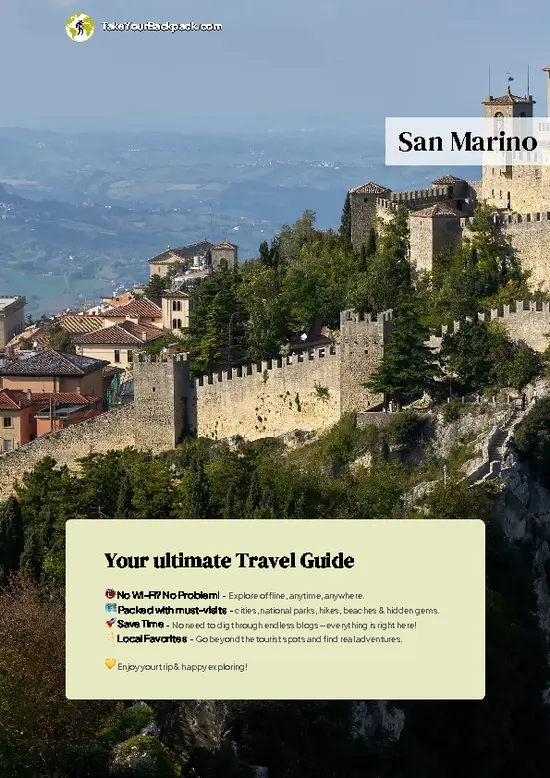
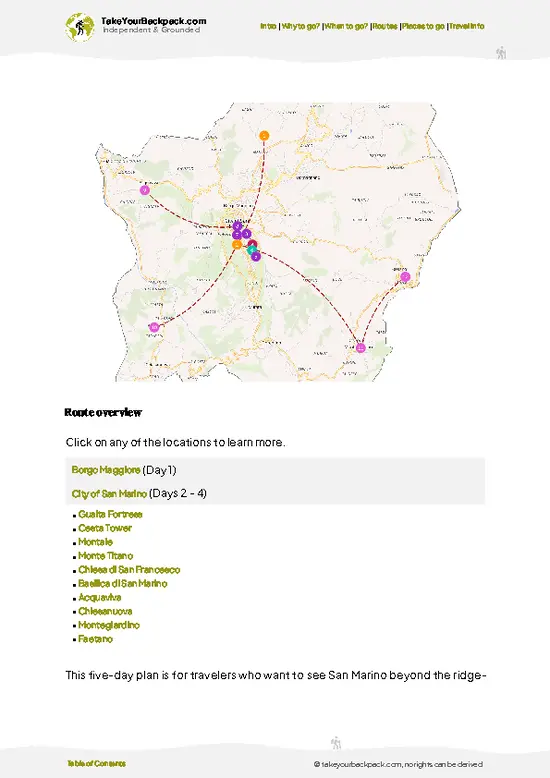
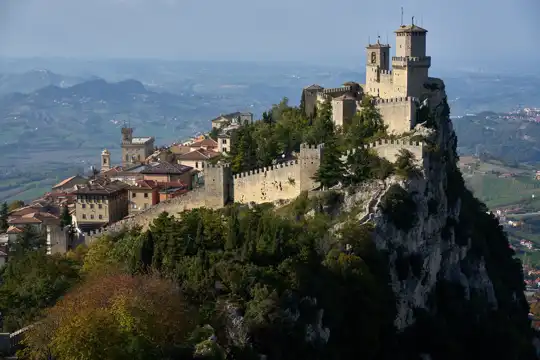
- Rocca Guaita (First Tower) — The oldest and most iconic of the three towers: great stonework, real medieval atmosphere and one of the best viewpoints over the surrounding hills and the Adriatic on a clear day.
- Rocca Cesta (Second Tower) & Museo delle Armi Antiche — A handsome fortress that houses an impressive collection of historical arms and armor; combines military history with a postcard panorama from the summit.
- Rocca Montale (Third Tower) — Smaller and more secluded than the other two towers; you can’t usually go inside, but the exterior keep and the surrounding walkways give a quiet, atmospheric sense of the city’s defensive past and nice lookout spots.
- Piazza della Libertà & Palazzo Pubblico — The ceremonial heart of the republic: the neo-Gothic town hall, the Statue of Liberty,
- Rocca Guaita (First Tower) — The oldest and most iconic of the three towers: great stonework, real medieval atmosphere and one of the best viewpoints over the surrounding hills and the Adriatic on a clear day.
- Rocca Cesta (Second Tower) & Museo delle Armi Antiche — A handsome fortress that houses an impressive collection of historical arms and armor; combines military history with a postcard panorama from the summit.
- Rocca Montale (Third Tower) — Smaller and more secluded than the other two towers; you can’t usually go inside, but the exterior keep and the surrounding walkways give a quiet, atmospheric sense of the city’s defensive past and nice lookout spots.
- Piazza della Libertà & Palazzo Pubblico — The ceremonial heart of the republic: the neo-Gothic town hall, the Statue of Liberty, the balcony where official events happen and a lively square that’s central to civic life—try to time it for a ceremony or guided tour of the palace.
- Basilica di San Marino (Basilica del Santo) — The neoclassical basilica that houses relics of Saint Marinus; it’s architecturally striking and important to understanding the city’s founding legend and religious traditions.
- Museo di Stato (State Museum) — A compact, well-displayed collection tracing San Marino’s archaeology, coins, medieval artifacts and documents—essential if you want the real historical context behind the walls and towers.
- San Francesco complex (Convent, Church & Cloister) — A peaceful medieval monastic site with frescoes, cloistered spaces and small museum displays; a quieter cultural stop that shows a different side of the city’s history.
- San Marino Funivia (upper station) & ridge viewpoints — The top cable-car station sits in the city and the short ride from Borgo Maggiore is worth it just for the swoop up the mountain; once there, follow the ridge viewpoints for sweeping vistas and photo spots.
- Historic lanes and panoramic terraces — The narrow cobbled streets, hidden stairways and little terraces between the towers are the city’s soul: browse local artisan shops, sample regional food, and find dozens of mini-viewpoints that feel genuinely lived-in.
- Teatro Titano — A small but active cultural venue in the city center: check the program for concerts, theater and film—great for catching local life and events beyond the tourist circuit.
Spotted a mistake or missing something? Contact us.

Explore the World's Oldest Republic: Private San Marino Tour

Cook Like a Local in San Marino Countryside

Tourist visit of the UNESCO Historic Center of San Marino

Private Walking Tour in San Marino: Historic Towers

San Marino: A Self Guided Audio Tour

Private San Marino Walking Tour

San Marino Walking Tour with Audio and Written Guide

San Marino Highlights: Monte Titano, Guaita Tower & Old Town

San Marino Small Group Guided Tour with Pass 7 attractions


 Best Backpacking
 Hi, I’m Johan (Netherlands 🇳🇱), the creator of TakeYourBackpack. Over the past 3 decades, I’ve backpacked through 90+ countries across six continents, gaining extensive experience with independent travel, long-term trips, and overland routes.