×

São Tomé and Príncipe🇸🇹 | best landmarksEssential 4 landmarks to Explore in São Tomé and Príncipe

Landmarks in São Tomé and Príncipe are old cocoa plantations, colonial forts and volcanic plugs rising from wet green forest, so you smell damp earth and fermenting cacao as much as you see anything. São Tomé island has the paved roads, the sweaty capital and the most variety. Príncipe is quieter, with rougher tracks and few other visitors. Independent travel works, but expect slow minibuses and humidity.

By Johan Kruseman 🇳🇱 | Updated October 9, 2026
Explore the best national parks in São Tomé and Príncipe

Why go?What Makes Them Special

This is a two-island volcanic nation with no mass tourism, so its landmarks feel lived-in rather than polished. The colonial cocoa and coffee era left plantation estates (roças) whose ochre buildings are now part ruin, part village, with laundry strung across former hospitals. Equatorial heat and constant moisture mean moss, rust and rot are part of every site. Nature supplies the rest: volcanic peaks and rainforest dominate the skyline, and clouds often hide the summits by midday.

Before choosing the country for this, know that signage is thin, opening hours are loose and interpretation is limited, so a local guide adds a great deal. Roads outside the capital can be potholed or washed out, and the country is small enough that you will meet the same few travelers repeatedly.
Our Approach to Ranking
The list of best unique sites in São Tomé and Príncipe is created based on history or culture, wow factor, atmosphere, quirks, and memorability. If you feel a unique site is missing in this list, please let us know.

When to go?When to Plan Your Trip

Best months: the gravana dry season: June to September is the best window, because rain drops sharply, roads firm up and mornings stay clear enough for views of the peaks. This is the gravana, when temperatures sit around 24 to 29°C and a cool, grey, breezy haze often hangs over the coast.

Shoulder and wet months: October to May is wetter, with the heaviest rain from roughly March to May, and the south of São Tomé island is far wetter than the dry northeast around the capital. Humidity stays high all year, and downpours turn dirt tracks to red mud. A short dry spell in January and February is a decent second choice, with warmer days around 28 to 31°C. Crowds are small in every season, and prices for guides and lodging shift only modestly, so weather should drive your timing.

unique site hoppingTips for Visiting Multiple Destinations

Plan for 7 to 10 days: A trip combining several landmarks needs 7 to 10 days, with about 5 to 7 on São Tomé island and 2 to 3 on Príncipe. Start in the capital, the transport hub, then work south along the coast road toward the plantations and the southern forest, and finish with the short flight or ferry to Príncipe if time allows.

Pacing and transfers: Allow half a day to a full day per stop, since guided walks start early to beat the cloud and heat. Capital to the far south takes about 2 to 4 hours by shared taxi or hired car depending on road condition. The flight to Príncipe takes around 40 minutes, while the ferry is far slower and weather-dependent.

The common mistake is cramming too many stops into one day and arriving at damp trails in afternoon rain. Move early, keep a buffer day … read more 👉
Plan for 7 to 10 days: A trip combining several landmarks needs 7 to 10 days, with about 5 to 7 on São Tomé island and 2 to 3 on Príncipe. Start in the capital, the transport hub, then work south along the coast road toward the plantations and the southern forest, and finish with the short flight or ferry to Príncipe if time allows.

Pacing and transfers: Allow half a day to a full day per stop, since guided walks start early to beat the cloud and heat. Capital to the far south takes about 2 to 4 hours by shared taxi or hired car depending on road condition. The flight to Príncipe takes around 40 minutes, while the ferry is far slower and weather-dependent.

The common mistake is cramming too many stops into one day and arriving at damp trails in afternoon rain. Move early, keep a buffer day for cancelled flights or washed-out roads, and book Príncipe transport ahead.

The ListMust-Visit landmarks in São Tomé and Príncipe

1 Roça Agostinho Neto

colonial plantation, faded grandeur, palm avenues

Wander through a former plantation complex, observing the architecture and remnants of São Tomé’s agricultural past among towering palms.

2 Cascata São Nicolau

jungle waterfall, natural pool, dense forest

Follow a forest trail to a secluded waterfall, where cool water tumbles into a pool surrounded by thick tropical vegetation.

3 Roça Bombaim

mountain valley, restored estate, cocoa fields

Visit a plantation set in a lush valley, where restored buildings and cocoa groves reveal the rhythms of rural life.

4 Roça Ponta Figo

coastal plantation, ocean backdrop, rural community

Experience a working plantation near the sea, where daily life unfolds against a backdrop of waves and cultivated land.

Loading the map 🌍

Expert viewInsights from Locals and Experts

How many to visit: Aim for 5 to 7 landmarks in a week. Distances are short, but roads are slow, trails are slick and the heat saps you by early afternoon, so two stops a day is the ceiling. Fewer, longer visits give you time to hear the forest wake up, eat lunch under a plantation veranda and talk with residents.

What to prioritize: If you like history, favor the plantation estates and old fortifications, where a guide turns peeling walls into stories. If you hike, choose the forest and volcanic sites, which need early starts and sturdy shoes, and give you misty views across the canopy. Beach-and-culture travelers can mix a couple of easy coastal stops with one longer day out. Skip trying to cover everything.

Costs: Budget about US$35 to 70 a day including a simple room, local meals and … read more 👉
How many to visit: Aim for 5 to 7 landmarks in a week. Distances are short, but roads are slow, trails are slick and the heat saps you by early afternoon, so two stops a day is the ceiling. Fewer, longer visits give you time to hear the forest wake up, eat lunch under a plantation veranda and talk with residents.

What to prioritize: If you like history, favor the plantation estates and old fortifications, where a guide turns peeling walls into stories. If you hike, choose the forest and volcanic sites, which need early starts and sturdy shoes, and give you misty views across the canopy. Beach-and-culture travelers can mix a couple of easy coastal stops with one longer day out. Skip trying to cover everything.

Costs: Budget about US$35 to 70 a day including a simple room, local meals and shared transport. Entry fees at heritage sites are usually small, from free to roughly US$5 to 10. A local guide for a hike or estate walk runs about US$15 to 40 per group, and a driver for a day costs around US$50 to 90. Carry euros or Santomean dobras in cash, as cards are rarely accepted outside a few hotels.

Safety and respect: Crime is low, but trails can be steep, muddy and unmarked, so a guide is a sound safety choice for forest and volcano walks. Bring rain gear, insect repellent and plenty of water. Plantation communities still live inside many historic estates, so ask before photographing people or homes, and greet residents first. A friendly “bom dia” opens doors, and a small tip to your guide goes a long way.

You get quiet paths, unhurried conversations and views few travelers ever see.

✈️ The backpacker research shortcutSão Tomé and Príncipe Travel Guide

An offline-friendly backpacking guide with optimized travel routes, ranked highlights, transport advice, and the best areas to stay.
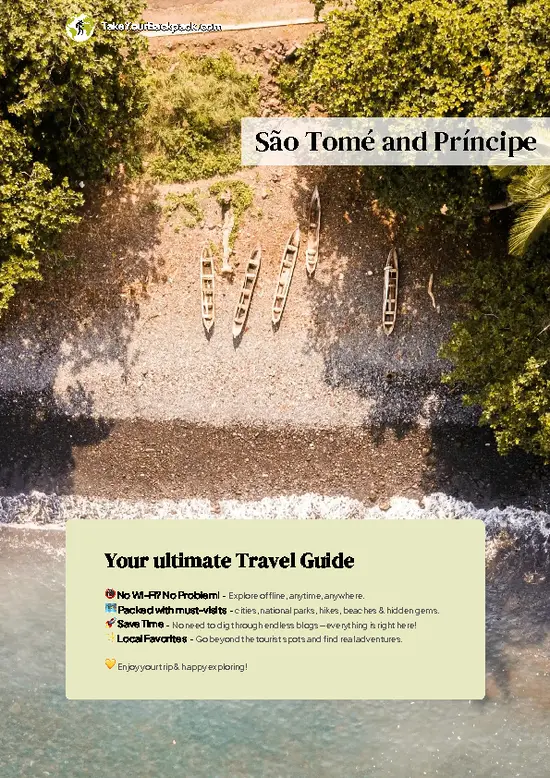
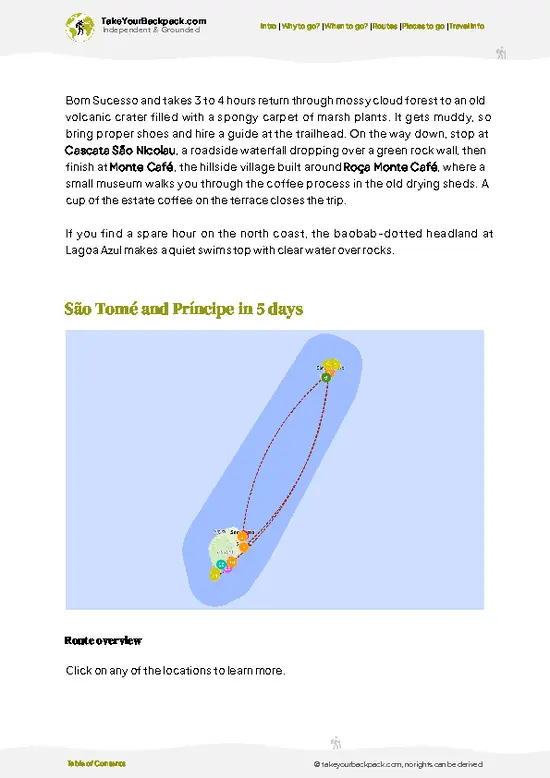
example page 0 from our offline Travel Guide for São Tomé and Príncipe
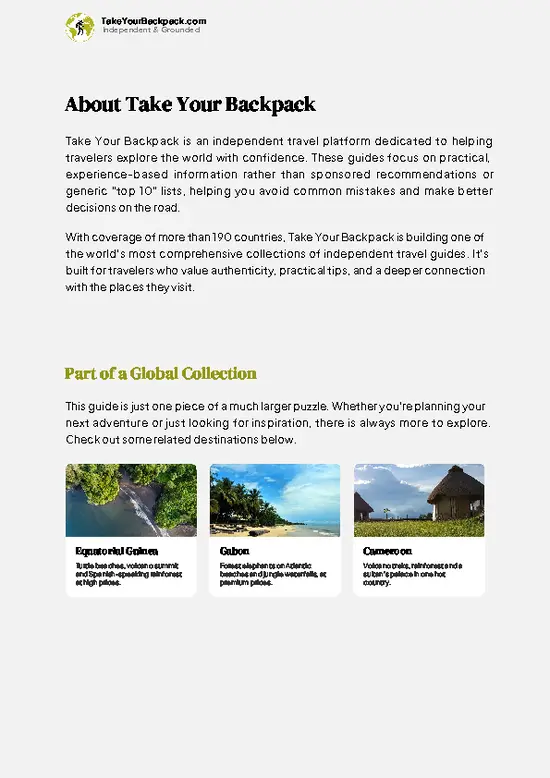
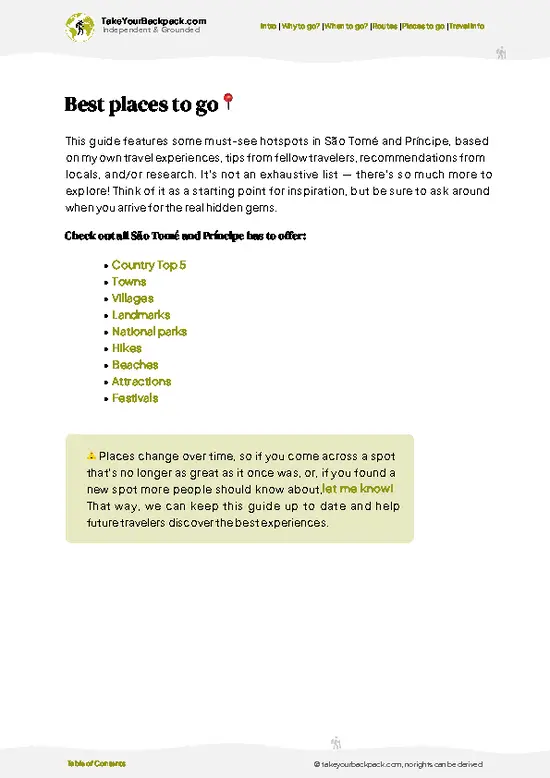
example page 1 from our offline Travel Guide for São Tomé and Príncipe
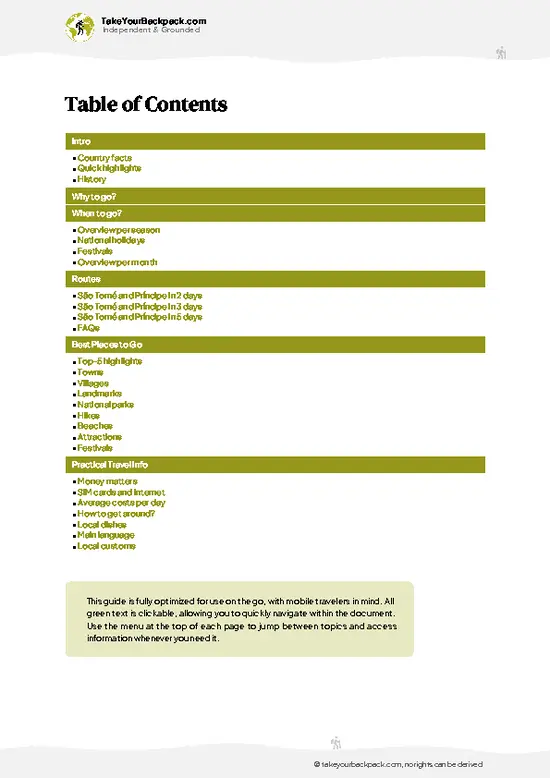
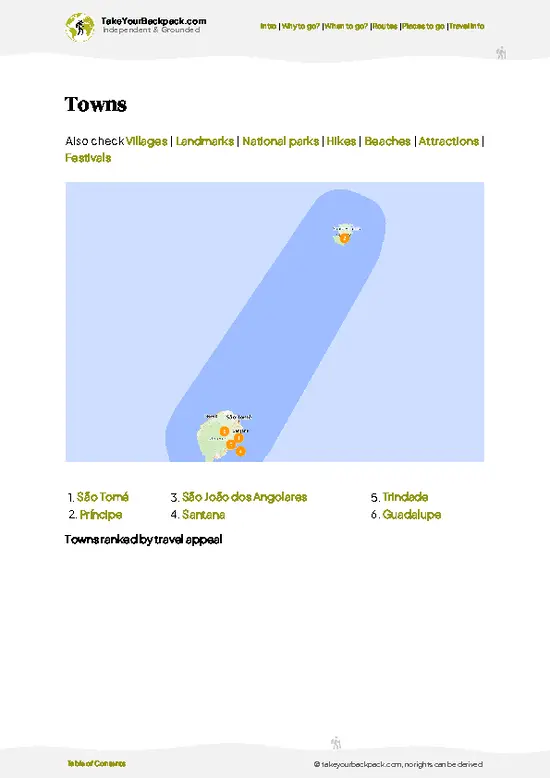
example page 2 from our offline Travel Guide for São Tomé and Príncipe
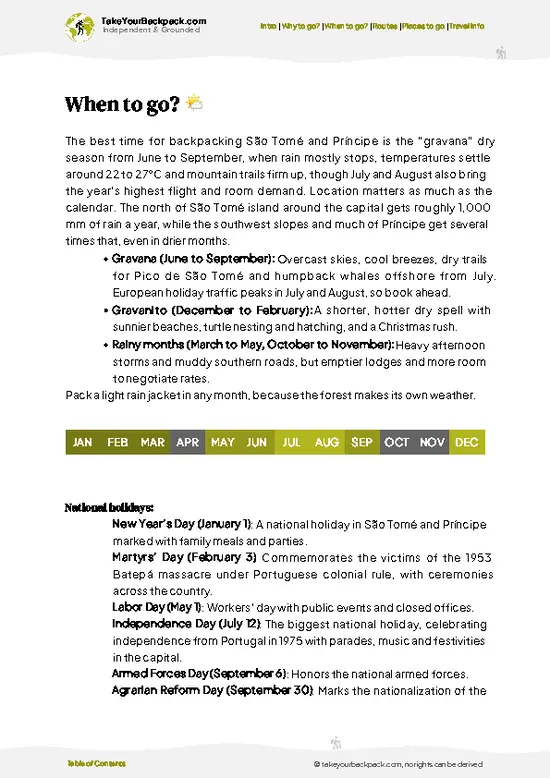
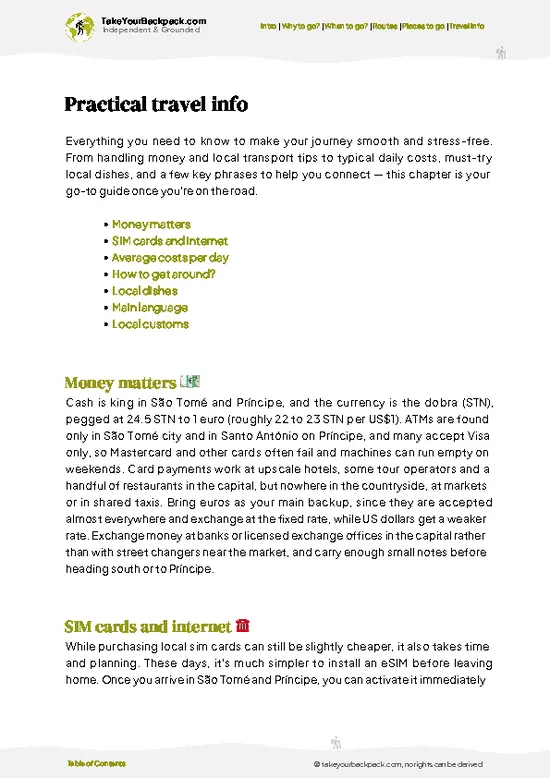
example page 3 from our offline Travel Guide for São Tomé and Príncipe
example page 4 from our offline Travel Guide for São Tomé and Príncipe
example page 5 from our offline Travel Guide for São Tomé and Príncipe
example page 6 from our offline Travel Guide for São Tomé and Príncipe
example page 7 from our offline Travel Guide for São Tomé and Príncipe
The digital guide (151 pages) contains:
✅ 40 highlights, ranked by travel appeal
✅ Optimized 2, 3 & 5-day travel routes
✅ Cities, national parks, landmarks, beaches
✅ How to get around
✅ Offline-friendly for travel without Wi-Fi
👉 Click to see all 30+ guide features

📅 Plan smarter in minutes, not weeks
✅ Month by month travel advice
✅ Festivals & national holidays
✅ Budget expectations

🗺️ Go to the right places, skip the overrated ones
✅ Honest pros & cons of destinations
✅ Top hikes, parks & viewpoints
✅ Lesser-known places most travelers miss
✅ Clear “worth it vs skip it” guidance

🛏️ Travel smoothly without rookie mistakes
✅ Best areas to stay
✅ Transport systems explained simply
✅ Common scams & safety advice
✅ SIM cards, money & practical tips

🌍 Understand the country, not just visit it
✅ Culture & traditions
✅ 52 Essential phrases & customs
✅ Festivals worth planning around
✅ Traveler-friendly historical context
✅ Insights that make places more meaningful

📱 Built for real travel conditions
✅ Fully downloadable PDF
✅ Works completely offline
✅ Optimized for phone use
✅ Useful in remote areas & buses
✅ Everything in one place
Save weeks of stressful planning
Get instant access to your full guide. 30‑day money-back guarantee.
+ Add another guide for just

By proceeding you agree to our terms.
Sent to your inbox immediately after payment • 100% Secure Checkout
Best Backpacking Travel Advisor 2025 tourism awardBest Backpacking
Travel Advisor
2025
What others say about Take Your Backpack Guides:
⭐⭐⭐⭐⭐
Fantastic, amazing amount of information!
⭐⭐⭐⭐⭐
My goodness this is amazing, it's what I've been looking for hats off too you!
⭐⭐⭐⭐⭐
I think this is absolutely BRILLIANT
⭐⭐⭐⭐
Very complete and informative. It's still missing places, but I gotta to commend you
⭐⭐⭐⭐⭐
This is truly amazing, thank you, can't wait to explore it with my kids!
⭐⭐⭐⭐⭐
Awesome resource, thank you!
⭐⭐⭐⭐⭐
This is amazing! Can't wait to explore the ones I haven't seen
⭐⭐⭐⭐
I love this! Well done, great idea.
⭐⭐⭐⭐⭐
Thanks for taking the time to make this gem!
⭐⭐⭐⭐⭐
This might be the best website I've ever seen.
⭐⭐⭐⭐⭐
Congratulations, and thank you so much for your work; it's incredibly valuable.
⭐⭐⭐⭐
In all seriousness I think you did a great job pointing out the important spots
⭐⭐⭐⭐⭐
10/10 very good
⭐⭐⭐⭐⭐
As someone who's only just starting to visit regularly this is awesome, thank you.
⭐⭐⭐⭐
Thank you very much! I'm going to visit my dad, it's going to be very useful!
⭐⭐⭐⭐⭐
This is really cool! We'll be travelling for the first time and this definitely come in handy.
⭐⭐⭐⭐⭐
You are now our minister of culture, congratulations 👨‍💼
⭐⭐⭐⭐⭐
Just wanted to tell you that this is a pearl! Going to follow your recommendations.
⭐⭐⭐⭐⭐
This is so cool. I'll definitely be using the resource for my travels soon.
⭐⭐⭐⭐⭐
This is very impressive! Good work.
⭐⭐⭐⭐⭐
This is an amazing and informative site. Very well done!

🛏️ Where to stay?Where to Stay: São Tomé and Príncipe Edition

São Tomé and Príncipe has very few true hostels, but budget travelers can find simple guesthouses, family homestays and basic rooms in converted colonial plantation houses (roças) from about 550 to 1,100 STN (US$25 to 50) a night. São Tomé city center, near the seafront Marginal, has the widest choice and puts you close to restaurants, markets, bars and shared taxis, though it can be noisy at night; the beaches between the airport and the city are quieter but need a taxi to reach town. In the south around Porto Alegre and on Príncipe around Santo António options are fewer and pricier, yet very safe and peaceful, with forest and beaches on the doorstep.

If you enjoy meeting fellow travelers, consider … read more 👉
São Tomé and Príncipe has very few true hostels, but budget travelers can find simple guesthouses, family homestays and basic rooms in converted colonial plantation houses (roças) from about 550 to 1,100 STN (US$25 to 50) a night. São Tomé city center, near the seafront Marginal, has the widest choice and puts you close to restaurants, markets, bars and shared taxis, though it can be noisy at night; the beaches between the airport and the city are quieter but need a taxi to reach town. In the south around Porto Alegre and on Príncipe around Santo António options are fewer and pricier, yet very safe and peaceful, with forest and beaches on the doorstep.

If you enjoy meeting fellow travelers, consider choosing hostels with high ratings for atmosphere. On the other hand, if you prefer having your own space, a hotel might be a better option.

São Tomé and PríncipeExplore Beyond This Category

👋 Meet the founderWho’s Behind Take Your Backpack?

Johan, backpacker and founder of TakeYourBackpackHi, I’m Johan (Netherlands 🇳🇱), the creator of TakeYourBackpack. Over the past 3 decades, I’ve backpacked through 90+ countries across six continents, gaining extensive experience with independent travel, long-term trips, and overland routes.

This site is built on a combination of firsthand travel experience and carefully curated insights from other backpackers. Many guides are based on places I’ve personally visited, while others bring together tips, observations, and practical advice shared by trusted travelers I’ve met along the way.

The goal is to provide realistic, experience-driven guidance — not generic itineraries — so you can explore destinations with better context, clearer expectations, and more confidence.