×

São Tomé and Príncipe🇸🇹 | attractionsMuseu Nacional de São Tomé e PríncipeSea fort, cannons, carved saints, plantation-era relics | things to do and best time to go

Explore Roça Monte CaféExplore Praia Jalé

Backpacking in Museu Nacional de São Tomé e Príncipe
👌 Worth visitingattraction ranked #3
By Johan Kruseman 🇳🇱 | Updated October 22, 2026

The Museu Nacional de São Tomé e Príncipe is best known for its setting: the 16th-century Fortaleza de São Sebastião, a squat stone fort with thick walls and old cannons facing the harbor. It sits on the waterfront in the capital of São Tomé and Príncipe, a short walk from the cathedral. Inside, the stone holds the day’s heat and smells of damp plaster, and light falls through small openings onto carved saints and colonial relics. Labels are sparse and mostly in Portuguese, since the museum is small and underfunded, so bring a phone translator or ask the attendant for context. Pay in cash at the door, because cards aren’t reliably accepted. Go in the morning, before the rooms warm up. Unlike the Museu do Cacau at Roça Agostinho Neto, which explains one plantation industry, this museum covers the whole island story in one compact fortress.

Discover everything you want to know in the 📖 São Tomé and Príncipe Travel Guide.


example page 0 from our offline Travel Guide for São Tomé and Príncipe
example page 1 from our offline Travel Guide for São Tomé and Príncipe
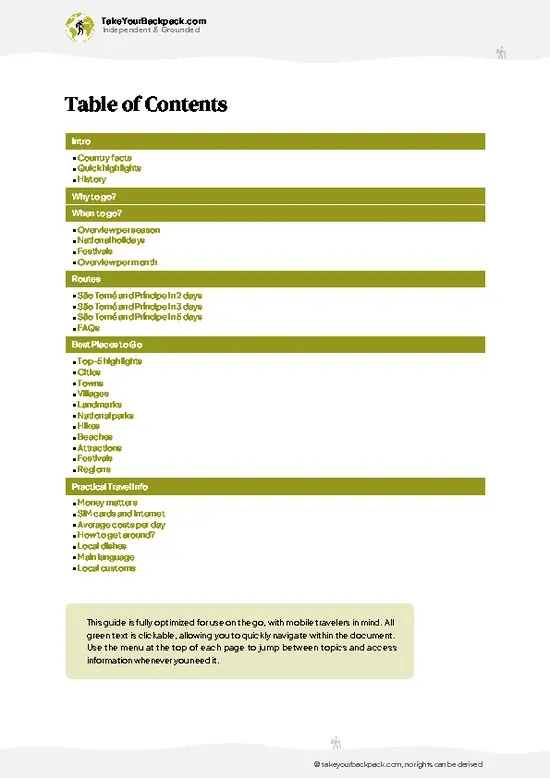
example page 2 from our offline Travel Guide for São Tomé and Príncipe
example page 3 from our offline Travel Guide for São Tomé and Príncipe
example page 4 from our offline Travel Guide for São Tomé and Príncipe
example page 5 from our offline Travel Guide for São Tomé and Príncipe
example page 6 from our offline Travel Guide for São Tomé and Príncipe
example page 7 from our offline Travel Guide for São Tomé and Príncipe
Loading the map 🌍
CLICK TO FILTER
cities
towns
villages
landmarks
national parks
hikes
beaches
attractions
festivals
regions
SHOW COUNTRY’S BESTSHOW ALL

✨ Why go?
Ranked #3 attraction in São Tomé and Príncipe
What sets this place apart

The Museu Nacional de São Tomé e Príncipe is the quickest way to understand how a tiny equatorial archipelago came to be shaped by sugar, slavery and cocoa. The fort itself, begun in 1566 to guard the harbor, is the main exhibit. You stand on the same ramparts where Portuguese gunners watched for pirates and rival fleets, with the working port below you.

The collection adds the human side. Religious sculpture and colonial-era objects show what the Portuguese brought and what the Church left behind, while ethnographic displays point to the Creole and Angolar communities who built the country’s culture. If you plan to visit plantation estates later, this is the right place to start, because the context makes those crumbling roças make sense.

It also costs little in time. Allow an hour or so, … read more 👉
The Museu Nacional de São Tomé e Príncipe is the quickest way to understand how a tiny equatorial archipelago came to be shaped by sugar, slavery and cocoa. The fort itself, begun in 1566 to guard the harbor, is the main exhibit. You stand on the same ramparts where Portuguese gunners watched for pirates and rival fleets, with the working port below you.

The collection adds the human side. Religious sculpture and colonial-era objects show what the Portuguese brought and what the Church left behind, while ethnographic displays point to the Creole and Angolar communities who built the country’s culture. If you plan to visit plantation estates later, this is the right place to start, because the context makes those crumbling roças make sense.

It also costs little in time. Allow an hour or so, and you will have a base for the rest of your route. For a traveler heading out to beaches and rainforest, it anchors the trip in São Tomé city’s old waterfront, where the country’s history began.

💡 HighlightsKey sights and experiences for travelers

  1. Fortaleza de São Sebastião: The building is the headline act. Its thick 16th-century walls, gate and harbor-facing ramparts were built to defend the Portuguese settlement, and the architecture alone justifies the visit.
  2. Rampart cannons: Old iron guns still point toward the bay. They make a good place to picture the pirate and naval raids that shaped the fort.
  3. Religious art collection: Carved saints, church furnishings and sacred objects from the island’s early Catholic centuries fill several rooms. The wood and stone figures show Portuguese and local craftsmanship.
  4. Colonial history rooms: Objects from the sugar and cocoa eras, along with items from the period of Portuguese rule, tell how the islands were settled and worked. It is the most direct way to grasp the forced labor that drove the plantations.
… read more 👉
  1. Fortaleza de São Sebastião: The building is the headline act. Its thick 16th-century walls, gate and harbor-facing ramparts were built to defend the Portuguese settlement, and the architecture alone justifies the visit.
  2. Rampart cannons: Old iron guns still point toward the bay. They make a good place to picture the pirate and naval raids that shaped the fort.
  3. Religious art collection: Carved saints, church furnishings and sacred objects from the island’s early Catholic centuries fill several rooms. The wood and stone figures show Portuguese and local craftsmanship.
  4. Colonial history rooms: Objects from the sugar and cocoa eras, along with items from the period of Portuguese rule, tell how the islands were settled and worked. It is the most direct way to grasp the forced labor that drove the plantations.
  5. Ethnographic displays: Exhibits on the Forros, Angolares and other communities introduce local crafts, daily tools and traditions. They give a context that guides rarely cover on the road.
  6. Harbor views from the walls: Walk the outer edge for fishing boats, the port and the curve of São Tomé’s bay. Morning light is softer and cooler here.
  7. Courtyard and fort interior: The inner space is quiet, with shade and stone underfoot. It is a good spot to cool off and read your notes before moving on.
The Museu Nacional de São Tomé e Príncipe charges a small entry fee of about €2 to 3, paid in cash at the door, and no advance booking is needed.
Spotted a mistake or missing something? Contact us.

Things to do near Museu Nacional de São Tomé e Príncipe

Ratings based on Tripadvisor reviews. When you book through this link, you support our work at no extra cost to you.

🌤️ When to go?Weather, crowds, and seasonal trade-offs

  • Gravana (June to September): The driest and coolest stretch, with daytime highs of 26 to 29°C (79 to 84°F) and nights near 20°C (68°F). Skies are often overcast, but rain is light, so walking the capital between the fort and the museum is comfortable. Fewer visitors means quiet galleries. Flights and beds can cost a little more in July and August.
  • Main rainy season (October to December): Heavy showers arrive in the afternoons, with highs of 29 to 31°C (84 to 88°F) and thick humidity. Mornings are usually clearer, so plan your visit then. Prices ease and crowds thin.
  • Short dry spell (January and February): Rain drops off and temperatures stay at 28 to 31°C (82 to 88°F). Pleasant for museum hopping, and a good moment before the next rains.
  • Second rains (March to May): The hottest and wettest months,
… read more 👉
  • Gravana (June to September): The driest and coolest stretch, with daytime highs of 26 to 29°C (79 to 84°F) and nights near 20°C (68°F). Skies are often overcast, but rain is light, so walking the capital between the fort and the museum is comfortable. Fewer visitors means quiet galleries. Flights and beds can cost a little more in July and August.
  • Main rainy season (October to December): Heavy showers arrive in the afternoons, with highs of 29 to 31°C (84 to 88°F) and thick humidity. Mornings are usually clearer, so plan your visit then. Prices ease and crowds thin.
  • Short dry spell (January and February): Rain drops off and temperatures stay at 28 to 31°C (82 to 88°F). Pleasant for museum hopping, and a good moment before the next rains.
  • Second rains (March to May): The hottest and wettest months, with downpours that can flood streets in town. Daylight stays close to 12 hours all year.
Arrive when the doors open in the morning, since afternoon storms and heat make the later hours less pleasant.


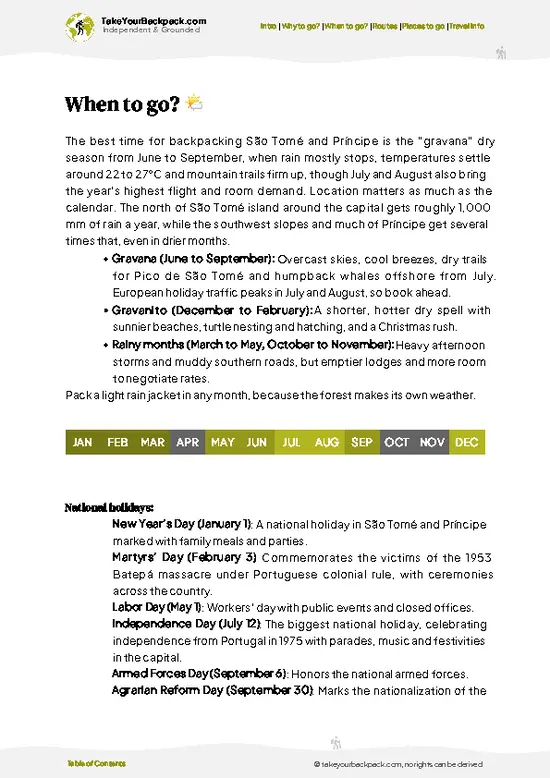
source: climatestotravel.comJANJanuary: fair for travelingFEBFebruary: fair for travelingMARMarch: fair for travelingAPRApril: fair for travelingMAYMay: good for travelingJUNJune: excellent for travelingJULJuly: excellent for travelingAUGAugust: excellent for travelingSEPSeptember: excellent for travelingOCTOctober: good for travelingNOVNovember: fair for travelingDECDecember: fair for traveling
when-to-go

✈️ The backpacker research shortcutSão Tomé and Príncipe Travel Guide

An offline-friendly backpacking guide with optimized travel routes, ranked highlights, transport advice, and the best areas to stay.
example page 0 from our offline Travel Guide for São Tomé and Príncipe
example page 1 from our offline Travel Guide for São Tomé and Príncipe
example page 2 from our offline Travel Guide for São Tomé and Príncipe
example page 3 from our offline Travel Guide for São Tomé and Príncipe
example page 4 from our offline Travel Guide for São Tomé and Príncipe
example page 5 from our offline Travel Guide for São Tomé and Príncipe
example page 6 from our offline Travel Guide for São Tomé and Príncipe
example page 7 from our offline Travel Guide for São Tomé and Príncipe
The digital guide (151 pages) contains:
✅ 38 highlights, ranked by travel appeal
✅ Optimized 2, 3 & 5-day travel routes
✅ Cities, national parks, landmarks, beaches
✅ How to get around
✅ Offline-friendly for travel without Wi-Fi
👉 Click to see all 30+ guide features

📅 Plan smarter in minutes, not weeks
✅ Month by month travel advice
✅ Festivals & national holidays
✅ Budget expectations

🗺️ Go to the right places, skip the overrated ones
✅ Honest pros & cons of destinations
✅ Top hikes, parks & viewpoints
✅ Lesser-known places most travelers miss
✅ Clear “worth it vs skip it” guidance

🛏️ Travel smoothly without rookie mistakes
✅ Best areas to stay
✅ Transport systems explained simply
✅ Common scams & safety advice
✅ SIM cards, money & practical tips

🌍 Understand the country, not just visit it
✅ Culture & traditions
✅ 52 Essential phrases & customs
✅ Festivals worth planning around
✅ Traveler-friendly historical context
✅ Insights that make places more meaningful

📱 Built for real travel conditions
✅ Fully downloadable PDF
✅ Works completely offline
✅ Optimized for phone use
✅ Useful in remote areas & buses
✅ Everything in one place
Stop searching, start planning
Get instant access to your full guide. 30‑day money-back guarantee.
+ Add another guide for just

By proceeding you agree to our terms.
Sent to your inbox immediately after payment • 100% Secure Checkout
Best Backpacking Travel Advisor 2025 tourism awardBest Backpacking
Travel Advisor
2025
What others say about Take Your Backpack Guides:
⭐⭐⭐⭐⭐
Fantastic, amazing amount of information!
⭐⭐⭐⭐⭐
My goodness this is amazing, it's what I've been looking for hats off too you!
⭐⭐⭐⭐⭐
I think this is absolutely BRILLIANT
⭐⭐⭐⭐
Very complete and informative. It's still missing places, but I gotta to commend you
⭐⭐⭐⭐⭐
This is truly amazing, thank you, can't wait to explore it with my kids!
⭐⭐⭐⭐⭐
Awesome resource, thank you!
⭐⭐⭐⭐⭐
This is amazing! Can't wait to explore the ones I haven't seen
⭐⭐⭐⭐
I love this! Well done, great idea.
⭐⭐⭐⭐⭐
Thanks for taking the time to make this gem!
⭐⭐⭐⭐⭐
This might be the best website I've ever seen.
⭐⭐⭐⭐⭐
Congratulations, and thank you so much for your work; it's incredibly valuable.
⭐⭐⭐⭐
In all seriousness I think you did a great job pointing out the important spots
⭐⭐⭐⭐⭐
10/10 very good
⭐⭐⭐⭐⭐
As someone who's only just starting to visit regularly this is awesome, thank you.
⭐⭐⭐⭐
Thank you very much! I'm going to visit my dad, it's going to be very useful!
⭐⭐⭐⭐⭐
This is really cool! We'll be travelling for the first time and this definitely come in handy.
⭐⭐⭐⭐⭐
You are now our minister of culture, congratulations 👨‍💼
⭐⭐⭐⭐⭐
Just wanted to tell you that this is a pearl! Going to follow your recommendations.
⭐⭐⭐⭐⭐
This is so cool. I'll definitely be using the resource for my travels soon.
⭐⭐⭐⭐⭐
This is very impressive! Good work.
⭐⭐⭐⭐⭐
This is an amazing and informative site. Very well done!

🛏️ Where to stay?Best areas to stay in São Tomé and Príncipe

The best base for the museum is the capital’s old center, where the museum sits within a short walk of the waterfront, the fort and the cathedral. Guesthouses and budget rooms here are the most practical choice for backpackers, with dorm-style options rare and private rooms the norm at roughly €15 to 35 a night. Being central means you can reach the market, small cafés, money exchange spots and shared taxi stops on foot, which matters because evenings are quiet and you want to avoid long walks in the dark.

The Avenida Marginal waterfront area is the most social corner. Travelers gather at seafront … read more 👉
The best base for the museum is the capital’s old center, where the museum sits within a short walk of the waterfront, the fort and the cathedral. Guesthouses and budget rooms here are the most practical choice for backpackers, with dorm-style options rare and private rooms the norm at roughly €15 to 35 a night. Being central means you can reach the market, small cafés, money exchange spots and shared taxi stops on foot, which matters because evenings are quiet and you want to avoid long walks in the dark.

The Avenida Marginal waterfront area is the most social corner. Travelers gather at seafront bars and grills as the heat drops, and you will meet divers, researchers and cacao-farm visitors comparing plans. It feels safe by Central African standards, though keep your phone tucked away after dark.

The neighborhoods inland, a little uphill, are calmer and cheaper, and suit anyone who wants a local feel and does not mind a short motorbike or shared-taxi hop to the sights. For beach time, the Praia Lagoa Azul side along the north road puts you farther from the museum, so it works better as a second stop than a base for city sightseeing. Book ahead in July and August, when rooms are scarce.

👛 Costs (as of 22 October 2026)Money, prices, and spending tips

A visit to the Museu Nacional de São Tomé e Príncipe fits a budget of about €32 to 55 a day, counting a simple room, local meals and short taxi rides. The museum itself is small and inexpensive, and you pay in dobras, though euros are often accepted at hotels.
CategoryBudget RangeLocal Reality
Museum entry€1 to 3Foreigners pay a small ticket at the door; cash only.
Camera permission€0 to 2Some rooms may charge a small fee for photos.
Local transport€1 to 5Shared taxis within the capital cost under €1 a ride; a private taxi runs a few euros.
Accommodation (low season)€12 to 25Simple guesthouse rooms in the center, fan-cooled at the cheapest end.
Accommodation (high season)€15 to 30Prices rise in July and August; book ahead.
Food€8 to 15Grilled fish, rice and fruit at small local eateries; café meals
… read more 👉
A visit to the Museu Nacional de São Tomé e Príncipe fits a budget of about €32 to 55 a day, counting a simple room, local meals and short taxi rides. The museum itself is small and inexpensive, and you pay in dobras, though euros are often accepted at hotels.
CategoryBudget RangeLocal Reality
Museum entry€1 to 3Foreigners pay a small ticket at the door; cash only.
Camera permission€0 to 2Some rooms may charge a small fee for photos.
Local transport€1 to 5Shared taxis within the capital cost under €1 a ride; a private taxi runs a few euros.
Accommodation (low season)€12 to 25Simple guesthouse rooms in the center, fan-cooled at the cheapest end.
Accommodation (high season)€15 to 30Prices rise in July and August; book ahead.
Food€8 to 15Grilled fish, rice and fruit at small local eateries; café meals cost more.
Guide or extras€0 to 5A guide may be offered at the entrance; a tip is appreciated.
Total Daily Budget€32 to 55Excludes flights and day trips outside the capital.


source: saotomeexpert.pt
⚠️ Prices can change and everyone travels differently, so take this as a rough guide. Hope it helps you plan your adventure!

FAQFrequently asked questions about Museu Nacional de São Tomé e Príncipe

Allow about one to two hours at the Museu Nacional de São Tomé e Príncipe, which is compact and easy to see in a single stop. It sits inside the old Fort of São Sebastião on the waterfront, so you can combine it with the nearby cathedral and seafront promenade in a half day. Visit in the morning to avoid the afternoon heat and rain.
Yes, the Museu Nacional de São Tomé e Príncipe is worth the fee, since the ticket costs only about €1 to 3. The collection covers colonial history, religious art and the cacao and sugar era, which gives useful context before you head to the plantations (roças) outside town. Cash is needed, so carry small notes.
The Museu Nacional de São Tomé e Príncipe is in the capital’s old fort on the waterfront, a 10 to 15 minute walk from most central guesthouses. From the airport it is a short taxi ride of about 5 to 10 minutes, costing roughly €3 to 6. Shared taxis along the main road drop you nearby for under €1.
⚠️ Things can change over time, so always validate details locally before you go.

Other São Toméan attractions near Museu Nacional de São Tomé e Príncipe

Explore more nearby:


💡 Not sure where to go next?
Create a personalized itinerary for São Tomé and Príncipe including Museu Nacional de São Tomé e Príncipe and the places that fit your trip.

Generate my itinerary

👉 Discover all attractions

Or checkout all São Tomé and Príncipe has to offer (think cities, towns, villages, national parks, hikes, beaches, festivals)
Country photo of São Tomé and Príncipe

We 💚 feedbackKey takeaways before you go

The Museu Nacional de São Tomé e Príncipe is often squeezed in as a ten-minute stop while waiting for a ride, and that wastes it. Give it a full hour, go early, and walk the ramparts before the rooms. Carry small cash for the door, and read the fort’s layout first so the exhibits make more sense.

✍️ Help improve this page!
The information on this page is based on in-depth research, insights shared by experienced travelers, and feedback from the local travel community in São Tomé and Príncipe. While every effort is made to keep the information accurate and current, conditions can change — so if you spot anything incorrect or outdated, please get in touch.


🙋‍♂️ Give feedback

👋 Meet the founderWho’s Behind Take Your Backpack?

Johan, backpacker and founder of TakeYourBackpackHi, I’m Johan (Netherlands 🇳🇱), the creator of TakeYourBackpack. Over the past 3 decades, I’ve backpacked through 90+ countries across six continents, gaining extensive experience with independent travel, long-term trips, and overland routes.

This site is built on a combination of firsthand travel experience and carefully curated insights from other backpackers. Many guides are based on places I’ve personally visited, while others bring together tips, observations, and practical advice shared by trusted travelers I’ve met along the way.

The goal is to provide realistic, experience-driven guidance — not generic itineraries — so you can explore destinations with better context, clearer expectations, and more confidence.