
×

São Tomé and Príncipe🇸🇹 | villagesSanto Antoniocolonial-era streets, riverside setting, local market stalls | things to do and best time to go

Explore Monte CaféExplore Roça São João dos Angolares

Backpacking in Santo Antonio
👀 For curious travelersvillage ranked #5
By Johan Kruseman 🇳🇱 | Updated September 3, 2026

A decade ago, Santo Antonio was the kind of place where the only soundtrack was the clack of dominoes and the occasional rooster—no Wi-Fi, no backpacker banter, just the slow pulse of island life. Today, it’s still slow, but now you’ll spot a few sunburned travelers nursing cold beers under faded awnings, swapping tips about waterfalls and turtle beaches. Santo Antonio sits on Príncipe, the smaller, wilder half of São Tomé and Príncipe, tucked into a crook of the island’s north coast where the rainforest nearly spills into the sea. For backpackers, it’s not a destination for nightlife or urban thrills—think more sleepy colonial streets, a market that wakes up with the sunrise, and the scent of woodsmoke drifting from backyard kitchens. The town works best as a launchpad: you’re here to arrange boat trips, hike to Oquê Pipi waterfall, or catch a ride to the beaches that make the island famous. Everything’s walkable, but you’ll need a moto-taxi or a lift for the real adventures. Hostels are rare, but guesthouses are friendly, and it’s easy to strike up a conversation—just don’t expect a crowd. Costs are higher than mainland Africa, but safety is rarely a concern. Compared to São Tomé city, Santo Antonio feels like a secret—less practical, more peaceful, and with just enough charm to make the journey feel like you’ve earned your first cold drink.

Discover everything you want to know in the 📖 São Tomé and Príncipe Travel Guide.
Loading the map 🌍
CLICK TO FILTER
towns
villages
landmarks
national parks
hikes
beaches
attractions
festivals
SHOW COUNTRY’S BESTSHOW ALL

✨ Why go?
Ranked #5 village in São Tomé and Príncipe
Reasons people choose to visit here

Santo Antonio serves as a gateway for backpackers exploring São Tomé and Príncipe, offering a blend of convenience and authenticity. The town’s walkable streets make it easy to navigate, with small-scale hostels and guesthouses that foster a friendly, communal vibe. You’ll find yourself sharing stories over local dishes like calulu or moqueca, where the aroma of fresh fish mingles with spices, creating a feast for the senses.

For those drawn to hiking, Santo Antonio is a perfect base. Nearby trails lead to lush landscapes and stunning vistas, rewarding your effort with breathtaking views. The beaches are just a short trip away, ideal for a refreshing dip after a day of exploration.

Backpackers often linger here for a few days, soaking in the laid-back atmosphere. It’s a haven for slow travelersread more 👉
Santo Antonio serves as a gateway for backpackers exploring São Tomé and Príncipe, offering a blend of convenience and authenticity. The town’s walkable streets make it easy to navigate, with small-scale hostels and guesthouses that foster a friendly, communal vibe. You’ll find yourself sharing stories over local dishes like calulu or moqueca, where the aroma of fresh fish mingles with spices, creating a feast for the senses.

For those drawn to hiking, Santo Antonio is a perfect base. Nearby trails lead to lush landscapes and stunning vistas, rewarding your effort with breathtaking views. The beaches are just a short trip away, ideal for a refreshing dip after a day of exploration.

Backpackers often linger here for a few days, soaking in the laid-back atmosphere. It’s a haven for slow travelers and solo adventurers looking to connect with others or simply unwind. While it’s not a nightlife hub, the town’s charm lies in its social atmosphere and the chance to experience local culture. If you’re seeking a blend of adventure and relaxation, Santo Antonio is a worthwhile stop on your journey.
Want to include Santo Antonio in your São Tomé and Príncipe route?
Create a personalized São Tomé and Príncipe itinerary that includes Santo Antonio and the places that fit your trip — based on your travel style, budget, and available time. Get your route in seconds.

Generate my trip

💡 HighlightsTop highlights of Santo Antonio

  • Igreja de Santo António — The parish church sits at the heart of town; simple colonial architecture and the focal point for local religious festivals, which are the best way to see community life up close.
  • Praça Central (Main Square) — Where people meet, kids play and elders swap news; surrounded by faded colonial façades and cafés, it’s the easiest place to read the rhythm of Santo António.
  • Porto de Santo António & Fish Market — Boats land just off the town and the early-morning fish market is a sensory, very real scene: fresh catches, smoking grills and fishermen you can chat with about life at sea.
  • Mercado Municipal — A compact market of stalls selling fruits, spices, cocoa beans and everyday goods; great for tasting local produce and picking up edible souvenirs.
  • Centro Cultural do
read more 👉
  • Igreja de Santo António — The parish church sits at the heart of town; simple colonial architecture and the focal point for local religious festivals, which are the best way to see community life up close.
  • Praça Central (Main Square) — Where people meet, kids play and elders swap news; surrounded by faded colonial façades and cafés, it’s the easiest place to read the rhythm of Santo António.
  • Porto de Santo António & Fish Market — Boats land just off the town and the early-morning fish market is a sensory, very real scene: fresh catches, smoking grills and fishermen you can chat with about life at sea.
  • Mercado Municipal — A compact market of stalls selling fruits, spices, cocoa beans and everyday goods; great for tasting local produce and picking up edible souvenirs.
  • Centro Cultural do Príncipe — The island’s cultural hub for music, dance and small exhibitions; check the schedule—an evening performance gives a far richer sense of local culture than any guidebook blurb.
  • Museu do Príncipe — Small, low-key museum with artifacts, colonial-era photos and displays about island history and traditional life; it’s modest but worth 30-45 minutes for context.
  • Palácio do Governo / Edifícios Coloniais — The administrative buildings and nearby colonial houses are photogenic and tell the story of the island’s Portuguese-era past; wandering these streets is history that’s visible, not just written.
  • Avenida Marginal (Seafront Walk) — A short, pleasant promenade along the water with views across the bay to islets and fishing activity; perfect for a late-afternoon stroll and sunset watching.
  • Artisans’ Stalls & Workshops — Small-scale craft sellers around the center offer baskets, carved items and cocoa-based products made by locals—good for buying directly from the maker and learning a bit about techniques.
  • Old Quarters & Little Miradouros (Viewpoints) — Take slow walks through the narrow streets up to tiny viewpoints between houses; the vistas over red-tiled roofs and the sea capture the town’s charm better than any single landmark.
A few real, visitable highlights just outside Santo António that make perfect day trips: Roça Sundy (historic cocoa plantation), Ilhéu Bom Bom (the islet and its marine area / resort), and Praia Banana (Banana Beach).
Spotted a mistake or missing something? Contact us.

⌛️ 1 dayHow to make the most of one day

Santo Antonio, the capital of São Tomé and Príncipe, is a vibrant blend of colonial charm and lush landscapes. The town hums with life, from the bustling markets to the serene coastline. You can feel the pulse of the island here, where every corner tells a story.

Start your morning at the Mercado Municipal. The air is thick with the scent of fresh fruit and spices. Vendors call out, their voices mingling with the chatter of locals. Grab a ripe banana or a slice of papaya for a quick breakfast. The market isn’t just a place to shop; it’s a slice of daily life. Engage with the vendors; they love sharing their stories and tips about the island.

After fueling up, stroll toward the historic center. The cobblestone streets lead you to the Igreja de Nossa Senhora da Graça. The church’s faded blue … read more 👉
Santo Antonio, the capital of São Tomé and Príncipe, is a vibrant blend of colonial charm and lush landscapes. The town hums with life, from the bustling markets to the serene coastline. You can feel the pulse of the island here, where every corner tells a story.

Start your morning at the Mercado Municipal. The air is thick with the scent of fresh fruit and spices. Vendors call out, their voices mingling with the chatter of locals. Grab a ripe banana or a slice of papaya for a quick breakfast. The market isn’t just a place to shop; it’s a slice of daily life. Engage with the vendors; they love sharing their stories and tips about the island.

After fueling up, stroll toward the historic center. The cobblestone streets lead you to the Igreja de Nossa Senhora da Graça. The church’s faded blue façade and intricate wooden doors are a photographer’s dream. Spend some time soaking in the atmosphere, then head to the nearby Praça da Independência. This square is perfect for people-watching, with locals gathering to chat and children playing.

In the afternoon, make your way to the lesser-known neighborhood of São João. Here, you’ll find the Museu Nacional de São Tomé e Príncipe. It’s often overlooked, but it offers a fascinating glimpse into the island’s history and culture. The museum’s exhibits are small but rich, showcasing artifacts that tell the story of the island’s colonial past and its vibrant traditions.

As the sun begins to set, head to the waterfront. The golden light dances on the waves, creating a magical backdrop for dinner. Try a local restaurant like O Pescador, where the grilled fish is fresh and flavorful. Enjoy the local catch while listening to the gentle lapping of the waves.

End your day with a leisurely walk along the beach. The sound of the ocean and the cool breeze will wrap around you, making it a perfect conclusion to your day in Santo Antonio. This isn’t just a visit; it’s an immersion into the heart of São Tomé and Príncipe.
Turn your Santo Antonio visit into an São Tomé and Príncipe adventure
Build a complete São Tomé and Príncipe route with Santo Antonio, hidden gems, must-see destinations, and realistic travel times included.

Generate my trip

🌤️ When to go?Seasonal considerations and timing


  • Topic: Weather — Santo Antonio’s dry season runs from June to September. Expect clear skies and low humidity, making the air feel crisp and the sun less oppressive. The wet season, from October to May, brings heavy rains that can turn trails into slippery mud slides, but also drapes the landscape in lush green.

  • Topic: Temperature — Temperatures hover between 24°C and 30°C (75°F to 86°F) year-round. The dry season offers more comfortable warmth, while the wet season’s humidity can push the heat into a sticky, exhausting zone.

  • Topic: Daylight Hours — Near the equator, Santo Antonio enjoys roughly 12 hours of daylight year-round. Sunrise around 6:00 AM and sunset near 6:00 PM give you a reliable window for hiking and exploring without the need to rush.

  • Topic: Crowds — Tourist numbers
read more 👉

  • Topic: Weather — Santo Antonio’s dry season runs from June to September. Expect clear skies and low humidity, making the air feel crisp and the sun less oppressive. The wet season, from October to May, brings heavy rains that can turn trails into slippery mud slides, but also drapes the landscape in lush green.

  • Topic: Temperature — Temperatures hover between 24°C and 30°C (75°F to 86°F) year-round. The dry season offers more comfortable warmth, while the wet season’s humidity can push the heat into a sticky, exhausting zone.

  • Topic: Daylight Hours — Near the equator, Santo Antonio enjoys roughly 12 hours of daylight year-round. Sunrise around 6:00 AM and sunset near 6:00 PM give you a reliable window for hiking and exploring without the need to rush.

  • Topic: Crowds — Tourist numbers peak during the dry months, especially July and August, when European travelers escape their cold. This means more lively markets and fuller guesthouses but also less solitude on trails.

  • Topic: Seasonal Activities — Dry months are perfect for trekking Pico Cão Grande or diving into coastal waters. The wet season invites you to witness the island’s dramatic waterfalls at full roar and vibrant bird migrations.

  • Topic: Price Fluctuations — Accommodation and tours spike in the dry season due to demand. Visiting just before or after this peak can save you money without sacrificing too much on weather quality.


Pro-tip: Aim for late May or early October to catch the tail ends of seasons—fewer crowds, reasonable prices, and a mix of lush scenery with manageable weather.


source: climatestotravel.comJANJanuary: fair for travelingFEBFebruary: fair for travelingMARMarch: fair for travelingAPRApril: fair for travelingMAYMay: good for travelingJUNJune: highly recommended for travelingJULJuly: excellent for travelingAUGAugust: excellent for travelingSEPSeptember: highly recommended for travelingOCTOctober: good for travelingNOVNovember: fair for travelingDECDecember: fair for traveling
when-to-go

✈️ The backpacker research shortcutSão Tomé and Príncipe Travel Guide

An offline-friendly backpacking guide with optimized travel routes, ranked highlights, transport advice, and the best areas to stay.
example page 0 from our offline Travel Guide for São Tomé and Príncipe
example page 1 from our offline Travel Guide for São Tomé and Príncipe
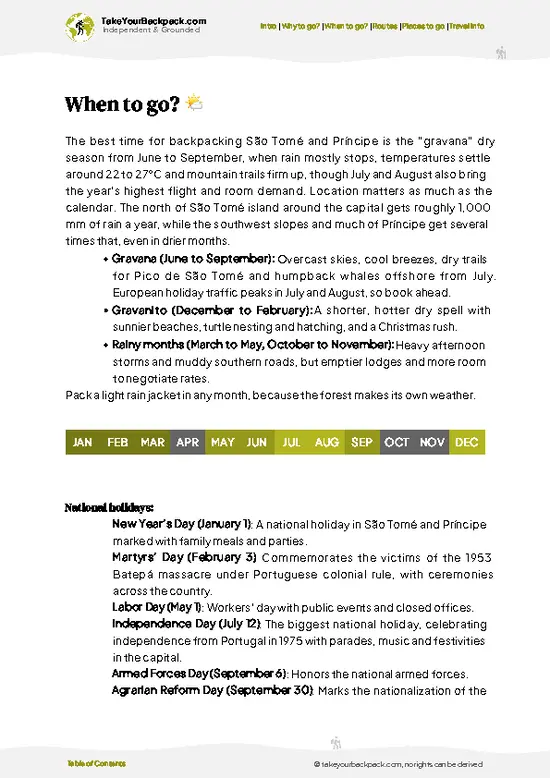
example page 2 from our offline Travel Guide for São Tomé and Príncipe
example page 3 from our offline Travel Guide for São Tomé and Príncipe
example page 4 from our offline Travel Guide for São Tomé and Príncipe
example page 5 from our offline Travel Guide for São Tomé and Príncipe
example page 6 from our offline Travel Guide for São Tomé and Príncipe
example page 7 from our offline Travel Guide for São Tomé and Príncipe
The digital guide (161 pages) contains:
40 highlights, ranked by travel appeal
Optimized 2, 3 & 5-day travel routes
Cities, national parks, landmarks, beaches
How to get around
Offline-friendly for travel without Wi-Fi
👉 Click to see all 30+ guide features

📅 Plan smarter in minutes, not weeks
Month by month travel advice
Festivals & national holidays
Budget expectations

🗺️ Go to the right places, skip the overrated ones
Honest pros & cons of destinations
Top hikes, parks & viewpoints
Lesser-known places most travelers miss
Clear “worth it vs skip it” guidance

🛏️ Travel smoothly without rookie mistakes
Best areas to stay
Transport systems explained simply
Common scams & safety advice
SIM cards, money & practical tips

🌍 Understand the country, not just visit it
Culture & traditions
52 Essential phrases & customs
Festivals worth planning around
Traveler-friendly historical context
Insights that make places more meaningful

📱 Built for real travel conditions
Fully downloadable PDF
Works completely offline
Optimized for phone use
Useful in remote areas & buses
Everything in one place
Save weeks of stressful planning
Get instant access to your full guide. 30‑day money-back guarantee.
+ Add another guide for just US$7.80

By proceeding you agree to our terms.
Sent to your inbox immediately after payment • 100% Secure Checkout
Best Backpacking Travel Advisor 2025 tourism awardBest Backpacking
Travel Advisor
2025
What others say about Take Your Backpack Guides:
⭐⭐⭐⭐⭐
Fantastic, amazing amount of information!
⭐⭐⭐⭐⭐
My goodness this is amazing, it's what I've been looking for hats off too you!
⭐⭐⭐⭐⭐
I think this is absolutely BRILLIANT
⭐⭐⭐⭐
Very complete and informative. It's still missing places, but I gotta to commend you
⭐⭐⭐⭐⭐
This is truly amazing, thank you, can't wait to explore it with my kids!
⭐⭐⭐⭐⭐
Awesome resource, thank you!
⭐⭐⭐⭐⭐
This is amazing! Can't wait to explore the ones I haven't seen
⭐⭐⭐⭐
I love this! Well done, great idea.
⭐⭐⭐⭐⭐
Thanks for taking the time to make this gem!
⭐⭐⭐⭐⭐
This might be the best website I've ever seen.
⭐⭐⭐⭐⭐
Congratulations, and thank you so much for your work; it's incredibly valuable.
⭐⭐⭐⭐
In all seriousness I think you did a great job pointing out the important spots
⭐⭐⭐⭐⭐
10/10 very good
⭐⭐⭐⭐⭐
As someone who's only just starting to visit regularly this is awesome, thank you.
⭐⭐⭐⭐
Thank you very much! I'm going to visit my dad, it's going to be very useful!
⭐⭐⭐⭐⭐
This is really cool! We'll be travelling for the first time and this definitely come in handy.
⭐⭐⭐⭐⭐
You are now our minister of culture, congratulations 👨‍💼
⭐⭐⭐⭐⭐
Just wanted to tell you that this is a pearl! Going to follow your recommendations.
⭐⭐⭐⭐⭐
This is so cool. I'll definitely be using the resource for my travels soon.
⭐⭐⭐⭐⭐
This is very impressive! Good work.
⭐⭐⭐⭐⭐
This is an amazing and informative site. Very well done!

🛏️ Where to stay?Best areas and accommodation options

In Santo Antonio, the heartbeat for backpackers pulses strongest around the city center and the adjacent waterfront district. This area is where you’ll find the best mix of safety, social buzz, and budget-friendly options. The streets here hum with local life—vendors selling fresh fruit, the scent of grilled fish mingling with salty sea air, and the chatter of travelers swapping stories over cold drinks. It’s compact enough to walk everywhere, which means you’re never far from a café or a lively bar where solo travelers naturally gather.

Compared to the quieter, more residential neighborhoods, … read more 👉
In Santo Antonio, the heartbeat for backpackers pulses strongest around the city center and the adjacent waterfront district. This area is where you’ll find the best mix of safety, social buzz, and budget-friendly options. The streets here hum with local life—vendors selling fresh fruit, the scent of grilled fish mingling with salty sea air, and the chatter of travelers swapping stories over cold drinks. It’s compact enough to walk everywhere, which means you’re never far from a café or a lively bar where solo travelers naturally gather.

Compared to the quieter, more residential neighborhoods, staying near the waterfront means you’re plugged into the city’s rhythm. Hostels and guesthouses cluster here, offering communal spaces that make meeting others effortless. The vibe is relaxed but energized, with a steady flow of locals and visitors that keeps things safe without feeling sterile or touristy.

Venture too far inland or into the less central districts, and you lose that social pulse and easy access to the city’s core. Public transport is limited, and the streets can feel deserted after dark, which isn’t ideal for solo backpackers. So, for a blend of security, sociability, and budget sense, the city center and waterfront strip are your best bets—where the light hits just right and the city’s soul is easiest to tap into.

🚌 Getting aroundGetting around like a local

Santo Antonio moves at its own rhythm—neither a frantic rush nor a slow drag, but a pulse that syncs with the sun’s climb and dip. The streets hum with a mix of purposeful locals and wandering visitors, where schedules exist but bend to the day’s mood. Mornings bring a crisp clarity, the scent of fresh bread and coffee wafting from corner shops, while afternoons stretch long and warm, inviting you to slow down and soak in the light filtering through jacaranda trees. Here, transit isn’t just about getting from A to B; it’s a dance between efficiency and the city’s laid-back charm. Knowing how to navigate this flow means you’re not just moving—you’re moving smart, catching the town’s vibe without getting stuck in its quirks.


  • Walking: Santo Antonio’s compact center is a walker’s playground.
read more 👉
Santo Antonio moves at its own rhythm—neither a frantic rush nor a slow drag, but a pulse that syncs with the sun’s climb and dip. The streets hum with a mix of purposeful locals and wandering visitors, where schedules exist but bend to the day’s mood. Mornings bring a crisp clarity, the scent of fresh bread and coffee wafting from corner shops, while afternoons stretch long and warm, inviting you to slow down and soak in the light filtering through jacaranda trees. Here, transit isn’t just about getting from A to B; it’s a dance between efficiency and the city’s laid-back charm. Knowing how to navigate this flow means you’re not just moving—you’re moving smart, catching the town’s vibe without getting stuck in its quirks.


  • Walking: Santo Antonio’s compact center is a walker’s playground. Most key spots lie within 20-30 minutes on foot, letting you absorb the city’s textures—the cracked cobblestones, the chatter spilling from open windows, the occasional burst of tropical blooms. Walking costs nothing, offers the richest sensory experience, and lets you pivot on a whim. Just wear sturdy shoes; some streets are uneven.


  • Local Buses: The backbone of budget transit, these buses run roughly from 6:00 AM to 9:00 PM. Fares hover around $0.50, making them unbeatable for cost. They’re not the fastest—expect frequent stops and a sometimes crowded ride—but they cover most neighborhoods and key transit hubs. The buses don’t always stick to a strict timetable, so catch one early to avoid peak crush and enjoy a cooler ride.


  • Shared Taxis (Colectivos): These minibuses or vans fill up before leaving, blending affordability with speed. They run along main corridors and can be flagged down anywhere along their route. Prices range from $1 to $2 depending on distance. They’re quicker than local buses and more flexible, but expect a lively, sometimes cramped atmosphere. Perfect if you want to save time without breaking the bank.


  • Motorbike Taxis: For the solo traveler who values speed and a bit of adrenaline, motorbike taxis zip through traffic and narrow alleys. They operate from dawn until late evening, charging around $2-$3 per short trip. Not the safest option for the faint-hearted, but unbeatable for quick hops when you’re tight on time and want to feel the city’s pulse up close.


  • Bicycle Rentals: A growing favorite, especially in the cooler morning hours. Rentals cost about $5-$7 per day. Santo Antonio’s mostly flat terrain and dedicated bike lanes make this a smooth, eco-friendly way to cover more ground than walking while still soaking in the city’s atmosphere. Just be mindful of traffic during rush hours and lock your bike securely.

👛 Costs (as of 3 September 2026)What things cost and how to budget

Backpacking in Santo Antonio, São Tomé and Príncipe, means embracing a slow, intimate pace where every euro stretches further than you might expect, but the island’s remoteness adds a unique flavor to costs.
  • Dorm Accommodation: Expect to pay around €10 to €15 per night for a bed in a basic guesthouse dorm. Options are limited, so prices can feel a bit higher than mainland Africa, but the simplicity and local charm make up for it.
  • Meals: Local eateries serve up fresh, straightforward dishes for about €3 to €6 per meal. Think grilled fish or chicken with rice and beans, flavored by the island’s tropical air and the faint scent of spices. Street food is cheaper but less common, so budget accordingly.
  • Local Transport: Getting around Santo Antonio is mostly by shared taxis or minibuses, costing
read more 👉
Backpacking in Santo Antonio, São Tomé and Príncipe, means embracing a slow, intimate pace where every euro stretches further than you might expect, but the island’s remoteness adds a unique flavor to costs.
  • Dorm Accommodation: Expect to pay around €10 to €15 per night for a bed in a basic guesthouse dorm. Options are limited, so prices can feel a bit higher than mainland Africa, but the simplicity and local charm make up for it.
  • Meals: Local eateries serve up fresh, straightforward dishes for about €3 to €6 per meal. Think grilled fish or chicken with rice and beans, flavored by the island’s tropical air and the faint scent of spices. Street food is cheaper but less common, so budget accordingly.
  • Local Transport: Getting around Santo Antonio is mostly by shared taxis or minibuses, costing roughly €0.50 to €1 per trip. The island’s small size means you won’t spend much time or money on transport, but expect some waiting and a casual schedule.
  • Basic Activities/Entry Fees: Entry to natural parks or cultural sites typically runs €2 to €5. Guided hikes or boat trips might push this higher, around €10 to €20, but these are where the island’s real magic unfolds—lush forests, volcanic landscapes, and vibrant marine life.
  • Miscellaneous Expenses: Budget around €2 to €5 daily for essentials like bottled water, occasional snacks, or small souvenirs. Internet access can be patchy and sometimes requires buying data bundles, which might add a few euros here and there.

A realistic daily budget for backpacking in Santo Antonio lands between €20 and €40. This range covers the essentials without skimping on the experiences that make the island worth the effort—the slow rhythms, the fresh ocean breeze, and the quiet moments in nature that reward the traveler willing to embrace the island’s pace.
⚠️ Prices can change and everyone travels differently, so take this as a rough guide. Hope it helps you plan your adventure!

🚌 Day tripsBest day trips from Santo Antonio

Santo Antonio is a fantastic launchpad for exploring the lush wonders of São Tomé and Príncipe. With its vibrant streets and welcoming locals, you’ll find it easy to dive into the island’s rich culture and stunning landscapes. Here are some day trips that will elevate your experience.

Roça São João
Just a short ride from Santo Antonio, Roça São João offers a glimpse into the island’s colonial past. The crumbling plantation buildings are a canvas of history, and the surrounding cocoa and coffee plantations are a sensory delight. The earthy scent of cocoa mingles with the fresh air, making the hike through the fields a treat. Plan for about 30 minutes to get there, and you can spend a couple of hours wandering the grounds. Budget around $10 for transport and a small fee for a guided tour. … read more 👉
Santo Antonio is a fantastic launchpad for exploring the lush wonders of São Tomé and Príncipe. With its vibrant streets and welcoming locals, you’ll find it easy to dive into the island’s rich culture and stunning landscapes. Here are some day trips that will elevate your experience.

Roça São João
Just a short ride from Santo Antonio, Roça São João offers a glimpse into the island’s colonial past. The crumbling plantation buildings are a canvas of history, and the surrounding cocoa and coffee plantations are a sensory delight. The earthy scent of cocoa mingles with the fresh air, making the hike through the fields a treat. Plan for about 30 minutes to get there, and you can spend a couple of hours wandering the grounds. Budget around $10 for transport and a small fee for a guided tour. The best time to visit is early morning when the light filters through the trees, casting a magical glow. A common mistake? Not taking the guided tour; the stories behind the ruins are what truly bring them to life.
👉 Explore Roça São João

Praia das Conchas
This beach is a postcard-perfect spot, just an hour from Santo Antonio. The turquoise waters and golden sands are inviting, but the real charm lies in the local vibe. Grab a fresh coconut from a vendor and soak in the sun. The trip costs about $15 for a round trip, and it’s best to go in the late afternoon when the sun dips low, painting the sky in hues of orange and pink. Many first-timers miss the best swimming spots; head to the left side of the beach for calmer waters.
👉 Explore Praia das Conchas

Ilha das Rolas
A boat ride to Ilha das Rolas is a must-do. The island is about an hour away, and the journey itself is a treat, with the salty breeze and the sound of waves. Once there, you can hike to the southernmost point of the equator. The total cost, including the boat and a small entrance fee, is around $25. Aim for a visit during the dry season, when the trails are less muddy. A rookie mistake? Forgetting to bring water; it’s easy to get caught up in the views and neglect hydration.


São Tomé City
A day in São Tomé City is a blend of culture and cuisine. It’s only about 30 minutes from Santo Antonio. Explore the bustling markets, where the scent of spices fills the air, and grab a bite of local dishes like calulu. Expect to spend around $10 for transport and meals. The best time to visit is on a Saturday when the market is alive with energy. Many travelers overlook the local eateries; don’t miss out on the authentic flavors that tell the story of the island.
Want to know what more São Tomé and Príncipe offers?
The São Tomé and Príncipe Travel Guide describes 40 highlights, from cities to national parks, from beaches to hikes

Get the Travel Guide -

🛡️ SafetyStaying Safe: What Travelers Should Know

Santo Antonio, while generally safe, does have its quirks. The streets are lively, filled with the scent of grilled fish and the chatter of locals. But keep your wits about you, especially in busier areas like the market. Crowds can be a magnet for pickpockets, so wear a crossbody bag and keep your valuables close.

If you’re solo, be mindful after dark. The town has a friendly vibe, but dimly lit streets can feel different at night. Stick to well-lit areas and consider walking with a buddy if you can.

Scams are rare, but a common annoyance is the occasional inflated taxi fare. Always agree on a price before hopping in. And don’t be surprised if some locals approach you with offers that seem too good to be true; a polite decline usually suffices.

Overall, embrace the rhythm of Santo Antonio, … read more 👉
Santo Antonio, while generally safe, does have its quirks. The streets are lively, filled with the scent of grilled fish and the chatter of locals. But keep your wits about you, especially in busier areas like the market. Crowds can be a magnet for pickpockets, so wear a crossbody bag and keep your valuables close.

If you’re solo, be mindful after dark. The town has a friendly vibe, but dimly lit streets can feel different at night. Stick to well-lit areas and consider walking with a buddy if you can.

Scams are rare, but a common annoyance is the occasional inflated taxi fare. Always agree on a price before hopping in. And don’t be surprised if some locals approach you with offers that seem too good to be true; a polite decline usually suffices.

Overall, embrace the rhythm of Santo Antonio, stay aware, and you’ll find the experience rewarding.

FAQFrequently asked questions about Santo Antonio

Santo Antonio is accessible by road from São Tomé city, approximately 40 kilometers away, typically a 1 to 1.5-hour drive. Local minibuses and taxis are common transport options, with taxis costing around 10 to 15 USD one way.
Yes, Santo Antonio is worth the trip for its authentic village atmosphere, local markets, and nearby natural attractions like beaches and hiking trails. It offers a quieter, less touristy experience compared to the capital.
Yes, Santo Antonio can be visited as a day trip from São Tomé city. Plan for at least 3 to 4 hours to explore the village and surroundings, considering travel time to and from the city.
⚠️ Things can change over time, so always validate details locally before you go.

Other São Toméan villages near Santo Antonio

Explore more nearby:

  • Santo Amaro—northern farmlands, local markets, rural crossroads| 163 km away
  • Monte Café—highland plantations, misty forests, coffee heritage| 172 km away
  • Santa Catarina—remote west coast, black sand beaches, fishing community| 185 km away

💡 Not sure where to go next?
Create a personalized itinerary for São Tomé and Príncipe including Santo Antonio and the places that fit your trip.

Generate my itinerary

👉 Discover all villages

Or checkout all São Tomé and Príncipe has to offer (think cities, towns, villages, national parks, hikes, beaches, festivals)
Country photo of São Tomé and Príncipe

We 💚 feedbackWhat to keep in mind

Santo Antonio has a rhythm all its own. The streets pulse with laughter, and the scent of grilled fish wafts through the air, mingling with the salty breeze. Don’t miss the local market; it’s a sensory overload of colors and sounds. The best surprise? The warmth of the locals—everyone’s ready to share a story or a smile. Just a heads-up: the roads can be bumpy, so take it slow. Embrace the journey; the destination is worth every jolt.

✍️ Help improve this page!
The information on this page is based on in-depth research, insights shared by experienced travelers, and feedback from the local travel community in São Tomé and Príncipe. While every effort is made to keep the information accurate and current, conditions can change — so if you spot anything incorrect or outdated, please get in touch.


🙋‍♂️ Give feedback

👋 Meet the founderWho’s Behind Take Your Backpack?

Johan, backpacker and founder of TakeYourBackpackHi, I’m Johan (Netherlands 🇳🇱), the creator of TakeYourBackpack. Over the past decade, I’ve backpacked through 80+ countries across six continents, gaining extensive experience with independent travel, long-term trips, and overland routes.

This site is built on a combination of firsthand travel experience and carefully curated insights from other backpackers. Many guides are based on places I’ve personally visited, while others bring together tips, observations, and practical advice shared by trusted travelers I’ve met along the way.

The goal is to provide realistic, experience-driven guidance — not generic itineraries — so you can explore destinations with better context, clearer expectations, and more confidence.

Get full country guide •
Instant download • 40 highlights • Full Offline guide