×

Senegal🇸🇳 | national parksSaloum Delta National ParkMangrove bolongs, Ile aux Oiseaux, shell mounds, salt pans | things to do and best time to go

Explore Langue de Barbarie National ParkExplore Niokolo-Koba National Park

Backpacking in Saloum Delta
🌟 Highlightnational park ranked #3
By Johan Kruseman 🇳🇱 | Updated October 22, 2026

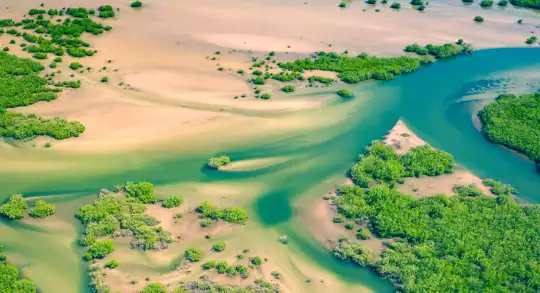
Most of the park is water, and the only way to cover it is by pirogue, so your transport budget is really a boat budget. Saloum Delta National Park sits in western Senegal, south of Dakar, where the Saloum River splits into a maze of mangrove channels, salt flats and sandy islands. Walking is limited to island paths, shell mounds and village tracks, and the scenery is flat, silver and green rather than dramatic. Pelicans, flamingos and ospreys fill the sky, while big mammals are scarce. Crowds stay thin, and the mood is quiet, salty and slow. Costs catch people out: a boat priced per vessel is cheap shared and painful alone, so split it at the jetty. Midday sun on open water burns fast, so bring a hat. Fix the price before boarding. A first day could mean a morning paddle through mangroves that smell of mud and brine, then lunch of grilled fish in a fishing village and an evening of drumbeats drifting across the water.

Discover everything you want to know in the 📖 Senegal Travel Guide.


example page 0 from our offline Travel Guide for Senegal
example page 1 from our offline Travel Guide for Senegal
example page 2 from our offline Travel Guide for Senegal
example page 3 from our offline Travel Guide for Senegal
example page 4 from our offline Travel Guide for Senegal
example page 5 from our offline Travel Guide for Senegal
example page 6 from our offline Travel Guide for Senegal
example page 7 from our offline Travel Guide for Senegal
Loading the map 🌍
CLICK TO FILTER
cities
towns
villages
landmarks
national parks
beaches
attractions
festivals
regions
SHOW COUNTRY’S BESTSHOW ALL

✨ Why go?
Ranked #3 national park in Senegal
What makes it a must-see national park

Saloum Delta National Park suits backpackers who like to piece together their own days rather than follow a bus tour. The main draw is a delta of mangrove channels called bolongs that you can explore by hired pirogue, kayak or a simple village boat, with prices you negotiate directly with boatmen. Camps and guesthouses on the islands and the mainland keep sleeping options simple and cheap, and many sit right beside the water.

Birders get the strongest case. The park holds large colonies of pelicans, flamingos, terns and herons, and the Ile aux Oiseaux is a nesting site you can reach on a short boat trip. Add the ancient shell mounds at Dioron Boumak, built up over centuries, and you have culture alongside wildlife.

The pace is the final reason. There are no queues, no ticket gates at every … read more 👉
Saloum Delta National Park suits backpackers who like to piece together their own days rather than follow a bus tour. The main draw is a delta of mangrove channels called bolongs that you can explore by hired pirogue, kayak or a simple village boat, with prices you negotiate directly with boatmen. Camps and guesthouses on the islands and the mainland keep sleeping options simple and cheap, and many sit right beside the water.

Birders get the strongest case. The park holds large colonies of pelicans, flamingos, terns and herons, and the Ile aux Oiseaux is a nesting site you can reach on a short boat trip. Add the ancient shell mounds at Dioron Boumak, built up over centuries, and you have culture alongside wildlife.

The pace is the final reason. There are no queues, no ticket gates at every corner, and plenty of time to sit on a jetty and watch the tide change. Self-guided travelers do well here as long as they settle prices early and talk to local guides at the villages.

💡 HighlightsTop highlights of Saloum Delta

  1. Mangrove channels by pirogue: The signature experience is gliding through narrow bolongs lined with red mangroves, where roots arch overhead and fish jump in the shallows. Go quietly and you will spot kingfishers and herons.
  2. Ile aux Oiseaux: A bird island where pelicans, cormorants, terns and spoonbills nest in dense colonies. The noise and smell are overwhelming, and the photography is superb.
  3. Dioron Boumak shell mounds: Huge mounds of ancient clam shells that serve as burial sites for earlier peoples. The white heaps are strange to climb, and baobabs grow from the top.
  4. Flamingo flats: Shallow lagoons and tidal flats where flocks of pink birds feed. Low tide gives the best viewing from the water's edge.
  5. Sipo and Djirnda village walks: Sandy lanes, fishing boats drawn up on the beach, smoking
… read more 👉
  1. Mangrove channels by pirogue: The signature experience is gliding through narrow bolongs lined with red mangroves, where roots arch overhead and fish jump in the shallows. Go quietly and you will spot kingfishers and herons.
  2. Ile aux Oiseaux: A bird island where pelicans, cormorants, terns and spoonbills nest in dense colonies. The noise and smell are overwhelming, and the photography is superb.
  3. Dioron Boumak shell mounds: Huge mounds of ancient clam shells that serve as burial sites for earlier peoples. The white heaps are strange to climb, and baobabs grow from the top.
  4. Flamingo flats: Shallow lagoons and tidal flats where flocks of pink birds feed. Low tide gives the best viewing from the water's edge.
  5. Sipo and Djirnda village walks: Sandy lanes, fishing boats drawn up on the beach, smoking racks and friendly greetings. Islanders also sell oysters gathered from the mangrove roots.
  6. Salt pans and tannes: Stark white and rust-red flats where locals harvest salt. The glare is intense, and the colors shift as the water evaporates.
  7. Baobab groves on the islands: Giant trees stand among the shell middens and village fields, some of them very old. They make perfect shade for a midday rest.
  8. Kayaking at dawn: Paddling the quiet side channels in early light puts you close to birdlife without engine noise. Local camps rent kayaks.
Start with the mangrove channels by pirogue in the early morning, because the tide, the cooler air and the active birds make everything else on this list easier to enjoy.
Spotted a mistake or missing something? Contact us.

🌤️ When to go?Best time to explore Saloum Delta

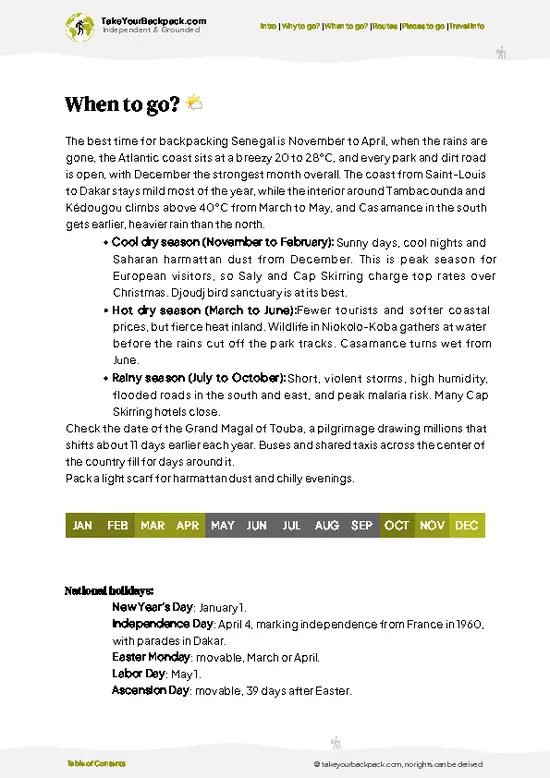
  • Cool Dry Season (November to February): Nights drop to 17 to 22°C (63 to 72°F) and days reach 28 to 33°C (82 to 91°F), with no rain. Birdlife peaks, pirogue trips are comfortable and the harmattan haze can flatten photos. Lodges charge top rates and fill around Christmas.
  • Hot Dry Season (March to May): Afternoons climb to 33 to 38°C (91 to 100°F), with sea breezes along the coast. Midday boat rides feel harsh, so go early. Prices ease and crowds thin out.
  • Rainy Season (June to October): Expect 28 to 33°C (82 to 91°F), thick humidity and heavy downpours, strongest in August and September. Mosquitoes multiply, some sand tracks turn to mud, and several camps close or discount rooms by a third or more. Mangroves are intensely green and the water is quiet.
  • Daylight: Days run about 11 to 13 hours across
… read more 👉
  • Cool Dry Season (November to February): Nights drop to 17 to 22°C (63 to 72°F) and days reach 28 to 33°C (82 to 91°F), with no rain. Birdlife peaks, pirogue trips are comfortable and the harmattan haze can flatten photos. Lodges charge top rates and fill around Christmas.
  • Hot Dry Season (March to May): Afternoons climb to 33 to 38°C (91 to 100°F), with sea breezes along the coast. Midday boat rides feel harsh, so go early. Prices ease and crowds thin out.
  • Rainy Season (June to October): Expect 28 to 33°C (82 to 91°F), thick humidity and heavy downpours, strongest in August and September. Mosquitoes multiply, some sand tracks turn to mud, and several camps close or discount rooms by a third or more. Mangroves are intensely green and the water is quiet.
  • Daylight: Days run about 11 to 13 hours across the year, so plan boat outings for morning and late afternoon.
Book December and January lodges weeks ahead, or go in late February for the same weather with fewer people.


source: climatestotravel.comJANJanuary: excellent for travelingFEBFebruary: excellent for travelingMARMarch: highly recommended for travelingAPRApril: highly recommended for travelingMAYMay: highly recommended for travelingJUNJune: fair for travelingJULJuly: below average for travelingAUGAugust: below average for travelingSEPSeptember: fair for travelingOCTOctober: fair for travelingNOVNovember: highly recommended for travelingDECDecember: excellent for traveling
when-to-go

✈️ The backpacker research shortcutSenegal Travel Guide

An offline-friendly backpacking guide with optimized travel routes, ranked highlights, transport advice, and the best areas to stay.
example page 0 from our offline Travel Guide for Senegal
example page 1 from our offline Travel Guide for Senegal
example page 2 from our offline Travel Guide for Senegal
example page 3 from our offline Travel Guide for Senegal
example page 4 from our offline Travel Guide for Senegal
example page 5 from our offline Travel Guide for Senegal
example page 6 from our offline Travel Guide for Senegal
example page 7 from our offline Travel Guide for Senegal
The digital guide (360 pages) contains:
✅ 85 highlights, ranked by travel appeal
✅ Optimized 5, 10 & 15-day travel routes
✅ Cities, national parks, landmarks, beaches
✅ How to get around
✅ Offline-friendly for travel without Wi-Fi
👉 Click to see all 30+ guide features

📅 Plan smarter in minutes, not weeks
✅ Month by month travel advice
✅ Festivals & national holidays
✅ Budget expectations

🗺️ Go to the right places, skip the overrated ones
✅ Honest pros & cons of destinations
✅ Top hikes, parks & viewpoints
✅ Lesser-known places most travelers miss
✅ Clear “worth it vs skip it” guidance

🛏️ Travel smoothly without rookie mistakes
✅ Best areas to stay
✅ Transport systems explained simply
✅ Common scams & safety advice
✅ SIM cards, money & practical tips

🌍 Understand the country, not just visit it
✅ Culture & traditions
✅ 52 Essential phrases & customs
✅ Festivals worth planning around
✅ Traveler-friendly historical context
✅ Insights that make places more meaningful

📱 Built for real travel conditions
✅ Fully downloadable PDF
✅ Works completely offline
✅ Optimized for phone use
✅ Useful in remote areas & buses
✅ Everything in one place
Stop searching, start planning
Get instant access to your full guide. 30‑day money-back guarantee.
+ Add another guide for just

By proceeding you agree to our terms.
Sent to your inbox immediately after payment • 100% Secure Checkout
Best Backpacking Travel Advisor 2025 tourism awardBest Backpacking
Travel Advisor
2025
What others say about Take Your Backpack Guides:
⭐⭐⭐⭐⭐
Fantastic, amazing amount of information!
⭐⭐⭐⭐⭐
My goodness this is amazing, it's what I've been looking for hats off too you!
⭐⭐⭐⭐⭐
I think this is absolutely BRILLIANT
⭐⭐⭐⭐
Very complete and informative. It's still missing places, but I gotta to commend you
⭐⭐⭐⭐⭐
This is truly amazing, thank you, can't wait to explore it with my kids!
⭐⭐⭐⭐⭐
Awesome resource, thank you!
⭐⭐⭐⭐⭐
This is amazing! Can't wait to explore the ones I haven't seen
⭐⭐⭐⭐
I love this! Well done, great idea.
⭐⭐⭐⭐⭐
Thanks for taking the time to make this gem!
⭐⭐⭐⭐⭐
This might be the best website I've ever seen.
⭐⭐⭐⭐⭐
Congratulations, and thank you so much for your work; it's incredibly valuable.
⭐⭐⭐⭐
In all seriousness I think you did a great job pointing out the important spots
⭐⭐⭐⭐⭐
10/10 very good
⭐⭐⭐⭐⭐
As someone who's only just starting to visit regularly this is awesome, thank you.
⭐⭐⭐⭐
Thank you very much! I'm going to visit my dad, it's going to be very useful!
⭐⭐⭐⭐⭐
This is really cool! We'll be travelling for the first time and this definitely come in handy.
⭐⭐⭐⭐⭐
You are now our minister of culture, congratulations 👨‍💼
⭐⭐⭐⭐⭐
Just wanted to tell you that this is a pearl! Going to follow your recommendations.
⭐⭐⭐⭐⭐
This is so cool. I'll definitely be using the resource for my travels soon.
⭐⭐⭐⭐⭐
This is very impressive! Good work.
⭐⭐⭐⭐⭐
This is an amazing and informative site. Very well done!

🛏️ Where to stay?How to pick the right area

Most backpackers sleep in the villages on and around the delta rather than in the park itself, and the best base is Toubacouta on the southern edge, with simple guesthouses and eco-lodges at about €15 to 45 a night. From there you can arrange pirogue trips into the mangroves with local guides, usually €15 to 30 per boat. Inside the park, there is no formal camping. Some rustic campements on the islands, such as Dionewar, Djirnda and Bassoul in the Sine-Saloum islands, offer basic rooms or mattresses in huts for roughly €10 to 25 including meals, often with bucket showers and shared toilets. Mar … read more 👉
Most backpackers sleep in the villages on and around the delta rather than in the park itself, and the best base is Toubacouta on the southern edge, with simple guesthouses and eco-lodges at about €15 to 45 a night. From there you can arrange pirogue trips into the mangroves with local guides, usually €15 to 30 per boat. Inside the park, there is no formal camping. Some rustic campements on the islands, such as Dionewar, Djirnda and Bassoul in the Sine-Saloum islands, offer basic rooms or mattresses in huts for roughly €10 to 25 including meals, often with bucket showers and shared toilets. Mar Lodj is a good island base with community-run lodging, and Palmarin on the coast has beach campements and a quiet feel. Ndangane and Mar Lodj also run small guesthouses reached by pirogue. Come with cash, since cards are rare. Fadiouth and Joal are cheaper stops on the road from Dakar, while Kaolack, the regional city, has the widest choice of budget hotels and the transport hub for onward bus or shared taxi connections. Book ahead in high season, and ask each place whether the price includes dinner and boat transfers.

👛 Costs (as of 22 October 2026)Money, prices, and spending tips

Saloum Delta National Park costs about €40 to 70 a day for a backpacker, depending on how often you hire a boat. The sample total below uses simple island lodging with meals and one shared pirogue outing, and you pay in West African francs, so carry cash from Dakar or Kaolack.
CategoryBudget RangeLocal Reality
Park entrance€1 to 4Small fee charged per person at the park gate or by guides; in some areas, boat tours bundle it in.
Accommodation (high season)€10 to 25Basic campement rooms or huts on the islands, mostly with shared bathrooms. Eco-lodges in Toubacouta run €40 and up.
Accommodation (low season)€8 to 18Many camps close in the rains, and the ones that stay open often discount.
Food€6 to 12Grilled fish, rice dishes and oysters in village eateries, with half-board often offered at campements.
… read more 👉
Saloum Delta National Park costs about €40 to 70 a day for a backpacker, depending on how often you hire a boat. The sample total below uses simple island lodging with meals and one shared pirogue outing, and you pay in West African francs, so carry cash from Dakar or Kaolack.
CategoryBudget RangeLocal Reality
Park entrance€1 to 4Small fee charged per person at the park gate or by guides; in some areas, boat tours bundle it in.
Accommodation (high season)€10 to 25Basic campement rooms or huts on the islands, mostly with shared bathrooms. Eco-lodges in Toubacouta run €40 and up.
Accommodation (low season)€8 to 18Many camps close in the rains, and the ones that stay open often discount.
Food€6 to 12Grilled fish, rice dishes and oysters in village eateries, with half-board often offered at campements.
Local transport€3 to 8Shared taxis and minibuses to the jetties cost a few euros, and a ferry between mainland and islands is cheap.
Pirogue tours and guides€10 to 25Private boats run €30 to 60, so splitting with others saves a lot.
Total Daily Budget€40 to 70Based on high-season lodging, with food, transport, one tour and the park fee.
⚠️ Prices can change and everyone travels differently, so take this as a rough guide. Hope it helps you plan your adventure!

🥾 TrailsHiking Saloum Delta national park: highlights and difficulty

Saloum Delta National Park is a water park first and a walking park second, so most days combine short boat hops with easy strolls on the islands. The terrain is flat, sandy and often shadeless, and difficulty is low, though heat and glare make longer walks tiring.

  • Dioron Boumak shell mound walk: An easy stroll of about 1 to 2 hours including the boat transfer, over crunching white shell beds with baobabs and sweeping views of the delta. Wear sturdy shoes.
  • Ile aux Oiseaux boat visit: Not a trail but a short pirogue trip of roughly 1 to 2 hours return from the nearby villages. You observe from
… read more 👉
Saloum Delta National Park is a water park first and a walking park second, so most days combine short boat hops with easy strolls on the islands. The terrain is flat, sandy and often shadeless, and difficulty is low, though heat and glare make longer walks tiring.

  • Dioron Boumak shell mound walk: An easy stroll of about 1 to 2 hours including the boat transfer, over crunching white shell beds with baobabs and sweeping views of the delta. Wear sturdy shoes.
  • Ile aux Oiseaux boat visit: Not a trail but a short pirogue trip of roughly 1 to 2 hours return from the nearby villages. You observe from the water, and landing is restricted to protect nesting birds.
  • Mangrove pirogue circuit: A half-day loop of 2 to 4 hours through bolongs, with stops at oyster-gathering spots. Calm water makes it suitable for beginners.
  • Village paths on Sipo and Djirnda: Sandy tracks of 1 to 3 hours past fields, fish-smoking yards and baobabs. Flat and gentle, though hot by midday.
  • Wildlife: Expect pelicans, flamingos, ospreys, monkeys on the mainland edge and dolphins in the wider estuary. Mammals are rare.

Getting to the park means reaching a mainland jetty by shared taxi or minibus, typically through Toubacouta, Foundiougne or Palmarin, then switching to a boat. Public transport stops at the water, so expect to hire a pirogue for the rest. Crowds are light outside peak weekends, and you can usually find a boat without booking. An entrance fee applies and is often collected at the jetty or through your guide, so carry cash in small bills.
⚠️ Hiking info can sometimes be outdated or inaccurate. Before you hit the trail, check the latest conditions with locals. If you do spot anything that's off, I'd love to hear from you, so I can update it for fellow travelers.

🛡️ SafetyTraveler Safety Guide

Saloum Delta is a low-risk place for hikers and boat travelers, and the main problems are heat, sun and mosquitoes rather than danger. Temperatures can top 35°C (95°F) before the rains, so carry at least 3 liters of water per day, wear a hat and reapply sunscreen on the open water, where there is almost no shade. Malaria is present, so take prophylaxis and use repellent at dusk. Pirogues are the main way to get around. Ask for life jackets, which are not always offered, and avoid overloaded boats or rough seas where the delta meets the Atlantic. Paths on the islands are flat sand and shell, with little navigation trouble, though tracks can flood in the rainy season. Wildlife is mostly birds, monkeys and the occasional dolphin, and you should not swim in murky mangrove channels. Hire a local … read more 👉
Saloum Delta is a low-risk place for hikers and boat travelers, and the main problems are heat, sun and mosquitoes rather than danger. Temperatures can top 35°C (95°F) before the rains, so carry at least 3 liters of water per day, wear a hat and reapply sunscreen on the open water, where there is almost no shade. Malaria is present, so take prophylaxis and use repellent at dusk. Pirogues are the main way to get around. Ask for life jackets, which are not always offered, and avoid overloaded boats or rough seas where the delta meets the Atlantic. Paths on the islands are flat sand and shell, with little navigation trouble, though tracks can flood in the rainy season. Wildlife is mostly birds, monkeys and the occasional dolphin, and you should not swim in murky mangrove channels. Hire a local guide for the mangroves, agree prices beforehand and keep valuables out of sight in towns like Kaolack.

FAQTraveler FAQ

Two to three days is enough for Saloum Delta National Park, with one night on an island and one near Toubacouta. That gives you time for a morning pirogue trip through the mangroves, a visit to the shell islands of Fadiouth or Joal, and some bird watching. Add a fourth day if you want to see Palmarin beach or walk the islands slowly.
Yes, Saloum Delta National Park can be reached without a car, though you will depend on shared taxis and boats. From Dakar, minibuses run to Mbour, Kaolack or Toubacouta in roughly 3 to 5 hours, and from there you can hop on pirogues to the islands. Local boat transfers cost about €2 to 10 per person or €30 to 60 for a private charter.
Yes, Saloum Delta National Park charges a small entrance fee, usually around €1 to 4 per person, often collected by guides or at jetties. Guided boat trips may include the fee, so ask first. No special trekking permit is needed for most visits, but bring your passport and cash since cards are rarely accepted.
⚠️ Things can change over time, so always validate details locally before you go.

Other Senegalese national parks near Saloum Delta

Explore more nearby:


💡 Not sure where to go next?
Create a personalized itinerary for Senegal including Saloum Delta and the places that fit your trip.

Generate my itinerary

👉 Discover all national parks

Or checkout all Senegal has to offer (think cities, towns, villages, national parks, hikes, beaches, festivals)
Country photo of Senegal

We 💚 feedbackParting advice and final tips

Saloum Delta National Park is at its best in the early morning, when the tide is high, the air is cool and the birds are loud. Cooler months bring clearer light and easier paddling, while midday in the hot season is brutal on open water. I would sleep on an island rather than the mainland, and bring a hat, plenty of water and a headlamp.

✍️ Help improve this page!
The information on this page is based on in-depth research, insights shared by experienced travelers, and feedback from the local travel community in Senegal. While every effort is made to keep the information accurate and current, conditions can change — so if you spot anything incorrect or outdated, please get in touch.


🙋‍♂️ Give feedback

👋 Meet the founderWho’s Behind Take Your Backpack?

Johan, backpacker and founder of TakeYourBackpackHi, I’m Johan (Netherlands 🇳🇱), the creator of TakeYourBackpack. Over the past 3 decades, I’ve backpacked through 90+ countries across six continents, gaining extensive experience with independent travel, long-term trips, and overland routes.

This site is built on a combination of firsthand travel experience and carefully curated insights from other backpackers. Many guides are based on places I’ve personally visited, while others bring together tips, observations, and practical advice shared by trusted travelers I’ve met along the way.

The goal is to provide realistic, experience-driven guidance — not generic itineraries — so you can explore destinations with better context, clearer expectations, and more confidence.