×

Senegal🇸🇳 | best national parksBest 10 national parks in Senegal

Senegal’s national parks are not one experience but several, split by climate and by how hard they are to reach. In the north, Djoudj means flat wetland, hot wind off the Sahel and the clamor of pelicans at dawn. In the south and east, Niokolo-Koba brings red laterite tracks, woodsmoke and thick gallery forest, with dust on everything. The Saloum Delta is all mangrove channels, salt crust and the smell of mud at low tide. Entry costs are modest, but guides, vehicles or boats add the real bill. Independent travelers can reach the western parks by bush taxi, while the far east asks for patience and a 4x4.

By Johan Kruseman 🇳🇱 | Updated October 19, 2026
Explore the best beaches in Senegal

Why go?Why These national park Stand Out

Senegal sits where the Sahara edge meets tropical Africa, and that is why its protected land is so varied. The Senegal River and the Saloum and Casamance estuaries hold wetlands that become one of the main stopovers for Palearctic migratory birds each winter, while the southeast keeps Sudanian savanna and riverine forest that has largely vanished across West Africa. You get fine-grained mud, harmattan haze and the grunt of hippos at night, all within one small country.

Before choosing Senegal for its parks, know that this is not an East African safari circuit. Wildlife density is low, big mammals are shy and hard to see, and the rewards lean toward birds, boat trips and atmosphere. Infrastructure is thin in the remote parks: rough tracks, few lodges, patchy fuel and almost no public transport … read more 👉
Senegal sits where the Sahara edge meets tropical Africa, and that is why its protected land is so varied. The Senegal River and the Saloum and Casamance estuaries hold wetlands that become one of the main stopovers for Palearctic migratory birds each winter, while the southeast keeps Sudanian savanna and riverine forest that has largely vanished across West Africa. You get fine-grained mud, harmattan haze and the grunt of hippos at night, all within one small country.

Before choosing Senegal for its parks, know that this is not an East African safari circuit. Wildlife density is low, big mammals are shy and hard to see, and the rewards lean toward birds, boat trips and atmosphere. Infrastructure is thin in the remote parks: rough tracks, few lodges, patchy fuel and almost no public transport inside park boundaries. Most visits require a hired guide, a boat or a vehicle, and a day can easily dissolve into waiting for one. French is the working language, so basic phrases help a lot. Come for rivers, birdsong and quiet, and the country delivers well.
Evaluating the Top Choices
The list of best national parks in Senegal is created based on landscapes, wildlife, adventure opportunities, facilities, and overall experience. If you feel a national park is missing in this list, please let us know.

When to go?When to Plan Your Trip

Best months: November to March: The best months for Senegal’s national parks are November to March, when the rains are long gone, days run roughly 25 to 35°C and wetland birds crowd the water. This is the dry season, and tracks are firm, so vehicles can reach places that turn to mud in summer. Mornings are cool and hazy, the light is soft, and the air smells of dry grass and woodsmoke. From December to February, harmattan wind carries Saharan dust, which flattens the horizon and can sting the throat but keeps nights comfortable.

Shoulder months: April to June: From April, heat builds fast. In the interior and southeast, afternoons often reach 38 to 42°C. Animals gather at the few remaining water points, which helps spotting in the savanna, but midday is brutal and most visitors work early … read more 👉
Best months: November to March: The best months for Senegal’s national parks are November to March, when the rains are long gone, days run roughly 25 to 35°C and wetland birds crowd the water. This is the dry season, and tracks are firm, so vehicles can reach places that turn to mud in summer. Mornings are cool and hazy, the light is soft, and the air smells of dry grass and woodsmoke. From December to February, harmattan wind carries Saharan dust, which flattens the horizon and can sting the throat but keeps nights comfortable.

Shoulder months: April to June: From April, heat builds fast. In the interior and southeast, afternoons often reach 38 to 42°C. Animals gather at the few remaining water points, which helps spotting in the savanna, but midday is brutal and most visitors work early and late. Coastal delta areas stay several degrees cooler thanks to sea breeze.

Rainy season: July to October: The rains arrive from June or July and peak in August and September, with the south and Casamance receiving 1,200 to 1,500 mm and the north far less, often under 400 mm. Laterite tracks turn to red slurry, some park roads close and grass grows tall enough to hide animals. Lodge prices dip, sometimes by 20 to 30 percent, and mosquitoes multiply. December to February is the busiest period, so book guides and boats ahead then.

national park hoppingPlanning Your Route Efficiently

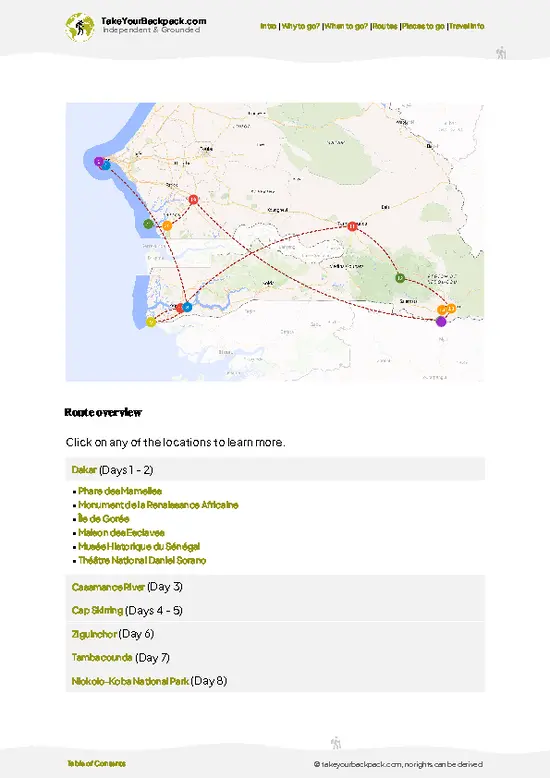
Plan 10 to 14 days for several parks: A trip combining several national parks in Senegal needs 10 to 14 days, because the parks sit in three distant corners and the roads between them are slow. The sensible direction is a loop from Dakar: north first to Saint-Louis for the Senegal River wetlands, back south through Dakar, then to the Saloum Delta, and finally east toward Tambacounda for the savanna parks. Dakar to Saint-Louis takes about 4 to 5 hours by road, Dakar to the Saloum area 3 to 4 hours, and Dakar to Tambacounda 7 to 9 hours by bush taxi or minibus. Allow 2 to 3 nights per park. Wetland and delta stops work on a half-day boat or a full day, while the savanna needs at least 2 days because tracks are slow and dawn is the best time.

Planning mistakes to avoid: The most common error … read more 👉
Plan 10 to 14 days for several parks: A trip combining several national parks in Senegal needs 10 to 14 days, because the parks sit in three distant corners and the roads between them are slow. The sensible direction is a loop from Dakar: north first to Saint-Louis for the Senegal River wetlands, back south through Dakar, then to the Saloum Delta, and finally east toward Tambacounda for the savanna parks. Dakar to Saint-Louis takes about 4 to 5 hours by road, Dakar to the Saloum area 3 to 4 hours, and Dakar to Tambacounda 7 to 9 hours by bush taxi or minibus. Allow 2 to 3 nights per park. Wetland and delta stops work on a half-day boat or a full day, while the savanna needs at least 2 days because tracks are slow and dawn is the best time.

Planning mistakes to avoid: The most common error is trying to cross the country in one stretch. Bush taxis leave when full, often midmorning, so a 5 hour journey can swallow a whole day. Build in a buffer day before each long leg. Another mistake is arriving in a remote park without a booked guide or vehicle, which leaves you stranded at the gate. Arrange transport from Tambacounda or a delta village the day before. Travel at dawn when the air is cool, and carry water and cash, as ATMs vanish outside regional towns.

The ListThe Best national parks of Senegal

1 Niokolo-Koba National Park

gallery forests, savanna plains, large mammals, Gambia River

Venture deep into Senegal’s interior to encounter buffalo, hippos, and monkeys along rivers winding through forest and open grassland.

2 Djoudj National Bird Sanctuary

wetland lagoons, migratory birds, pelican colonies, boat excursions

Glide by boat through shallow waters as thousands of birds gather, nest, and feed in one of Africa’s most important avian stopovers.

3 Bandia Wildlife Reserve

acacia woodland, roaming antelope, baobab groves, open savanna

Walk beneath scattered baobabs and acacias, watching herds of antelope and zebra move through open grassland in a protected reserve.

4 Saloum Delta National Park

mangrove channels, tidal islands, fishing villages, salt flats

Paddle through maze-like waterways, passing stilted villages and salt pans, where daily life adapts to the rhythm of the tides.

5 Fathala Wildlife Reserve

savanna landscape, guided safaris, West African megafauna, baobab trees

Join a guided drive across open grasslands to spot roaming antelope, giraffes, and the region’s iconic baobabs under wide skies.

6 Réserve Naturelle Communautaire de Dindéfélo

limestone cliffs, cascading waterfall, forested canyons, chimpanzee habitat

Climb into cool, shaded gorges to reach a waterfall hidden among cliffs, where chimpanzees and birds find refuge in dense forest.

senegal-national-park-reserve-naturelle-communautaire-de-dindefelo
© Google |

7 Îles de la Madeleine

volcanic islets, seabird colonies, boat excursions, rugged cliffs

Take a boat to uninhabited islands where dramatic cliffs, nesting birds, and clear waters create a unique day trip from Dakar.

senegal-national-park-iles-de-la-madeleine
© Google |

8 Langue de Barbarie National Park

narrow sandspit, Atlantic beaches, nesting turtles, estuary views

Walk along a slender strip of sand where ocean and river meet, watching for sea turtles and shifting dunes shaped by the tides.

9 Réserve Naturelle de Popenguine

coastal cliffs, dry forest, panoramic viewpoints, endemic flora

Hike rugged coastal trails above the Atlantic, pausing at lookouts over cliffs and searching for rare plants unique to this reserve.

10 Basse Casamance National Park

dense rainforest, rare primates, winding trails, remote villages

Navigate shaded forest paths where elusive monkeys move overhead and traditional communities live at the edge of thick, humid greenery.

11 Réserve de Faune de Ndiaël

seasonal wetlands, open grassland, waterbirds, grazing antelope

Visit after the rains to see temporary lakes fill with life, attracting herds and flocks to a landscape that shifts with the seasons.

senegal-national-park-reserve-de-faune-de-ndiael
© Google |

12 Réserve de Faune de Ferlo Nord

arid steppe, acacia groves, Sahel wildlife, nomadic herders

Travel across dry plains dotted with acacias, where herders move with their livestock and hardy wildlife survives in sparse shade.

13 Réserve de Faune de Ferlo Sud

semi-arid bush, scattered waterholes, migratory ungulates, thorn scrub

Follow tracks through thorny brush to isolated waterholes, watching for antelope and birds that rely on these rare sources.

Think you know Senegal?

Prove you’re a true local — uncover 3 lesser-known national parks in Senegal that locals tend to keep to themselves.
Loading the map 🌍

Expert viewInsights from Locals and Experts

How many parks to visit: I advise two or three parks, not more. Distances are long, tracks are rough, and each park needs at least a full morning on the water or a dawn drive to be worth the effort. Packing in five turns a trip into a blur of bush taxis. Two or three lets you hear the pelicans clatter at first light or the hoot of a hippo in the dark without watching the clock.

Which kind for which traveler: Birders and first-timers on a tight budget should put a wetland or delta park first. They are close to Dakar, offer pirogue trips through still water and mangrove roots, and the birdlife is dramatic even if you know nothing about birds. Travelers who want walking, rough camps and a sense of remoteness should add the savanna and forest park in the southeast, where red dust, termite mounds … read more 👉
How many parks to visit: I advise two or three parks, not more. Distances are long, tracks are rough, and each park needs at least a full morning on the water or a dawn drive to be worth the effort. Packing in five turns a trip into a blur of bush taxis. Two or three lets you hear the pelicans clatter at first light or the hoot of a hippo in the dark without watching the clock.

Which kind for which traveler: Birders and first-timers on a tight budget should put a wetland or delta park first. They are close to Dakar, offer pirogue trips through still water and mangrove roots, and the birdlife is dramatic even if you know nothing about birds. Travelers who want walking, rough camps and a sense of remoteness should add the savanna and forest park in the southeast, where red dust, termite mounds and woodsmoke are the texture of the day. Families and anyone short on time can stick to the western parks, which suit shorter stays.

What it costs: Budget US$35 to 60 a day for a backpacker using public transport, guesthouses and shared guides. Park entry typically runs about 5,000 to 10,000 CFA francs (US$8 to 17) per person, a boat trip adds 10,000 to 30,000 CFA francs (US$17 to 50) shared, and a guide or 4x4 for the savanna can reach 40,000 to 80,000 CFA francs (US$65 to 130) a day, so split it with others. Basic rooms cost 8,000 to 20,000 CFA francs (US$13 to 33). Carry cash, since cards rarely work outside Dakar.

Safety and cultural points: Parks are generally calm, but check current advice for Casamance and the borders before heading south or east. Malaria is present all year, so take prophylaxis and cover up at dusk, when mosquitoes swarm over the water. Heat is the bigger daily risk, with shade scarce on open flats, so wear a hat and drink more than feels necessary. Never walk off-track in the savanna, and keep your distance from hippos, which cause more trouble than any predator. In villages beside the parks, greet people first with “Salaam aleikum,” ask before taking photos and dress modestly, with covered shoulders and knees. Friday midday is prayer time and many guides will be unavailable. Hiring local guides and eating in village kitchens keeps money in communities, and you get the best meal of the trip: grilled fish with onion sauce and rice, eaten with your hands under a tin roof.

✈️ The backpacker research shortcutSenegal Travel Guide

An offline-friendly backpacking guide with optimized travel routes, ranked highlights, transport advice, and the best areas to stay.
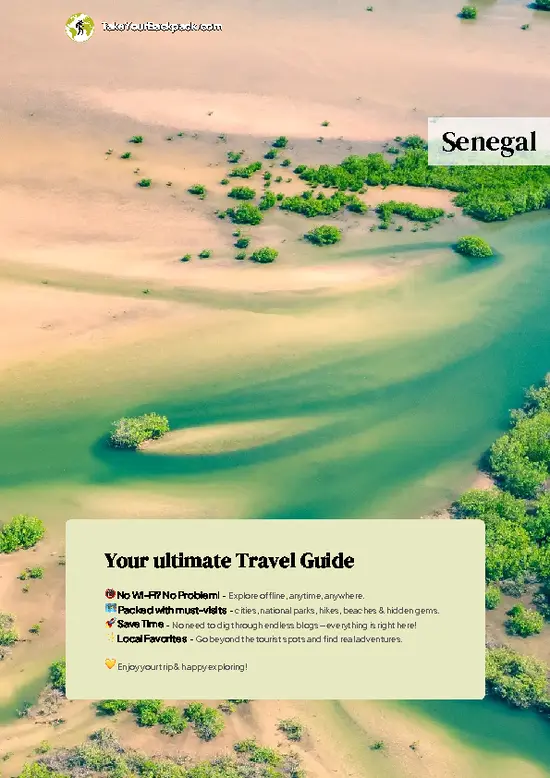
example page 0 from our offline Travel Guide for Senegal
example page 1 from our offline Travel Guide for Senegal
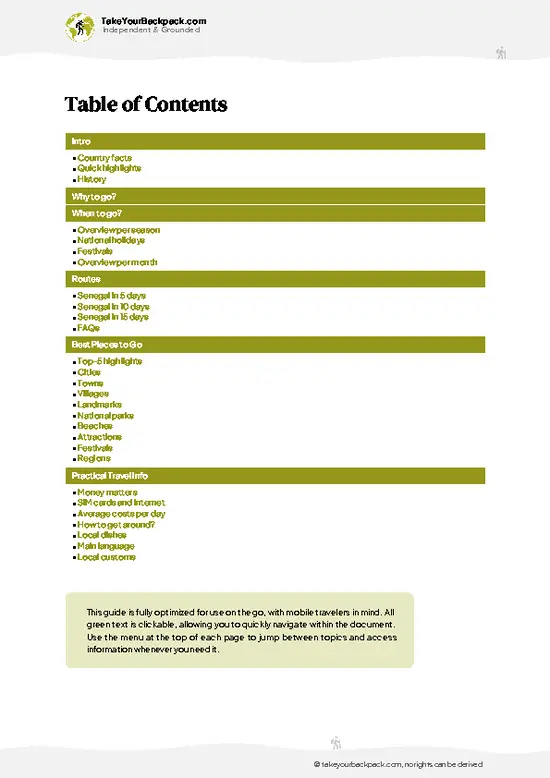
example page 2 from our offline Travel Guide for Senegal
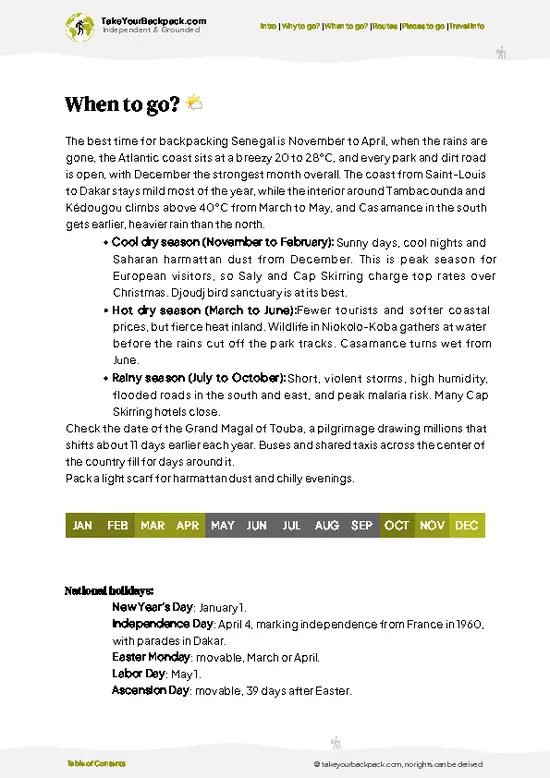
example page 3 from our offline Travel Guide for Senegal
example page 4 from our offline Travel Guide for Senegal
example page 5 from our offline Travel Guide for Senegal
example page 6 from our offline Travel Guide for Senegal
example page 7 from our offline Travel Guide for Senegal
The digital guide (360 pages) contains:
✅ 85 highlights, ranked by travel appeal
✅ Optimized 5, 10 & 15-day travel routes
✅ Cities, national parks, landmarks, beaches
✅ How to get around
✅ Offline-friendly for travel without Wi-Fi
👉 Click to see all 30+ guide features

📅 Plan smarter in minutes, not weeks
✅ Month by month travel advice
✅ Festivals & national holidays
✅ Budget expectations

🗺️ Go to the right places, skip the overrated ones
✅ Honest pros & cons of destinations
✅ Top hikes, parks & viewpoints
✅ Lesser-known places most travelers miss
✅ Clear “worth it vs skip it” guidance

🛏️ Travel smoothly without rookie mistakes
✅ Best areas to stay
✅ Transport systems explained simply
✅ Common scams & safety advice
✅ SIM cards, money & practical tips

🌍 Understand the country, not just visit it
✅ Culture & traditions
✅ 52 Essential phrases & customs
✅ Festivals worth planning around
✅ Traveler-friendly historical context
✅ Insights that make places more meaningful

📱 Built for real travel conditions
✅ Fully downloadable PDF
✅ Works completely offline
✅ Optimized for phone use
✅ Useful in remote areas & buses
✅ Everything in one place
Stop searching, start planning
Get instant access to your full guide. 30‑day money-back guarantee.
+ Add another guide for just

By proceeding you agree to our terms.
Sent to your inbox immediately after payment • 100% Secure Checkout
Best Backpacking Travel Advisor 2025 tourism awardBest Backpacking
Travel Advisor
2025
What others say about Take Your Backpack Guides:
⭐⭐⭐⭐⭐
Fantastic, amazing amount of information!
⭐⭐⭐⭐⭐
My goodness this is amazing, it's what I've been looking for hats off too you!
⭐⭐⭐⭐⭐
I think this is absolutely BRILLIANT
⭐⭐⭐⭐
Very complete and informative. It's still missing places, but I gotta to commend you
⭐⭐⭐⭐⭐
This is truly amazing, thank you, can't wait to explore it with my kids!
⭐⭐⭐⭐⭐
Awesome resource, thank you!
⭐⭐⭐⭐⭐
This is amazing! Can't wait to explore the ones I haven't seen
⭐⭐⭐⭐
I love this! Well done, great idea.
⭐⭐⭐⭐⭐
Thanks for taking the time to make this gem!
⭐⭐⭐⭐⭐
This might be the best website I've ever seen.
⭐⭐⭐⭐⭐
Congratulations, and thank you so much for your work; it's incredibly valuable.
⭐⭐⭐⭐
In all seriousness I think you did a great job pointing out the important spots
⭐⭐⭐⭐⭐
10/10 very good
⭐⭐⭐⭐⭐
As someone who's only just starting to visit regularly this is awesome, thank you.
⭐⭐⭐⭐
Thank you very much! I'm going to visit my dad, it's going to be very useful!
⭐⭐⭐⭐⭐
This is really cool! We'll be travelling for the first time and this definitely come in handy.
⭐⭐⭐⭐⭐
You are now our minister of culture, congratulations 👨‍💼
⭐⭐⭐⭐⭐
Just wanted to tell you that this is a pearl! Going to follow your recommendations.
⭐⭐⭐⭐⭐
This is so cool. I'll definitely be using the resource for my travels soon.
⭐⭐⭐⭐⭐
This is very impressive! Good work.
⭐⭐⭐⭐⭐
This is an amazing and informative site. Very well done!

🛏️ Where to stay?Where to Stay in Senegal

Senegal has a small but growing hostel scene, with dorm beds at roughly 8,000 to 15,000 CFA (US$13 to 25) and simple guesthouses, called “auberges” or “campements”, filling most of the budget gaps. In Dakar, Ngor and Yoff hold the most backpacker-friendly beds, close to surf breaks, beach bars and Ngor Island, with quieter streets than the center but a 30 to 45 minute ride to the city’s markets. Nearby Almadies has the best nightlife and the highest prices. Plateau puts you within walking distance of Sandaga market and the ferry to Gorée, but it empties out after dark and has more petty theft. Outside the capital, the old island quarter of Saint-Louis and the villages of the Sine-Saloum delta … read more 👉
Senegal has a small but growing hostel scene, with dorm beds at roughly 8,000 to 15,000 CFA (US$13 to 25) and simple guesthouses, called “auberges” or “campements”, filling most of the budget gaps. In Dakar, Ngor and Yoff hold the most backpacker-friendly beds, close to surf breaks, beach bars and Ngor Island, with quieter streets than the center but a 30 to 45 minute ride to the city’s markets. Nearby Almadies has the best nightlife and the highest prices. Plateau puts you within walking distance of Sandaga market and the ferry to Gorée, but it empties out after dark and has more petty theft. Outside the capital, the old island quarter of Saint-Louis and the villages of the Sine-Saloum delta offer good-value guesthouses in a far calmer setting.

If you enjoy meeting fellow travelers, consider choosing hostels with high ratings for atmosphere. On the other hand, if you prefer having your own space, a hotel might be a better option.

SenegalMore of Senegal

👋 Meet the founderWho’s Behind Take Your Backpack?

Johan, backpacker and founder of TakeYourBackpackHi, I’m Johan (Netherlands 🇳🇱), the creator of TakeYourBackpack. Over the past 3 decades, I’ve backpacked through 90+ countries across six continents, gaining extensive experience with independent travel, long-term trips, and overland routes.

This site is built on a combination of firsthand travel experience and carefully curated insights from other backpackers. Many guides are based on places I’ve personally visited, while others bring together tips, observations, and practical advice shared by trusted travelers I’ve met along the way.

The goal is to provide realistic, experience-driven guidance — not generic itineraries — so you can explore destinations with better context, clearer expectations, and more confidence.