×

Svalbard🇸🇯 | best villagesEssential 2 villages to Explore in Svalbard

Villages in Svalbard are few, small and shaped by coal and research rather than farming or fishing. The settlements differ in cost, access and atmosphere: the main hub has flights, shops and tours, while the others are reached by boat, snowmobile or special arrangement. Independent travelers and backpackers should expect high prices, strict rules on movement outside town and very few visitors beyond the hub.

By Johan Kruseman 🇳🇱 | Updated October 18, 2026
Explore the best landmarks in Svalbard

Why go?What Makes Them Special

Svalbard sits at 74 to 81 degrees north, so permafrost, polar night and midnight sun dictate how people live. Almost no settlement here grew from agriculture. Communities exist because of coal mining, science and, increasingly, tourism, which gives them a working, temporary character rather than a long rural heritage.

The archipelago is governed by the Svalbard Treaty, so it is visa-free for many nationalities, but supplies, housing and services are limited and expensive. Only a small part of the land is road-connected, and roads end at town edges. Travelers should know that polar bears make leaving a settlement without a guide or rifle-trained companion a safety matter, and that most places beyond the main hub have no regular public transport, limited accommodation and little to buy.
How the List Was Created
The list of best villages in Svalbard is created based on authenticity, scenic beauty, community spirit, traditions, and overall character. If you feel a village is missing in this list, please let us know.

When to go?Seasonal Guide to Visiting

Best months: The best months are March to May for snow-covered landscapes with returning daylight, and June to August for open water and midnight sun, when ships and boat tours operate. Winter (November to February) is polar night, with temperatures around -10 to -20°C in the main settlement, and cold snaps below that.
Shoulder seasons and prices: Late February to April brings snowmobile access with daylight growing quickly, and prices for tours and rooms are typically at their highest around Easter. Summer temperatures are roughly 3 to 8°C, with light rain or fog common. September and early October are quieter and cheaper, but boat departures thin out and daylight shrinks fast. Accommodation can be 20 to 40% cheaper outside the peak spring and summer windows. Remote settlements often have … read more 👉
Best months: The best months are March to May for snow-covered landscapes with returning daylight, and June to August for open water and midnight sun, when ships and boat tours operate. Winter (November to February) is polar night, with temperatures around -10 to -20°C in the main settlement, and cold snaps below that.
Shoulder seasons and prices: Late February to April brings snowmobile access with daylight growing quickly, and prices for tours and rooms are typically at their highest around Easter. Summer temperatures are roughly 3 to 8°C, with light rain or fog common. September and early October are quieter and cheaper, but boat departures thin out and daylight shrinks fast. Accommodation can be 20 to 40% cheaper outside the peak spring and summer windows. Remote settlements often have restricted services outside the main tourist season, so check opening dates before booking.

village hoppingSuggested Travel Strategies

Trip length: A trip combining several villages in Svalbard needs 5 to 8 days, because transport is limited and weather can change schedules. The main hub, reached by flight from Oslo or Tromsø (about 2 to 3 hours), is the natural start and finish, since onward travel departs from there.
Direction and pacing: Plan 1 to 2 nights per stop. Reaching other settlements takes about 2 to 6 hours by boat or snowmobile depending on season and destination, or a short charter flight, and these links run only on certain days or in certain months. Fit hub-based days around those departures, not the other way round.
Common mistakes: Travelers often book tight flight connections the same day as a boat or snowmobile trip. Leave a buffer of at least one day at the end. Another mistake is assuming scheduled transport … read more 👉
Trip length: A trip combining several villages in Svalbard needs 5 to 8 days, because transport is limited and weather can change schedules. The main hub, reached by flight from Oslo or Tromsø (about 2 to 3 hours), is the natural start and finish, since onward travel departs from there.
Direction and pacing: Plan 1 to 2 nights per stop. Reaching other settlements takes about 2 to 6 hours by boat or snowmobile depending on season and destination, or a short charter flight, and these links run only on certain days or in certain months. Fit hub-based days around those departures, not the other way round.
Common mistakes: Travelers often book tight flight connections the same day as a boat or snowmobile trip. Leave a buffer of at least one day at the end. Another mistake is assuming scheduled transport exists everywhere; confirm bookings in advance and leave a spare day for fog, wind or ice.

The ListTop villages of Svalbard

1 Barentsburg

Russian mining heritage, Soviet-era murals, Arctic coal town

Experience a working settlement where Russian language, industrial relics, and stark architecture reveal Svalbard’s layered geopolitical history.

2 Ny-Ålesund

International science base, remote outpost, historic airship site

Visit a restricted-access research village where scientists monitor climate and wildlife, and remnants of polar expeditions linger at the edge of the ice.

Loading the map 🌍

Expert viewExpert Commentary on villages

How many to visit: I advise two settlements on a first trip, three at most. Transport is infrequent and expensive, and a third stop usually consumes a large part of the budget and schedule for a short visit. Two lets you see the contrast between the main hub and a more remote community without rushing.
Choosing the kind: Budget travelers and first-timers should prioritize the main hub, which has supermarkets, a campground in summer and the widest choice of guided trips. Travelers with more time and money, interested in mining history or Arctic science, should add a remote settlement reached by boat or small aircraft, where services are minimal.
Costs: Expect US$120 to 200 a day for a frugal independent trip, covering a dorm bed or camping (roughly US$35 to 60), self-catered food from supermarkets … read more 👉
How many to visit: I advise two settlements on a first trip, three at most. Transport is infrequent and expensive, and a third stop usually consumes a large part of the budget and schedule for a short visit. Two lets you see the contrast between the main hub and a more remote community without rushing.
Choosing the kind: Budget travelers and first-timers should prioritize the main hub, which has supermarkets, a campground in summer and the widest choice of guided trips. Travelers with more time and money, interested in mining history or Arctic science, should add a remote settlement reached by boat or small aircraft, where services are minimal.
Costs: Expect US$120 to 200 a day for a frugal independent trip, covering a dorm bed or camping (roughly US$35 to 60), self-catered food from supermarkets and occasional transport. Guided day trips by snowmobile or boat typically cost US$150 to 400 per person. Boat or flight transfers to remote settlements can add US$100 to 500 each way. Book early for spring and summer, because places sell out and last-minute prices rise. Carrying cash is rarely needed since cards are accepted nearly everywhere.
Safety and conduct: Polar bears are a real risk, and leaving a settlement boundary without a guide who carries a firearm and flare gear is unwise and in some places required. Rental of a rifle is possible, but training and a permit are needed, and guides are the better option. Weather can ground flights and cancel boats, so keep a spare day and travel insurance that covers evacuation. Do not disturb cultural heritage sites older than 1946, which are protected by law, and do not take souvenirs from them. Remove shoes indoors in many homes and lodgings, and respect that these are working communities, not attractions.

✈️ The backpacker research shortcutSvalbard Travel Guide

An offline-friendly backpacking guide with optimized travel routes, ranked highlights, transport advice, and the best areas to stay.
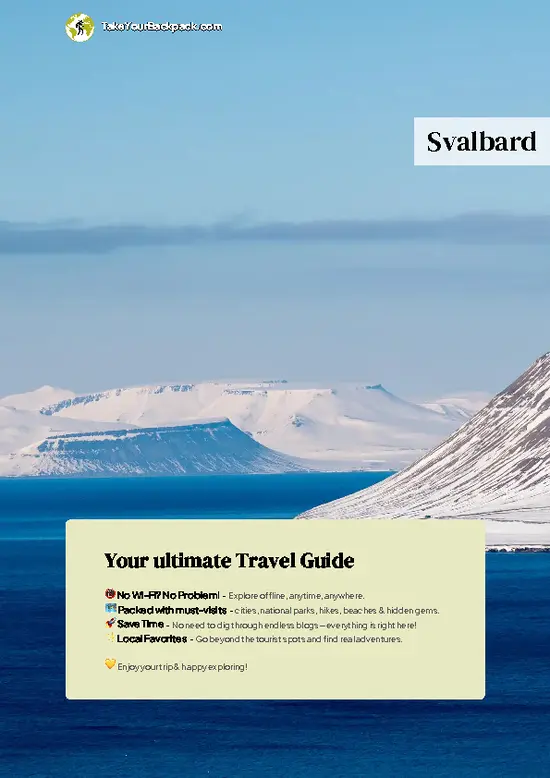
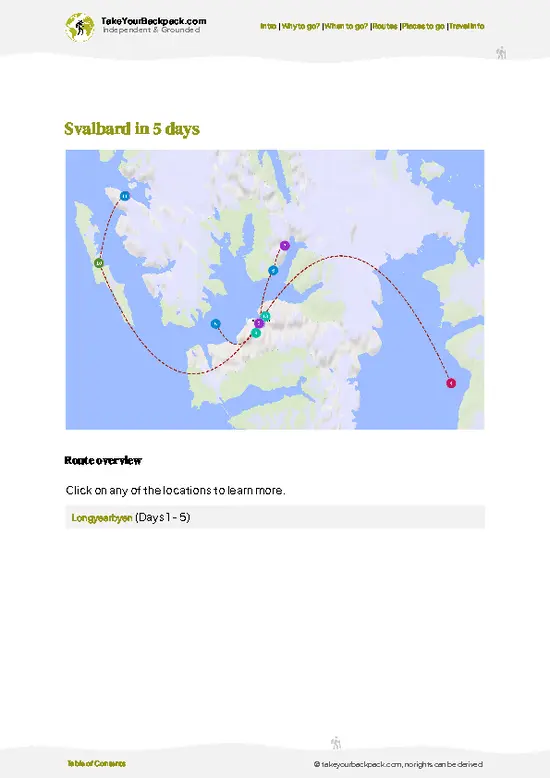
example page 0 from our offline Travel Guide for Svalbard
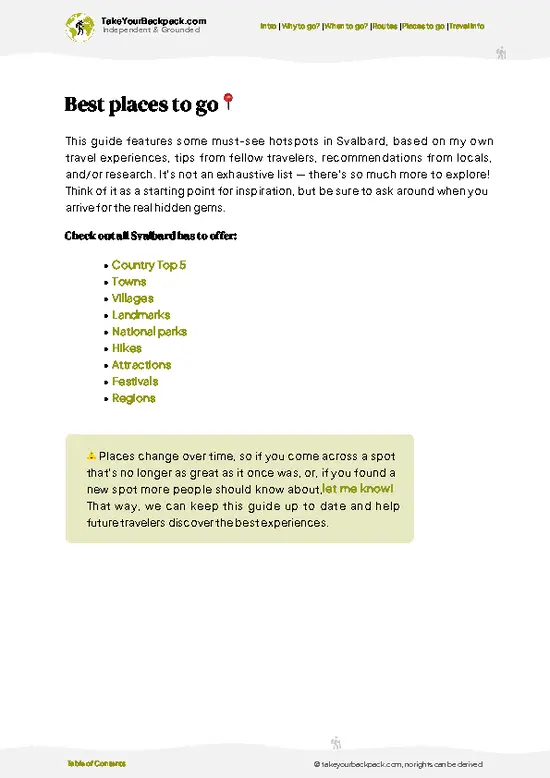
example page 1 from our offline Travel Guide for Svalbard
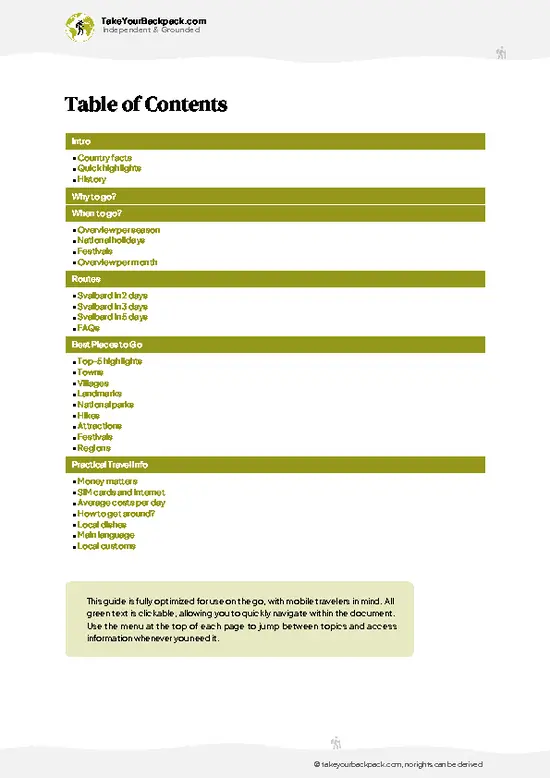
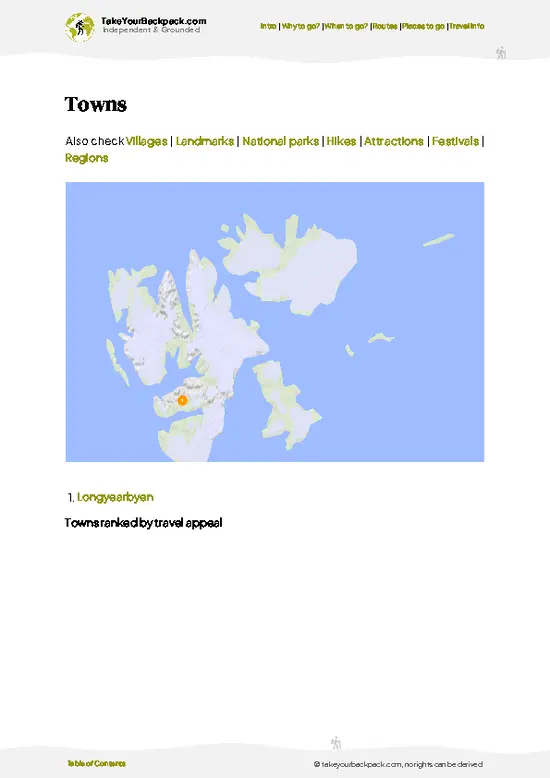
example page 2 from our offline Travel Guide for Svalbard
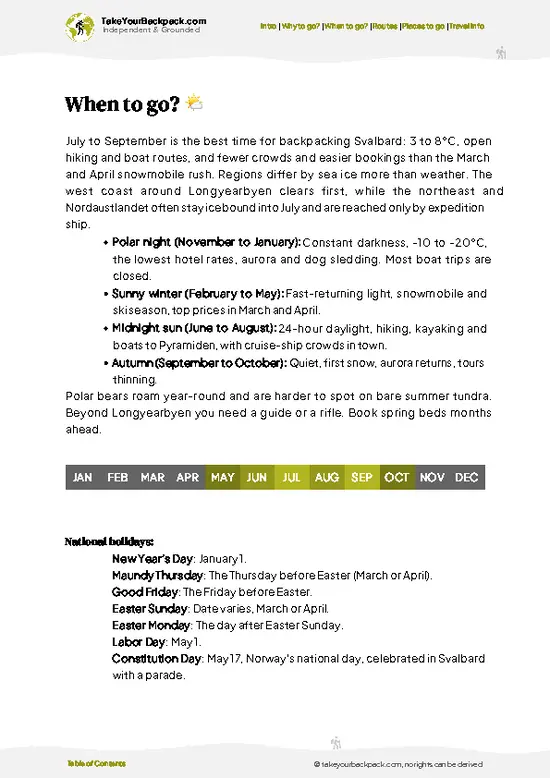
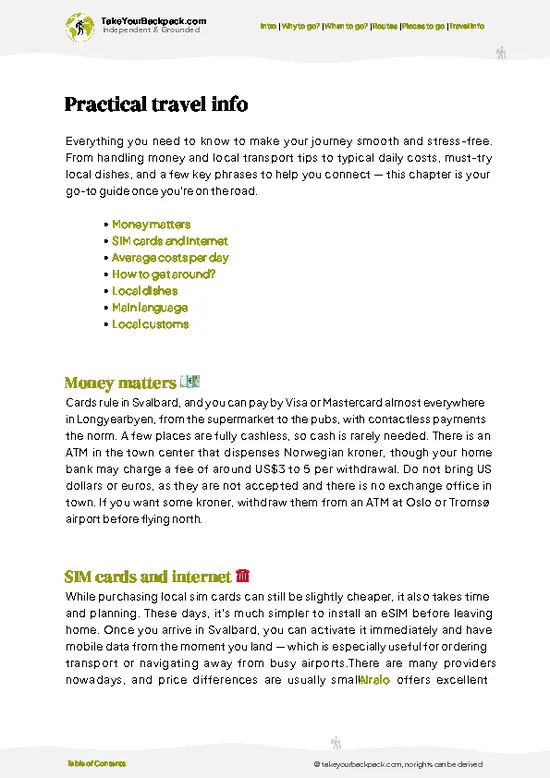
example page 3 from our offline Travel Guide for Svalbard
example page 4 from our offline Travel Guide for Svalbard
example page 5 from our offline Travel Guide for Svalbard
example page 6 from our offline Travel Guide for Svalbard
example page 7 from our offline Travel Guide for Svalbard
The digital guide (120 pages) contains:
✅ 28 highlights, ranked by travel appeal
✅ Optimized 2, 3 & 5-day travel routes
✅ Cities, national parks, landmarks, beaches
✅ How to get around
✅ Offline-friendly for travel without Wi-Fi
👉 Click to see all 30+ guide features

📅 Plan smarter in minutes, not weeks
✅ Month by month travel advice
✅ Festivals & national holidays
✅ Budget expectations

🗺️ Go to the right places, skip the overrated ones
✅ Honest pros & cons of destinations
✅ Top hikes, parks & viewpoints
✅ Lesser-known places most travelers miss
✅ Clear “worth it vs skip it” guidance

🛏️ Travel smoothly without rookie mistakes
✅ Best areas to stay
✅ Transport systems explained simply
✅ Common scams & safety advice
✅ SIM cards, money & practical tips

🌍 Understand the country, not just visit it
✅ Culture & traditions
✅ 52 Essential phrases & customs
✅ Festivals worth planning around
✅ Traveler-friendly historical context
✅ Insights that make places more meaningful

📱 Built for real travel conditions
✅ Fully downloadable PDF
✅ Works completely offline
✅ Optimized for phone use
✅ Useful in remote areas & buses
✅ Everything in one place
Stop searching, start planning
Get instant access to your full guide. 30‑day money-back guarantee.
+ Add another guide for just

By proceeding you agree to our terms.
Sent to your inbox immediately after payment • 100% Secure Checkout
Best Backpacking Travel Advisor 2025 tourism awardBest Backpacking
Travel Advisor
2025
What others say about Take Your Backpack Guides:
⭐⭐⭐⭐⭐
Fantastic, amazing amount of information!
⭐⭐⭐⭐⭐
My goodness this is amazing, it's what I've been looking for hats off too you!
⭐⭐⭐⭐⭐
I think this is absolutely BRILLIANT
⭐⭐⭐⭐
Very complete and informative. It's still missing places, but I gotta to commend you
⭐⭐⭐⭐⭐
This is truly amazing, thank you, can't wait to explore it with my kids!
⭐⭐⭐⭐⭐
Awesome resource, thank you!
⭐⭐⭐⭐⭐
This is amazing! Can't wait to explore the ones I haven't seen
⭐⭐⭐⭐
I love this! Well done, great idea.
⭐⭐⭐⭐⭐
Thanks for taking the time to make this gem!
⭐⭐⭐⭐⭐
This might be the best website I've ever seen.
⭐⭐⭐⭐⭐
Congratulations, and thank you so much for your work; it's incredibly valuable.
⭐⭐⭐⭐
In all seriousness I think you did a great job pointing out the important spots
⭐⭐⭐⭐⭐
10/10 very good
⭐⭐⭐⭐⭐
As someone who's only just starting to visit regularly this is awesome, thank you.
⭐⭐⭐⭐
Thank you very much! I'm going to visit my dad, it's going to be very useful!
⭐⭐⭐⭐⭐
This is really cool! We'll be travelling for the first time and this definitely come in handy.
⭐⭐⭐⭐⭐
You are now our minister of culture, congratulations 👨‍💼
⭐⭐⭐⭐⭐
Just wanted to tell you that this is a pearl! Going to follow your recommendations.
⭐⭐⭐⭐⭐
This is so cool. I'll definitely be using the resource for my travels soon.
⭐⭐⭐⭐⭐
This is very impressive! Good work.
⭐⭐⭐⭐⭐
This is an amazing and informative site. Very well done!

🛏️ Where to stay?Best Stay Options in Svalbard

Budget beds do exist in Svalbard, Norway, but they cluster almost entirely in Longyearbyen, where a dorm bed or basic single in a guesthouse runs roughly NOK 450 to 800 (US$42 to 75) a night, and a summer tent pitch near the airport is the cheapest option of all. Nybyen, about 2 km up the valley, is where most budget guesthouses sit in converted miners’ barracks with shared bathrooms and kitchens: quiet, scenic and close to glacier trailheads, but a 20 to 25 minute walk from the bars and shops. Sentrum, the town center, puts you steps from the museums, restaurants and the few pubs, though its hotels cost noticeably more, while camping at Hotellneset by the airport is cheapest but about 4 km … read more 👉
Budget beds do exist in Svalbard, Norway, but they cluster almost entirely in Longyearbyen, where a dorm bed or basic single in a guesthouse runs roughly NOK 450 to 800 (US$42 to 75) a night, and a summer tent pitch near the airport is the cheapest option of all. Nybyen, about 2 km up the valley, is where most budget guesthouses sit in converted miners’ barracks with shared bathrooms and kitchens: quiet, scenic and close to glacier trailheads, but a 20 to 25 minute walk from the bars and shops. Sentrum, the town center, puts you steps from the museums, restaurants and the few pubs, though its hotels cost noticeably more, while camping at Hotellneset by the airport is cheapest but about 4 km from town and open only in summer.

If you enjoy meeting fellow travelers, consider choosing hostels with high ratings for atmosphere. On the other hand, if you prefer having your own space, a hotel might be a better option.

SvalbardWhere to Go Next

👋 Meet the founderWho’s Behind Take Your Backpack?

Johan, backpacker and founder of TakeYourBackpackHi, I’m Johan (Netherlands 🇳🇱), the creator of TakeYourBackpack. Over the past 3 decades, I’ve backpacked through 90+ countries across six continents, gaining extensive experience with independent travel, long-term trips, and overland routes.

This site is built on a combination of firsthand travel experience and carefully curated insights from other backpackers. Many guides are based on places I’ve personally visited, while others bring together tips, observations, and practical advice shared by trusted travelers I’ve met along the way.

The goal is to provide realistic, experience-driven guidance — not generic itineraries — so you can explore destinations with better context, clearer expectations, and more confidence.