
×

Timor-Leste🇹🇱 | beachesArbiru BeachGray sand, Atauro silhouette, fishing boats, western Dili | things to do and best time to go

Explore Valu BeachExplore Bikeli Beach

Backpacking in Arbiru Beach
👌 Worth visitingbeach ranked #8
By Johan Kruseman 🇳🇱 | Updated October 15, 2026

Warm gray sand sticks to your calves while a breeze carries wood smoke and grilled fish from somewhere behind the palms, and the water goes the color of weak tea after a hard rain. Arbiru Beach sits on the western side of Dili, in Timor-Leste, close enough to the city that a short ride gets you here. It is not a postcard. Litter collects after storms, the sand is darker than the resort photos suggest, and shade is patchy by midday. Crowds stay thin outside weekends, and costs are low, with cheap food and guesthouses back in town. The swimming is calm in the dry months, and the reef is close enough for casual snorkeling. At dusk, the ridge of Atauro Island darkens against an orange sky.

Part of Backpacking in Timor-Leste: all 46 places on one map, with routes and the best time to go.
Discover everything you want to know in the 📖 Timor-Leste Travel Guide.
Loading the map 🌍
CLICK TO FILTER
cities
towns
villages
national parks
hikes
beaches
attractions
festivals
regions
SHOW COUNTRY’S BESTSHOW ALL

✨ Why go?
Ranked #8 beach in Timor-Leste
What sets this place apart

Backpackers stop here because Dili has few places where you can walk straight from a city bed to a swim without organizing a day trip. Arbiru gives you the Dili waterfront on a quieter stretch, where locals fish from the shore, kids kick balls at low tide, and nobody is selling you a tour. It works as a reset between the capital's errands, such as visa matters, bus tickets and supply runs, and the longer hauls to the east or the mountains. The second reason is the horizon. On a clear afternoon you can see Atauro Island across the water, which helps if you are deciding whether to spend a few nights there. Pair that with cheap local eating nearby and a short ride back to town, and it makes an easy half day that costs almost nothing and asks little of you.

💡 HighlightsKey sights and experiences for travelers

  1. Sunset over the Wetar Strait: The sun drops straight into the water here, and the sky runs from pale yellow to deep orange while fishermen head out. Arrive about an hour before dark, when the heat eases and the sand cools underfoot.
  2. Atauro Island views: On a clear afternoon the long, dark outline of Atauro sits on the horizon, a good way to decide if the island is worth your time. Mornings usually give the sharpest view.
  3. Shore snorkeling: Coral lies close to the beach, and you can see small reef fish and the occasional colorful coral patch in calm water. Bring your own mask, since rental here is not something to count on.
  4. Beach walking toward Tasi Tolu: Following the shoreline west gives you an easy stroll past fishing boats pulled onto the sand, with the sound of surf and the smell of drying
… read more 👉
  1. Sunset over the Wetar Strait: The sun drops straight into the water here, and the sky runs from pale yellow to deep orange while fishermen head out. Arrive about an hour before dark, when the heat eases and the sand cools underfoot.
  2. Atauro Island views: On a clear afternoon the long, dark outline of Atauro sits on the horizon, a good way to decide if the island is worth your time. Mornings usually give the sharpest view.
  3. Shore snorkeling: Coral lies close to the beach, and you can see small reef fish and the occasional colorful coral patch in calm water. Bring your own mask, since rental here is not something to count on.
  4. Beach walking toward Tasi Tolu: Following the shoreline west gives you an easy stroll past fishing boats pulled onto the sand, with the sound of surf and the smell of drying nets. The salt lakes of Tasi Tolu are a natural next stop.
  5. Grilled fish and a cold coconut: Local vendors and simple eateries near the beach serve fresh grilled fish with rice, and young coconuts to drink. Eat at the stalls where locals are sitting, and keep small bills handy.
Start with the sunset, because the light softens the rubbish and the dark sand, and the fishing boats make the best foreground for photos.
Spotted a mistake or missing something? Contact us.

Things to do near Arbiru Beach

Ratings based on Tripadvisor reviews. When you book through this link, you support our work at no extra cost to you.

🌤️ When to go?Choosing the right time of year

  • Dry Season (May to November): Dry season is the best window, with sunny days of 29 to 32°C (84 to 90°F) and cooler evenings near 22°C (72°F). Seas are calmest and visibility for snorkeling is best from July to October.
  • Wet Season (December to April): Afternoon downpours turn the dirt tracks to mud and can cut off access for a day or two. Expect 30 to 33°C (86 to 91°F), heavy humidity, and murkier water, though the hills turn bright green.
  • Daylight: Sunrise comes around 6:30 a.m. and sunset near 6:30 p.m. all year, so plan beach time for mornings.
  • Crowds and Prices: Arbiru sees few visitors outside weekends and Timorese holidays like Independence Day (May 20) and Christmas week, when Dili families arrive. Prices barely move with the seasons.
Go on a weekday in July or August for the quietest, clearest water.

source: climatestotravel.comJANJanuary: fair for travelingFEBFebruary: fair for travelingMARMarch: fair for travelingAPRApril: good for travelingMAYMay: excellent for travelingJUNJune: excellent for travelingJULJuly: excellent for travelingAUGAugust: excellent for travelingSEPSeptember: excellent for travelingOCTOctober: highly recommended for travelingNOVNovember: fair for travelingDECDecember: fair for traveling
when-to-go

✈️ The backpacker research shortcutTimor-Leste Travel Guide

What the free pages can't give you: ready-made routes, every place ranked, and it works offline. All in 1 guide.
example page 0 from our offline Travel Guide for Timor-Leste
example page 1 from our offline Travel Guide for Timor-Leste
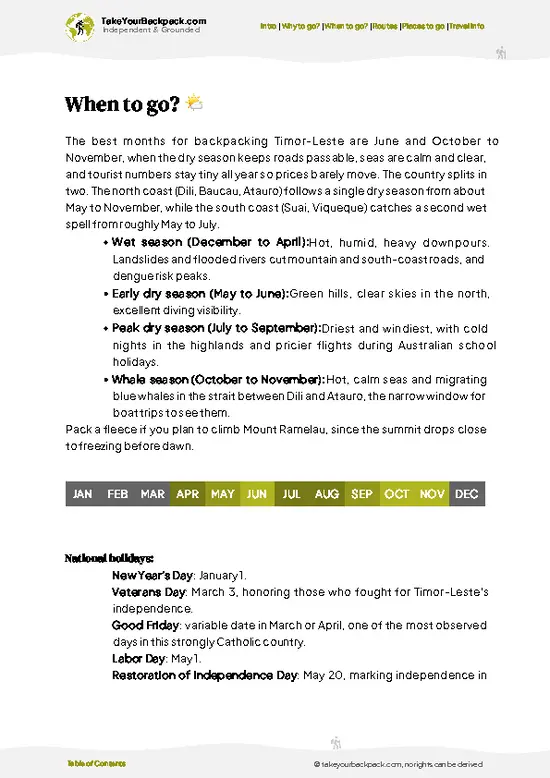
example page 2 from our offline Travel Guide for Timor-Leste
example page 3 from our offline Travel Guide for Timor-Leste
example page 4 from our offline Travel Guide for Timor-Leste
example page 5 from our offline Travel Guide for Timor-Leste
example page 6 from our offline Travel Guide for Timor-Leste
example page 7 from our offline Travel Guide for Timor-Leste
The digital guide (171 pages) contains:
✅ Ready-made 2, 3 & 5-day routes
✅ All 46 places ranked, so you skip the overrated ones
✅ Works offline, all in 1 guide
✅ Cities, national parks, landmarks, beaches
✅ How to get around
👉 Click to see all 30+ guide features

📅 Plan smarter in minutes, not weeks
✅ Month by month travel advice
✅ Festivals & national holidays
✅ Budget expectations

🗺️ Go to the right places, skip the overrated ones
✅ Honest pros & cons of destinations
✅ Top hikes, parks & viewpoints
✅ Lesser-known places most travelers miss
✅ Clear “worth it vs skip it” guidance

🛏️ Travel smoothly without rookie mistakes
✅ Best areas to stay
✅ Transport systems explained simply
✅ Common scams & safety advice
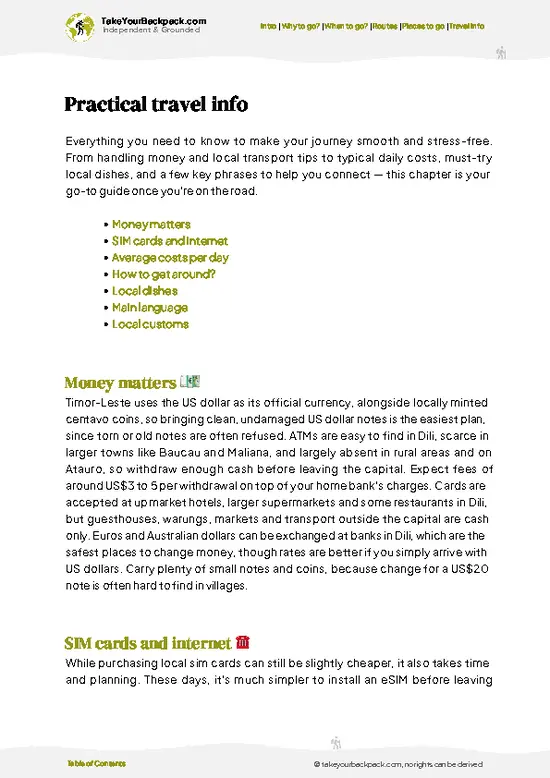
✅ SIM cards, money & practical tips

🌍 Understand the country, not just visit it
✅ Culture & traditions
✅ 52 Essential phrases & customs
✅ Festivals worth planning around
✅ Traveler-friendly historical context
✅ Insights that make places more meaningful

📱 Built for real travel conditions
✅ Fully downloadable PDF
✅ Works completely offline
✅ Optimized for phone use
✅ Useful in remote areas & buses
✅ All in 1 guide
Stop searching, start planning
Get instant access to your full guide. 30‑day money-back guarantee.
+ Add another guide for just

By proceeding you agree to our terms.
Sent to your inbox immediately after payment • 100% Secure Checkout
Best Backpacking Travel Advisor 2025 tourism awardBest Backpacking
Travel Advisor
2025
What others say about Take Your Backpack Guides:
⭐⭐⭐⭐⭐
Fantastic, amazing amount of information!
⭐⭐⭐⭐⭐
My goodness this is amazing, it's what I've been looking for hats off too you!
⭐⭐⭐⭐⭐
I think this is absolutely BRILLIANT
⭐⭐⭐⭐
Very complete and informative. It's still missing places, but I gotta to commend you
⭐⭐⭐⭐⭐
This is truly amazing, thank you, can't wait to explore it with my kids!
⭐⭐⭐⭐⭐
Awesome resource, thank you!
⭐⭐⭐⭐⭐
This is amazing! Can't wait to explore the ones I haven't seen
⭐⭐⭐⭐
I love this! Well done, great idea.
⭐⭐⭐⭐⭐
Thanks for taking the time to make this gem!
⭐⭐⭐⭐⭐
This might be the best website I've ever seen.
⭐⭐⭐⭐⭐
Congratulations, and thank you so much for your work; it's incredibly valuable.
⭐⭐⭐⭐
In all seriousness I think you did a great job pointing out the important spots
⭐⭐⭐⭐⭐
10/10 very good
⭐⭐⭐⭐⭐
As someone who's only just starting to visit regularly this is awesome, thank you.
⭐⭐⭐⭐
Thank you very much! I'm going to visit my dad, it's going to be very useful!
⭐⭐⭐⭐⭐
This is really cool! We'll be travelling for the first time and this definitely come in handy.
⭐⭐⭐⭐⭐
You are now our minister of culture, congratulations 👨‍💼
⭐⭐⭐⭐⭐
Just wanted to tell you that this is a pearl! Going to follow your recommendations.
⭐⭐⭐⭐⭐
This is so cool. I'll definitely be using the resource for my travels soon.
⭐⭐⭐⭐⭐
This is very impressive! Good work.
⭐⭐⭐⭐⭐
This is an amazing and informative site. Very well done!

🛏️ Where to stay?Where staying makes the most sense

Dili is the most practical place to sleep, since Arbiru Beach lies on the city’s own western shore at Bebonuk, a few kilometers from the center. The Dili waterfront and the streets around Farol and Colmera have the widest choice of dorm beds and basic guesthouses, roughly US$10 to 25 a night, plus the hostel crowd you can share a rented scooter or minivan with. Walking distance to cafes and the Esplanada makes it easy to meet other travelers, and early starts are simple from here. If you want to wake up by the water, Arbiru Beach Resort sits right on this stretch of sand. For most backpackers, … read more 👉
Dili is the most practical place to sleep, since Arbiru Beach lies on the city’s own western shore at Bebonuk, a few kilometers from the center. The Dili waterfront and the streets around Farol and Colmera have the widest choice of dorm beds and basic guesthouses, roughly US$10 to 25 a night, plus the hostel crowd you can share a rented scooter or minivan with. Walking distance to cafes and the Esplanada makes it easy to meet other travelers, and early starts are simple from here. If you want to wake up by the water, Arbiru Beach Resort sits right on this stretch of sand. For most backpackers, a bed in central Dili plus a short taxi or microlet ride works best.

🛡️ SafetySafety Tips and Common Scams in Arbiru Beach

Arbiru is a relaxed, locally used beach with few hazards, and most visitors just swim in the calm shallows near the shore. Currents can pick up off the open stretches, especially in the wet season when swell rises, so stay where Timorese families are in the water and avoid swimming alone far out. There are no lifeguards or flag systems, so your own judgment matters. Saltwater crocodiles are respected across Timor-Leste, so skip swimming at dusk or near river mouths, and heed what locals tell you. Reef edges can be sharp, so wear water shoes. The sun is intense from mid-morning, so bring shade, a hat, and plenty of water, since little is sold nearby. Petty theft is uncommon, but keep valuables out of sight and never leave bags unattended on the sand or in a parked vehicle.

FAQTraveler FAQ

Arbiru Beach sits on Dili’s western waterfront at Bebonuk, about 4 to 5 kilometers from the city center and close to the airport. A taxi takes 10 to 15 minutes and costs a few US dollars, and microlets (shared minibuses) running west along the coast road cost about US$0.25.
Swimming is the main draw, with calm, shallow water near the shore that suits a relaxed dip, especially from May to November. Snorkeling is possible along reef edges when visibility is good, mainly July to October, though you should bring your own mask as rentals are rare. Surfing is not a reason to come, since waves are small and inconsistent, and crocodile awareness means avoiding swimming at dusk.
Yes, there is generally no official entrance fee to reach the beach. Locals sometimes ask for a small parking or access contribution of about US$1 to 2 per vehicle, and a few beachside huts may charge a small amount for shade or a table. Bring cash in US dollars, since Timor-Leste uses the US dollar and beach vendors do not take cards.
⚠️ Things can change over time, so always validate details locally before you go.

Other Timorese beaches near Arbiru Beach

Explore more nearby:


💡 Not sure where to go next?
Create a personalized itinerary for Timor-Leste including Arbiru Beach and the places that fit your trip.

Generate my itinerary

👉 Discover all beaches

Or checkout all Timor-Leste has to offer (think cities, towns, villages, national parks, hikes, beaches, festivals)
Country photo of Timor-Leste

We 💚 feedbackIs it worth it?

Treat Arbiru as a late-afternoon stop in a Dili day, then head on to the salt lakes of Tasi Tolu or back toward the waterfront for dinner. I would bring my own snorkel gear, a hat, and small bills for coconuts, and skip the midday hours when the sand burns.

✍️ Help improve this page!
The information on this page is based on in-depth research, insights shared by experienced travelers, and feedback from the local travel community in Timor-Leste. While every effort is made to keep the information accurate and current, conditions can change — so if you spot anything incorrect or outdated, please get in touch.


🙋‍♂️ Give feedback

👋 Meet the founderWho’s Behind Take Your Backpack?

Johan, backpacker and founder of TakeYourBackpackHi, I’m Johan (Netherlands 🇳🇱), the creator of TakeYourBackpack. Over the past 25 years, I’ve backpacked through 88 countries across six continents, gaining extensive experience with independent travel, long-term trips, and overland routes.

This site is built on a combination of firsthand travel experience and carefully curated insights from other backpackers. Many guides are based on places I’ve personally visited, while others bring together tips, observations, and practical advice shared by trusted travelers I’ve met along the way.

The goal is to provide realistic, experience-driven guidance — not generic itineraries — so you can explore destinations with better context, clearer expectations, and more confidence.