×

Vanuatu🇻🇺 | national parksLoru Conservation AreaGuided rainforest loop, buttress roots, kingfisher calls, plant lore | things to do and best time to go

Explore Espiritu SantoExplore Roi Mata National Park

Backpacking in Loru Conservation Area
🌟 Highlightnational park ranked #2
By Johan Kruseman 🇳🇱 | Updated October 7, 2026

Your guide stops mid-stride, lifts one finger, and the whole forest seems to hold still: a pigeon is cooing somewhere above the buttress roots, and the air smells of wet leaf litter and rotting fruit. That is Loru. It sits in the southeast of Espiritu Santo in Vanuatu, a patch of lowland rainforest looked after by the local community, with narrow footpaths that climb over roots and slip through ferns. You get birdsong at head height, fruit bats overhead and shade that drops the temperature several degrees. The downsides are plain. There are no big summits, no dramatic waterfalls and no polished visitor center, and the mud after rain is serious. Crowds are essentially absent. The vibe is quiet, local and unhurried. It suits curious walkers, bird lovers and anyone who likes a guide who knows every tree by name. It won’t suit people chasing a headline viewpoint or a long, hard trek.

Discover everything you want to know in the 📖 Vanuatu Travel Guide.


Loading the map 🌍
CLICK TO FILTER
towns
villages
landmarks
national parks
hikes
beaches
attractions
festivals
regions
SHOW COUNTRY’S BESTSHOW ALL

✨ Why go?
Ranked #2 national park in Vanuatu
Why Loru Conservation Area should be on your travel list

Loru gives you something most of Vanuatu’s famous sights don’t: lowland forest that is still standing on an island where coconut plantations and cattle pasture have taken a lot of the coastal plain. Walking here is a chance to see what the coast of Santo looked like before that happened, and to do it on foot, at your own rhythm, with a local custodian rather than a coach party. The walking is gentle, so you don’t need serious fitness or gear, only sturdy shoes and a rain layer.

The second pull is the birdlife. Santo is one of the better islands in Vanuatu for forest birds, and Loru is a convenient place to look for the Vanuatu kingfisher and the fruit pigeons that gather in fruiting trees. Dawn is the time to be there. The third reason is how it fits a budget trip: you can arrange a visit … read more 👉
Loru gives you something most of Vanuatu’s famous sights don’t: lowland forest that is still standing on an island where coconut plantations and cattle pasture have taken a lot of the coastal plain. Walking here is a chance to see what the coast of Santo looked like before that happened, and to do it on foot, at your own rhythm, with a local custodian rather than a coach party. The walking is gentle, so you don’t need serious fitness or gear, only sturdy shoes and a rain layer.

The second pull is the birdlife. Santo is one of the better islands in Vanuatu for forest birds, and Loru is a convenient place to look for the Vanuatu kingfisher and the fruit pigeons that gather in fruiting trees. Dawn is the time to be there. The third reason is how it fits a budget trip: you can arrange a visit directly with the community, you spend money where it actually helps protect the forest, and the half-day format leaves room to combine it with beaches, blue holes and the wartime sites elsewhere on Santo.

💡 HighlightsThe experiences that define the visit

  1. The Loru lowland rainforest walk. The main experience is a guided loop through intact forest with a dense, layered canopy, vines hanging like cables and a floor of ferns and fallen fruit. Stops are frequent, because your guide points out medicinal and useful plants as you go.
  2. Giant banyan and buttressed trees. Some of the old trees have root flanges taller than you, and standing inside one gives you an immediate sense of the forest’s age. They are also good places to stop for water and shade.
  3. Vanuatu kingfisher and forest birds. Early morning is when the calls start. You may hear or spot the Vanuatu kingfisher, fruit pigeons and parrots moving through the canopy. Bring binoculars if you own them, since much of the action happens high up.
  4. Flying foxes. Fruit bats roost and feed in the area, and
… read more 👉
  1. The Loru lowland rainforest walk. The main experience is a guided loop through intact forest with a dense, layered canopy, vines hanging like cables and a floor of ferns and fallen fruit. Stops are frequent, because your guide points out medicinal and useful plants as you go.
  2. Giant banyan and buttressed trees. Some of the old trees have root flanges taller than you, and standing inside one gives you an immediate sense of the forest’s age. They are also good places to stop for water and shade.
  3. Vanuatu kingfisher and forest birds. Early morning is when the calls start. You may hear or spot the Vanuatu kingfisher, fruit pigeons and parrots moving through the canopy. Bring binoculars if you own them, since much of the action happens high up.
  4. Flying foxes. Fruit bats roost and feed in the area, and in the right light you can watch them hang in the upper branches or cross the sky at dusk. They are a big part of how the forest spreads its seeds, and your guide can explain why they matter locally.
  5. Coconut crab country. Santo’s forests are home to coconut crabs, giant land crabs that are protected from over-harvesting in conservation areas. Sightings are never guaranteed, but the burrows and claw-scraped husks are easy to learn to spot.
  6. Traditional plant knowledge. Guides explain how leaves, bark and vines are used for medicine, rope, weaving and cooking. This is the part of the walk that turns a pretty forest into a working landscape, and it’s worth asking questions.
Allow two to three hours for the walk and stops, or half a morning if you want to linger for birds.
Spotted a mistake or missing something? Contact us.

Things to do near Loru Conservation Area

Ratings based on Tripadvisor reviews. When you book through this link, you support our work at no extra cost to you.

🌤️ When to go?When to go for the best experience

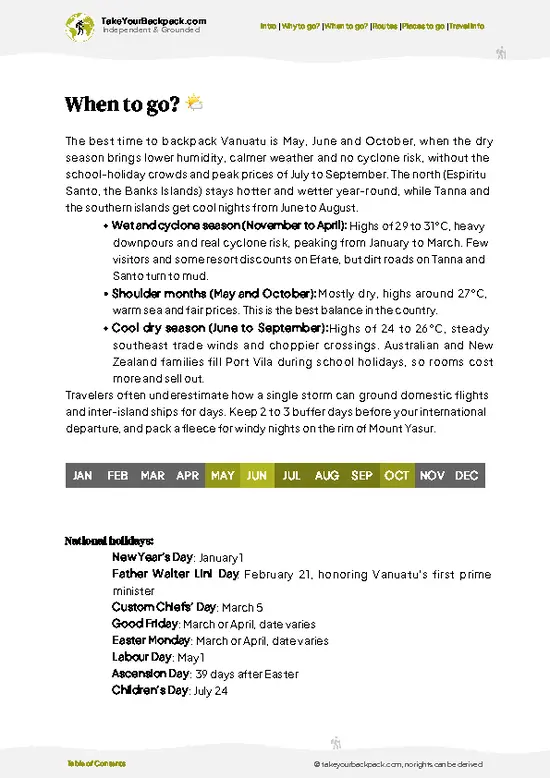
  • Dry Season (May to October): Daytime highs run 26 to 29°C (79 to 84°F), nights dip to 18 to 21°C (64 to 70°F), and the forest trails and the road from Port Vila stay firm underfoot. Sunrise is around 6:00 and sunset around 17:45, so plan walks for morning.
  • Wet Season (November to April): Expect 28 to 32°C (82 to 90°F), heavy humidity, and downpours that turn the Efate forest paths muddy and stir up mosquitoes. Cyclones can hit between January and March, and flights or ferries get disrupted. Days stretch to about 13 hours of light in December.
  • Crowds and Prices: Loru is a small community reserve on Santo, so you will rarely share it with other visitors in any month. Cruise ships and school holidays (July and December) push up flight and Luganville bed prices more than anything inside the reserve.
… read more 👉
  • Dry Season (May to October): Daytime highs run 26 to 29°C (79 to 84°F), nights dip to 18 to 21°C (64 to 70°F), and the forest trails and the road from Port Vila stay firm underfoot. Sunrise is around 6:00 and sunset around 17:45, so plan walks for morning.
  • Wet Season (November to April): Expect 28 to 32°C (82 to 90°F), heavy humidity, and downpours that turn the Efate forest paths muddy and stir up mosquitoes. Cyclones can hit between January and March, and flights or ferries get disrupted. Days stretch to about 13 hours of light in December.
  • Crowds and Prices: Loru is a small community reserve on Santo, so you will rarely share it with other visitors in any month. Cruise ships and school holidays (July and December) push up flight and Luganville bed prices more than anything inside the reserve.
  • Turtle and Bird Activity: The coconut crab and bird-watching season peaks in the cooler dry months, when the forest is quieter and calls carry.
Book a guide a few days ahead in July or December, since the local community runs access and staffing is small.


source: climatestotravel.comJANJanuary: fair for travelingFEBFebruary: fair for travelingMARMarch: fair for travelingAPRApril: fair for travelingMAYMay: highly recommended for travelingJUNJune: excellent for travelingJULJuly: excellent for travelingAUGAugust: highly recommended for travelingSEPSeptember: highly recommended for travelingOCTOctober: excellent for travelingNOVNovember: fair for travelingDECDecember: fair for traveling
vanuatu-national-park-loru-conservation-area
© Google | Vanuatu Moon

✈️ The backpacker research shortcutVanuatu Travel Guide

An offline-friendly backpacking guide with optimized travel routes, ranked highlights, transport advice, and the best areas to stay.
example page 0 from our offline Travel Guide for Vanuatu
example page 1 from our offline Travel Guide for Vanuatu
example page 2 from our offline Travel Guide for Vanuatu
example page 3 from our offline Travel Guide for Vanuatu
example page 4 from our offline Travel Guide for Vanuatu
example page 5 from our offline Travel Guide for Vanuatu
example page 6 from our offline Travel Guide for Vanuatu
example page 7 from our offline Travel Guide for Vanuatu
The digital guide (149 pages) contains:
✅ 41 highlights, ranked by travel appeal
✅ Optimized 2, 3 & 5-day travel routes
✅ Cities, national parks, landmarks, beaches
✅ How to get around
✅ Offline-friendly for travel without Wi-Fi
👉 Click to see all 30+ guide features

📅 Plan smarter in minutes, not weeks
✅ Month by month travel advice
✅ Festivals & national holidays
✅ Budget expectations

🗺️ Go to the right places, skip the overrated ones
✅ Honest pros & cons of destinations
✅ Top hikes, parks & viewpoints
✅ Lesser-known places most travelers miss
✅ Clear “worth it vs skip it” guidance

🛏️ Travel smoothly without rookie mistakes
✅ Best areas to stay
✅ Transport systems explained simply
✅ Common scams & safety advice
✅ SIM cards, money & practical tips

🌍 Understand the country, not just visit it
✅ Culture & traditions
✅ 52 Essential phrases & customs
✅ Festivals worth planning around
✅ Traveler-friendly historical context
✅ Insights that make places more meaningful

📱 Built for real travel conditions
✅ Fully downloadable PDF
✅ Works completely offline
✅ Optimized for phone use
✅ Useful in remote areas & buses
✅ Everything in one place
Save weeks of stressful planning
Get instant access to your full guide. 30‑day money-back guarantee.
+ Add another guide for just

By proceeding you agree to our terms.
Sent to your inbox immediately after payment • 100% Secure Checkout
Best Backpacking Travel Advisor 2025 tourism awardBest Backpacking
Travel Advisor
2025
What others say about Take Your Backpack Guides:
⭐⭐⭐⭐⭐
Fantastic, amazing amount of information!
⭐⭐⭐⭐⭐
My goodness this is amazing, it's what I've been looking for hats off too you!
⭐⭐⭐⭐⭐
I think this is absolutely BRILLIANT
⭐⭐⭐⭐
Very complete and informative. It's still missing places, but I gotta to commend you
⭐⭐⭐⭐⭐
This is truly amazing, thank you, can't wait to explore it with my kids!
⭐⭐⭐⭐⭐
Awesome resource, thank you!
⭐⭐⭐⭐⭐
This is amazing! Can't wait to explore the ones I haven't seen
⭐⭐⭐⭐
I love this! Well done, great idea.
⭐⭐⭐⭐⭐
Thanks for taking the time to make this gem!
⭐⭐⭐⭐⭐
This might be the best website I've ever seen.
⭐⭐⭐⭐⭐
Congratulations, and thank you so much for your work; it's incredibly valuable.
⭐⭐⭐⭐
In all seriousness I think you did a great job pointing out the important spots
⭐⭐⭐⭐⭐
10/10 very good
⭐⭐⭐⭐⭐
As someone who's only just starting to visit regularly this is awesome, thank you.
⭐⭐⭐⭐
Thank you very much! I'm going to visit my dad, it's going to be very useful!
⭐⭐⭐⭐⭐
This is really cool! We'll be travelling for the first time and this definitely come in handy.
⭐⭐⭐⭐⭐
You are now our minister of culture, congratulations 👨‍💼
⭐⭐⭐⭐⭐
Just wanted to tell you that this is a pearl! Going to follow your recommendations.
⭐⭐⭐⭐⭐
This is so cool. I'll definitely be using the resource for my travels soon.
⭐⭐⭐⭐⭐
This is very impressive! Good work.
⭐⭐⭐⭐⭐
This is an amazing and informative site. Very well done!

🛏️ Where to stay?Best areas to stay in Vanuatu

Most backpackers sleep in Luganville, the main town on Espiritu Santo, since Loru Conservation Area (on the east side of Santo, near Port Olry) has no formal accommodation inside the reserve itself. Luganville has hostel dorms, simple guesthouses and mid-range hotels, and it is where the airport, supermarkets, banks and the main market sit. Expect dorms from about 2,500 to 3,500 VT (US$21 to 30) and private rooms from 6,000 to 12,000 VT (US$50 to 100). From there, Loru is roughly an hour by road along the east coast, reachable by rental truck, hired driver or shared minibus to Port Olry.
The closest … read more 👉
Most backpackers sleep in Luganville, the main town on Espiritu Santo, since Loru Conservation Area (on the east side of Santo, near Port Olry) has no formal accommodation inside the reserve itself. Luganville has hostel dorms, simple guesthouses and mid-range hotels, and it is where the airport, supermarkets, banks and the main market sit. Expect dorms from about 2,500 to 3,500 VT (US$21 to 30) and private rooms from 6,000 to 12,000 VT (US$50 to 100). From there, Loru is roughly an hour by road along the east coast, reachable by rental truck, hired driver or shared minibus to Port Olry.
The closest practical base is Port Olry, a quiet fishing village with a long beach. Here you will find a few bungalow-style guesthouses and family-run stays, usually with fan rooms, shared facilities and meals arranged on request, at roughly 4,000 to 9,000 VT (US$34 to 76) a night. Staying here cuts your travel time to the reserve and puts you close to village life.
If you want to camp or sleep in a village homestay near the reserve, ask the local community or your guide. Arrangements are informal and need to be made in advance. Carry cash in vatu, since card machines are rare outside Luganville.

👛 Costs (as of 7 October 2026)What things cost and how to budget

A realistic budget for visiting Loru Conservation Area is about US$65 to 145 a day, once you include a Luganville or Port Olry bed, food, and transport to the reserve. Prices below are in US dollars, though you will pay in Vanuatu vatu (roughly 120 VT per US$1).
CategoryBudget RangeLocal Reality
Entrance and GuideUSD 10 to 25The community charges a small fee for access, and guided walks are priced per group. Pay in cash.
AccommodationUSD 25 to 60High season (July and December) runs from dorms and basic bungalows in Port Olry to guesthouses in Luganville. Low season is often a few dollars cheaper.
Local TransportUSD 10 to 25Shared minibuses from Luganville toward Port Olry are cheap, while a hired truck or driver for the day costs more but gives flexibility.
Food and SuppliesUSD 15 to 25Market produce,
… read more 👉
A realistic budget for visiting Loru Conservation Area is about US$65 to 145 a day, once you include a Luganville or Port Olry bed, food, and transport to the reserve. Prices below are in US dollars, though you will pay in Vanuatu vatu (roughly 120 VT per US$1).
CategoryBudget RangeLocal Reality
Entrance and GuideUSD 10 to 25The community charges a small fee for access, and guided walks are priced per group. Pay in cash.
AccommodationUSD 25 to 60High season (July and December) runs from dorms and basic bungalows in Port Olry to guesthouses in Luganville. Low season is often a few dollars cheaper.
Local TransportUSD 10 to 25Shared minibuses from Luganville toward Port Olry are cheap, while a hired truck or driver for the day costs more but gives flexibility.
Food and SuppliesUSD 15 to 25Market produce, rice and tinned fish are cheap, a restaurant meal in Luganville costs USD 8 to 15, and village meals are often arranged in advance.
Water and ExtrasUSD 5 to 10Bottled water, repellent and snacks from Luganville supermarkets, since shops near the reserve are small and limited.
Total Daily BudgetUSD 65 to 145Based on one high-season accommodation choice, a guide, shared transport and simple food.
⚠️ Prices can change and everyone travels differently, so take this as a rough guide. Hope it helps you plan your adventure!

🥾 TrailsWhere to hike in Loru Conservation Area: trails for every level

Loru is for easy to moderate forest walking, and the paths are short, shaded and mostly flat to gently rolling. They are not signed like a national park circuit. You walk the routes your community guide chooses, and the experience changes with the day, the fruiting trees and the weather.
  • Main forest loop: a guided walk of roughly two to three hours at a slow pace, starting at the community entry point and winding through lowland rainforest. The terrain is soft earth, roots and occasional muddy dips, and the difficulty is easy to moderate.
  • Birdwatching walk: the same paths done early in the morning
… read more 👉
Loru is for easy to moderate forest walking, and the paths are short, shaded and mostly flat to gently rolling. They are not signed like a national park circuit. You walk the routes your community guide chooses, and the experience changes with the day, the fruiting trees and the weather.
  • Main forest loop: a guided walk of roughly two to three hours at a slow pace, starting at the community entry point and winding through lowland rainforest. The terrain is soft earth, roots and occasional muddy dips, and the difficulty is easy to moderate.
  • Birdwatching walk: the same paths done early in the morning with frequent pauses. Fruit pigeons, parrots and the Vanuatu kingfisher are the targets, and the effort is low but patience matters.
  • Plant and culture walk: a slower version that focuses on useful trees, vines and medicinal plants. It is the best choice if you care more about local knowledge than distance covered.
  • Wildlife: expect flying foxes, forest birds, lizards and the signs of coconut crabs. Mosquitoes are active in the damp understory, so cover your arms and legs.
  • Terrain and footwear: wear closed shoes with grip, since leaf litter hides roots and the ground stays slick for a long time after rain. A light rain jacket, insect repellent and a water bottle are all you need.
Getting there is straightforward by local minibus or taxi on the island’s coastal road, then a short walk or ride to the community entrance. Arranging a guide in advance helps, since there is no staffed ticket office. Visitor numbers are very low, so you will often have the forest to yourself. A modest community fee or guide payment is usual, and it directly supports the conservation effort, so carry small bills in vatu.
⚠️ Hiking info can sometimes be outdated or inaccurate. Before you hit the trail, check the latest conditions with locals. If you do spot anything that's off, I'd love to hear from you, so I can update it for fellow travelers.

🛡️ SafetyStaying Safe: What Travelers Should Know

Loru is a low-risk place to walk, provided you treat the forest and weather with a bit of respect. Trails are narrow, root-laced and slick after rain, so shoes with real grip matter more than anything else you pack. Heat and humidity are the most common problems, and a liter or two of water per person plus a light long-sleeved layer will handle most of it. Mosquitoes carry dengue in Vanuatu, so use repellent at dawn and dusk. Malaria is present on Santo, so speak to a travel clinic about prophylaxis before you go.
There are no dangerous large animals. Watch for wasps and the odd centipede when you step off the path. Coconut crabs and birds are protected here, so look without touching or feeding.
Go with a local guide. The reserve is community-owned, paths are not signed in detail, and cellphone … read more 👉
Loru is a low-risk place to walk, provided you treat the forest and weather with a bit of respect. Trails are narrow, root-laced and slick after rain, so shoes with real grip matter more than anything else you pack. Heat and humidity are the most common problems, and a liter or two of water per person plus a light long-sleeved layer will handle most of it. Mosquitoes carry dengue in Vanuatu, so use repellent at dawn and dusk. Malaria is present on Santo, so speak to a travel clinic about prophylaxis before you go.
There are no dangerous large animals. Watch for wasps and the odd centipede when you step off the path. Coconut crabs and birds are protected here, so look without touching or feeding.
Go with a local guide. The reserve is community-owned, paths are not signed in detail, and cellphone coverage can be patchy. Tell your host where you are headed, and avoid walking in the dark. During cyclone season, check forecasts before leaving town.

FAQCommon questions from travelers

One full day is enough for Loru Conservation Area itself, with a morning guided forest walk and time to look for birds and coconut crabs. Add a second day if you want to combine it with the beaches around Port Olry, which sits on the same stretch of Santo’s east coast. Most visitors base themselves in Luganville, about an hour away by road.
A car is not strictly needed, but it makes the trip far easier. Shared minibuses run from Luganville toward Port Olry along the east coast, costing a few dollars, and you can then arrange a local ride to the reserve. A hired truck or driver for the day from Luganville typically costs around US$50 to 100, depending on distance and waiting time.
Yes, expect a small community fee to enter Loru Conservation Area, usually paid in cash to the local guide or landowners. A guide is strongly advised, with costs of roughly US$10 to 25 per group depending on length of the walk. No national park permit is required, but arrange access in advance through your accommodation or the community.
⚠️ Things can change over time, so always validate details locally before you go.

Other Ni-Vanuatu national parks near Loru Conservation Area

Explore more nearby:

  • Vansa Bay Conservation Area—Low-tide shoreline, mangrove roots, community reef reserve, village kava| 11 km away
  • Blue Hole—limestone pools, freshwater swimming, jungle canopy, rope swings| 18 km away
  • Espiritu Santo—Champagne Beach bubbles, President Coolidge wreck, Millennium Cave, Mt Tabwemasana| 29 km away

💡 Not sure where to go next?
Create a personalized itinerary for Vanuatu including Loru Conservation Area and the places that fit your trip.

Generate my itinerary

👉 Discover all national parks

Or checkout all Vanuatu has to offer (think cities, towns, villages, national parks, hikes, beaches, festivals)
Country photo of Vanuatu

We 💚 feedbackParting advice and final tips

Most visitors treat Loru as a quick photo stop and rush the walk at midday, when the birds have gone quiet and the heat sits heavy under the canopy. Go early, ask your guide to slow down at every fruiting tree, and let the forest come to you. Pack binoculars, plenty of water and shoes you don’t mind getting muddy.

✍️ Help improve this page!
The information on this page is based on in-depth research, insights shared by experienced travelers, and feedback from the local travel community in Vanuatu. While every effort is made to keep the information accurate and current, conditions can change — so if you spot anything incorrect or outdated, please get in touch.


🙋‍♂️ Give feedback

👋 Meet the founderWho’s Behind Take Your Backpack?

Johan, backpacker and founder of TakeYourBackpackHi, I’m Johan (Netherlands 🇳🇱), the creator of TakeYourBackpack. Over the past 3 decades, I’ve backpacked through 90+ countries across six continents, gaining extensive experience with independent travel, long-term trips, and overland routes.

This site is built on a combination of firsthand travel experience and carefully curated insights from other backpackers. Many guides are based on places I’ve personally visited, while others bring together tips, observations, and practical advice shared by trusted travelers I’ve met along the way.

The goal is to provide realistic, experience-driven guidance — not generic itineraries — so you can explore destinations with better context, clearer expectations, and more confidence.