×

Venezuela🇻🇪 | festivalsFestival Internacional de TeatroTeresa Carreño halls, plaza street theater, physical comedy, small Caracas stages | things to do and best time to go

Explore Feria de la ChinitaExplore Festival de la Orquídea

Backpacking in Internacional de Teatro
By Johan Kruseman 🇳🇱 | Updated October 19, 2026

Festival Internacional de Teatro de Caracas is not a single-venue event; it spreads across the city, with shows in grand theaters, plazas and small independent halls. It takes place in Caracas, Venezuela’s capital, in the valley near the Ávila mountain, and centers on theater from Latin America and further afield: street companies, dance-theater, puppetry and contemporary drama. Audiences are mostly local students, artists and families, so the mood is warm and unpolished rather than touristy. Expect several weeks of programming, with many free outdoor shows and paid indoor ones at modest prices. Skip anything that needs fast Spanish if you have none, but physical theater and street work need no translation, and those are the best value. Go for the access to real Venezuelan cultural life. A first day could start with a free plaza performance in the afternoon, then a night show at Teatro Teresa Carreño.

Discover everything you want to know in the 📖 Venezuela Travel Guide.
Safety warning

The current risk level for Venezuela is high. Check the advice before going.


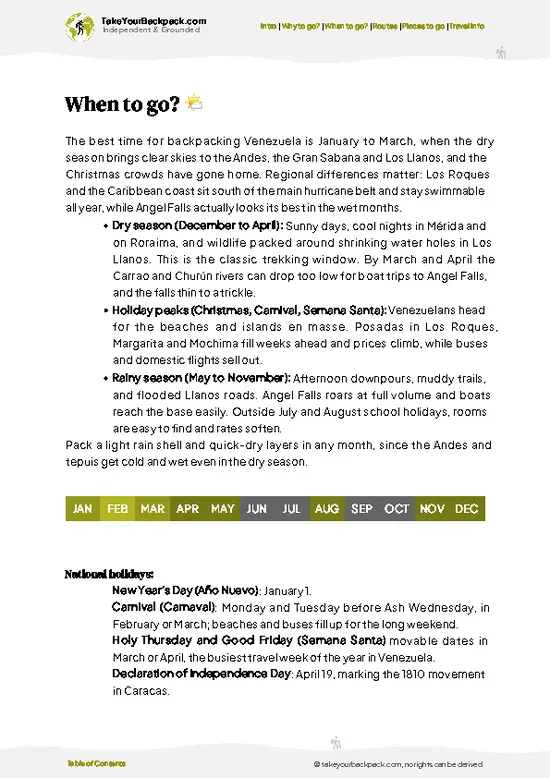
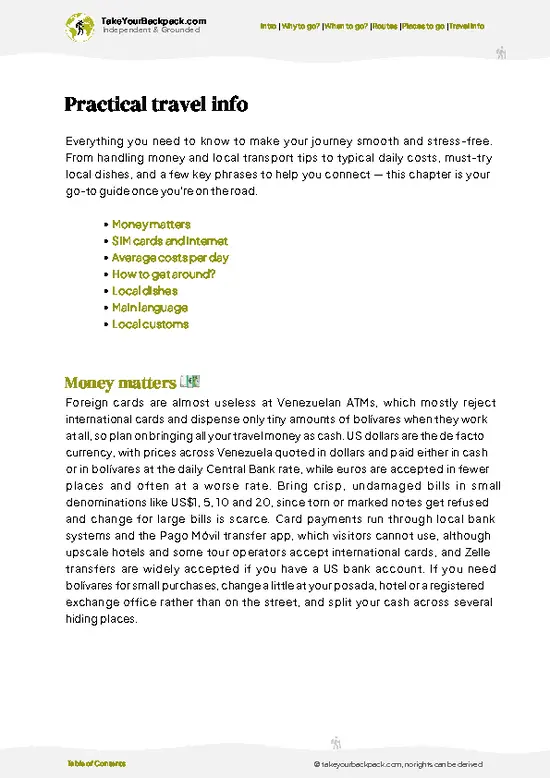
example page 0 from our offline Travel Guide for Venezuela
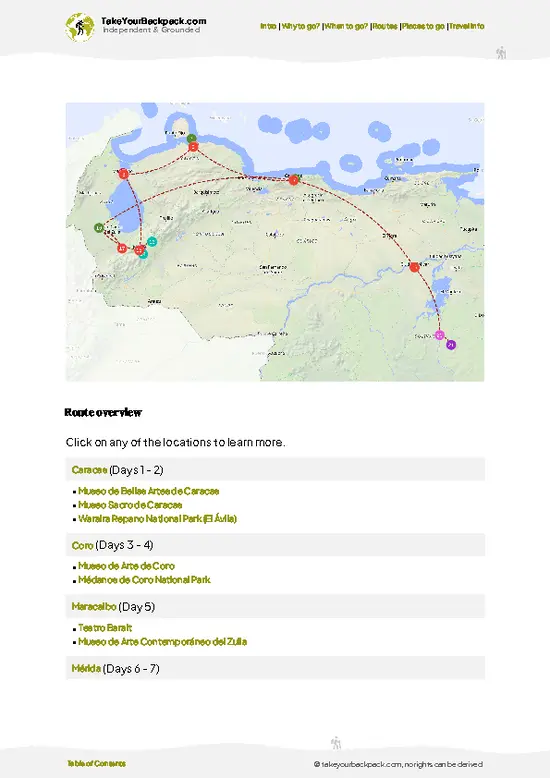
example page 1 from our offline Travel Guide for Venezuela
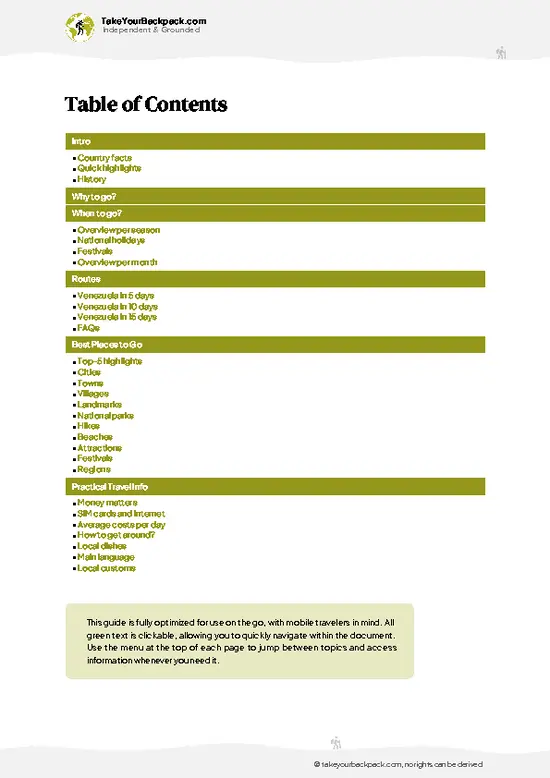
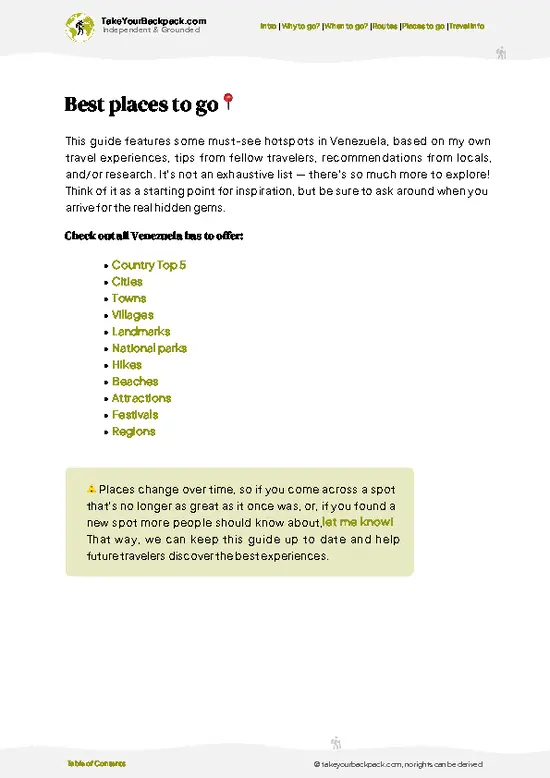
example page 2 from our offline Travel Guide for Venezuela
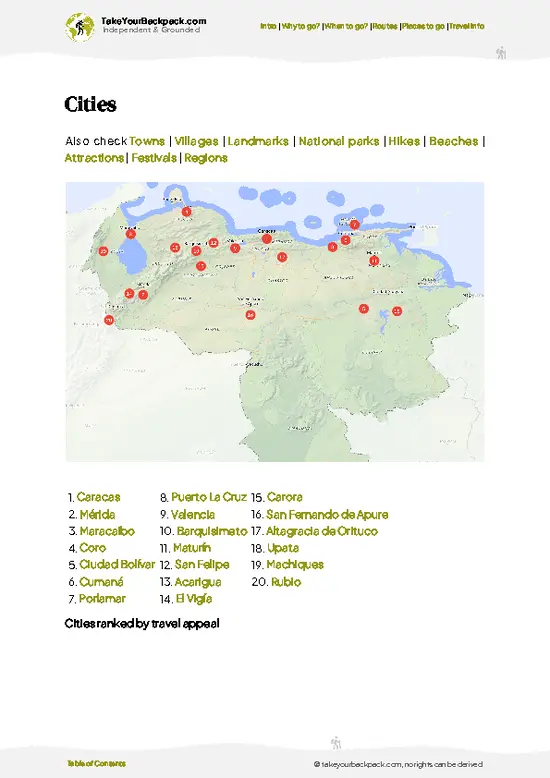
example page 3 from our offline Travel Guide for Venezuela
example page 4 from our offline Travel Guide for Venezuela
example page 5 from our offline Travel Guide for Venezuela
example page 6 from our offline Travel Guide for Venezuela
example page 7 from our offline Travel Guide for Venezuela
Loading the map 🌍
CLICK TO FILTER
cities
towns
villages
landmarks
national parks
hikes
beaches
attractions
festivals
regions
SHOW COUNTRY’S BESTSHOW ALL

✨ Why go?
Ranked #99 festival in Venezuela
Why visitors keep coming back

Festival Internacional de Teatro gives you a reason to see Caracas through its people instead of just passing through on the way to the coast or the Andes. Backpackers plan around it because the city’s cultural scene turns visible: companies from across Latin America arrive, and you can sit beside actors and students at the same free street shows. That is how you meet locals quickly, often over a late coffee or a shared bottle after a performance.

The second pull is value. Many open-air shows cost nothing, and the larger indoor tickets are far cheaper than comparable theater festivals in Europe or Buenos Aires. Venues cluster around the Teatro Teresa Carreño and the central plazas, so you can see several shows a day on foot or by metro.

It also fits longer routes well: Caracas links easily … read more 👉
Festival Internacional de Teatro gives you a reason to see Caracas through its people instead of just passing through on the way to the coast or the Andes. Backpackers plan around it because the city’s cultural scene turns visible: companies from across Latin America arrive, and you can sit beside actors and students at the same free street shows. That is how you meet locals quickly, often over a late coffee or a shared bottle after a performance.

The second pull is value. Many open-air shows cost nothing, and the larger indoor tickets are far cheaper than comparable theater festivals in Europe or Buenos Aires. Venues cluster around the Teatro Teresa Carreño and the central plazas, so you can see several shows a day on foot or by metro.

It also fits longer routes well: Caracas links easily to Los Roques, Mérida and the beaches of the Caribbean coast, so a few festival days make a lively start or finish.

💡 HighlightsWhat this place is best known for

  1. Teatro Teresa Carreño: the festival’s best-known stage, a huge modernist complex in central Caracas with several halls. Major international companies play here, and the acoustics and production values are the best you’ll find in the city.
  2. Street theater in the plazas: free performances in public squares draw crowds of families and students. Stilt walkers, physical comedy and puppetry need no Spanish, and the audience energy is half the show.
  3. Teatro Municipal de Caracas: a 19th-century opera-style house with gilded balconies. Seeing a play under its painted ceiling is a good contrast to the open-air shows.
  4. Independent and small-venue productions: local companies stage experimental pieces in intimate rooms. These are where you hear the sharpest Venezuelan voices on current life, with audiences
… read more 👉
  1. Teatro Teresa Carreño: the festival’s best-known stage, a huge modernist complex in central Caracas with several halls. Major international companies play here, and the acoustics and production values are the best you’ll find in the city.
  2. Street theater in the plazas: free performances in public squares draw crowds of families and students. Stilt walkers, physical comedy and puppetry need no Spanish, and the audience energy is half the show.
  3. Teatro Municipal de Caracas: a 19th-century opera-style house with gilded balconies. Seeing a play under its painted ceiling is a good contrast to the open-air shows.
  4. Independent and small-venue productions: local companies stage experimental pieces in intimate rooms. These are where you hear the sharpest Venezuelan voices on current life, with audiences of a few dozen and conversation with the cast afterward.
  5. International guest companies: troupes from across Latin America and beyond bring styles you won’t easily see otherwise, from contemporary dance-theater to classical adaptations. Pick one in a language you can follow, or one driven by movement.
The plaza street shows in the afternoon pair well with an evening performance at Teatro Teresa Carreño in the same day.
Spotted a mistake or missing something? Contact us.

🌤️ When to go?When is the celebration of Festival Internacional de Teatro?

The Festival Internacional de Teatro de Caracas has historically run for about two weeks in spring (March to April, in some editions later), with performances in Teatro Teresa Carreño, Teatro Municipal and smaller halls across central Caracas, and exact dates shift each edition.
  • Best days: The opening weekend carries the big international companies and street parades. Weekdays are quieter, and standby seats are easier to get.
  • Weather: Expect 22 to 30°C (72 to 86°F) in the city, with sun by day and a chance of short afternoon showers. Bring a light rain jacket, sunscreen and a sweater for chilly, air-conditioned halls.
  • Booking: Reserve a bed two to four weeks ahead. Prices near the venues can climb 20 to 40 percent on opening weekend. Buy tickets for headline shows as soon as the program is released.
… read more 👉
The Festival Internacional de Teatro de Caracas has historically run for about two weeks in spring (March to April, in some editions later), with performances in Teatro Teresa Carreño, Teatro Municipal and smaller halls across central Caracas, and exact dates shift each edition.
  • Best days: The opening weekend carries the big international companies and street parades. Weekdays are quieter, and standby seats are easier to get.
  • Weather: Expect 22 to 30°C (72 to 86°F) in the city, with sun by day and a chance of short afternoon showers. Bring a light rain jacket, sunscreen and a sweater for chilly, air-conditioned halls.
  • Booking: Reserve a bed two to four weeks ahead. Prices near the venues can climb 20 to 40 percent on opening weekend. Buy tickets for headline shows as soon as the program is released.
  • Crowds: Avoid the Autopista Francisco Fajardo and metro lines 1 at rush hour (6 to 9 am, 4 to 7 pm). Head home before 10 pm.
Arrive a day early to pick up tickets and get your bearings.


source: climatestotravel.comJANJanuary: not recommended for travelingFEBFebruary: not recommended for travelingMARMarch: excellent for travelingAPRApril: not recommended for travelingMAYMay: not recommended for travelingJUNJune: not recommended for travelingJULJuly: not recommended for travelingAUGAugust: not recommended for travelingSEPSeptember: not recommended for travelingOCTOctober: not recommended for travelingNOVNovember: not recommended for travelingDECDecember: not recommended for traveling

✈️ The backpacker research shortcutVenezuela Travel Guide

An offline-friendly backpacking guide with optimized travel routes, ranked highlights, transport advice, and the best areas to stay.
example page 0 from our offline Travel Guide for Venezuela
example page 1 from our offline Travel Guide for Venezuela
example page 2 from our offline Travel Guide for Venezuela
example page 3 from our offline Travel Guide for Venezuela
example page 4 from our offline Travel Guide for Venezuela
example page 5 from our offline Travel Guide for Venezuela
example page 6 from our offline Travel Guide for Venezuela
example page 7 from our offline Travel Guide for Venezuela
The digital guide (290 pages) contains:
✅ 91 highlights, ranked by travel appeal
✅ Optimized 5, 10 & 15-day travel routes
✅ Cities, national parks, landmarks, beaches
✅ How to get around
✅ Offline-friendly for travel without Wi-Fi
👉 Click to see all 30+ guide features

📅 Plan smarter in minutes, not weeks
✅ Month by month travel advice
✅ Festivals & national holidays
✅ Budget expectations

🗺️ Go to the right places, skip the overrated ones
✅ Honest pros & cons of destinations
✅ Top hikes, parks & viewpoints
✅ Lesser-known places most travelers miss
✅ Clear “worth it vs skip it” guidance

🛏️ Travel smoothly without rookie mistakes
✅ Best areas to stay
✅ Transport systems explained simply
✅ Common scams & safety advice
✅ SIM cards, money & practical tips

🌍 Understand the country, not just visit it
✅ Culture & traditions
✅ 52 Essential phrases & customs
✅ Festivals worth planning around
✅ Traveler-friendly historical context
✅ Insights that make places more meaningful

📱 Built for real travel conditions
✅ Fully downloadable PDF
✅ Works completely offline
✅ Optimized for phone use
✅ Useful in remote areas & buses
✅ Everything in one place
Stop searching, start planning
Get instant access to your full guide. 30‑day money-back guarantee.
+ Add another guide for just

By proceeding you agree to our terms.
Sent to your inbox immediately after payment • 100% Secure Checkout
Best Backpacking Travel Advisor 2025 tourism awardBest Backpacking
Travel Advisor
2025
What others say about Take Your Backpack Guides:
⭐⭐⭐⭐⭐
Fantastic, amazing amount of information!
⭐⭐⭐⭐⭐
My goodness this is amazing, it's what I've been looking for hats off too you!
⭐⭐⭐⭐⭐
I think this is absolutely BRILLIANT
⭐⭐⭐⭐
Very complete and informative. It's still missing places, but I gotta to commend you
⭐⭐⭐⭐⭐
This is truly amazing, thank you, can't wait to explore it with my kids!
⭐⭐⭐⭐⭐
Awesome resource, thank you!
⭐⭐⭐⭐⭐
This is amazing! Can't wait to explore the ones I haven't seen
⭐⭐⭐⭐
I love this! Well done, great idea.
⭐⭐⭐⭐⭐
Thanks for taking the time to make this gem!
⭐⭐⭐⭐⭐
This might be the best website I've ever seen.
⭐⭐⭐⭐⭐
Congratulations, and thank you so much for your work; it's incredibly valuable.
⭐⭐⭐⭐
In all seriousness I think you did a great job pointing out the important spots
⭐⭐⭐⭐⭐
10/10 very good
⭐⭐⭐⭐⭐
As someone who's only just starting to visit regularly this is awesome, thank you.
⭐⭐⭐⭐
Thank you very much! I'm going to visit my dad, it's going to be very useful!
⭐⭐⭐⭐⭐
This is really cool! We'll be travelling for the first time and this definitely come in handy.
⭐⭐⭐⭐⭐
You are now our minister of culture, congratulations 👨‍💼
⭐⭐⭐⭐⭐
Just wanted to tell you that this is a pearl! Going to follow your recommendations.
⭐⭐⭐⭐⭐
This is so cool. I'll definitely be using the resource for my travels soon.
⭐⭐⭐⭐⭐
This is very impressive! Good work.
⭐⭐⭐⭐⭐
This is an amazing and informative site. Very well done!

🛏️ Where to stay?Best areas to stay in Venezuela

Stay in Sabana Grande or Chacao, the two areas that put you within a short metro or taxi ride of the main theaters while keeping safety manageable.
Sabana Grande is the budget traveler’s base. It has a long pedestrian boulevard, metro line 1 access, cheap eateries and a steady stream of locals and backpackers, so you can walk back in the evening along busy streets. Keep to the main boulevard after dark and avoid side streets late at night.
Chacao and Altamira, on the eastern side, are calmer and noticeably safer at night. They have leafy streets, cafés, and the Altamira metro stop, and the social … read more 👉
Stay in Sabana Grande or Chacao, the two areas that put you within a short metro or taxi ride of the main theaters while keeping safety manageable.
Sabana Grande is the budget traveler’s base. It has a long pedestrian boulevard, metro line 1 access, cheap eateries and a steady stream of locals and backpackers, so you can walk back in the evening along busy streets. Keep to the main boulevard after dark and avoid side streets late at night.
Chacao and Altamira, on the eastern side, are calmer and noticeably safer at night. They have leafy streets, cafés, and the Altamira metro stop, and the social scene among travelers is stronger here, with shared dorms and guesthouses that attract solo visitors. Prices run a bit higher than Sabana Grande but the extra security is worth it if you are out late after shows.
Central Caracas around Plaza Venezuela and Los Caobos puts you closest to Teatro Teresa Carreño and the museums, handy for morning rehearsals and matinees, though it empties out after dark. Use a taxi at night from any of these areas, ordered through your accommodation rather than hailed on the street.

👛 Costs (as of 19 October 2026)What things cost and how to budget

Expect to spend about US$45 to 85 per day at the Festival Internacional de Teatro, with a high-season total around US$68.
CategoryBudget RangeLocal Reality
Festival ticketsUS$3 to 20 per showMany local and street performances are free, while headline shows at Teatro Teresa Carreño cost more.
AccommodationUS$12 to 30 per nightDorms and simple private rooms in Sabana Grande or Chacao, higher at peak weekends.
Local transportUS$2 to 8 per dayMetro rides cost cents, and taxis at night run US$3 to 8 per ride.
Food & drinksUS$10 to 20 per dayArepas, empanadas and set lunches are cheap, sit-down dinners cost more.
Miscellaneous expensesUS$3 to 10 per dayWater, snacks, SIM data, and small tips for ushers or guides.
Total Daily BudgetUS$45 to 85About US$68 using high-season accommodation, one ticket and mid-range spending.
⚠️ Prices can change and everyone travels differently, so take this as a rough guide. Hope it helps you plan your adventure!

🍲 FoodWhat to Eat & Drink

Food at the festival is mostly street and kiosk fare around the theaters, plus the cafés of central Caracas, so you eat well without fuss.
Go for an arepa stuffed with reina pepiada (chicken and avocado) or carne mechada, or a cachapa, a sweet corn pancake folded around salty queso de mano. Empanadas filled with cheese or shark (cazón) are the best quick snack between shows, and tequeños, fried cheese sticks, show up at almost every counter. Wash it down with papelón con limón, a cold drink of raw cane sugar and lime, or a fresh juice of mango or guanábana. For something stronger, try Venezuelan rum such as Santa Teresa, or a cold local beer like Polar.
Carry small US dollar bills, since many stalls take dollars in cash and some accept local currency or card transfers, but card machines are … read more 👉
Food at the festival is mostly street and kiosk fare around the theaters, plus the cafés of central Caracas, so you eat well without fuss.
Go for an arepa stuffed with reina pepiada (chicken and avocado) or carne mechada, or a cachapa, a sweet corn pancake folded around salty queso de mano. Empanadas filled with cheese or shark (cazón) are the best quick snack between shows, and tequeños, fried cheese sticks, show up at almost every counter. Wash it down with papelón con limón, a cold drink of raw cane sugar and lime, or a fresh juice of mango or guanábana. For something stronger, try Venezuelan rum such as Santa Teresa, or a cold local beer like Polar.
Carry small US dollar bills, since many stalls take dollars in cash and some accept local currency or card transfers, but card machines are unreliable. Small change is hard to come by, so pay with bills close to the price.
Lines at kiosks swell in the half hour before evening performances, so eat early. Portions are generous, and an arepa is often enough for a meal.

FAQTraveler FAQ

The Festival Internacional de Teatro de Caracas usually runs for about two weeks in spring, typically March into April, though exact dates shift each edition. Performances take place at Teatro Teresa Carreño, Teatro Municipal and smaller venues in central Caracas. Check the program a month ahead, since schedules are often confirmed late.
Attending the Festival Internacional de Teatro costs roughly US$45 to 85 a day for an independent traveler. Tickets run about US$3 to 20 per show, and many street and community performances are free. A dorm bed or simple room in Sabana Grande or Chacao adds US$12 to 30 per night.
For the Festival Internacional de Teatro, advance tickets are wise for headline international productions at Teatro Teresa Carreño, which can sell out on opening weekend. Smaller shows and street events usually allow entry on the day, often with standby seats for weekday performances. Buy a few days ahead at the venue box office or through the official program channels.
⚠️ Things can change over time, so always validate details locally before you go.

Other Venezuelan festivals near Internacional de Teatro

Explore more nearby:


💡 Not sure where to go next?
Create a personalized itinerary for Venezuela including Internacional de Teatro and the places that fit your trip.

Generate my itinerary

👉 Discover all festivals

Or checkout all Venezuela has to offer (think cities, towns, villages, national parks, hikes, beaches, festivals)
Country photo of Venezuela

We 💚 feedbackIs it worth it?

Many first-timers focus on the big halls and miss the post-show hour, when actors and audiences linger outside and talk. That is where invitations to the next night’s party appear. I would bring a small notebook, learn a few Spanish phrases for chatting about the show, and check the printed program each morning, since venues and times shift.

✍️ Help improve this page!
The information on this page is based on in-depth research, insights shared by experienced travelers, and feedback from the local travel community in Venezuela. While every effort is made to keep the information accurate and current, conditions can change — so if you spot anything incorrect or outdated, please get in touch.


🙋‍♂️ Give feedback

👋 Meet the founderWho’s Behind Take Your Backpack?

Johan, backpacker and founder of TakeYourBackpackHi, I’m Johan (Netherlands 🇳🇱), the creator of TakeYourBackpack. Over the past 3 decades, I’ve backpacked through 90+ countries across six continents, gaining extensive experience with independent travel, long-term trips, and overland routes.

This site is built on a combination of firsthand travel experience and carefully curated insights from other backpackers. Many guides are based on places I’ve personally visited, while others bring together tips, observations, and practical advice shared by trusted travelers I’ve met along the way.

The goal is to provide realistic, experience-driven guidance — not generic itineraries — so you can explore destinations with better context, clearer expectations, and more confidence.