v2.webp)
- Krujë Castle (Kalaja e Krujës) — The town’s defining fortress perched above the valley; walking the towers and walls gives the best historical context for the Ottoman sieges and unbeatable views over the plain toward Tirana and the coast.
- Skanderbeg Museum (inside the castle) — Dedicated to Albania’s national hero, the museum’s exhibits, armor replicas and dioramas are staged inside the castle keep, so you get history in the setting where much of it played out.
- Ethnographic Museum (traditional house museum) — A well-preserved Ottoman-era house with rooms set up to show everyday life, crafts and costumes; small but vivid, it’s the place to feel how people in the region actually lived centuries ago.
- Old Bazaar (Pazari i Vjetër) — Narrow, restored lanes full of stalls and small shops selling
- Krujë Castle (Kalaja e Krujës) — The town’s defining fortress perched above the valley; walking the towers and walls gives the best historical context for the Ottoman sieges and unbeatable views over the plain toward Tirana and the coast.
- Skanderbeg Museum (inside the castle) — Dedicated to Albania’s national hero, the museum’s exhibits, armor replicas and dioramas are staged inside the castle keep, so you get history in the setting where much of it played out.
- Ethnographic Museum (traditional house museum) — A well-preserved Ottoman-era house with rooms set up to show everyday life, crafts and costumes; small but vivid, it’s the place to feel how people in the region actually lived centuries ago.
- Old Bazaar (Pazari i Vjetër) — Narrow, restored lanes full of stalls and small shops selling silver filigree, rugs, antiques and souvenirs; it’s both a living craft hub and the social heart of old Krujë, perfect for pottering and people-watching.
- Silver filigree and artisan workshops — Krujë is famous for delicate silverwork; stepping into a small workshop to watch a jeweler or buy a piece is a genuine, local craft experience you won’t get from a soulless tourist shop.
- Castle viewpoints and terraces — Not a single spot but several terraces around the fortress where locals and visitors pause for long views of the Adriatic plain, the mountains, and the town’s red-tiled roofs — great for sunset photos or just a quiet sit.
- Ottoman-era lanes and merchant houses (historic quarter) — The cobbled alleys winding down from the castle are full of original stone houses and small courtyards; wandering them gives a real sense of the town’s continuity and everyday scale.
- Krujë Clock Tower (Kulla e Sahatit) and town square — A compact, walkable focal point in town; the tower and surrounding square are useful landmarks and a good place to see locals gather, markets set up or catch a local café for coffee.
- Local taverns and çaj (tea) houses in the bazaar area — Eating at a family-run tavern or sipping tea in a bazaar café is as culturally revealing as any museum: traditional dishes, home recipes and old-school hospitality that tell you more about the place than any plaque.
- Small exhibition and display rooms in the castle complex (arms, local finds) — Scattered exhibit rooms with arms, traditional costumes and archaeological finds complement the main museum and are worth a quick look to round out the historical picture.
Spotted a mistake or missing something? Contact us.

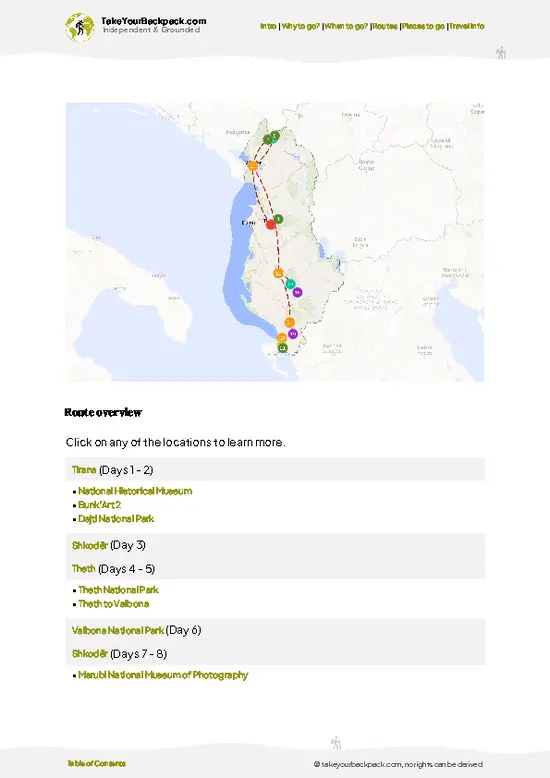
Kruja castle, the old Bazaar & Sarisalltik- Departure from Tirana

Hiking to Gamti, Bovilla Lake and Kruja Day Trip from Tirana

Kruja Castle, Museum & Bazaar Day Trip from Durres/Golem

Kruja, Old Bazaar, Museum,Sari Saltik tour from Tirana

Kruja & Durres; Semi - Private Day Tour from Tirana

Private Bovilla Lake and Kruja City Day Tour from Tirana

From Tirana: Kruja City, The Castle and Old Bazaar Day trip

Day Tour of Kruja Castle & Durrës fromTirana.

North & South Albania: A 5 Day Tour


 Best Backpacking
.jpg) Hi, I’m Johan (Netherlands 🇳🇱), the creator of TakeYourBackpack. Over the past 3 decades, I’ve backpacked through 90+ countries across six continents, gaining extensive experience with independent travel, long-term trips, and overland routes.
Hi, I’m Johan (Netherlands 🇳🇱), the creator of TakeYourBackpack. Over the past 3 decades, I’ve backpacked through 90+ countries across six continents, gaining extensive experience with independent travel, long-term trips, and overland routes.