×

Albania🇦🇱 | best townsBest 10 towns in Albania

Towns in Albania arrive as a layered set of smells and sounds: grilled lamb and diesel on a coastal promenade, church bells and the call to prayer in the same valley, espresso cups clinking on stone squares at dusk. The southern coast is the busiest and priciest in summer, with beach crowds and packed ferries. The stone-built hill towns of the south and center are quieter, steep and cobbled, with slow furgon (minibus) links. The northern mountain towns are the roughest to reach and the cheapest, with gravel roads and farm breakfasts. Independent travelers manage all of it with a bus app, patience and small cash.

By Johan Kruseman 🇳🇱 | Updated October 18, 2026
Explore the best villages in Albania

Why go?Key Factors That Shape the Experience

Albania’s towns are shaped by geography first. Mountains cover most of the country, so settlements cling to river gorges, hillsides and narrow coastal shelves rather than spreading across plains. The result is compact centers where stone lanes slope under your feet, and where you hear the same few things at once: scooters, church or mosque, and a neighbor shouting across a balcony.

History adds layers you can see and touch. Ottoman bazaars, Orthodox churches, communist-era concrete blocks painted in bright colors and small bunkers in fields all sit within a few kilometers of each other. Religious mix is unusual too: Muslim, Orthodox and Catholic communities share towns without much fuss, so cafés, bakeries and calls to prayer overlap in a single street.

Before choosing Albania for its towns, … read more 👉
Albania’s towns are shaped by geography first. Mountains cover most of the country, so settlements cling to river gorges, hillsides and narrow coastal shelves rather than spreading across plains. The result is compact centers where stone lanes slope under your feet, and where you hear the same few things at once: scooters, church or mosque, and a neighbor shouting across a balcony.

History adds layers you can see and touch. Ottoman bazaars, Orthodox churches, communist-era concrete blocks painted in bright colors and small bunkers in fields all sit within a few kilometers of each other. Religious mix is unusual too: Muslim, Orthodox and Catholic communities share towns without much fuss, so cafés, bakeries and calls to prayer overlap in a single street.

Before choosing Albania for its towns, know the infrastructure is uneven. There is no useful national rail network, and travel runs on minibuses (furgons) that leave when full and often from informal stops rather than stations. Roads range from fast new highways to potholed mountain tracks. Cash in lek is still the easiest way to pay at small cafés, guesthouses and buses. In return, prices stay low, hosts are generous with raki and coffee, and the towns feel lived in, not staged for visitors.
Behind the Scenes of Selection
The list of best towns in Albania is created based on charm, local culture, atmosphere, hidden gems, and visitor appeal. If you feel a town is missing in this list, please let us know.

When to go?Best Time to Visit Albania for towns

Best months: May, June and September are the best months for towns in Albania, with daytime highs of roughly 22 to 30°C, warm evenings for sitting outdoors and sea temperatures that suit a swim from June. Stone streets are pleasant to walk, light is golden by 6 p.m., and crowds stay manageable.
Summer peak: July and August push coastal temperatures to 30 to 36°C and inland valleys even higher, so midday lanes reflect heat off the stone. Coastal towns fill with Albanian, Kosovar and European holidaymakers, and room prices can climb by 30 to 60 percent compared with shoulder months, so book ahead in the south. Hill and mountain towns stay noticeably cooler, with evenings of about 15 to 20°C.
Shoulder and winter: April and October are good for hill towns, though showers arrive, and October often … read more 👉
Best months: May, June and September are the best months for towns in Albania, with daytime highs of roughly 22 to 30°C, warm evenings for sitting outdoors and sea temperatures that suit a swim from June. Stone streets are pleasant to walk, light is golden by 6 p.m., and crowds stay manageable.
Summer peak: July and August push coastal temperatures to 30 to 36°C and inland valleys even higher, so midday lanes reflect heat off the stone. Coastal towns fill with Albanian, Kosovar and European holidaymakers, and room prices can climb by 30 to 60 percent compared with shoulder months, so book ahead in the south. Hill and mountain towns stay noticeably cooler, with evenings of about 15 to 20°C.
Shoulder and winter: April and October are good for hill towns, though showers arrive, and October often brings the first heavy rain. From November to March, rain falls often along the coast and in the south, and the mountains in the north get snow, with 0 to 10°C days. Many seaside guesthouses, cafés and seasonal restaurants close from roughly October to April, while bazaars and city-style towns keep going. Northern mountain roads can become hard to pass in winter, so check the weather before committing.

town hoppingOptimizing Your Multi-Stop Itinerary

How many days: A trip linking several Albanian towns needs 7 to 14 days, with 10 days giving enough room without constant packing. The country is small, but mountain roads turn short distances into long rides.
Regions and direction: Tirana is the main transport hub, with buses and furgons fanning out to every region. Three clusters work well: the north (Shkodra and the Alps area), the center and interior (Berat and nearby hill towns), and the south (the coast and Gjirokastra). A north to south direction suits most routes, since you finish near the beaches and the Greek border or ferry links, and you avoid doubling back through Tirana.
Time per stop: Plan 1 to 2 nights for compact towns and 2 to 3 for places with a hiking or day-trip base. Typical travel between regions runs 2 to 4 hours, such … read more 👉
How many days: A trip linking several Albanian towns needs 7 to 14 days, with 10 days giving enough room without constant packing. The country is small, but mountain roads turn short distances into long rides.
Regions and direction: Tirana is the main transport hub, with buses and furgons fanning out to every region. Three clusters work well: the north (Shkodra and the Alps area), the center and interior (Berat and nearby hill towns), and the south (the coast and Gjirokastra). A north to south direction suits most routes, since you finish near the beaches and the Greek border or ferry links, and you avoid doubling back through Tirana.
Time per stop: Plan 1 to 2 nights for compact towns and 2 to 3 for places with a hiking or day-trip base. Typical travel between regions runs 2 to 4 hours, such as Tirana to Berat, and 4 to 6 hours for longer south or north hauls, with road conditions deciding the time.
Planning mistakes: The common error is stacking one town per day, which leaves most of the trip on a bus seat. Another is assuming a timetable exists: furgons leave when full, often by mid-afternoon at the latest, so travel in the morning. Leave a spare day for delays in the mountains, and book coastal beds early in summer.

The ListTop towns of Albania

1 Berat

Ottoman-era windows, hilltop castle, riverside quarters

Climb narrow stone lanes, discover layered architecture, and watch daily life unfold beneath the shadow of a centuries-old fortress.

albania-city-berat
© Google | Dhananjay Baghel

2 Gjirokastër

slate-roofed houses, fortress museum, cobbled bazaar

Trace the steep streets between stone mansions, explore a castle with panoramic views, and browse artisan shops in the old market.

albania-city-gjirokaster
© Google | Simo

3 Sarandë

ferry port, palm-lined esplanade, ancient Butrint nearby

Arrive by sea, walk the lively waterfront, and use the town as a base for exploring archaeological sites and southern beaches.

4 Shkodër

Rozafa Castle, lakefront cycling, Venetian-era streets

Cycle along the lakeshore, explore a castle with mountain views, and navigate a city shaped by trade and cross-border influences.

5 Krujë

mountain ridge, medieval bazaar, Skanderbeg museum

Walk the old market for crafts, visit a national hero’s stronghold, and take in sweeping views over the plains below.

albania-city-kruje
© Google | M L

6 Himarë

pebble beaches, Greek-speaking villages, coastal cliffs

Swim in clear Ionian waters, wander through hillside hamlets, and notice the blend of languages and traditions along the Albanian Riviera.

7 Pogradec

Lake Ohrid shore, lakeside promenade, freshwater fish

Relax by the water, sample local trout, and watch families gather along the tree-shaded paths beside one of Europe’s oldest lakes.

8 Korçë

broad boulevards, art deco buildings, winter festivals

Stroll tree-lined avenues, sample local beer, and join lively gatherings that reflect the city’s cultural and seasonal rhythms.

albania-city-korce
© Google | Nail Osmani

9 Përmet

thermal springs, Vjosa river, stone bridges

Soak in natural hot pools, hike river trails, and enjoy a town known for its hospitality and slow food traditions.

albania-city-permet
© Google | Simo

10 Lezhë

hilltop ruins, Adriatic marshes, Skanderbeg memorial

Visit a town where ancient walls overlook wetlands, and Albania’s national story is marked in stone and quiet landscapes.

11 Orikum

lagoon views, Roman ruins, fishing boats, coastal plain

Visit a working port where archaeological sites, quiet wetlands, and daily fishing routines shape the rhythm of local life.

12 Divjakë

lagoon park, birdwatching towers, pine forests

Venture into wetlands alive with birdlife, walk shaded trails, and experience a coastal town shaped by its protected natural surroundings.

albania-city-divjake
© Google |

13 Kukës

lake peninsula, post-communist architecture, borderland setting

Observe daily life in a rebuilt town, shaped by migration and proximity to Kosovo, surrounded by water and rugged hills.

14 Ersekë

alpine plateau, local cheese markets, quiet main square

Experience a slower pace in a highland town where mountain air, dairy traditions, and open landscapes shape daily routines.

15 Këlcyrë

Vjosa river gorge, Ottoman bridge, mountain backdrop, roadside markets

Follow the river through dramatic gorges, pause at old stone crossings, and sample local produce in a valley town shaped by trade routes.

albania-city-kelcyre
© Google |

16 Pustec

Lake Prespa, Macedonian culture, lakeside villages, reed beds

Cross into a lakeside community where Slavic traditions, birdlife, and tranquil water define the pace and flavor of each day.

Think you know Albania?

Prove you’re a true local — uncover 6 lesser-known towns in Albania that locals tend to keep to themselves.
Loading the map 🌍

Expert viewWhat You Should Know

How many towns: Visit four to six towns in a week or ten days. That count leaves room for one full day of walking in each, a long coffee on a square and a buffer for late minibuses. More than six means most of your Albania is seen through a window.
Which kind to prioritize: Choose by travel style. Hikers and slow travelers should lean toward the northern mountain towns, where you eat farm cheese, yogurt and grilled meat in family guesthouses and wake to cowbells. Culture-focused travelers do best in the stone hill towns, with Ottoman houses, castles and museums within a short climb. Beach travelers should pick one or two coastal towns and accept the summer crowds and pricier rooms, since the best swimming sits beyond the busiest strips. Mixing one of each kind gives the clearest picture of … read more 👉
How many towns: Visit four to six towns in a week or ten days. That count leaves room for one full day of walking in each, a long coffee on a square and a buffer for late minibuses. More than six means most of your Albania is seen through a window.
Which kind to prioritize: Choose by travel style. Hikers and slow travelers should lean toward the northern mountain towns, where you eat farm cheese, yogurt and grilled meat in family guesthouses and wake to cowbells. Culture-focused travelers do best in the stone hill towns, with Ottoman houses, castles and museums within a short climb. Beach travelers should pick one or two coastal towns and accept the summer crowds and pricier rooms, since the best swimming sits beyond the busiest strips. Mixing one of each kind gives the clearest picture of the country.
Budget: Budget US$25 to 40 a day in shoulder season for a dorm or simple guesthouse room (US$10 to 20), meals at local grills and bakeries (US$8 to 15) and local transport. Summer on the coast can raise that to US$45 to 70. Castle and museum entries usually cost 200 to 1,000 lek (about US$2 to 11). Intercity furgons run roughly 400 to 1,500 lek (about US$4 to 16) a leg, and local guides for half-day walks are about US$25 to 50. Keep lek in small notes, since cafés and minibus drivers rarely have change for large bills.
Safety and culture: Towns are generally safe, with petty theft the main concern at crowded summer spots. Driving is the real risk: overtaking is aggressive, and mountain roads lack guardrails, so many travelers stay on buses. Cross streets carefully, as drivers seldom yield. Dress modestly when entering mosques and churches, and remove shoes in mosques. Nodding and shaking the head can mean the opposite of what you expect (a shake can mean yes), so confirm with words. Accept the offered coffee or raki, since refusing a host’s hospitality can read as rude, and a short “faleminderit” (thank you) goes a long way. Rural areas may still hold unmarked mine or unexploded ordnance risks, so stay on marked paths when hiking, and you get safe, open trails with views over rooftops and valleys.

✈️ The backpacker research shortcutAlbania Travel Guide

An offline-friendly backpacking guide with optimized travel routes, ranked highlights, transport advice, and the best areas to stay.
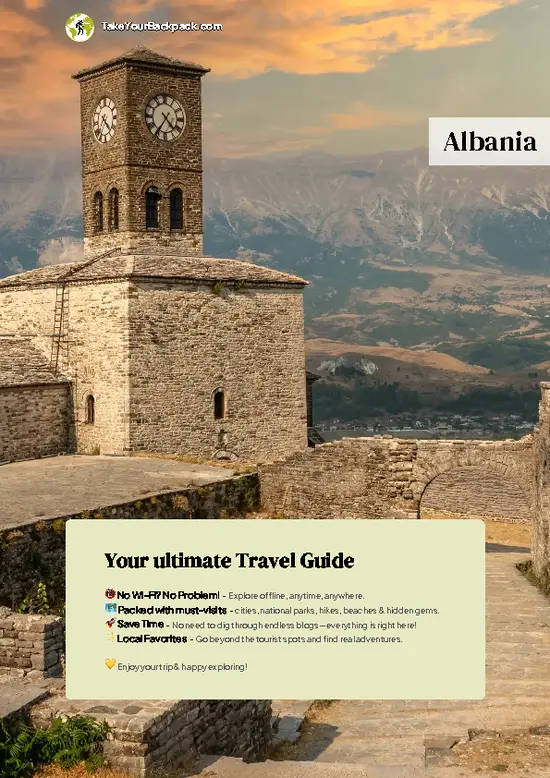
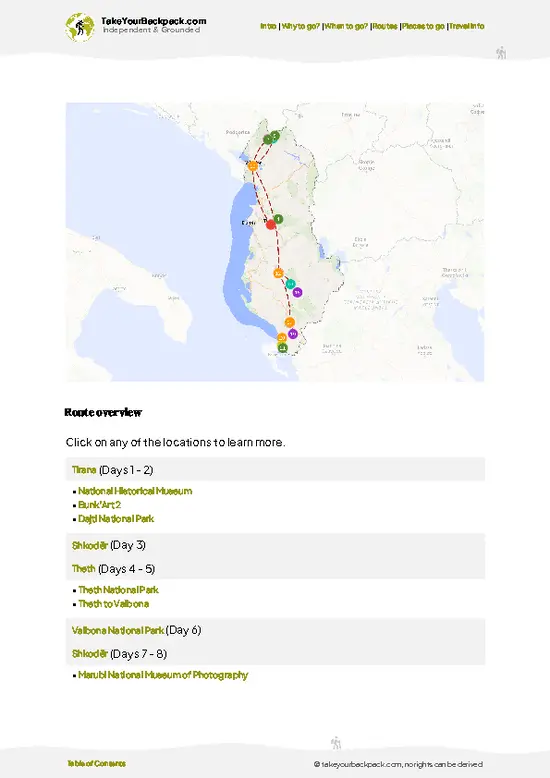
example page 0 from our offline Travel Guide for Albania
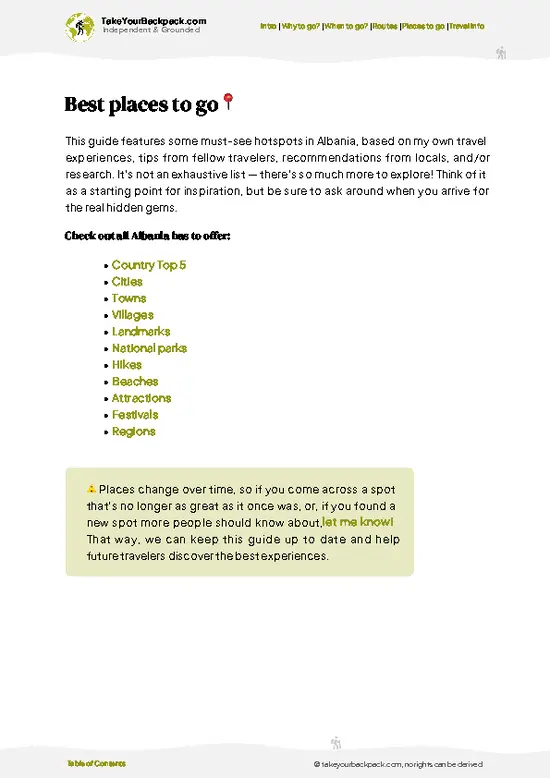
example page 1 from our offline Travel Guide for Albania
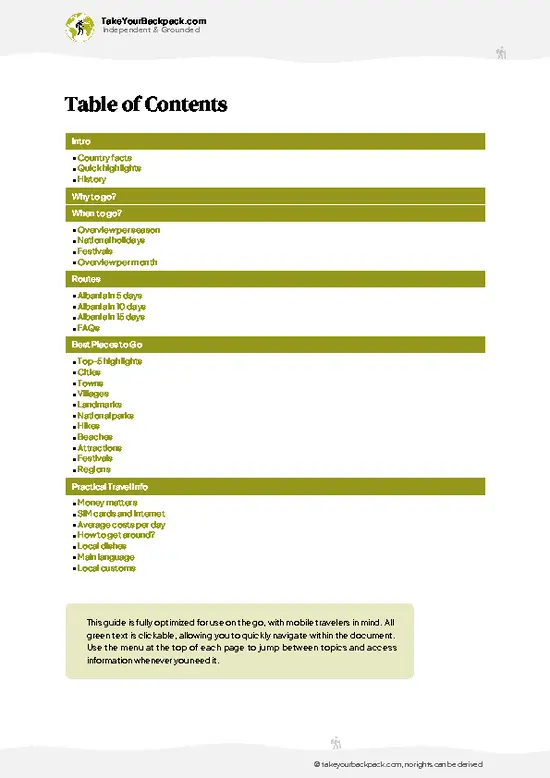
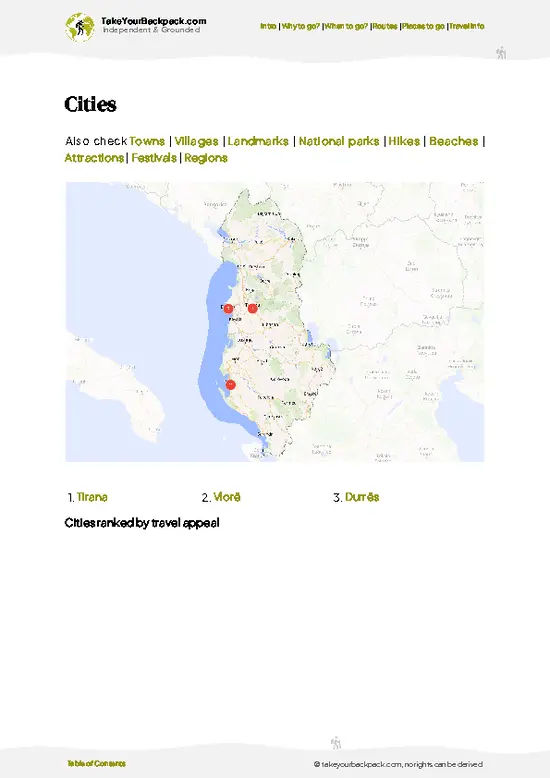
example page 2 from our offline Travel Guide for Albania
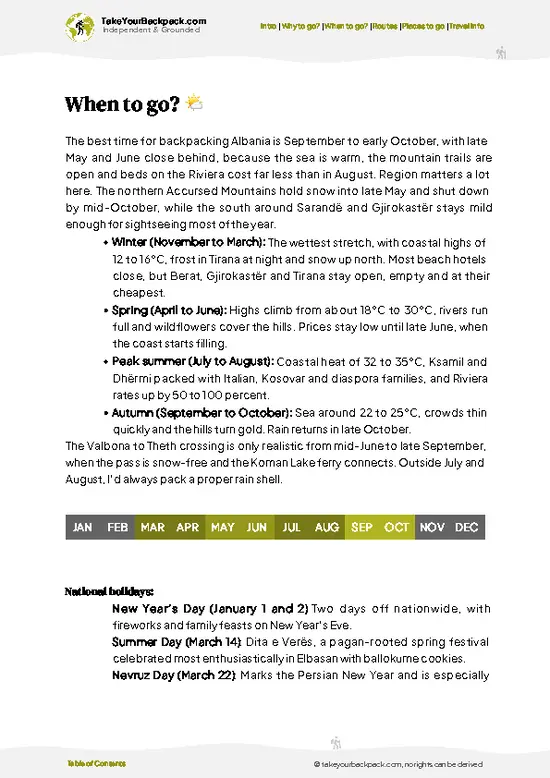
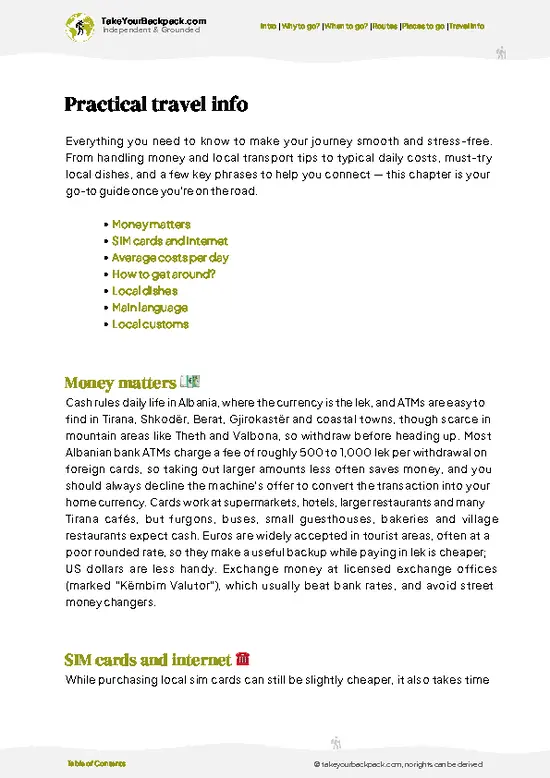
example page 3 from our offline Travel Guide for Albania
example page 4 from our offline Travel Guide for Albania
example page 5 from our offline Travel Guide for Albania
example page 6 from our offline Travel Guide for Albania
example page 7 from our offline Travel Guide for Albania
The digital guide (305 pages) contains:
✅ 78 highlights, ranked by travel appeal
✅ Optimized 5, 10 & 15-day travel routes
✅ Cities, national parks, landmarks, beaches
✅ How to get around
✅ Offline-friendly for travel without Wi-Fi
👉 Click to see all 30+ guide features

📅 Plan smarter in minutes, not weeks
✅ Month by month travel advice
✅ Festivals & national holidays
✅ Budget expectations

🗺️ Go to the right places, skip the overrated ones
✅ Honest pros & cons of destinations
✅ Top hikes, parks & viewpoints
✅ Lesser-known places most travelers miss
✅ Clear “worth it vs skip it” guidance

🛏️ Travel smoothly without rookie mistakes
✅ Best areas to stay
✅ Transport systems explained simply
✅ Common scams & safety advice
✅ SIM cards, money & practical tips

🌍 Understand the country, not just visit it
✅ Culture & traditions
✅ 52 Essential phrases & customs
✅ Festivals worth planning around
✅ Traveler-friendly historical context
✅ Insights that make places more meaningful

📱 Built for real travel conditions
✅ Fully downloadable PDF
✅ Works completely offline
✅ Optimized for phone use
✅ Useful in remote areas & buses
✅ Everything in one place
Stop searching, start planning
Get instant access to your full guide. 30‑day money-back guarantee.
+ Add another guide for just

By proceeding you agree to our terms.
Sent to your inbox immediately after payment • 100% Secure Checkout
Best Backpacking Travel Advisor 2025 tourism awardBest Backpacking
Travel Advisor
2025
What others say about Take Your Backpack Guides:
⭐⭐⭐⭐⭐
Fantastic, amazing amount of information!
⭐⭐⭐⭐⭐
My goodness this is amazing, it's what I've been looking for hats off too you!
⭐⭐⭐⭐⭐
I think this is absolutely BRILLIANT
⭐⭐⭐⭐
Very complete and informative. It's still missing places, but I gotta to commend you
⭐⭐⭐⭐⭐
This is truly amazing, thank you, can't wait to explore it with my kids!
⭐⭐⭐⭐⭐
Awesome resource, thank you!
⭐⭐⭐⭐⭐
This is amazing! Can't wait to explore the ones I haven't seen
⭐⭐⭐⭐
I love this! Well done, great idea.
⭐⭐⭐⭐⭐
Thanks for taking the time to make this gem!
⭐⭐⭐⭐⭐
This might be the best website I've ever seen.
⭐⭐⭐⭐⭐
Congratulations, and thank you so much for your work; it's incredibly valuable.
⭐⭐⭐⭐
In all seriousness I think you did a great job pointing out the important spots
⭐⭐⭐⭐⭐
10/10 very good
⭐⭐⭐⭐⭐
As someone who's only just starting to visit regularly this is awesome, thank you.
⭐⭐⭐⭐
Thank you very much! I'm going to visit my dad, it's going to be very useful!
⭐⭐⭐⭐⭐
This is really cool! We'll be travelling for the first time and this definitely come in handy.
⭐⭐⭐⭐⭐
You are now our minister of culture, congratulations 👨‍💼
⭐⭐⭐⭐⭐
Just wanted to tell you that this is a pearl! Going to follow your recommendations.
⭐⭐⭐⭐⭐
This is so cool. I'll definitely be using the resource for my travels soon.
⭐⭐⭐⭐⭐
This is very impressive! Good work.
⭐⭐⭐⭐⭐
This is an amazing and informative site. Very well done!

🛏️ Where to stay?Where to Base Yourself

Albania has a dense, cheap hostel scene, with dorm beds typically running 1,200 to 2,000 lek (about US$13 to 22) and private guesthouse rooms not far above that. In Tirana, the streets around Skanderbeg Square put you within walking distance of the main sights and bus connections, while Blloku has the best bars and cafés but louder nights and higher prices. Down south, Saranda packs hostels near the seafront promenade for beach access and summer nightlife, whereas the old quarters of Berat (Mangalem) and Gjirokastër (around the Old Bazaar) are quiet and atmospheric but involve steep cobbled climbs with a backpack.

If you enjoy meeting fellow travelers, consider choosing hostels with high ratings … read more 👉
Albania has a dense, cheap hostel scene, with dorm beds typically running 1,200 to 2,000 lek (about US$13 to 22) and private guesthouse rooms not far above that. In Tirana, the streets around Skanderbeg Square put you within walking distance of the main sights and bus connections, while Blloku has the best bars and cafés but louder nights and higher prices. Down south, Saranda packs hostels near the seafront promenade for beach access and summer nightlife, whereas the old quarters of Berat (Mangalem) and Gjirokastër (around the Old Bazaar) are quiet and atmospheric but involve steep cobbled climbs with a backpack.

If you enjoy meeting fellow travelers, consider choosing hostels with high ratings for atmosphere. On the other hand, if you prefer having your own space, a hotel might be a better option.

AlbaniaExpand Your Journey

👋 Meet the founderWho’s Behind Take Your Backpack?

Johan, backpacker and founder of TakeYourBackpackHi, I’m Johan (Netherlands 🇳🇱), the creator of TakeYourBackpack. Over the past 3 decades, I’ve backpacked through 90+ countries across six continents, gaining extensive experience with independent travel, long-term trips, and overland routes.

This site is built on a combination of firsthand travel experience and carefully curated insights from other backpackers. Many guides are based on places I’ve personally visited, while others bring together tips, observations, and practical advice shared by trusted travelers I’ve met along the way.

The goal is to provide realistic, experience-driven guidance — not generic itineraries — so you can explore destinations with better context, clearer expectations, and more confidence.