×

Algeria🇩🇿 | hikesHoggar MountainsMulti-day Atakor treks, Tahat ascent, phonolite plugs, Tuareg-guided | things to do and best time to go

Explore AssekremExplore Djurdjura Mountains

Backpacking in Hoggar Mountains
🌟 Highlighthike ranked #3
By Johan Kruseman 🇳🇱 | Updated October 22, 2026

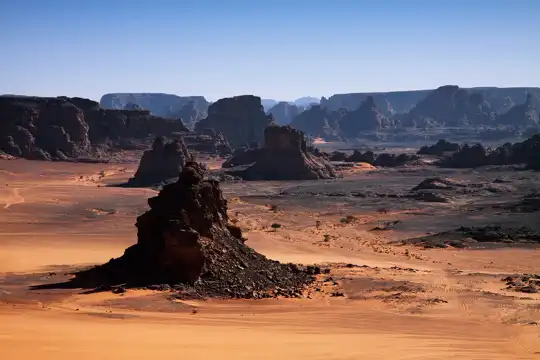
Hoggar Mountains (the Ahaggar) is a volcanic massif rather than a sand-dune landscape, and the air at 2,000 meters can drop below freezing on winter nights. It sits in the far south of Algeria, in the central Sahara, with Tamanrasset as the gateway town. Expect basalt spires, phonolite plugs, dry gravel wadis and acacia-dotted plateaus, all in a hard, pink-to-black light. Sound is mostly wind, goat bells and the crunch of rock underfoot. Treks run from a few days to two weeks, mostly at altitude with steep, loose scrambles, so fitness and acclimatization matter. Independent walking is not realistic here: access to the park and the Assekrem plateau goes through licensed Tuareg guides, and the start is a long 4x4 transfer from Tamanrasset, which has flights from Algiers. Silence and star-heavy skies are the payoff. Your first day could mean a pre-dawn 4x4 climb from Tamanrasset, a rocky walk to the Assekrem hermitage, and mint tea beside a fire as the peaks darken.

Discover everything you want to know in the 📖 Algeria Travel Guide.
Best time to go: October - May
Duration: 5 days
Distance: 50 kilometers
Total ascent: 1500 meters


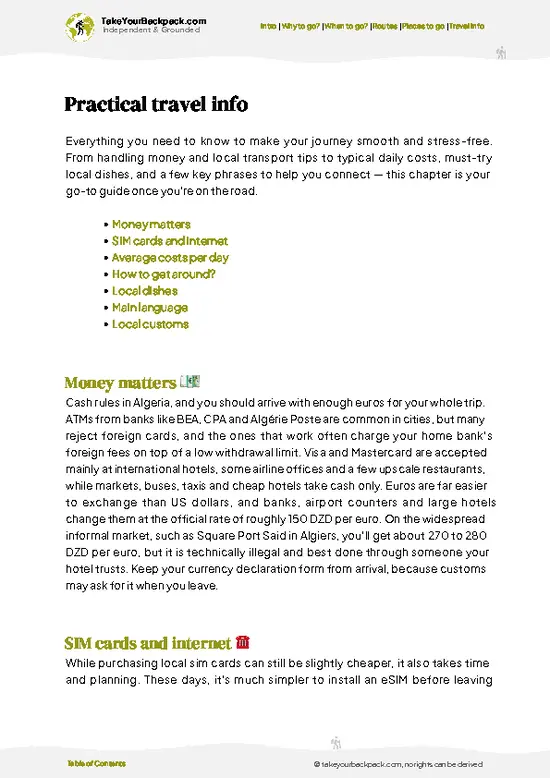
example page 0 from our offline Travel Guide for Algeria
example page 1 from our offline Travel Guide for Algeria
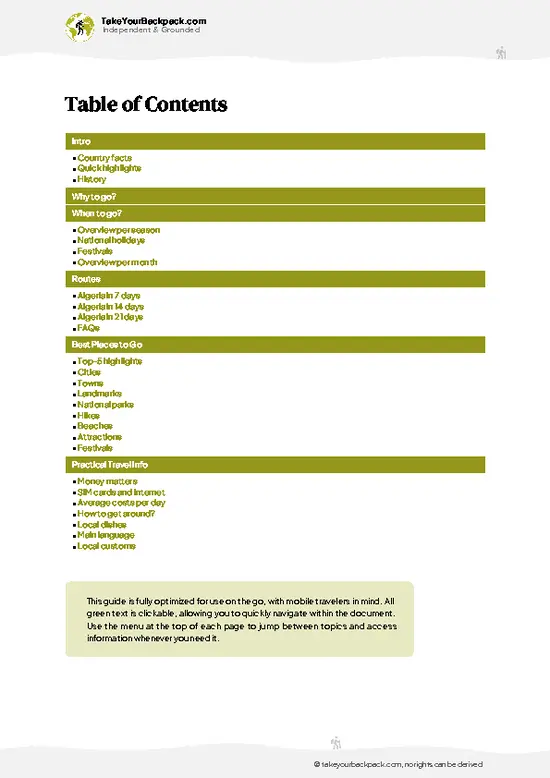
example page 2 from our offline Travel Guide for Algeria
example page 3 from our offline Travel Guide for Algeria
example page 4 from our offline Travel Guide for Algeria
example page 5 from our offline Travel Guide for Algeria
example page 6 from our offline Travel Guide for Algeria
example page 7 from our offline Travel Guide for Algeria
Loading the map 🌍
CLICK TO FILTER
cities
towns
landmarks
national parks
hikes
beaches
attractions
festivals
SHOW COUNTRY’S BESTSHOW ALL

✨ Why go?
Ranked #3 hike in Algeria
Why visitors keep coming back

Hoggar Mountains gives you a Saharan trek that feels nothing like the dune postcards: black volcanic needles rising out of pale sand, with walking days measured in rock, not sand. The main pull is the Assekrem plateau at about 2,700 meters, where the day starts and ends around a hermitage built by Charles de Foucauld, and the view over the spires is the one you came for. The second reason is the people. Treks are run with Tuareg guides and cooks who know every water pocket, camel track and shelter, so you eat fresh bread baked in the sand and sleep under a sky with almost no light pollution. Distances are flexible too. You can do a short loop from Assekrem in two or three days, or string together longer routes toward Tahat, Algeria’s highest peak at 2,908 meters, across a week or more. For … read more 👉
Hoggar Mountains gives you a Saharan trek that feels nothing like the dune postcards: black volcanic needles rising out of pale sand, with walking days measured in rock, not sand. The main pull is the Assekrem plateau at about 2,700 meters, where the day starts and ends around a hermitage built by Charles de Foucauld, and the view over the spires is the one you came for. The second reason is the people. Treks are run with Tuareg guides and cooks who know every water pocket, camel track and shelter, so you eat fresh bread baked in the sand and sleep under a sky with almost no light pollution. Distances are flexible too. You can do a short loop from Assekrem in two or three days, or string together longer routes toward Tahat, Algeria’s highest peak at 2,908 meters, across a week or more. For a veteran, the isolation is the draw. For a first-timer, the guided format removes the navigation risk.

💡 HighlightsWhat this place is best known for

  1. Assekrem Plateau and Hermitage: The best-known sight of the massif, at about 2,700 meters. A stone hermitage built by Charles de Foucauld in 1911 sits beside a sunrise and sunset viewpoint over hundreds of volcanic spires. Many groups sleep in basic shelters nearby to catch both light changes.
  2. Mount Tahat: At 2,908 meters, the highest peak in Algeria. The approach is a steady rocky climb across boulder fields and the summit gives a long view over the whole Atakor range. Allow a full day with a guide.
  3. Atakor Volcanic Plateau: The central core of the massif, a landscape of phonolite plugs and basalt towers. Walking here means loose scree, narrow ridges and sharp rock formations that change color through the day.
  4. Tassili Tamanrasset rock spires of Ilamane: Tall, narrow volcanic needles in the Atakor
… read more 👉
  1. Assekrem Plateau and Hermitage: The best-known sight of the massif, at about 2,700 meters. A stone hermitage built by Charles de Foucauld in 1911 sits beside a sunrise and sunset viewpoint over hundreds of volcanic spires. Many groups sleep in basic shelters nearby to catch both light changes.
  2. Mount Tahat: At 2,908 meters, the highest peak in Algeria. The approach is a steady rocky climb across boulder fields and the summit gives a long view over the whole Atakor range. Allow a full day with a guide.
  3. Atakor Volcanic Plateau: The central core of the massif, a landscape of phonolite plugs and basalt towers. Walking here means loose scree, narrow ridges and sharp rock formations that change color through the day.
  4. Tassili Tamanrasset rock spires of Ilamane: Tall, narrow volcanic needles in the Atakor region, popular for photography and scrambling. Their dark, vertical shapes stand out against pale gravel valleys.
  5. Tuareg Camps and Gardens near Hoggar: Small mountain settlements with irrigated plots, goats and tea fires. Stopping at one gives you contact with local life and a chance to buy simple crafts.
Assekrem is the best item for a first visit, since it needs the least walking and delivers the most dramatic light.
Spotted a mistake or missing something? Contact us.

🌤️ When to go?When to go for the best experience

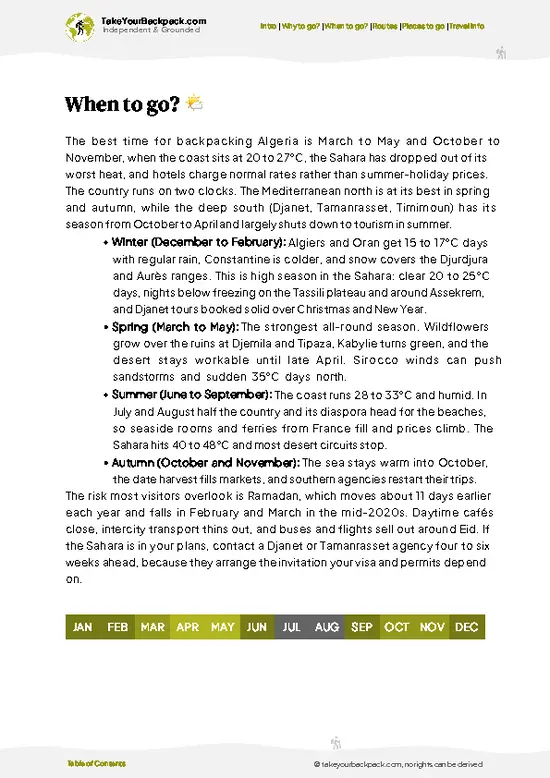
Late October to March is the window for trekking the Hoggar, with sunny days and cold nights.
  • Winter (December to February): Days run 15 to 22°C (59 to 72°F), and nights at Assekrem (about 2,700 m) can fall to -5 to 0°C (23 to 32°F). Daylight lasts roughly 10.5 hours. This is peak season, so Tamanrasset agencies fill up and prices for guides and 4x4 transfers are at their highest.
  • Autumn (October to November): Days of 22 to 28°C (72 to 82°F) and nights of 5 to 12°C (41 to 54°F) make walking easy. Crowds build toward December, and prices climb with them.
  • Spring (March to April): Days of 25 to 32°C (77 to 90°F) are warm but workable, and cool nights suit the high camps. Crowds thin and quotes become easier to negotiate. Dust and wind can reduce visibility.
  • Summer (May to September): Lowland heat
… read more 👉
Late October to March is the window for trekking the Hoggar, with sunny days and cold nights.
  • Winter (December to February): Days run 15 to 22°C (59 to 72°F), and nights at Assekrem (about 2,700 m) can fall to -5 to 0°C (23 to 32°F). Daylight lasts roughly 10.5 hours. This is peak season, so Tamanrasset agencies fill up and prices for guides and 4x4 transfers are at their highest.
  • Autumn (October to November): Days of 22 to 28°C (72 to 82°F) and nights of 5 to 12°C (41 to 54°F) make walking easy. Crowds build toward December, and prices climb with them.
  • Spring (March to April): Days of 25 to 32°C (77 to 90°F) are warm but workable, and cool nights suit the high camps. Crowds thin and quotes become easier to negotiate. Dust and wind can reduce visibility.
  • Summer (May to September): Lowland heat reaches 35 to 40°C (95 to 104°F), and the peaks stay around 25 to 30°C (77 to 86°F). Days are long, about 13 hours of light. Few groups operate, so prices drop, but midday walking is punishing.
Book your guide and transport a few weeks ahead for December and January, when demand spikes around the holidays.


source: climatestotravel.comJANJanuary: highly recommended for travelingFEBFebruary: highly recommended for travelingMARMarch: excellent for travelingAPRApril: highly recommended for travelingMAYMay: good for travelingJUNJune: fair for travelingJULJuly: below average for travelingAUGAugust: below average for travelingSEPSeptember: fair for travelingOCTOctober: excellent for travelingNOVNovember: highly recommended for travelingDECDecember: highly recommended for traveling
when-to-go

✈️ The backpacker research shortcutAlgeria Travel Guide

An offline-friendly backpacking guide with optimized travel routes, ranked highlights, transport advice, and the best areas to stay.
example page 0 from our offline Travel Guide for Algeria
example page 1 from our offline Travel Guide for Algeria
example page 2 from our offline Travel Guide for Algeria
example page 3 from our offline Travel Guide for Algeria
example page 4 from our offline Travel Guide for Algeria
example page 5 from our offline Travel Guide for Algeria
example page 6 from our offline Travel Guide for Algeria
example page 7 from our offline Travel Guide for Algeria
The digital guide (314 pages) contains:
✅ 79 highlights, ranked by travel appeal
✅ Optimized 7, 14 & 21-day travel routes
✅ Cities, national parks, landmarks, beaches
✅ How to get around
✅ Offline-friendly for travel without Wi-Fi
👉 Click to see all 30+ guide features

📅 Plan smarter in minutes, not weeks
✅ Month by month travel advice
✅ Festivals & national holidays
✅ Budget expectations

🗺️ Go to the right places, skip the overrated ones
✅ Honest pros & cons of destinations
✅ Top hikes, parks & viewpoints
✅ Lesser-known places most travelers miss
✅ Clear “worth it vs skip it” guidance

🛏️ Travel smoothly without rookie mistakes
✅ Best areas to stay
✅ Transport systems explained simply
✅ Common scams & safety advice
✅ SIM cards, money & practical tips

🌍 Understand the country, not just visit it
✅ Culture & traditions
✅ 52 Essential phrases & customs
✅ Festivals worth planning around
✅ Traveler-friendly historical context
✅ Insights that make places more meaningful

📱 Built for real travel conditions
✅ Fully downloadable PDF
✅ Works completely offline
✅ Optimized for phone use
✅ Useful in remote areas & buses
✅ Everything in one place
Stop searching, start planning
Get instant access to your full guide. 30‑day money-back guarantee.
+ Add another guide for just

By proceeding you agree to our terms.
Sent to your inbox immediately after payment • 100% Secure Checkout
Best Backpacking Travel Advisor 2025 tourism awardBest Backpacking
Travel Advisor
2025
What others say about Take Your Backpack Guides:
⭐⭐⭐⭐⭐
Fantastic, amazing amount of information!
⭐⭐⭐⭐⭐
My goodness this is amazing, it's what I've been looking for hats off too you!
⭐⭐⭐⭐⭐
I think this is absolutely BRILLIANT
⭐⭐⭐⭐
Very complete and informative. It's still missing places, but I gotta to commend you
⭐⭐⭐⭐⭐
This is truly amazing, thank you, can't wait to explore it with my kids!
⭐⭐⭐⭐⭐
Awesome resource, thank you!
⭐⭐⭐⭐⭐
This is amazing! Can't wait to explore the ones I haven't seen
⭐⭐⭐⭐
I love this! Well done, great idea.
⭐⭐⭐⭐⭐
Thanks for taking the time to make this gem!
⭐⭐⭐⭐⭐
This might be the best website I've ever seen.
⭐⭐⭐⭐⭐
Congratulations, and thank you so much for your work; it's incredibly valuable.
⭐⭐⭐⭐
In all seriousness I think you did a great job pointing out the important spots
⭐⭐⭐⭐⭐
10/10 very good
⭐⭐⭐⭐⭐
As someone who's only just starting to visit regularly this is awesome, thank you.
⭐⭐⭐⭐
Thank you very much! I'm going to visit my dad, it's going to be very useful!
⭐⭐⭐⭐⭐
This is really cool! We'll be travelling for the first time and this definitely come in handy.
⭐⭐⭐⭐⭐
You are now our minister of culture, congratulations 👨‍💼
⭐⭐⭐⭐⭐
Just wanted to tell you that this is a pearl! Going to follow your recommendations.
⭐⭐⭐⭐⭐
This is so cool. I'll definitely be using the resource for my travels soon.
⭐⭐⭐⭐⭐
This is very impressive! Good work.
⭐⭐⭐⭐⭐
This is an amazing and informative site. Very well done!

🛏️ Where to stay?Best areas and accommodation options

If you enjoy meeting fellow travelers, consider choosing hostels with high ratings for atmosphere. On the other hand, if you prefer having your own space, a hotel might be a better option.

🥾 Hike detailsEverything you need to know before hiking Hoggar Mountains

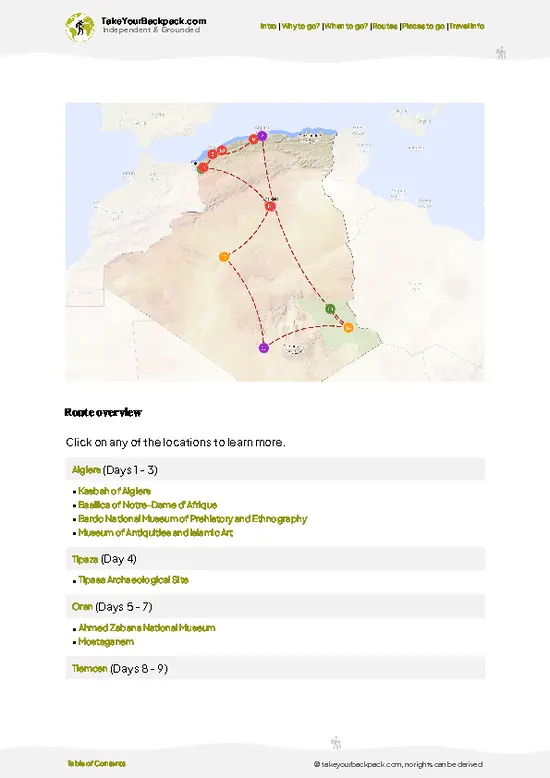
Hoggar Mountains trek overview: Hoggar Mountains offers guided treks of varying length around Assekrem and the Atakor plateau.
Total Distance: Typically 25 to 80 kilometers depending on the route, with classic multi-day loops around 40 to 60 kilometers.
Estimated Duration: 3 to 10 days, with 4 to 6 hours of walking per day.
Difficulty: Moderate to demanding. Altitude, loose rock, cold nights and hot days make it harder than the distances suggest.
Starting Point: Tamanrasset, reached by domestic flight from Algiers or long road routes. From there, a 4x4 transfer takes you into the mountains.
Major Landmarks:
  • Assekrem:
… read more 👉
Hoggar Mountains trek overview: Hoggar Mountains offers guided treks of varying length around Assekrem and the Atakor plateau.
Total Distance: Typically 25 to 80 kilometers depending on the route, with classic multi-day loops around 40 to 60 kilometers.
Estimated Duration: 3 to 10 days, with 4 to 6 hours of walking per day.
Difficulty: Moderate to demanding. Altitude, loose rock, cold nights and hot days make it harder than the distances suggest.
Starting Point: Tamanrasset, reached by domestic flight from Algiers or long road routes. From there, a 4x4 transfer takes you into the mountains.
Major Landmarks:
  • Assekrem: Hermitage and sunrise viewpoint at about 2,700 meters.
  • Tahat: Algeria’s highest summit at 2,908 meters.
  • Atakor: Volcanic plateau of spires and plugs.
Terrain and Scenery: Basalt and phonolite rock, boulder fields, dry wadis, sandy valleys and sharp ridges. Light turns the peaks from pink to near black.
Vegetation: Sparse. Acacia, tamarisk, wild olive and desert grasses grow in sheltered valleys and gardens.
Wildlife: Mostly small. Barbary sheep, foxes, lizards and hardy birds are possible, along with goats and camels kept by local herders.
⚠️ Hiking info can sometimes be outdated or inaccurate. Before you hit the trail, check the latest conditions with locals. If you do spot anything that's off, I'd love to hear from you, so I can update it for fellow travelers.

🛡️ SafetySafety Tips and Common Scams in Hoggar Mountains

Hoggar Mountains trekking is straightforward in good conditions, but the main hazards are cold, dryness and remoteness rather than technical terrain. Nights above 2,000 m in winter drop below freezing, so bring a sleeping bag rated to about -10°C (14°F) and warm layers, even though afternoons feel mild. Footing is loose volcanic rock and sand, and the peaks and ridges offer few landmarks. Trails are often faint, and the area is trackless in places, so walk with your guide and do not wander off alone. Water sources are scarce and seasonal, so carry at least 3 liters per person per day and ask your guide about refills at villages and guelta pools. Sun exposure is strong year-round, so wear a hat, sunglasses and sunscreen. Mobile coverage disappears outside Tamanrasset, so a satellite communicator … read more 👉
Hoggar Mountains trekking is straightforward in good conditions, but the main hazards are cold, dryness and remoteness rather than technical terrain. Nights above 2,000 m in winter drop below freezing, so bring a sleeping bag rated to about -10°C (14°F) and warm layers, even though afternoons feel mild. Footing is loose volcanic rock and sand, and the peaks and ridges offer few landmarks. Trails are often faint, and the area is trackless in places, so walk with your guide and do not wander off alone. Water sources are scarce and seasonal, so carry at least 3 liters per person per day and ask your guide about refills at villages and guelta pools. Sun exposure is strong year-round, so wear a hat, sunglasses and sunscreen. Mobile coverage disappears outside Tamanrasset, so a satellite communicator is a sensible backup. Check current travel advisories and local conditions before departure, and keep to routes your agency recommends. Treat any water from pools before drinking.

FAQTraveler FAQ

Hoggar Mountains treks run from a one-day excursion to Assekrem to 5 to 10 day circuits through Tahat and Atakor. The classic Assekrem hermitage trip from Tamanrasset takes 1 to 2 days, with a 4x4 transfer of about 3 to 4 hours each way. Longer walking routes through the Atakor volcanic massif usually cover 12 to 20 km per day. Many groups add a sunrise stop at Assekrem.
Hoggar Mountains trekking is moderate for most routes and demanding on the longer circuits. The main challenges are altitude of up to 2,700 m at Assekrem (Mount Tahat reaches about 2,908 m), cold nights, and 5 to 7 hours of walking on rocky, sandy ground. Short Assekrem visits need little fitness, while multi-day treks suit people comfortable with long days carrying a daypack. You will need to carry or arrange water.
Hoggar Mountains travel requires a licensed local guide, and treks go through an agency in Tamanrasset. A guided package including 4x4, food and camping typically costs about US$50 to 120 per person per day, depending on group size and season. Entry to the Ahaggar National Park needs a permit that your agency usually arranges, with fees of a few US dollars per person. Visitors also need an Algerian visa, and agencies often need passport details a week or more ahead.
⚠️ Things can change over time, so always validate details locally before you go.

Other Algerian hikes near Hoggar Mountains

Explore more nearby:

  • Assekrem—rocky plateau, desert sunrise, hermitage site| 10 km away
  • Djebel Chelia—highest summit, steep ascents, panoramic outlooks| 1342 km away
  • Atlas Mountains—broad ridgelines, Berber villages, seasonal rivers| 1402 km away

💡 Not sure where to go next?
Create a personalized itinerary for Algeria including Hoggar Mountains and the places that fit your trip.

Generate my itinerary

👉 Discover all hikes

Or checkout all Algeria has to offer (think cities, towns, villages, national parks, hikes, beaches, festivals)
Country photo of Algeria

We 💚 feedbackParting advice and final tips

Hoggar Mountains pairs best with a few days in Tamanrasset beforehand to acclimatize and organize a guide, and a flight back north to the Algerian coast afterward for a total contrast. I would bring a warm sleeping bag, because winter nights at Assekrem bite, and I would plan an extra buffer day.

✍️ Help improve this page!
The information on this page is based on in-depth research, insights shared by experienced travelers, and feedback from the local travel community in Algeria. While every effort is made to keep the information accurate and current, conditions can change — so if you spot anything incorrect or outdated, please get in touch.


🙋‍♂️ Give feedback

👋 Meet the founderWho’s Behind Take Your Backpack?

Johan, backpacker and founder of TakeYourBackpackHi, I’m Johan (Netherlands 🇳🇱), the creator of TakeYourBackpack. Over the past 3 decades, I’ve backpacked through 90+ countries across six continents, gaining extensive experience with independent travel, long-term trips, and overland routes.

This site is built on a combination of firsthand travel experience and carefully curated insights from other backpackers. Many guides are based on places I’ve personally visited, while others bring together tips, observations, and practical advice shared by trusted travelers I’ve met along the way.

The goal is to provide realistic, experience-driven guidance — not generic itineraries — so you can explore destinations with better context, clearer expectations, and more confidence.