How many hikes: Plan on
three to five hikes in a two- to three-week trip. That number fits Algeria’s reality: transfers are long, public transport is slow, and each region needs a day or two to arrange food, a guide or a lift. Fewer, longer walks leave you time for the glass of mint tea someone presses on you in a mountain village, which often becomes the highlight of the day.
Which kind to prioritize: If you travel on a
tight budget and want independence, focus on the northern mountains. You can walk with a local contact or hire a village guide, sleep in guesthouses and eat in small restaurants. If you want
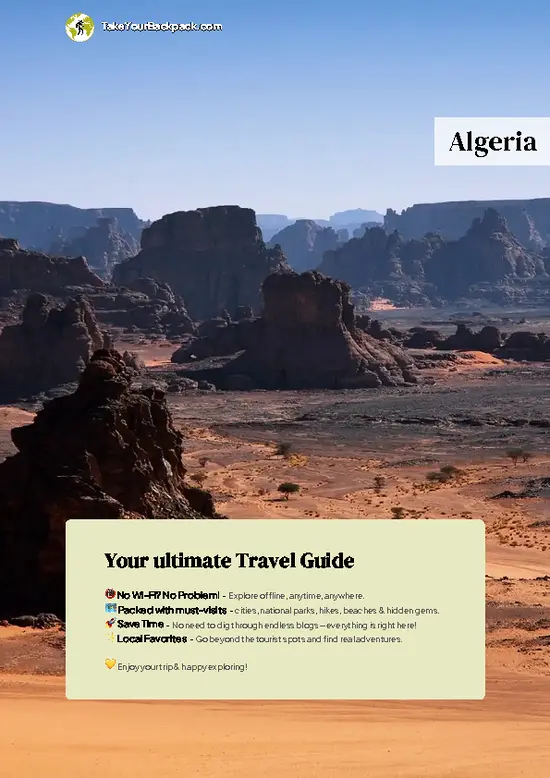
scale and silence, put the Sahara first: the Tassili and Hoggar deliver rock towers, dry riverbeds and starry nights that no northern ridge can match, but only with an agency. Short on …
read more 👉 How many hikes: Plan on
three to five hikes in a two- to three-week trip. That number fits Algeria’s reality: transfers are long, public transport is slow, and each region needs a day or two to arrange food, a guide or a lift. Fewer, longer walks leave you time for the glass of mint tea someone presses on you in a mountain village, which often becomes the highlight of the day.
Which kind to prioritize: If you travel on a
tight budget and want independence, focus on the northern mountains. You can walk with a local contact or hire a village guide, sleep in guesthouses and eat in small restaurants. If you want
scale and silence, put the Sahara first: the Tassili and Hoggar deliver rock towers, dry riverbeds and starry nights that no northern ridge can match, but only with an agency. Short on time, choose one northern range and one desert trek rather than three similar highland walks. Those who like culture alongside walking should lean toward the Aurès and Kabylia, where villages and markets are part of the day.
What it costs: In the north, expect
US$30 to 55 a day (roughly 4,000 to 7,500 Algerian dinars at the bank-rate scale used by agencies) covering a guesthouse or basic hotel at US$15 to 30, meals at US$5 to 12, and shared taxis or minibuses at US$2 to 10 per leg. A local guide for a day hike usually costs US$20 to 40. Saharan treks are priced as packages, typically
US$60 to 120 a day including guide, cook, food, camping gear and vehicle, plus park or permit fees that agencies fold in. Domestic flights to Djanet or Tamanrasset often run US$80 to 200 each way. A whole trip of two to three weeks commonly lands at US$900 to 2,000 excluding international flights. Carry cash, since cards are rarely accepted outside big hotels.
Safety and culture: Most travelers move through hiking areas without trouble, but
check your government’s current advice and avoid border zones in the far south and east, where movement is restricted. Use a registered agency for the Sahara; they handle checkpoints and permits. Carry your passport and copies, because police and gendarmes stop vehicles, and a polite, patient attitude speeds things along.
Carry
3 to 4 liters of water per person per day in the desert, sun protection, and warm layers for nights that drop near freezing. In the mountains, paths are often unsigned, so download offline maps and tell your host your route; mist can drop in fast.
Dress modestly in villages, with covered shoulders and knees, particularly for women. Ask before photographing people, and never photograph military or police sites. During Ramadan, avoid eating or drinking openly in public during daylight. Accept offered tea or bread when you can; refusing gently with a hand on the heart is understood, and a short greeting in French or Arabic opens doors in places where English is scarce.
v2.webp)


 Best Backpacking
.jpg) Hi, I’m Johan (Netherlands 🇳🇱), the creator of TakeYourBackpack. Over the past 3 decades, I’ve backpacked through 90+ countries across six continents, gaining extensive experience with independent travel, long-term trips, and overland routes.
Hi, I’m Johan (Netherlands 🇳🇱), the creator of TakeYourBackpack. Over the past 3 decades, I’ve backpacked through 90+ countries across six continents, gaining extensive experience with independent travel, long-term trips, and overland routes.