×

Algeria🇩🇿 | citiesAlgiersMediterranean port, Ottoman palaces, hillside districts | things to do and best time to go

Explore Plage ClovisExplore Annaba

Backpacking in Algiers
🏆 Top pickcity ranked #1
By Johan Kruseman 🇳🇱 | Updated June 8, 2026

Everyone’s heard that people come to Algiers for the whitewashed Casbah, but let’s be honest: the real game is played in the city’s contrasts—French colonial boulevards colliding with Ottoman palaces, the Mediterranean haze softening Soviet-era concrete, and the daily rhythm that’s equal parts café culture and call to prayer. Algiers sits on the country’s northern edge, climbing steep hills above the sea, a vantage point that’s as strategic as it is scenic. For backpackers, Algiers is a puzzle box: cheap street food and affordable metro rides, but a language barrier that can slow you down if you don’t have a few words of French or Arabic. You’ll find the Martyrs’ Memorial and the Bardo Museum genuinely worth your time, but nightlife is subdued and hostels are rare—expect to meet more locals than fellow travelers. Safety is solid by North African standards, but the city’s energy is more reserved than Oran’s party vibe or Constantine’s dramatic cliffs. Algiers rewards patience and curiosity; it’s not effortless, but that’s exactly why it sticks with you.

Discover everything you want to know in the 📖 Algeria Travel Guide.


Get your Algeria guide
91 ranked highlights, routes & tips, works offline (356 pages)
Loading the map 🌍
CLICK TO FILTER
cities
towns
landmarks
national parks
hikes
beaches
attractions
festivals
SHOW COUNTRY’S BESTSHOW ALL

✨ Why go?
Ranked #1 city in Algeria
Reasons people choose to visit here

Algiers is a strategic basecamp for backpackers navigating North Africa. The city’s affordability makes it a magnet for budget travelers, with hostels that offer both comfort and a chance to meet fellow adventurers. You’ll find delicious street food at every corner, allowing you to fuel up without breaking the bank.

The walkability of Algiers is a game-changer; you can easily explore its vibrant neighborhoods on foot, soaking in the local culture and architecture. While the city has its highlights, it’s also a launchpad for day trips to stunning coastal towns or the Sahara, making it a practical choice for those wanting to experience more of Algeria.

Nightlife here is surprisingly lively, with cafes and bars that buzz with energy, perfect for unwinding after a day of exploration. Plus, … read more 👉
Algiers is a strategic basecamp for backpackers navigating North Africa. The city’s affordability makes it a magnet for budget travelers, with hostels that offer both comfort and a chance to meet fellow adventurers. You’ll find delicious street food at every corner, allowing you to fuel up without breaking the bank.

The walkability of Algiers is a game-changer; you can easily explore its vibrant neighborhoods on foot, soaking in the local culture and architecture. While the city has its highlights, it’s also a launchpad for day trips to stunning coastal towns or the Sahara, making it a practical choice for those wanting to experience more of Algeria.

Nightlife here is surprisingly lively, with cafes and bars that buzz with energy, perfect for unwinding after a day of exploration. Plus, easy onward travel options connect you to other North African destinations, so you’re not stuck here if you want to keep moving.

In short, Algiers offers a blend of value, culture, and convenience that can elevate your backpacking journey, whether you choose to linger or just pass through.
Want to include Algiers in your Algeria route?
Create a personalized Algeria itinerary that includes Algiers and the places that fit your trip — based on your travel style, budget, and available time. Get your route in seconds.

Generate my trip

💡 HighlightsTop highlights of Algiers

  • La Casbah (the old medina) — A tangled, UNESCO-listed maze of white-washed houses, Ottoman palaces and tiny lanes where everyday life still plays out. Walk it slowly: stairways, viewpoints over the bay and hidden courtyards give a real feel for historic Algiers that no postcard can capture (and keep an eye on your bag in crowded alleys).
  • Maqam Echahid (Martyrs’ Memorial) — That dramatic concrete trio of palm leaves on the hill is the city’s modern symbol of independence. Aside from the photo-op, the site gives you sweeping views of Algiers and a sober, well-curated look at the war for independence.
  • Basilique Notre-Dame d’Afrique — Perched on a cliff above the bay, this 19th-century basilica offers both beautiful neo-Byzantine architecture and one of the best lookout points in the city.
read more 👉
  • La Casbah (the old medina) — A tangled, UNESCO-listed maze of white-washed houses, Ottoman palaces and tiny lanes where everyday life still plays out. Walk it slowly: stairways, viewpoints over the bay and hidden courtyards give a real feel for historic Algiers that no postcard can capture (and keep an eye on your bag in crowded alleys).
  • Maqam Echahid (Martyrs’ Memorial) — That dramatic concrete trio of palm leaves on the hill is the city’s modern symbol of independence. Aside from the photo-op, the site gives you sweeping views of Algiers and a sober, well-curated look at the war for independence.
  • Basilique Notre-Dame d’Afrique — Perched on a cliff above the bay, this 19th-century basilica offers both beautiful neo-Byzantine architecture and one of the best lookout points in the city. It’s also a quiet example of the city’s layered religious history; go for the view, stay for the atmosphere.
  • Jardin d’Essai du Hamma (Hamma Botanical Garden) — A shady, surprisingly vast green lung dating to the 19th century, full of palms, fountains and rare plants. Great for a relaxed afternoon, local families, and a break from the city’s heat and noise.
  • Ketchaoua Mosque — Sitting at the Casbah’s lower edge, this mosque (once a cathedral under the French) mixes Ottoman and Moorish details. It’s architecturally intriguing and right in the heart of the old city—easy to combine with a Casbah walk.
  • La Grande Poste d’Alger — One of Algiers’ most photogenic colonial buildings, with ornate facades and a buzzing square in front. Pop in to admire the interior tilework, watch life unfold on the steps, and grab a coffee at a nearby café.
  • Palais des Rais / Bastion 23 — A restored waterfront cluster of Ottoman-era houses and small museums at the foot of the Casbah. It’s quieter than the main tourist spots and perfect for sea views, seafood lunches and exploring alleyways that feel lifted from another century.
  • Musée National des Beaux-Arts d’Alger — One of Africa’s oldest fine art museums, with an impressive collection of Algerian and North African painting and sculptures. The building and collection together give you cultural context beyond the usual historic sites.
  • Musée National du Moudjahid — Focused on Algeria’s struggle for independence, this museum is full of documents, uniforms and personal stories that make the history tangible. Important for understanding why modern Algiers looks and feels the way it does.
  • La Corniche (seafront promenade) — The long coastal road and promenades that hug the Mediterranean—great for walking, watching fishermen, cheap seafood stalls and sunset views. It’s where locals go to unwind; evenings are especially lively.
A few excellent day trips within easy reach: the Roman ruins at Tipaza, the coastal town and museum at Cherchell, and the mountain scenery of Chréa National Park.
Spotted a mistake or missing something? Contact us.

Things to do in Algiers

Ratings based on Tripadvisor reviews. When you book through this link, you support our work at no extra cost to you.

🏘️ NeighborhoodsNeighborhood guide to Algiers

Algiers is a city where history and modernity collide, offering backpackers a rich tapestry of experiences. Here’s a breakdown of key neighborhoods to help you navigate your stay.

Kasbah: This UNESCO World Heritage site is a maze of narrow streets and stunning Ottoman architecture. The vibe is steeped in history, making it perfect for those who appreciate culture. Costs are moderate, with plenty of budget-friendly accommodations. Walkability is high, but be prepared for steep climbs. Nightlife is minimal; it’s more about quiet exploration. Ideal for short stays to soak in the atmosphere.

El Madania: Close to the waterfront, this area buzzes with local life. It’s a great spot for budget eats and markets. The vibe is lively, especially around the Jardin d’Essai. Walkability is excellent, and … read more 👉
Algiers is a city where history and modernity collide, offering backpackers a rich tapestry of experiences. Here’s a breakdown of key neighborhoods to help you navigate your stay.

Kasbah: This UNESCO World Heritage site is a maze of narrow streets and stunning Ottoman architecture. The vibe is steeped in history, making it perfect for those who appreciate culture. Costs are moderate, with plenty of budget-friendly accommodations. Walkability is high, but be prepared for steep climbs. Nightlife is minimal; it’s more about quiet exploration. Ideal for short stays to soak in the atmosphere.

El Madania: Close to the waterfront, this area buzzes with local life. It’s a great spot for budget eats and markets. The vibe is lively, especially around the Jardin d’Essai. Walkability is excellent, and public transport is easily accessible. Nightlife options are more relaxed, with cafes and bars. Suitable for both short and longer stays, especially if you want to blend in with locals.

Belouizdad: Known for its vibrant street art and youthful energy, this neighborhood is a bit off the tourist path. Costs are lower, making it a budget-friendly option. It’s walkable, but you might want to use public transport for longer distances. Nightlife is lively, with local music and gatherings. Best for longer stays if you want to immerse yourself in the local scene.

El Harrach: A suburban area that offers a glimpse into everyday Algerian life. It’s quieter and more residential, with lower costs. Walkability is decent, but public transport is essential for exploring further. Nightlife is subdued, focusing on family-oriented activities. Great for longer stays if you want a break from the tourist hustle.

⌛️ 1 daySeeing the highlights in 24 hours

Algiers, the capital of Algeria, is a city where history and modernity collide in a vibrant tapestry of culture. The Mediterranean breeze carries whispers of ancient empires, while the bustling streets pulse with contemporary life. It’s a place where you can wander through the remnants of Ottoman architecture and then sip coffee in a sleek café, all in the same day.

Start your morning in the Kasbah, a UNESCO World Heritage site. This labyrinth of narrow alleys and whitewashed buildings is a feast for the senses. Grab a flaky *boulangerie* pastry from a local vendor and enjoy it while exploring the winding streets. Don’t miss the stunning views of the bay from the top of the hill; it’s a perfect spot for a quick photo op.

As the sun climbs higher, make your way to the nearby Jardin d’Essai, … read more 👉
Algiers, the capital of Algeria, is a city where history and modernity collide in a vibrant tapestry of culture. The Mediterranean breeze carries whispers of ancient empires, while the bustling streets pulse with contemporary life. It’s a place where you can wander through the remnants of Ottoman architecture and then sip coffee in a sleek café, all in the same day.

Start your morning in the Kasbah, a UNESCO World Heritage site. This labyrinth of narrow alleys and whitewashed buildings is a feast for the senses. Grab a flaky *boulangerie* pastry from a local vendor and enjoy it while exploring the winding streets. Don’t miss the stunning views of the bay from the top of the hill; it’s a perfect spot for a quick photo op.

As the sun climbs higher, make your way to the nearby Jardin d’Essai, a botanical garden that feels like a secret oasis. Here, you can stroll among exotic plants and enjoy a moment of tranquility. It’s a lesser-known spot, often overlooked by tourists, but it’s a refreshing break from the urban hustle.

In the afternoon, head to the bustling district of El Madania. Visit the impressive Grande Poste, an architectural marvel that showcases the city’s French colonial past. Nearby, the vibrant market at Place du 1er Mai offers a sensory overload of colors and sounds. Sample some local street food—try the *couscous* or *mechoui*—and engage with the friendly vendors.

As evening approaches, make your way to the coastal promenade, the Corniche. This is where locals gather to unwind. Find a seaside café, order a mint tea, and watch the sunset paint the sky in hues of orange and pink.

Wrap up your day with a visit to the Museum of Modern Art, a hidden gem that showcases contemporary Algerian artists. It’s a perfect way to reflect on the day’s experiences while diving deeper into the local culture. Algiers may be a city of contrasts, but it’s these very contrasts that make it a captivating destination.
Turn your Algiers visit into an Algeria adventure
Build a complete Algeria route with Algiers, hidden gems, must-see destinations, and realistic travel times included.

Generate my trip

🌤️ When to go?Choosing the right time of year


  • Weather: Algiers enjoys a Mediterranean climate, meaning mild, wet winters and hot, dry summers. The best window is spring (April to June) when temperatures hover between 18-25°C (64-77°F), avoiding the oppressive summer heat that can soar above 30°C (86°F).

  • Temperature: Winter months (December to February) bring cooler weather, around 10-15°C (50-59°F), which is fine if you prefer brisk walks but expect rain. Summer highs often push past 30°C (86°F), making midday trekking less pleasant.

  • Daylight Hours: Spring and early summer offer long days, with up to 14 hours of daylight in June, maximizing your exploration time without rushing.

  • Crowds: Tourist numbers peak in July and August, especially along the coast. Visiting in shoulder seasons like April-May or September-October means fewer
read more 👉

  • Weather: Algiers enjoys a Mediterranean climate, meaning mild, wet winters and hot, dry summers. The best window is spring (April to June) when temperatures hover between 18-25°C (64-77°F), avoiding the oppressive summer heat that can soar above 30°C (86°F).

  • Temperature: Winter months (December to February) bring cooler weather, around 10-15°C (50-59°F), which is fine if you prefer brisk walks but expect rain. Summer highs often push past 30°C (86°F), making midday trekking less pleasant.

  • Daylight Hours: Spring and early summer offer long days, with up to 14 hours of daylight in June, maximizing your exploration time without rushing.

  • Crowds: Tourist numbers peak in July and August, especially along the coast. Visiting in shoulder seasons like April-May or September-October means fewer crowds, more authentic interactions, and less competition for budget accommodations.

  • Seasonal Activities: Spring brings blossoming gardens and outdoor markets in full swing, while summer hosts cultural festivals—though these can spike prices and crowd levels.

  • Price Fluctuations: Expect accommodation and flight prices to climb during summer and festival periods. Booking in spring or autumn often yields better deals without sacrificing comfort.


Pro-tip: Target late April to early June for the smartest balance of weather, daylight, crowd control, and wallet-friendly prices—turning your Algiers trip into a strategic win.


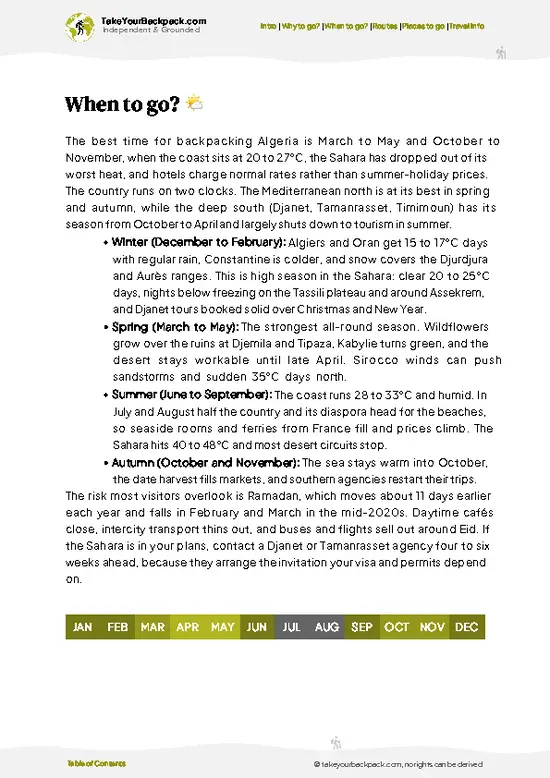
source: climatestotravel.comJANJanuary: fair for travelingFEBFebruary: fair for travelingMARMarch: good for travelingAPRApril: excellent for travelingMAYMay: excellent for travelingJUNJune: highly recommended for travelingJULJuly: fair for travelingAUGAugust: fair for travelingSEPSeptember: highly recommended for travelingOCTOctober: highly recommended for travelingNOVNovember: good for travelingDECDecember: fair for traveling
when-to-go

✈️ The backpacker research shortcutAlgeria Travel Guide

An offline-friendly backpacking guide with optimized travel routes, ranked highlights, transport advice, and the best areas to stay.
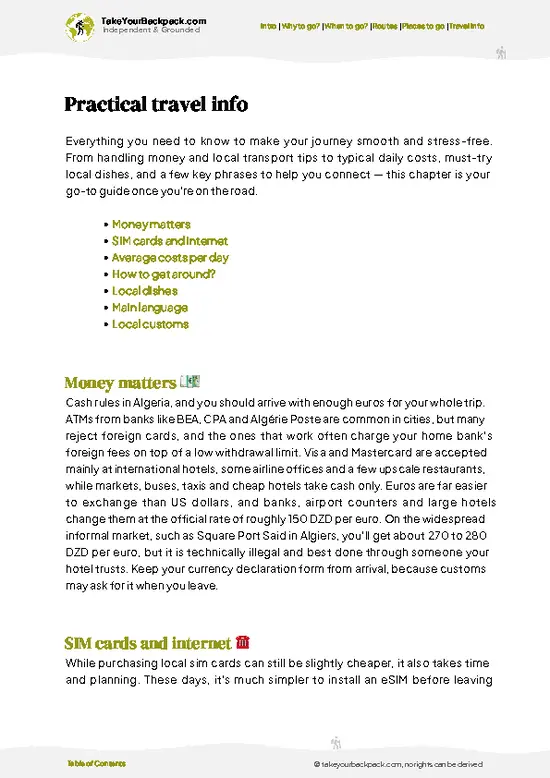
example page 0 from our offline Travel Guide for Algeria
example page 1 from our offline Travel Guide for Algeria
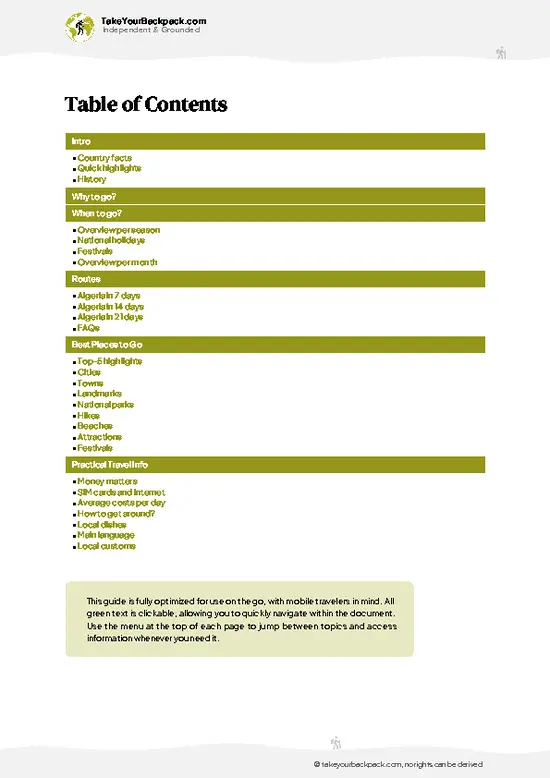
example page 2 from our offline Travel Guide for Algeria
example page 3 from our offline Travel Guide for Algeria
example page 4 from our offline Travel Guide for Algeria
example page 5 from our offline Travel Guide for Algeria
example page 6 from our offline Travel Guide for Algeria
example page 7 from our offline Travel Guide for Algeria
The digital guide (356 pages) contains:
91 highlights, ranked by travel appeal
Optimized 7, 14 & 21-day travel routes
Cities, national parks, landmarks, beaches
How to get around
Offline-friendly for travel without Wi-Fi
👉 Click to see all 30+ guide features

📅 Plan smarter in minutes, not weeks
Month by month travel advice
Festivals & national holidays
Budget expectations

🗺️ Go to the right places, skip the overrated ones
Honest pros & cons of destinations
Top hikes, parks & viewpoints
Lesser-known places most travelers miss
Clear “worth it vs skip it” guidance

🛏️ Travel smoothly without rookie mistakes
Best areas to stay
Transport systems explained simply
Common scams & safety advice
SIM cards, money & practical tips

🌍 Understand the country, not just visit it
Culture & traditions
52 Essential phrases & customs
Festivals worth planning around
Traveler-friendly historical context
Insights that make places more meaningful

📱 Built for real travel conditions
Fully downloadable PDF
Works completely offline
Optimized for phone use
Useful in remote areas & buses
Everything in one place
Save weeks of stressful planning
Get instant access to your full guide. 30‑day money-back guarantee.


By proceeding you agree to our terms.
Sent to your inbox immediately after payment • 100% Secure Checkout
Best Backpacking Travel Advisor 2025 tourism awardBest Backpacking
Travel Advisor
2025
What others say about Take Your Backpack Guides:
⭐⭐⭐⭐⭐
Fantastic, amazing amount of information!
⭐⭐⭐⭐⭐
My goodness this is amazing, it's what I've been looking for hats off too you!
⭐⭐⭐⭐⭐
I think this is absolutely BRILLIANT
⭐⭐⭐⭐
Very complete and informative. It's still missing places, but I gotta to commend you
⭐⭐⭐⭐⭐
This is truly amazing, thank you, can't wait to explore it with my kids!
⭐⭐⭐⭐⭐
Awesome resource, thank you!
⭐⭐⭐⭐⭐
This is amazing! Can't wait to explore the ones I haven't seen
⭐⭐⭐⭐
I love this! Well done, great idea.
⭐⭐⭐⭐⭐
Thanks for taking the time to make this gem!
⭐⭐⭐⭐⭐
This might be the best website I've ever seen.
⭐⭐⭐⭐⭐
Congratulations, and thank you so much for your work; it's incredibly valuable.
⭐⭐⭐⭐
In all seriousness I think you did a great job pointing out the important spots
⭐⭐⭐⭐⭐
10/10 very good
⭐⭐⭐⭐⭐
As someone who's only just starting to visit regularly this is awesome, thank you.
⭐⭐⭐⭐
Thank you very much! I'm going to visit my dad, it's going to be very useful!
⭐⭐⭐⭐⭐
This is really cool! We'll be travelling for the first time and this definitely come in handy.
⭐⭐⭐⭐⭐
You are now our minister of culture, congratulations 👨‍💼
⭐⭐⭐⭐⭐
Just wanted to tell you that this is a pearl! Going to follow your recommendations.
⭐⭐⭐⭐⭐
This is so cool. I'll definitely be using the resource for my travels soon.
⭐⭐⭐⭐⭐
This is very impressive! Good work.
⭐⭐⭐⭐⭐
This is an amazing and informative site. Very well done!

🛏️ Where to stay?Where staying makes the most sense

Algiers is a sprawling city where your choice of neighborhood shapes the entire trip experience. For backpackers, the key is balancing safety, social energy, and budget-friendly options, and that usually points to the central districts around the Casbah and the neighborhoods just north of it.

The Casbah itself is a double-edged sword. It’s the historic heart, full of winding alleys and local life, but it can feel a bit chaotic and less polished on safety and comfort fronts. It’s fascinating to visit but less ideal for overnight stays if you’re solo or new to the city. Instead, look just outside … read more 👉
Algiers is a sprawling city where your choice of neighborhood shapes the entire trip experience. For backpackers, the key is balancing safety, social energy, and budget-friendly options, and that usually points to the central districts around the Casbah and the neighborhoods just north of it.

The Casbah itself is a double-edged sword. It’s the historic heart, full of winding alleys and local life, but it can feel a bit chaotic and less polished on safety and comfort fronts. It’s fascinating to visit but less ideal for overnight stays if you’re solo or new to the city. Instead, look just outside the Casbah, toward the neighborhoods of El Madania and Hydra. These areas offer a more relaxed vibe with safer streets and a decent spread of hostels and budget guesthouses. You’ll find a mix of locals and travelers here, which makes it easier to connect without the tourist bubble.

El Madania is particularly good for social backpackers. It’s lively but not overwhelming, with cafes and small markets where you can hang out and meet people. Hydra leans a bit more upscale but still has affordable spots and a calm atmosphere, perfect if you want to recharge after a day of exploring.

Compared to the southern or eastern suburbs, which are more residential and less geared toward visitors, these central neighborhoods give you the best trade-off: enough comfort and safety to relax, enough social buzz to keep things interesting, and enough budget options to stretch your money without sacrificing experience.

🚌 Getting aroundHow to get from A to B

Algiers moves at its own rhythm—a blend of Mediterranean calm and North African hustle. It’s not a city where you’ll find everything running like clockwork, but neither is it a free-for-all. The flow here is a dance between the old and the new, where informal jitneys share the streets with official buses, and the pedestrian’s pace sets the tempo in the Casbah’s winding alleys. Time is flexible, but not infinite; money stretches further if you know where to invest it, and comfort is a relative concept shaped by the city’s layered history and vibrant street life. Understanding these trade-offs is your key to mastering Algiers’ transit game.


  • Walking: The ultimate budget option and the best way to absorb Algiers’ character. The Casbah and downtown are compact enough for exploring on foot,
read more 👉
Algiers moves at its own rhythm—a blend of Mediterranean calm and North African hustle. It’s not a city where you’ll find everything running like clockwork, but neither is it a free-for-all. The flow here is a dance between the old and the new, where informal jitneys share the streets with official buses, and the pedestrian’s pace sets the tempo in the Casbah’s winding alleys. Time is flexible, but not infinite; money stretches further if you know where to invest it, and comfort is a relative concept shaped by the city’s layered history and vibrant street life. Understanding these trade-offs is your key to mastering Algiers’ transit game.


  • Walking: The ultimate budget option and the best way to absorb Algiers’ character. The Casbah and downtown are compact enough for exploring on foot, but be ready for steep hills and uneven sidewalks. Zero cost, full immersion, but expect slower travel and some physical effort.


  • ETUSA Buses: The backbone of public transit, with routes covering most of the city. Buses start around 5:30 AM and run until about 10 PM. Tickets cost roughly 30 DZD (about $0.20), making it the cheapest motorized option. Expect crowded conditions during rush hours and variable punctuality—comfort is basic, but the price is unbeatable.


  • Taxi Collectifs (Shared Taxis): These are informal minibuses or sedans running fixed routes, often faster than buses because they weave through traffic and make fewer stops. Prices hover around 50-70 DZD per ride. They run from early morning until late evening but lack official schedules, so timing is unpredictable. Comfort is tight quarters but better speed and frequency.


  • Individual Taxis: Metered taxis offer door-to-door convenience and run 24/7, but fares can quickly add up—expect to pay at least 200 DZD for short trips within the city center. Negotiating a flat rate is common, especially at night. Comfort is higher than buses or shared taxis, but the cost and occasional traffic jams make this a trade-off between speed and budget.


  • Tramway: A newer addition to Algiers’ transit scene, the tram runs on a limited route connecting key neighborhoods. It operates roughly from 6 AM to 10 PM, with tickets around 40 DZD. It’s faster and more comfortable than buses, but coverage is limited, so it’s best for specific corridors rather than city-wide travel.


Mastering Algiers’ transit means balancing these options: walk when you want to soak in the city’s soul, hop on a bus or shared taxi to stretch your budget and cover ground, and save taxis or the tram for when time or comfort really matters. Each choice is a calculated trade-off—your ticket to playing the city’s rhythm like a pro.

👛 Costs (as of 13 April 2025)What things cost and how to budget

Backpacking in Algiers offers a clear trade-off between cost and comfort, with prices reflecting the city’s evolving infrastructure and local economy. Here’s the breakdown of what you’re likely to spend daily as an independent traveler:
  • Dorm Accommodation (High Season): Expect to pay around €12 to €18 per night in popular hostels or budget guesthouses. These spots fill up quickly during peak travel months, so prices edge higher.
  • Dorm Accommodation (Off-Season): Drop to about €8 to €12 per night when demand cools. You might find quieter, more flexible options, but the quality can vary.
  • Meals: Street food and local eateries serve filling meals for €2 to €5. If you opt for a mid-range restaurant, budget €7 to €12 for a three-course meal. Markets offer fresh produce if you want to cook, keeping
read more 👉
Backpacking in Algiers offers a clear trade-off between cost and comfort, with prices reflecting the city’s evolving infrastructure and local economy. Here’s the breakdown of what you’re likely to spend daily as an independent traveler:
  • Dorm Accommodation (High Season): Expect to pay around €12 to €18 per night in popular hostels or budget guesthouses. These spots fill up quickly during peak travel months, so prices edge higher.
  • Dorm Accommodation (Off-Season): Drop to about €8 to €12 per night when demand cools. You might find quieter, more flexible options, but the quality can vary.
  • Meals: Street food and local eateries serve filling meals for €2 to €5. If you opt for a mid-range restaurant, budget €7 to €12 for a three-course meal. Markets offer fresh produce if you want to cook, keeping costs low.
  • Local Transport: Single bus or tram rides cost roughly €0.30 to €0.50. These are the backbone of getting around cheaply but can be crowded and slow during rush hours.
  • City Transport Pass: A daily pass for unlimited use of buses and trams runs about €1.50 to €2. This is a smart buy if you plan multiple trips in a day.
  • Basic Activities/Entry Fees: Museums and historical sites typically charge €2 to €5. Some major landmarks might be a bit higher but rarely exceed €7. Many cultural spots offer discounted or free entry on certain days.
  • Miscellaneous Expenses: Budget around €3 to €6 for essentials like bottled water, snacks, or small souvenirs. Internet cafes or SIM cards for data can add a few euros if you need connectivity on the go.

In total, a backpacker in Algiers can expect to spend between €20 and €40 per day, depending on season and lifestyle choices. This range balances basic comfort with local flavor, giving you control over where to save and where to splurge for a richer experience.


source: algeria.com
⚠️ Prices can change and everyone travels differently, so take this as a rough guide. Hope it helps you plan your adventure!

🚌 Day tripsBest day trips from Algiers

Algiers serves as a fantastic launchpad for day trips that reveal the rich tapestry of Algeria’s history and landscapes. Here are some standout options that balance time, money, and comfort.

Tipaza
Just an hour’s drive from Algiers, Tipaza is a treasure trove of Roman ruins perched along the Mediterranean coast. You can wander through ancient amphitheaters and mosaics while soaking in the sea breeze. The entrance fee is minimal, and a shared taxi can cost around 200 DZD. The best time to visit is spring or early fall when the weather is mild. A common mistake is underestimating the time needed to explore; plan for at least half a day to truly appreciate the site.
👉 Explore Tipaza

Chrea National Park
For a taste of Algeria’s natural beauty, head to Chrea National Park, about two hours … read more 👉
Algiers serves as a fantastic launchpad for day trips that reveal the rich tapestry of Algeria’s history and landscapes. Here are some standout options that balance time, money, and comfort.

Tipaza
Just an hour’s drive from Algiers, Tipaza is a treasure trove of Roman ruins perched along the Mediterranean coast. You can wander through ancient amphitheaters and mosaics while soaking in the sea breeze. The entrance fee is minimal, and a shared taxi can cost around 200 DZD. The best time to visit is spring or early fall when the weather is mild. A common mistake is underestimating the time needed to explore; plan for at least half a day to truly appreciate the site.
👉 Explore Tipaza

Chrea National Park
For a taste of Algeria’s natural beauty, head to Chrea National Park, about two hours from Algiers. This mountainous region offers stunning views and a chance to hike among cedar forests. The park is free to enter, but budget for transportation, which can run around 500 DZD for a shared taxi. Late spring is ideal for wildflowers, while winter brings snow for a different experience. Many first-timers miss the park’s hidden trails; grab a local map to uncover the best spots.
👉 Explore Chrea National Park

Blida
A quick 45-minute trip from Algiers, Blida is known for its lush landscapes and vibrant local markets. You can stroll through the bustling souks, sample fresh produce, and enjoy a traditional meal for less than 1,000 DZD. The fall is particularly lovely, with cooler temperatures and fewer tourists. A common pitfall is sticking to the main streets; venture into the back alleys for authentic experiences and hidden cafés.


Kouba
Just a half-hour away, Kouba offers a unique blend of history and culture. Visit the stunning 18th-century mosque and explore the local art scene. The cost is negligible, especially if you take public transport, which is around 50 DZD. Spring is the best time to visit, as the gardens bloom beautifully. First-timers often overlook the local artisans; take time to chat and learn about their crafts.


Each of these trips allows you to dive deeper into Algeria’s diverse offerings without sacrificing too much time or money. Choose wisely, and you’ll come away with experiences that resonate long after you’ve returned home.
Want to know what more Algeria offers?
The Algeria Travel Guide describes 91 highlights, from cities to national parks, from beaches to hikes

Get the Travel Guide -

🍲 FoodEating & Drinking in Algiers

In Algiers, food is a vibrant tapestry of flavors that tells the story of its rich history. Start with couscous, a staple that’s often served with tender lamb or chicken, drizzled with a spicy sauce. Don’t miss brik, a crispy pastry filled with egg and herbs, best enjoyed from a street vendor. The smell of frying dough wafts through the air, drawing you in.

For drinks, try mint tea, a sweet, refreshing staple that’s more than just a beverage; it’s a ritual. You’ll find locals sipping it in cafés, where the atmosphere buzzes with conversation. Be prepared for the etiquette: it’s customary to pour from a height to create a frothy top, signaling hospitality.

Backpackers often gravitate toward markets and street stalls. The Kasbah is a treasure trove of local eats, where you can sample everything … read more 👉
In Algiers, food is a vibrant tapestry of flavors that tells the story of its rich history. Start with couscous, a staple that’s often served with tender lamb or chicken, drizzled with a spicy sauce. Don’t miss brik, a crispy pastry filled with egg and herbs, best enjoyed from a street vendor. The smell of frying dough wafts through the air, drawing you in.

For drinks, try mint tea, a sweet, refreshing staple that’s more than just a beverage; it’s a ritual. You’ll find locals sipping it in cafés, where the atmosphere buzzes with conversation. Be prepared for the etiquette: it’s customary to pour from a height to create a frothy top, signaling hospitality.

Backpackers often gravitate toward markets and street stalls. The Kasbah is a treasure trove of local eats, where you can sample everything from grilled meats to fresh seafood. The social vibe is infectious; sharing food is a way to connect, so don’t hesitate to join a table or chat with locals.

Remember, meals can be leisurely affairs. Embrace the pace, and savor each bite. In Algiers, food isn’t just sustenance; it’s a celebration of life.

🛡️ SafetyStaying Safe: What Travelers Should Know

Algiers is generally safe for backpackers, but a few situational awareness tips can enhance your experience. Stick to well-trodden areas like the Kasbah and the waterfront, especially after dark. While the city has a friendly vibe, solo travelers should exercise caution at night. Opt for well-lit streets and avoid wandering too far from populated areas.

Scams are rare, but a common annoyance is the occasional overly eager vendor. They might try to engage you in conversation, hoping to sell you something. A polite but firm “no, thank you” usually does the trick.

Keep your belongings close, especially in crowded markets. Pickpocketing isn’t rampant, but it can happen in busy spots. Use a crossbody bag and keep your phone and wallet secure.

Overall, with a bit of mindfulness, you can navigate … read more 👉
Algiers is generally safe for backpackers, but a few situational awareness tips can enhance your experience. Stick to well-trodden areas like the Kasbah and the waterfront, especially after dark. While the city has a friendly vibe, solo travelers should exercise caution at night. Opt for well-lit streets and avoid wandering too far from populated areas.

Scams are rare, but a common annoyance is the occasional overly eager vendor. They might try to engage you in conversation, hoping to sell you something. A polite but firm “no, thank you” usually does the trick.

Keep your belongings close, especially in crowded markets. Pickpocketing isn’t rampant, but it can happen in busy spots. Use a crossbody bag and keep your phone and wallet secure.

Overall, with a bit of mindfulness, you can navigate Algiers confidently, focusing on the rich culture and history rather than potential pitfalls.

Other Algerian cities near Algiers

Explore more nearby:

  • Tipaza—Roman ruins, Mediterranean coastline, pine forests| 58 km away
  • Medea—Mountain air, Ottoman fountains, vineyards| 61 km away
  • Tizi Ouzou—Kabyle villages, mountain backdrop, olive groves| 88 km away

💡 Not sure where to go next?
Create a personalized itinerary for Algeria including Algiers and the places that fit your trip.

Generate my itinerary

👉 Discover all cities

Or checkout all Algeria has to offer (think cities, towns, villages, national parks, hikes, beaches, festivals)
Country photo of Algeria

We 💚 feedbackKey takeaways before you go

Algiers has a pulse that’s hard to ignore. The mix of Mediterranean charm and rich history creates a vibe that feels alive. Don’t miss the Casbah; it’s a maze of narrow streets and hidden cafes that’ll surprise you at every turn. But a heads-up: the heat can be intense, especially in summer. Stay hydrated and take breaks in the shade. Embrace the chaos, and you’ll find the city’s heart beating just for you. It’s a place that rewards curiosity.

✍️ Help improve this page!
The information on this page is based on in-depth research, insights shared by experienced travelers, and feedback from the local travel community in Algeria. While every effort is made to keep the information accurate and current, conditions can change — so if you spot anything incorrect or outdated, please get in touch.


🙋‍♂️ Give feedback

👋 Meet the founderWho’s Behind Take Your Backpack?

Johan, backpacker and founder of TakeYourBackpackHi, I’m Johan (Netherlands 🇳🇱), the creator of TakeYourBackpack. Over the past decade, I’ve backpacked through 80+ countries across six continents, gaining extensive experience with independent travel, long-term trips, and overland routes.

This site is built on a combination of firsthand travel experience and carefully curated insights from other backpackers. Many guides are based on places I’ve personally visited, while others bring together tips, observations, and practical advice shared by trusted travelers I’ve met along the way.

The goal is to provide realistic, experience-driven guidance — not generic itineraries — so you can explore destinations with better context, clearer expectations, and more confidence.

Get full Algeria guide •
Instant download • 91 highlights • Full Offline guide