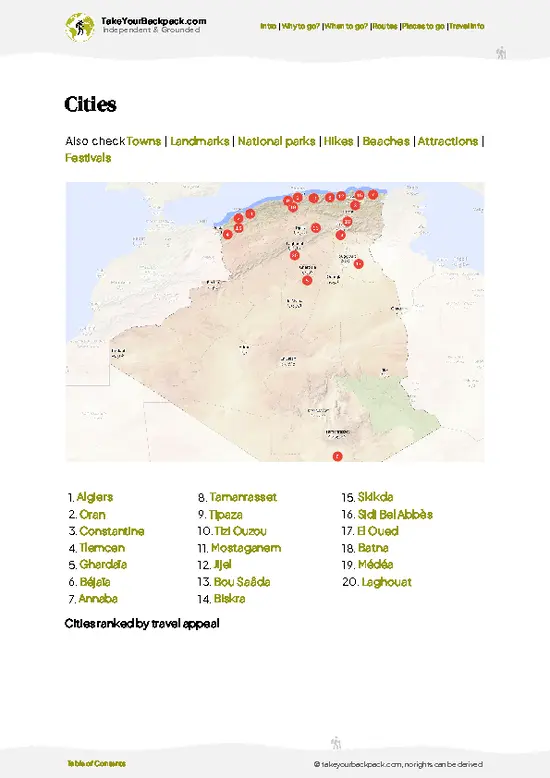
Algeria is the largest country in Africa, and its cities exist in dramatic contrast to one another because
geography sorted them. Nearly all large urban centers cling to the narrow Mediterranean strip, where rainfall and ports drew Phoenicians, Romans, Ottomans and the French in turn. Walk almost anywhere there and you pass
Roman stone, Ottoman wooden balconies and French iron-railed apartment blocks within a few hundred meters, with the call to prayer mixing with car horns and the clatter of café cups. Inland, the Tell Atlas and High Plateaus hold older market and caravan towns, and beyond them the
Sahara oases rely on water channels and date palms. That layering gives a traveler real range without crossing a border.
Before choosing Algeria for its cities, know the
practical conditions. …
read more 👉Algeria is the largest country in Africa, and its cities exist in dramatic contrast to one another because geography sorted them. Nearly all large urban centers cling to the narrow Mediterranean strip, where rainfall and ports drew Phoenicians, Romans, Ottomans and the French in turn. Walk almost anywhere there and you pass Roman stone, Ottoman wooden balconies and French iron-railed apartment blocks within a few hundred meters, with the call to prayer mixing with car horns and the clatter of café cups. Inland, the Tell Atlas and High Plateaus hold older market and caravan towns, and beyond them the Sahara oases rely on water channels and date palms. That layering gives a traveler real range without crossing a border.
Before choosing Algeria for its cities, know the practical conditions. Foreign visitors need a visa arranged in advance, and tourism infrastructure is thin: few hostels, limited English, and cash (Algerian dinar) is still the main way to pay, with card use patchy outside upscale hotels. Signs are in Arabic and French, so basic French goes a long way. Public transport is cheap but crowded, and long distances mean long days on buses, trains or domestic flights. Heat in summer is fierce, while winter evenings on the plateaus can be sharply cold. The upside is that you meet few other tourists, hospitality is warm, tea and pastries get pressed on you, and prices stay low. Dress modestly, ask before photographing people, and expect curiosity, not hassle.
Evaluating the Top Choices
The list of best cities in Algeria is created based on culture, vibe, attractions, transport ease, and local charm. If you feel a city is missing in this list, please let us know.
v2.webp)


 Best Backpacking
.jpg) Hi, I’m Johan (Netherlands 🇳🇱), the creator of TakeYourBackpack. Over the past 3 decades, I’ve backpacked through 90+ countries across six continents, gaining extensive experience with independent travel, long-term trips, and overland routes.
Hi, I’m Johan (Netherlands 🇳🇱), the creator of TakeYourBackpack. Over the past 3 decades, I’ve backpacked through 90+ countries across six continents, gaining extensive experience with independent travel, long-term trips, and overland routes.