×

Algeria🇩🇿 | attractionsTimgad Archaeological SiteRoman grid plan, triumphal arch, ancient library | things to do and best time to go

Explore Maqam EchahidExplore Tipasa Archaeological Site

Backpacking in Timgad Archaeological Site
By Johan Kruseman 🇳🇱 | Updated October 15, 2026

Here’s what nobody tells you: Timgad’s ruins are so empty you’ll hear your own footsteps echoing through a Roman city grid—no crowds, no selfie-stick gauntlet, just you and two thousand years of history. Timgad Archaeological Site and its museum sit on the northern fringe of the Aurès Mountains, a few kilometers from the modern town of Timgad in eastern Algeria, far from the Mediterranean tourist conveyor belt. If you’re picturing the chaos of Rome’s Forum or the polished drama of Carthage, reset your expectations. Timgad is raw, sun-bleached, and sprawling, with columns and mosaics scattered like a forgotten board game. The wow-factor is real: you can walk the decumanus maximus, duck into the ancient library, and climb the theater’s stone seats without a single tour group in sight. But getting here isn’t a casual detour—public transport is patchy, and you’ll need to budget for a private taxi or a rental car. Entry is cheap, but the real cost is time and effort. Timgad isn’t for box-tickers; it’s for travelers who want to feel like they’ve discovered something the world forgot.

Discover everything you want to know in the 📖 Algeria Travel Guide.


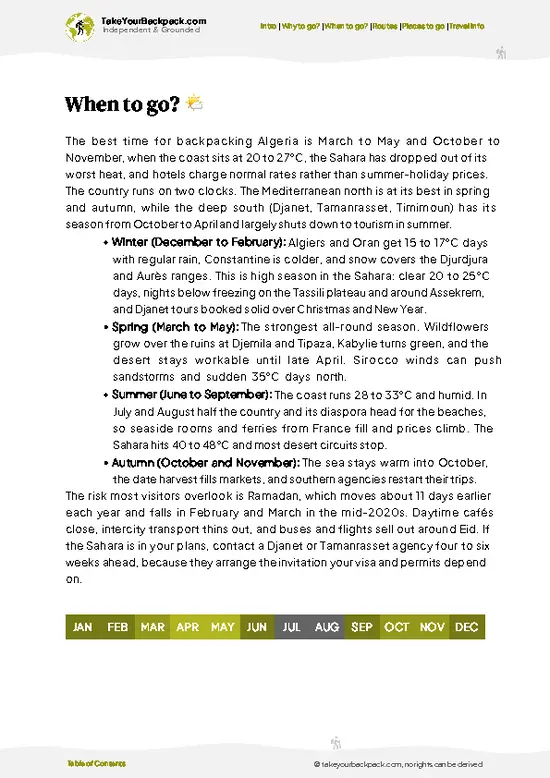
example page 0 from our offline Travel Guide for Algeria
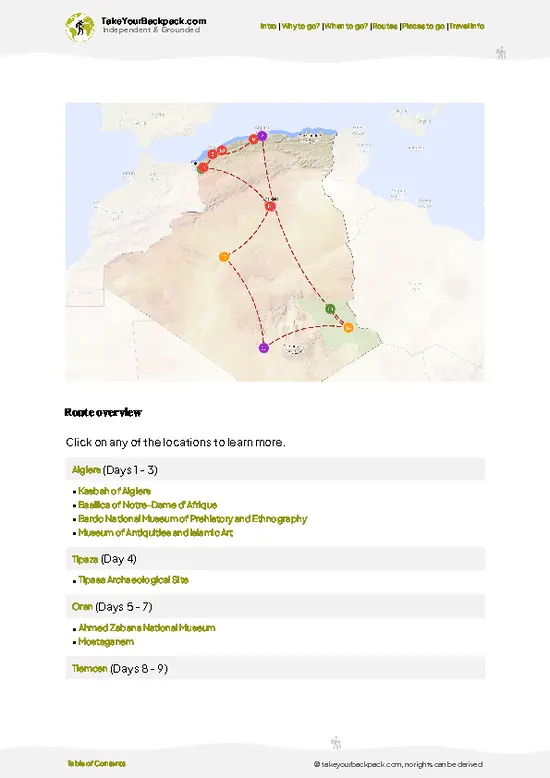
example page 1 from our offline Travel Guide for Algeria
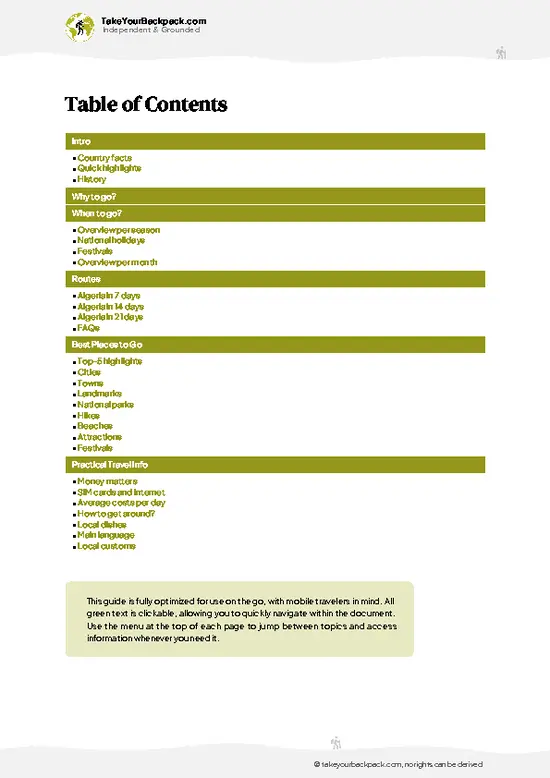
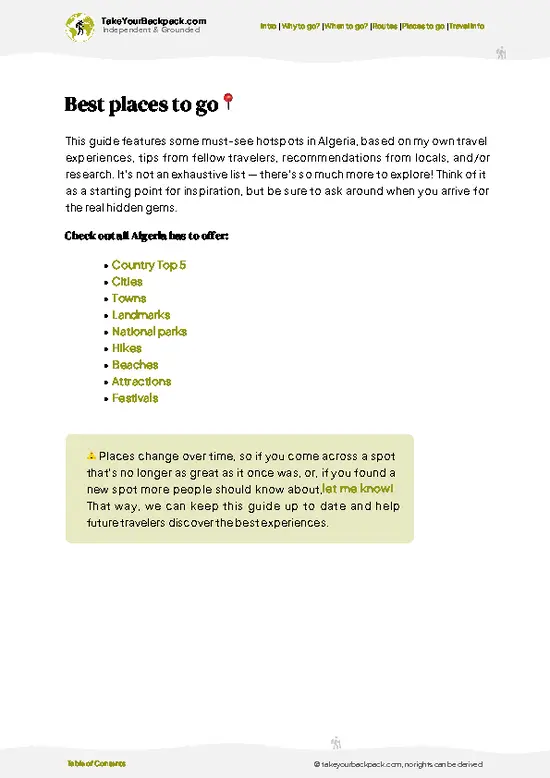
example page 2 from our offline Travel Guide for Algeria
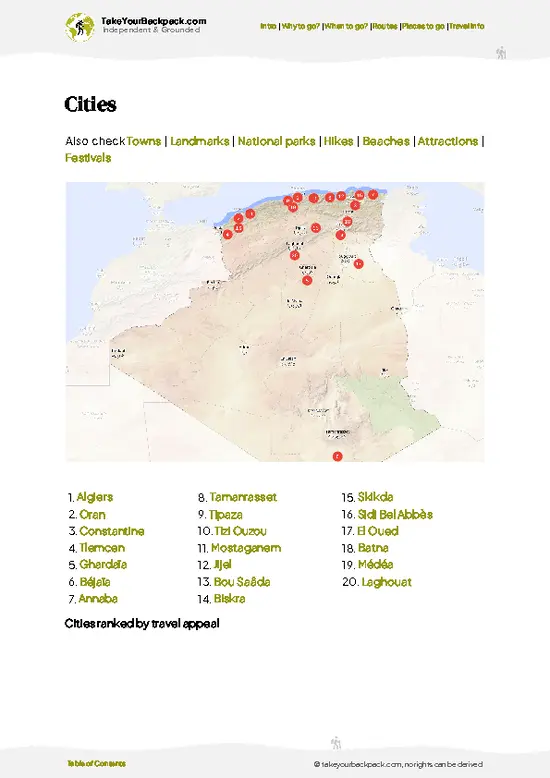
example page 3 from our offline Travel Guide for Algeria
example page 4 from our offline Travel Guide for Algeria
example page 5 from our offline Travel Guide for Algeria
example page 6 from our offline Travel Guide for Algeria
example page 7 from our offline Travel Guide for Algeria
Loading the map 🌍
CLICK TO FILTER
cities
towns
landmarks
national parks
hikes
beaches
attractions
festivals
SHOW COUNTRY’S BESTSHOW ALL

✨ Why go?
Ranked #99 attraction in Algeria
Why Timgad Archaeological Site should be on your travel list

Timgad Archaeological Site in Algeria is not your typical postcard-perfect ruin where you snap a quick selfie and move on. Yes, it’s a magnet for history buffs and backpackers alike because it’s one of the best-preserved Roman colonial towns on the planet. But here’s the real deal: it’s a sprawling, open-air classroom that demands time and curiosity. The crowds? Manageable if you go early or late in the day, far from the Instagram rush. The entry fee isn’t dirt cheap, but it’s a steal compared to the depth of experience you get.

This isn’t just about ancient stones; it’s about walking through a city that thrived 2,000 years ago, with its grid streets, triumphal arches, and a theater that still echoes with the ghosts of performances long past. The museum adds layers, showcasing artifacts that … read more 👉
Timgad Archaeological Site in Algeria is not your typical postcard-perfect ruin where you snap a quick selfie and move on. Yes, it’s a magnet for history buffs and backpackers alike because it’s one of the best-preserved Roman colonial towns on the planet. But here’s the real deal: it’s a sprawling, open-air classroom that demands time and curiosity. The crowds? Manageable if you go early or late in the day, far from the Instagram rush. The entry fee isn’t dirt cheap, but it’s a steal compared to the depth of experience you get.

This isn’t just about ancient stones; it’s about walking through a city that thrived 2,000 years ago, with its grid streets, triumphal arches, and a theater that still echoes with the ghosts of performances long past. The museum adds layers, showcasing artifacts that bring the site’s story to life beyond the ruins. For backpackers threading through Algeria, Timgad is a milestone — a tangible connection to a complex past that’s often overshadowed by modern narratives. It’s a place where history hits you with the weight of reality, not just the gloss of a travel brochure. If you want to understand Algeria beyond the surface, this is where you start.

💡 HighlightsThe experiences that define the visit

The Decumanus Maximus: Roman Urban Planning, Unfiltered
Forget the drone shots—walk the main east-west street yourself. The Decumanus Maximus is a straight line of ancient ambition, flanked by toppled columns and sun-bleached paving stones that have survived centuries of sand and silence. You’re not just looking at ruins; you’re tracing the original Roman grid, so precise you could almost use it as a ruler. The sheer scale and symmetry are a masterclass in city-building, and unlike Rome or Pompeii, you’ll probably have it to yourself—no selfie-stick gauntlet, just the wind and your own footsteps.


The Library: Where Knowledge Outlasted Empire
Timgad’s library isn’t just a pile of stones. It’s one of the best-preserved ancient libraries in the Roman world, and you can still see the niches where … read more 👉
The Decumanus Maximus: Roman Urban Planning, Unfiltered
Forget the drone shots—walk the main east-west street yourself. The Decumanus Maximus is a straight line of ancient ambition, flanked by toppled columns and sun-bleached paving stones that have survived centuries of sand and silence. You’re not just looking at ruins; you’re tracing the original Roman grid, so precise you could almost use it as a ruler. The sheer scale and symmetry are a masterclass in city-building, and unlike Rome or Pompeii, you’ll probably have it to yourself—no selfie-stick gauntlet, just the wind and your own footsteps.


The Library: Where Knowledge Outlasted Empire
Timgad’s library isn’t just a pile of stones. It’s one of the best-preserved ancient libraries in the Roman world, and you can still see the niches where scrolls once lived. Stand there and imagine the debates, the scholars, the slow burn of ideas in a frontier town. There’s no velvet rope or glass case—just you, the stones, and the ghosts of readers past. It’s a rare, tactile connection to the intellectual life of an empire, and it’s more moving than any museum placard.


The Theater: Acoustics and Drama in the Middle of Nowhere
This isn’t a crumbling amphitheater you squint at from behind a fence. Timgad’s theater is carved into the hillside, with seating for 3,500 and acoustics that still work. Stand on the stage and whisper—your friends up top will hear you. The view sweeps out over the ruins and the Aurès Mountains, and if you time it right, you might catch a local performance or just the sound of your own laughter echoing through history. It’s raw, it’s real, and it’s a reminder that entertainment didn’t start with Netflix.


The Forum: The Social Engine of a Roman Outpost
Skip the Instagram filters—this is where the real drama happened. The forum was Timgad’s beating heart: politics, gossip, trade, and the occasional brawl. The layout is still clear, with the basilica, curia, and market spaces all visible. Stand in the center and you’ll feel the scale of Roman ambition, but also the everyday chaos of a city on the edge of the empire. It’s not polished, but that’s the point—this is the raw material of civilization.


The Museum: Context, Not Just Relics
Most site museums are afterthoughts. Not here. Timgad’s museum is compact but punchy, with mosaics, statues, and everyday objects that put flesh on the bones of the ruins outside. The mosaics are especially sharp—look for the hunting scenes and the Medusa, which pack more personality than any postcard. The museum gives you the backstory you need to decode the site, and it’s blissfully free of crowds. You’ll leave with a sense of the people, not just the stones.
Spotted a mistake or missing something? Contact us.

🌤️ When to go?When to go for the best experience

  • Weather: The best window to visit Timgad is between April and June or September to October. During these months, the weather is mild and dry, avoiding the brutal summer heat that can soar above 38°C (100°F) in July and August, which makes wandering ruins exhausting and less enjoyable.
  • Temperature: Spring and autumn offer comfortable temperatures ranging from 15°C to 25°C (59°F to 77°F). Winters, from December to February, can be chilly, dropping to around 5°C (41°F) at night, which might be a shock if you’re not prepared for cold snaps in the desert environment.
  • Daylight Hours: Longer daylight in spring and early autumn means more time to explore without rushing. Expect roughly 12 to 14 hours of daylight from April through October, giving you ample time to soak in the site’s vastness and
… read more 👉
  • Weather: The best window to visit Timgad is between April and June or September to October. During these months, the weather is mild and dry, avoiding the brutal summer heat that can soar above 38°C (100°F) in July and August, which makes wandering ruins exhausting and less enjoyable.
  • Temperature: Spring and autumn offer comfortable temperatures ranging from 15°C to 25°C (59°F to 77°F). Winters, from December to February, can be chilly, dropping to around 5°C (41°F) at night, which might be a shock if you’re not prepared for cold snaps in the desert environment.
  • Daylight Hours: Longer daylight in spring and early autumn means more time to explore without rushing. Expect roughly 12 to 14 hours of daylight from April through October, giving you ample time to soak in the site’s vastness and details.
  • Crowds: Despite its fame, Timgad doesn’t get overwhelmed with tourists. However, weekends and Algerian public holidays can bring local visitors, so aim for weekdays to enjoy a quieter experience.
  • Seasonal Activities: The site hosts occasional cultural events in spring and autumn, which can add a layer of local flavor but also bring more people. If you want solitude, avoid these event dates.
  • Price Fluctuations: Entrance fees remain stable year-round, but travel costs to and from Timgad can spike during peak tourist seasons (spring and autumn) due to higher demand for transport and accommodation in nearby towns.
Pro-tip: Visit early morning during shoulder seasons to dodge heat, crowds, and inflated prices—this is when Timgad’s ancient stones truly speak.


source: climatestotravel.comJANJanuary: fair for travelingFEBFebruary: fair for travelingMARMarch: good for travelingAPRApril: excellent for travelingMAYMay: excellent for travelingJUNJune: excellent for travelingJULJuly: below average for travelingAUGAugust: below average for travelingSEPSeptember: excellent for travelingOCTOctober: excellent for travelingNOVNovember: good for travelingDECDecember: fair for traveling
algeria-attraction-timgad-archaeological-site
© Google |

✈️ The backpacker research shortcutAlgeria Travel Guide

An offline-friendly backpacking guide with optimized travel routes, ranked highlights, transport advice, and the best areas to stay.
example page 0 from our offline Travel Guide for Algeria
example page 1 from our offline Travel Guide for Algeria
example page 2 from our offline Travel Guide for Algeria
example page 3 from our offline Travel Guide for Algeria
example page 4 from our offline Travel Guide for Algeria
example page 5 from our offline Travel Guide for Algeria
example page 6 from our offline Travel Guide for Algeria
example page 7 from our offline Travel Guide for Algeria
The digital guide (314 pages) contains:
✅ 79 highlights, ranked by travel appeal
✅ Optimized 7, 14 & 21-day travel routes
✅ Cities, national parks, landmarks, beaches
✅ How to get around
✅ Offline-friendly for travel without Wi-Fi
👉 Click to see all 30+ guide features

📅 Plan smarter in minutes, not weeks
✅ Month by month travel advice
✅ Festivals & national holidays
✅ Budget expectations

🗺️ Go to the right places, skip the overrated ones
✅ Honest pros & cons of destinations
✅ Top hikes, parks & viewpoints
✅ Lesser-known places most travelers miss
✅ Clear “worth it vs skip it” guidance

🛏️ Travel smoothly without rookie mistakes
✅ Best areas to stay
✅ Transport systems explained simply
✅ Common scams & safety advice
✅ SIM cards, money & practical tips

🌍 Understand the country, not just visit it
✅ Culture & traditions
✅ 52 Essential phrases & customs
✅ Festivals worth planning around
✅ Traveler-friendly historical context
✅ Insights that make places more meaningful

📱 Built for real travel conditions
✅ Fully downloadable PDF
✅ Works completely offline
✅ Optimized for phone use
✅ Useful in remote areas & buses
✅ Everything in one place
Stop searching, start planning
Get instant access to your full guide. 30‑day money-back guarantee.
+ Add another guide for just

By proceeding you agree to our terms.
Sent to your inbox immediately after payment • 100% Secure Checkout
Best Backpacking Travel Advisor 2025 tourism awardBest Backpacking
Travel Advisor
2025
What others say about Take Your Backpack Guides:
⭐⭐⭐⭐⭐
Fantastic, amazing amount of information!
⭐⭐⭐⭐⭐
My goodness this is amazing, it's what I've been looking for hats off too you!
⭐⭐⭐⭐⭐
I think this is absolutely BRILLIANT
⭐⭐⭐⭐
Very complete and informative. It's still missing places, but I gotta to commend you
⭐⭐⭐⭐⭐
This is truly amazing, thank you, can't wait to explore it with my kids!
⭐⭐⭐⭐⭐
Awesome resource, thank you!
⭐⭐⭐⭐⭐
This is amazing! Can't wait to explore the ones I haven't seen
⭐⭐⭐⭐
I love this! Well done, great idea.
⭐⭐⭐⭐⭐
Thanks for taking the time to make this gem!
⭐⭐⭐⭐⭐
This might be the best website I've ever seen.
⭐⭐⭐⭐⭐
Congratulations, and thank you so much for your work; it's incredibly valuable.
⭐⭐⭐⭐
In all seriousness I think you did a great job pointing out the important spots
⭐⭐⭐⭐⭐
10/10 very good
⭐⭐⭐⭐⭐
As someone who's only just starting to visit regularly this is awesome, thank you.
⭐⭐⭐⭐
Thank you very much! I'm going to visit my dad, it's going to be very useful!
⭐⭐⭐⭐⭐
This is really cool! We'll be travelling for the first time and this definitely come in handy.
⭐⭐⭐⭐⭐
You are now our minister of culture, congratulations 👨‍💼
⭐⭐⭐⭐⭐
Just wanted to tell you that this is a pearl! Going to follow your recommendations.
⭐⭐⭐⭐⭐
This is so cool. I'll definitely be using the resource for my travels soon.
⭐⭐⭐⭐⭐
This is very impressive! Good work.
⭐⭐⭐⭐⭐
This is an amazing and informative site. Very well done!

🛏️ Where to stay?Choosing the right base

If you’re heading to the Timgad Archaeological Site, brace yourself: this isn’t a backpacker’s party town. The reality is, the area around Timgad is quiet, rural, and far from the bustling hostels and lively street scenes you might expect from other famous ruins. The crowds here are minimal, but that’s because the infrastructure for budget travelers is slim. You won’t find a cluster of hostels or a buzzing backpacker hub right next to the site. Instead, your best bet is to base yourself in Batna, the nearest city about 30 kilometers away.

Batna isn’t glamorous, but it’s where you’ll find the … read more 👉
If you’re heading to the Timgad Archaeological Site, brace yourself: this isn’t a backpacker’s party town. The reality is, the area around Timgad is quiet, rural, and far from the bustling hostels and lively street scenes you might expect from other famous ruins. The crowds here are minimal, but that’s because the infrastructure for budget travelers is slim. You won’t find a cluster of hostels or a buzzing backpacker hub right next to the site. Instead, your best bet is to base yourself in Batna, the nearest city about 30 kilometers away.

Batna isn’t glamorous, but it’s where you’ll find the social vibe and budget options that make solo travel manageable. It’s a working city with a real Algerian pulse—markets, street food stalls, and a handful of guesthouses where you can meet other travelers without the tourist gloss. Safety-wise, Batna is stable enough for cautious solo backpackers who stick to the main areas and avoid wandering after dark. It’s not a party scene, but it’s authentic and practical.

From Batna, you can arrange a taxi or local transport to Timgad early in the day, beating the small crowds and heat. This setup means you get the best of both worlds: a social base with budget-friendly options and easy access to one of Algeria’s most impressive Roman ruins. It’s not flashy, but it’s real—and that’s where the magic lives.

👛 Costs (as of 15 October 2026)Travel costs and budget guide for Timgad Archaeological Site

As of the most recent estimates, the entrance fee for the Timgad Archaeological Site is approximately 200 to 500 Algerian Dinars (DZD), which is about €1.50 to €3.50. Additional costs may include guided tours, which are highly recommended for a more comprehensive experience. Local guides are available at the entrance, with fees typically ranging from 600 to 1,000 DZD (approximately €4.50 to €7.50). It's advisable to bring cash in Algerian Dinars, as credit card facilities may not be available at the site.
⚠️ Prices can change and everyone travels differently, so take this as a rough guide. Hope it helps you plan your adventure!

FAQCommon questions from travelers

You need about 2 to 3 hours to visit Timgad Archaeological Site thoroughly. This allows time to explore the extensive Roman ruins and the museum exhibits without rushing. Allocate extra time if you want to take detailed photos or join a guided tour.
Yes, Timgad Archaeological Site is worth the entrance fee, which is typically around 300 Algerian Dinars (about 2-3 USD). The site is a well-preserved example of Roman urban planning and architecture, offering significant historical value. The museum complements the visit with artifacts that provide context to the ruins.
To get to Timgad Archaeological Site, the nearest major city is Batna, about 35 kilometers away. From Batna, you can take a taxi or a local bus heading towards Timgad village. The site is accessible by road, but public transport options may be limited, so arranging a private transfer or rental car is often more convenient.
⚠️ Things can change over time, so always validate details locally before you go.

Other Algerian attractions near Timgad Archaeological Site

Explore more nearby:

  • Constantine Bridges—Gorge crossings, Sidi M’Cid span, swaying footbridge, Rhumel canyon| 99 km away
  • Basilica of St. Augustine—Augustine relic, Annaba hilltop, Hippo ruins, stained glass| 192 km away
  • El Oued Souk—Gypsum domes, Souf dates, rose-of-sand, woven rugs| 240 km away

💡 Not sure where to go next?
Create a personalized itinerary for Algeria including Timgad Archaeological Site and the places that fit your trip.

Generate my itinerary

👉 Discover all attractions

Or checkout all Algeria has to offer (think cities, towns, villages, national parks, hikes, beaches, festivals)
Country photo of Algeria

We 💚 feedbackKey takeaways before you go

Timgad isn’t some polished postcard spot—expect a handful of tourists but not the crush you dread. The real magic is how the ruins stretch out, quiet and vast, letting you imagine Roman life without a screen in sight. The museum’s small but packed with artifacts that give context beyond the stones. Heads up: it’s hot and exposed, so bring shade and water. If you’re chasing authenticity over hype, Timgad delivers a raw, powerful connection to history that sticks with you long after you leave.

✍️ Help improve this page!
The information on this page is based on in-depth research, insights shared by experienced travelers, and feedback from the local travel community in Algeria. While every effort is made to keep the information accurate and current, conditions can change — so if you spot anything incorrect or outdated, please get in touch.


🙋‍♂️ Give feedback

👋 Meet the founderWho’s Behind Take Your Backpack?

Johan, backpacker and founder of TakeYourBackpackHi, I’m Johan (Netherlands 🇳🇱), the creator of TakeYourBackpack. Over the past 3 decades, I’ve backpacked through 90+ countries across six continents, gaining extensive experience with independent travel, long-term trips, and overland routes.

This site is built on a combination of firsthand travel experience and carefully curated insights from other backpackers. Many guides are based on places I’ve personally visited, while others bring together tips, observations, and practical advice shared by trusted travelers I’ve met along the way.

The goal is to provide realistic, experience-driven guidance — not generic itineraries — so you can explore destinations with better context, clearer expectations, and more confidence.