
×

Angola🇦🇴 | festivalsLuanda CarnivalMain parade, satirical floats, batucada percussion, waterfront crowds | things to do and best time to go

Explore Huambo International Festival of Traditional MusicExplore Luanda International Jazz Festival

Backpacking in Luanda Carnival
🏆 Top pickfestival ranked #1
By Johan Kruseman 🇳🇱 | Updated October 15, 2026

Luanda Carnival once meant a street takeover, with whole neighborhoods marching down the Marginal and the old downtown avenues to the thump of batucada drums, and many Angolans still describe that era with a wistful grin. Today the parade is more organized: grandstands, fenced routes and scheduled group appearances. It still happens in Luanda, on the Atlantic coast in the northwest of Angola, and the main parade route runs through the city center near the bay. Expect heat, diesel fumes, grilled corn smoke, feathers, sequins and brass, with kuduro and semba drifting in from every side. Groups from different municipalities and neighborhoods compete with choreographed floats and costumes that satirize or celebrate Angolan life. Crowds are mostly local families and students, with few foreign visitors. Costs catch people out: hotels in Luanda are among the priciest in Africa, so book weeks ahead. Carry small kwanza notes, since card machines fail. Go for a festival that is Angolan first, and polished second.

Discover everything you want to know in the 📖 Angola Travel Guide.


example page 0 from our offline Travel Guide for Angola
example page 1 from our offline Travel Guide for Angola
example page 2 from our offline Travel Guide for Angola
example page 3 from our offline Travel Guide for Angola
example page 4 from our offline Travel Guide for Angola
example page 5 from our offline Travel Guide for Angola
example page 6 from our offline Travel Guide for Angola
example page 7 from our offline Travel Guide for Angola
Loading the map 🌍
CLICK TO FILTER
cities
towns
landmarks
national parks
hikes
beaches
attractions
festivals
regions
SHOW COUNTRY’S BESTSHOW ALL

✨ Why go?
Ranked #1 festival in Angola
Why Luanda Carnival should be on your travel list

Backpackers route through Luanda Carnival because it is one of the few chances to see Angolan culture performed by Angolans for Angolans. Most of the crowd is local, so you are not one of thousands of tourists. Groups arrive with drummers, dancers and costumed characters rooted in semba and kizomba traditions, and you can watch the rhythms that later traveled to Brazil and Portugal in their home setting. Strangers pull you into dance circles within minutes, which makes it easy to meet people in a country where independent travel is still uncommon.

The timing matters too. Carnival falls in the hot, humid season before Lent, which suits a coastal stay in Luanda. It fits neatly into a longer Angola loop: you can add the Kalandula Falls in Malanje province, the Kissama (Quiçama) National Park … read more 👉
Backpackers route through Luanda Carnival because it is one of the few chances to see Angolan culture performed by Angolans for Angolans. Most of the crowd is local, so you are not one of thousands of tourists. Groups arrive with drummers, dancers and costumed characters rooted in semba and kizomba traditions, and you can watch the rhythms that later traveled to Brazil and Portugal in their home setting. Strangers pull you into dance circles within minutes, which makes it easy to meet people in a country where independent travel is still uncommon.

The timing matters too. Carnival falls in the hot, humid season before Lent, which suits a coastal stay in Luanda. It fits neatly into a longer Angola loop: you can add the Kalandula Falls in Malanje province, the Kissama (Quiçama) National Park a couple of hours south of the capital, or the beaches of Benguela further down the coast. Compared with Rio, prices of everything else in Luanda remain high, but the carnival itself costs little to watch. Spend the money on a good location, not on the show.

💡 HighlightsPlaces and moments you shouldn't skip

  1. The main parade: Groups from Luanda’s municipalities and neighborhoods march in organized competition, wearing elaborate costumes and moving in rehearsed choreography. This is the core event and the best way to see how much effort communities put in.
  2. Live percussion and dance: Drums set the pace, and dancers move to semba, kuduro and other Angolan styles. Standing near the drum sections lets you feel the beat in your chest.
  3. Satirical costumes and floats: Many groups use costumes to comment on daily life, politics or history. Ask a local to explain the jokes, because they carry most of the meaning.
  4. Street food and drinks: Vendors sell grilled corn, skewers, fried snacks and cold beer along the route. Prices are modest compared with restaurants in the city, though carry small kwanza notes.
  5. The waterfront
… read more 👉
  1. The main parade: Groups from Luanda’s municipalities and neighborhoods march in organized competition, wearing elaborate costumes and moving in rehearsed choreography. This is the core event and the best way to see how much effort communities put in.
  2. Live percussion and dance: Drums set the pace, and dancers move to semba, kuduro and other Angolan styles. Standing near the drum sections lets you feel the beat in your chest.
  3. Satirical costumes and floats: Many groups use costumes to comment on daily life, politics or history. Ask a local to explain the jokes, because they carry most of the meaning.
  4. Street food and drinks: Vendors sell grilled corn, skewers, fried snacks and cold beer along the route. Prices are modest compared with restaurants in the city, though carry small kwanza notes.
  5. The waterfront atmosphere: The parade passes through the city center near the bay, where the Atlantic breeze softens the heat. Arriving early gives you shade, a spot to sit and a view of the crowd gathering.
Watch the main parade first, since everything else on the route makes more sense once you have seen how the groups perform.
Spotted a mistake or missing something? Contact us.

Things to do around Luanda Carnival

Ratings based on Tripadvisor reviews. When you book through this link, you support our work at no extra cost to you.

🌤️ When to go?When is the celebration of Luanda Carnival?

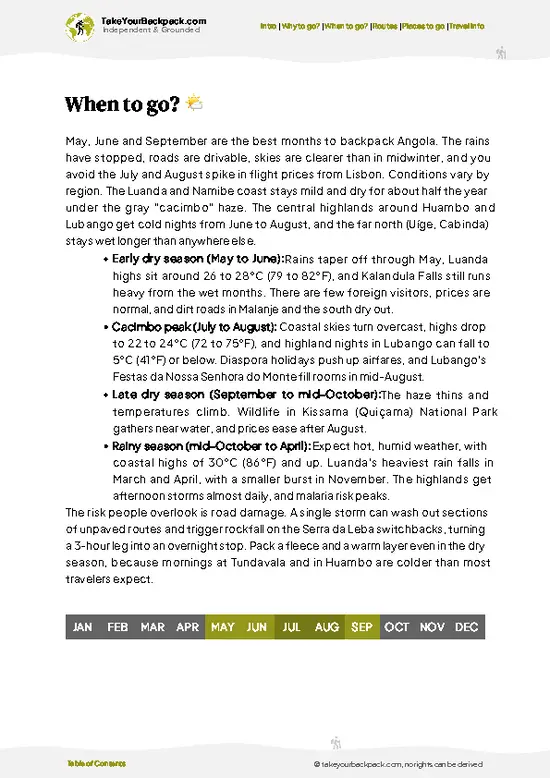
Luanda Carnival peaks on Carnival Tuesday, usually in February or early March (the date follows Easter, falling 47 days before it), with the main parade along the Marginal, the waterfront avenue in central Luanda.
  • Best day: Carnival Tuesday is the one to catch, when the grupos de carnaval fill the Marginal with feathers, drums and choreographed floats. Arrive for the build-up, since the early groups tend to be the most polished.
  • Weather: Expect hot, humid days of about 28 to 32°C (82 to 90°F), with the odd heavy shower. Bring a hat, sunscreen, a light rain layer and a water bottle. Sunset comes around 6:30 pm.
  • Booking: Reserve your bed 3 to 4 weeks ahead. Central rooms often cost 30 to 50% more that week. Grandstand seating, where sold, goes early, while standing along the Marginal is free.
  • Crowds:
… read more 👉
Luanda Carnival peaks on Carnival Tuesday, usually in February or early March (the date follows Easter, falling 47 days before it), with the main parade along the Marginal, the waterfront avenue in central Luanda.
  • Best day: Carnival Tuesday is the one to catch, when the grupos de carnaval fill the Marginal with feathers, drums and choreographed floats. Arrive for the build-up, since the early groups tend to be the most polished.
  • Weather: Expect hot, humid days of about 28 to 32°C (82 to 90°F), with the odd heavy shower. Bring a hat, sunscreen, a light rain layer and a water bottle. Sunset comes around 6:30 pm.
  • Booking: Reserve your bed 3 to 4 weeks ahead. Central rooms often cost 30 to 50% more that week. Grandstand seating, where sold, goes early, while standing along the Marginal is free.
  • Crowds: Come into the center by midmorning, before roads around the Marginal close. Leave on foot toward Ilha or Maianga after the parade, since the first hour of taxis is chaotic.
Book flights into the airport 40 km out at least a day early, because the road into town clogs on parade days.


source: climatestotravel.comJANJanuary: not recommended for travelingFEBFebruary: excellent for travelingMARMarch: not recommended for travelingAPRApril: not recommended for travelingMAYMay: not recommended for travelingJUNJune: not recommended for travelingJULJuly: not recommended for travelingAUGAugust: not recommended for travelingSEPSeptember: not recommended for travelingOCTOctober: not recommended for travelingNOVNovember: not recommended for travelingDECDecember: not recommended for traveling

✈️ The backpacker research shortcutAngola Travel Guide

An offline-friendly backpacking guide with optimized travel routes, ranked highlights, transport advice, and the best areas to stay.
example page 0 from our offline Travel Guide for Angola
example page 1 from our offline Travel Guide for Angola
example page 2 from our offline Travel Guide for Angola
example page 3 from our offline Travel Guide for Angola
example page 4 from our offline Travel Guide for Angola
example page 5 from our offline Travel Guide for Angola
example page 6 from our offline Travel Guide for Angola
example page 7 from our offline Travel Guide for Angola
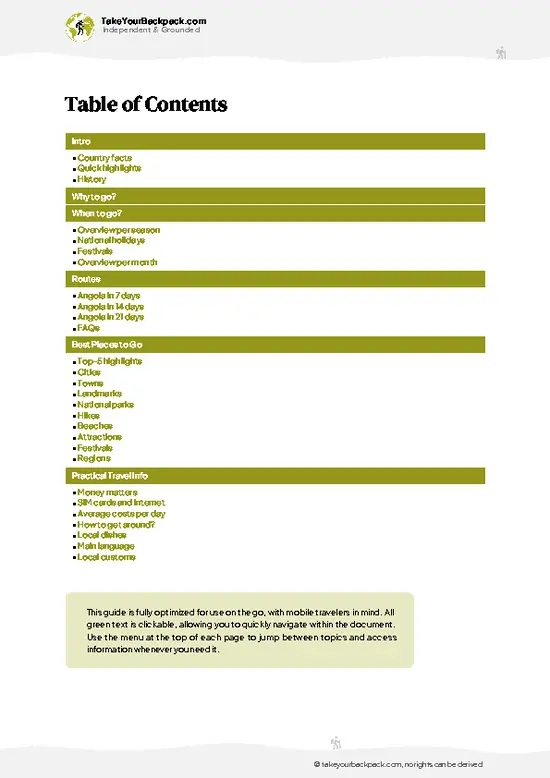
The digital guide (246 pages) contains:
✅ 71 highlights, ranked by travel appeal
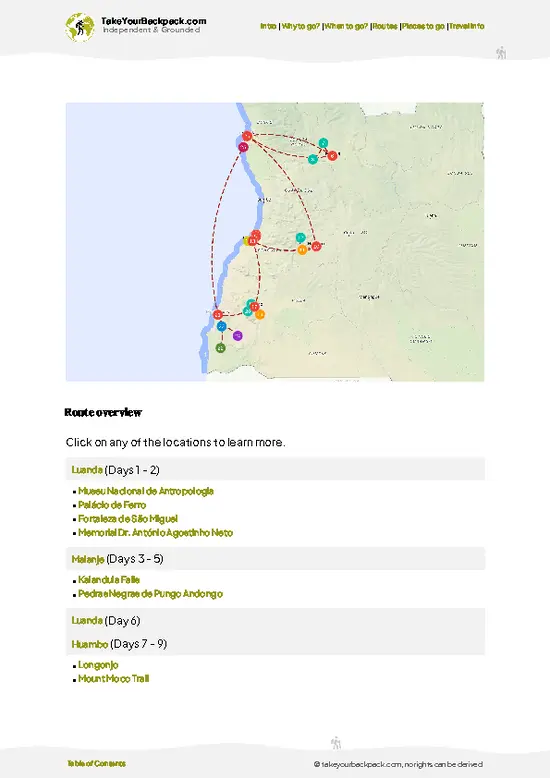
✅ Optimized 7, 14 & 21-day travel routes
✅ Cities, national parks, landmarks, beaches
✅ How to get around
✅ Offline-friendly for travel without Wi-Fi
👉 Click to see all 30+ guide features

📅 Plan smarter in minutes, not weeks
✅ Month by month travel advice
✅ Festivals & national holidays
✅ Budget expectations

🗺️ Go to the right places, skip the overrated ones
✅ Honest pros & cons of destinations
✅ Top hikes, parks & viewpoints
✅ Lesser-known places most travelers miss
✅ Clear “worth it vs skip it” guidance

🛏️ Travel smoothly without rookie mistakes
✅ Best areas to stay
✅ Transport systems explained simply
✅ Common scams & safety advice
✅ SIM cards, money & practical tips

🌍 Understand the country, not just visit it
✅ Culture & traditions
✅ 52 Essential phrases & customs
✅ Festivals worth planning around
✅ Traveler-friendly historical context
✅ Insights that make places more meaningful

📱 Built for real travel conditions
✅ Fully downloadable PDF
✅ Works completely offline
✅ Optimized for phone use
✅ Useful in remote areas & buses
✅ Everything in one place
Stop searching, start planning
Get instant access to your full guide. 30‑day money-back guarantee.
+ Add another guide for just

By proceeding you agree to our terms.
Sent to your inbox immediately after payment • 100% Secure Checkout
Best Backpacking Travel Advisor 2025 tourism awardBest Backpacking
Travel Advisor
2025
What others say about Take Your Backpack Guides:
⭐⭐⭐⭐⭐
Fantastic, amazing amount of information!
⭐⭐⭐⭐⭐
My goodness this is amazing, it's what I've been looking for hats off too you!
⭐⭐⭐⭐⭐
I think this is absolutely BRILLIANT
⭐⭐⭐⭐
Very complete and informative. It's still missing places, but I gotta to commend you
⭐⭐⭐⭐⭐
This is truly amazing, thank you, can't wait to explore it with my kids!
⭐⭐⭐⭐⭐
Awesome resource, thank you!
⭐⭐⭐⭐⭐
This is amazing! Can't wait to explore the ones I haven't seen
⭐⭐⭐⭐
I love this! Well done, great idea.
⭐⭐⭐⭐⭐
Thanks for taking the time to make this gem!
⭐⭐⭐⭐⭐
This might be the best website I've ever seen.
⭐⭐⭐⭐⭐
Congratulations, and thank you so much for your work; it's incredibly valuable.
⭐⭐⭐⭐
In all seriousness I think you did a great job pointing out the important spots
⭐⭐⭐⭐⭐
10/10 very good
⭐⭐⭐⭐⭐
As someone who's only just starting to visit regularly this is awesome, thank you.
⭐⭐⭐⭐
Thank you very much! I'm going to visit my dad, it's going to be very useful!
⭐⭐⭐⭐⭐
This is really cool! We'll be travelling for the first time and this definitely come in handy.
⭐⭐⭐⭐⭐
You are now our minister of culture, congratulations 👨‍💼
⭐⭐⭐⭐⭐
Just wanted to tell you that this is a pearl! Going to follow your recommendations.
⭐⭐⭐⭐⭐
This is so cool. I'll definitely be using the resource for my travels soon.
⭐⭐⭐⭐⭐
This is very impressive! Good work.
⭐⭐⭐⭐⭐
This is an amazing and informative site. Very well done!

🛏️ Where to stay?Where staying makes the most sense

The best base for Luanda Carnival is the Ilha de Luanda and Maianga-Ingombota area, within a short taxi ride of the parade route along the Marginal. Angola has a small backpacker scene, so you choose by safety and access rather than by a hostel strip.
Ingombota, the central district, is the most practical. Restaurants, banks, ATMs and the waterfront are walkable by day, and taxis are easy to flag. Guesthouses and mid-range pensions here are the safest budget choice, and other travelers and expats are easy to meet in cafés and bars. It also puts you close to the Marginal, where the main parade is … read more 👉
The best base for Luanda Carnival is the Ilha de Luanda and Maianga-Ingombota area, within a short taxi ride of the parade route along the Marginal. Angola has a small backpacker scene, so you choose by safety and access rather than by a hostel strip.
Ingombota, the central district, is the most practical. Restaurants, banks, ATMs and the waterfront are walkable by day, and taxis are easy to flag. Guesthouses and mid-range pensions here are the safest budget choice, and other travelers and expats are easy to meet in cafés and bars. It also puts you close to the Marginal, where the main parade is staged.
Ilha de Luanda, the sandbar peninsula, is lively at night with beach bars and seafood restaurants. It is social and popular with locals and visitors, though rooms are pricier and traffic on the single access road clogs on parade day. Stay here if you want evenings by the sea.
Maianga and Alvalade are quieter residential areas with some guesthouses and apartment rentals, good for longer stays and shared apartments if you travel with a friend. Prices drop slightly, but taxis are needed after dark.
Avoid walking at night anywhere in the city. Use registered taxis or ride-hailing apps, ask your host to call a driver, and book accommodation with secure entry and a generator, since power cuts are common.

👛 Costs (as of 15 October 2026)Typical daily expenses

Expect to spend roughly US$90 to 200 a day in Luanda during Carnival, since the city is among the more expensive in Africa and prices rise on parade weekend. Costs below are approximate, in US dollars (paid locally in Angolan kwanza).
CategoryBudget RangeLocal Reality
Festival ticketsUS$0 to 20Street parades along the Marginal are free to watch. Some paid stands or organized events charge a small fee, and prices vary by year.
AccommodationUS$50 to 130Budget guesthouses and apartments in Ingombota or Maianga start around US$50. Rates climb sharply and rooms sell out near the parade.
Local transportUS$10 to 40Ride-hailing and registered taxis cost US$3 to 10 per trip. Shared minibuses (candongueiros) are cheaper but crowded and less advisable at night.
Food & drinksUS$20 to 50Street grills and
… read more 👉
Expect to spend roughly US$90 to 200 a day in Luanda during Carnival, since the city is among the more expensive in Africa and prices rise on parade weekend. Costs below are approximate, in US dollars (paid locally in Angolan kwanza).
CategoryBudget RangeLocal Reality
Festival ticketsUS$0 to 20Street parades along the Marginal are free to watch. Some paid stands or organized events charge a small fee, and prices vary by year.
AccommodationUS$50 to 130Budget guesthouses and apartments in Ingombota or Maianga start around US$50. Rates climb sharply and rooms sell out near the parade.
Local transportUS$10 to 40Ride-hailing and registered taxis cost US$3 to 10 per trip. Shared minibuses (candongueiros) are cheaper but crowded and less advisable at night.
Food & drinksUS$20 to 50Street grills and local plates cost US$4 to 10. Restaurant meals run US$12 to 30, and a beer costs US$1.50 to 4.
Miscellaneous expensesUS$10 to 30Includes water, SIM card and data, small tips, and costumes or accessories. Carry cash, as cards are not widely accepted.
⚠️ Prices can change and everyone travels differently, so take this as a rough guide. Hope it helps you plan your adventure!

🍲 FoodLocal Flavors for Backpackers

Carnival food in Luanda is street-side and communal, with grills smoking along the parade route and in the neighborhoods that host the groups. Expect grilled chicken and fish (often carapau or tilapia), espetadas of beef, and fried mandioca or sweet potato on the side.
Try muamba de galinha, chicken stewed in palm oil with okra and garlic, served with funge, a stiff cassava or maize porridge you pinch and dip by hand. Calulu, a fish stew with dried fish and vegetables, is worth hunting down in family-run spots in Ilha and Ingombota. Snack on kissaca (cassava leaves) and pastéis or gindungo chili sauce for heat, which Angolans apply liberally.
For drinks, Cuca and Nocal are the local beers, sold cold from coolers and often poured in plastic cups or bought by the bottle. Try kissangua, a mildly … read more 👉
Carnival food in Luanda is street-side and communal, with grills smoking along the parade route and in the neighborhoods that host the groups. Expect grilled chicken and fish (often carapau or tilapia), espetadas of beef, and fried mandioca or sweet potato on the side.
Try muamba de galinha, chicken stewed in palm oil with okra and garlic, served with funge, a stiff cassava or maize porridge you pinch and dip by hand. Calulu, a fish stew with dried fish and vegetables, is worth hunting down in family-run spots in Ilha and Ingombota. Snack on kissaca (cassava leaves) and pastéis or gindungo chili sauce for heat, which Angolans apply liberally.
For drinks, Cuca and Nocal are the local beers, sold cold from coolers and often poured in plastic cups or bought by the bottle. Try kissangua, a mildly fermented maize drink, or mazanza and ginguba (roasted peanuts) from vendors. Wine from Portugal is common in restaurants.
Cash in kwanza is king at stalls, so carry small notes, as vendors rarely have change for large bills. Portions are generous and meant to share, and lines form around the best grills. Eat where locals do, ask prices before ordering, and stick to freshly cooked food and bottled water.

FAQTraveler FAQ

Luanda Carnival takes place in February or early March, on the days leading up to Ash Wednesday, with the main parade on Carnival Tuesday. The exact dates change each year with Easter, so check the Angolan cultural announcements about a month ahead. Flights and hotels in Luanda fill early, so book at least 4 to 6 weeks before.
Watching the street parade is generally free, so your main costs are the room, food and transport. Luanda hotels are expensive, often US$100 to 250 a night for a decent mid-range room, and a street meal or snack costs around 2,000 to 5,000 kwanza (roughly US$2 to 6). Seats in grandstand areas, where offered, usually cost extra.
Tickets are usually not needed for the street parade, since it is open to the public along the route. Reserved or grandstand seating, where available, is sold locally, so ask your hotel or a local contact a week or two before. The thing you must arrange in advance is accommodation in Luanda; many nationalities, including EU, UK and US citizens, need no visa for short stays.
⚠️ Things can change over time, so always validate details locally before you go.

Other Angolan festivals near Luanda Carnival

Explore more nearby:

  • FENACULT—Provincial dance troupes, semba and dikanza, regional crafts, muamba de galinha, every five years| 0 km away
  • National Carnival of Angola—parade floats, elaborate costumes, samba troupes| 1 km away
  • FestiKinaxixi—Largo do Kinaxixi, local fashion, street food, city-center dancing| 2 km away

💡 Not sure where to go next?
Create a personalized itinerary for Angola including Luanda Carnival and the places that fit your trip.

Generate my itinerary

👉 Discover all festivals

Or checkout all Angola has to offer (think cities, towns, villages, national parks, hikes, beaches, festivals)
Country photo of Angola

We 💚 feedbackSumming up the experience

Go for the afternoon parade, when the heat starts to ease and the light turns gold over the bay. Arrive early to claim shade, and stay as the sun drops, because the crowd loosens up and the drummers get louder. Book your room well ahead, carry small kwanza notes, and leave valuables at the hotel. The best surprise is how quickly people include you.

✍️ Help improve this page!
The information on this page is based on in-depth research, insights shared by experienced travelers, and feedback from the local travel community in Angola. While every effort is made to keep the information accurate and current, conditions can change — so if you spot anything incorrect or outdated, please get in touch.


🙋‍♂️ Give feedback

👋 Meet the founderWho’s Behind Take Your Backpack?

Johan, backpacker and founder of TakeYourBackpackHi, I’m Johan (Netherlands 🇳🇱), the creator of TakeYourBackpack. Over the past 3 decades, I’ve backpacked through 90+ countries across six continents, gaining extensive experience with independent travel, long-term trips, and overland routes.

This site is built on a combination of firsthand travel experience and carefully curated insights from other backpackers. Many guides are based on places I’ve personally visited, while others bring together tips, observations, and practical advice shared by trusted travelers I’ve met along the way.

The goal is to provide realistic, experience-driven guidance — not generic itineraries — so you can explore destinations with better context, clearer expectations, and more confidence.