



×

Antigua & Barbuda🇦🇬 | townsAll SaintsAntigua Black pineapples, windmill towers, rum shops, village churches | things to do and best time to go

Explore St. John’sExplore Parham

Backpacking in All Saints
🌟 Highlighttown ranked #2
By Johan Kruseman 🇳🇱 | Updated November 10, 2026

All Saints suits slow travelers who want to see how Antiguans actually live, away from the resort strips. If you need beaches on your doorstep, nightlife or a hostel scene, you will find it less rewarding. The village sits in the interior of Antigua, in Antigua and Barbuda, a short ride from the coast and the capital. Buses run from St. John’s, but they leave when full and thin out by late afternoon, so travel in the morning and use a taxi to get back after dark. Guesthouses and rentals are scattered and sleepy, so you meet locals more than other backpackers. Roadside stands sell the famous Antigua Black pineapple, and prices are lower than at tourist stalls. Bring small bills and cash, since many little shops do not take cards. Spend a first day wandering the main road in the cool of the morning, stopping at a fruit stand, then catching a bus or taxi to a beach for the afternoon.

Part of Backpacking in Antigua & Barbuda: all 36 places on one map, with routes and the best time to go.
Discover everything you want to know in the 📖 Antigua & Barbuda Travel Guide.


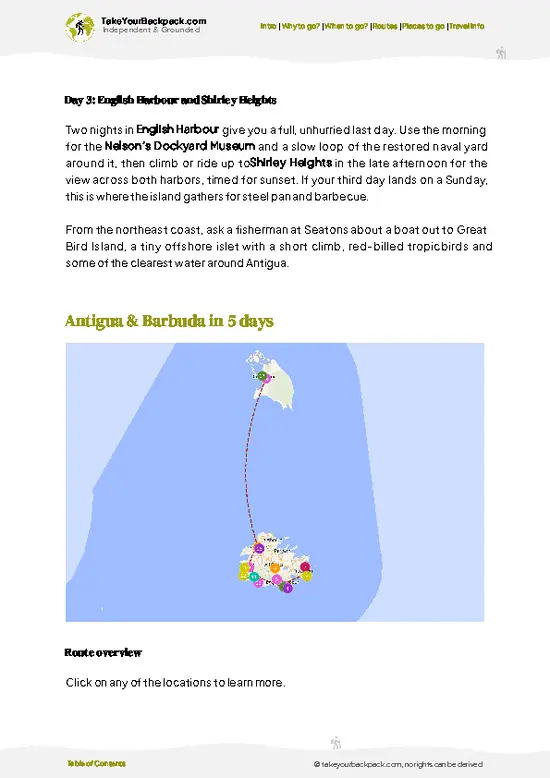
example page 0 from our offline Travel Guide for Antigua and Barbuda
example page 1 from our offline Travel Guide for Antigua and Barbuda
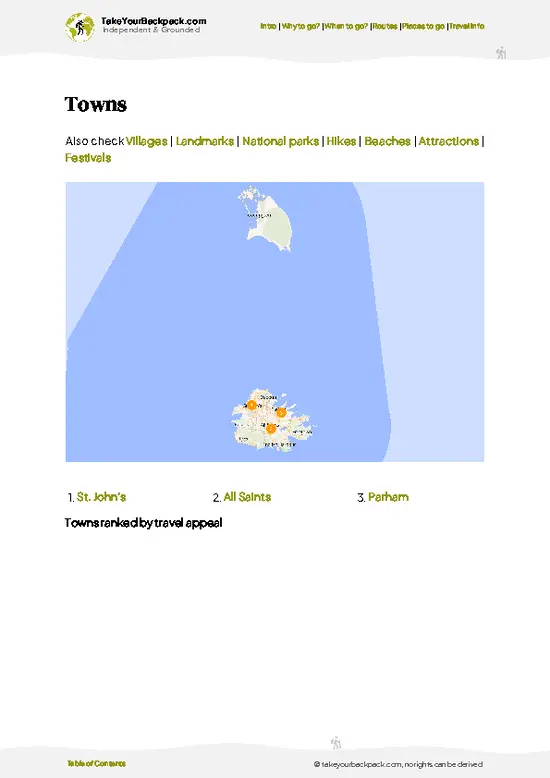
example page 2 from our offline Travel Guide for Antigua and Barbuda
example page 3 from our offline Travel Guide for Antigua and Barbuda
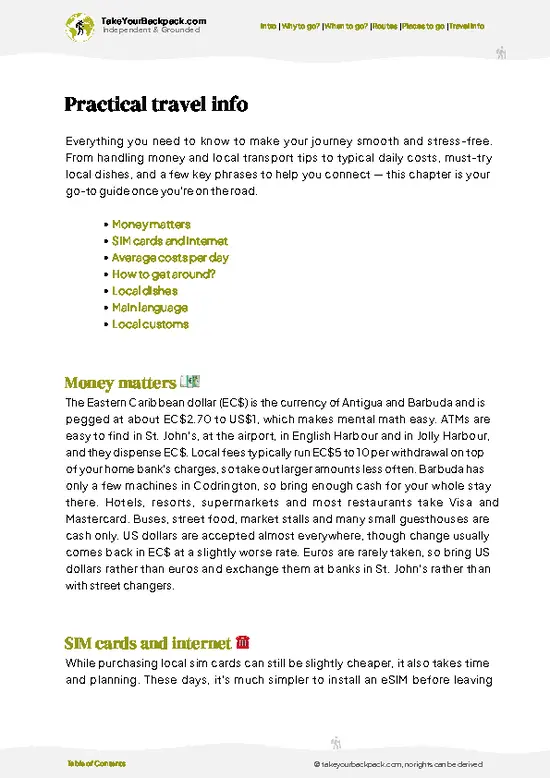
example page 4 from our offline Travel Guide for Antigua and Barbuda
example page 5 from our offline Travel Guide for Antigua and Barbuda
example page 6 from our offline Travel Guide for Antigua and Barbuda
example page 7 from our offline Travel Guide for Antigua and Barbuda
Loading the map 🌍
CLICK TO FILTER
towns
villages
landmarks
national parks
hikes
beaches
attractions
festivals
SHOW COUNTRY’S BESTSHOW ALL

✨ Why go?
Ranked #2 town in Antigua & Barbuda
Reasons people choose to visit here

All Saints works as a calm inland base where you see Antigua’s everyday side. The village sits in the middle of the island, so Fig Tree Drive and the southern rainforest hills are close, and the beaches of the south and west are an easy hop. Most travelers stay a night or two, though slow travelers can linger longer if they rent a room and enjoy the rhythm. The draw is the village’s pottery tradition, centered on neighboring Sea View Farm, plus roadside stands selling the sweet Antigua Black pineapple from the southwest hills instead of a hotel buffet. Evenings are quiet. Expect rum shops, neighbors chatting outside and the sound of tree frogs, not a hostel common room. That suits solo travelers who like to talk with locals, hikers heading to the hills and couples traveling on a modest budget. … read more 👉
All Saints works as a calm inland base where you see Antigua’s everyday side. The village sits in the middle of the island, so Fig Tree Drive and the southern rainforest hills are close, and the beaches of the south and west are an easy hop. Most travelers stay a night or two, though slow travelers can linger longer if they rent a room and enjoy the rhythm. The draw is the village’s pottery tradition, centered on neighboring Sea View Farm, plus roadside stands selling the sweet Antigua Black pineapple from the southwest hills instead of a hotel buffet. Evenings are quiet. Expect rum shops, neighbors chatting outside and the sound of tree frogs, not a hostel common room. That suits solo travelers who like to talk with locals, hikers heading to the hills and couples traveling on a modest budget. It is less useful if you want a social scene. Plan on hiring a taxi for beach days, because buses fade out in the late afternoon.

💡 HighlightsPlaces and moments you shouldn't skip

  1. Antigua Black pineapple stands: The sweet, small Antigua Black is grown in the southwest hills and sold from roadside tables here. Go in the morning when the fruit is freshly cut, and expect to pay a few dollars for a good one. Allow 30 to 45 minutes to taste and chat with the seller, and plan on buying one to eat on the spot.
  2. The old sugar mill towers: The countryside around All Saints is dotted with stone windmill towers left from the plantation era, which shaped the island’s economy and its people. They are free to see from the road, and the best light is early morning or late afternoon. Give yourself an hour to walk between them and read the landscape.
  3. The village rum shops: These small, colorful bars are the social heart of All Saints. Drop in around late afternoon for a cold local beer
… read more 👉
  1. Antigua Black pineapple stands: The sweet, small Antigua Black is grown in the southwest hills and sold from roadside tables here. Go in the morning when the fruit is freshly cut, and expect to pay a few dollars for a good one. Allow 30 to 45 minutes to taste and chat with the seller, and plan on buying one to eat on the spot.
  2. The old sugar mill towers: The countryside around All Saints is dotted with stone windmill towers left from the plantation era, which shaped the island’s economy and its people. They are free to see from the road, and the best light is early morning or late afternoon. Give yourself an hour to walk between them and read the landscape.
  3. The village rum shops: These small, colorful bars are the social heart of All Saints. Drop in around late afternoon for a cold local beer for about US$2 to 3, or rum with a mixer for a little more. The talk usually turns to cricket, and an hour is plenty.
  4. Village churches: The churches set around All Saints, which has given the village its name, anchor Sunday life. If you go to a service, dress neatly and sit at the back, and expect singing that carries across the street. Services run roughly one to two hours and are free, though a small donation is welcome.
Beyond All Saints, day trips reach Fig Tree Drive through the rainforest, the trails of Wallings Nature Reserve, the ruins of Betty’s Hope sugar estate, and the viewpoint at Shirley Heights.
For a first visit, start with the Antigua Black pineapple stands, since they are the quickest way to taste the island’s best-known fruit.
Spotted a mistake or missing something? Contact us.

Things to do around All Saints

Ratings based on Tripadvisor reviews. When you book through this link, you support our work at no extra cost to you.

🏘️ NeighborhoodsNeighborhood guide to All Saints

All Saints is a small inland village, so you can sort it into a few pockets and still see the whole thing in an afternoon. Here is how each one works and the smarter way to use it.
  • Village center and main road. The central junction has the small shops, bakeries and rum bars that line the road running through the middle of Antigua. It is spread along the road, not clustered, so walking is fine in the cool of early morning but miserable at midday sun. Go before 10 a.m., grab a fresh bread and a cold drink from a shop, and you will have seen the lot.
  • Pottery area. Neighboring Sea View Farm, just north of the village, is the center of Antigua’s traditional pottery, and Elvie’s Pottery there sells hand-thrown clay pieces. Craftspeople work on weekdays, which is why weekday mornings are the time to
… read more 👉
All Saints is a small inland village, so you can sort it into a few pockets and still see the whole thing in an afternoon. Here is how each one works and the smarter way to use it.
  • Village center and main road. The central junction has the small shops, bakeries and rum bars that line the road running through the middle of Antigua. It is spread along the road, not clustered, so walking is fine in the cool of early morning but miserable at midday sun. Go before 10 a.m., grab a fresh bread and a cold drink from a shop, and you will have seen the lot.
  • Pottery area. Neighboring Sea View Farm, just north of the village, is the center of Antigua’s traditional pottery, and Elvie’s Pottery there sells hand-thrown clay pieces. Craftspeople work on weekdays, which is why weekday mornings are the time to stop; weekends are often quiet. Buy small pieces that fit in a daypack.
  • Fig Tree Drive side. Heading south the road climbs toward the rainforest hills and mango and banana farms. Roadside stands sell fruit in season, and prices are lowest when you buy straight from the grower. Distances are long between stops, so carry water.
  • Wallings and the west hills. Wallings Nature Reserve and its reservoir sit in the wooded hills a short drive away. Trails are shaded, which is why late afternoon is lovely for a hike, though mosquitoes come out at dusk, so bring repellent.
  • Nightlife. There is very little. Locals gather at small bars on weekends, and the real party scene is on the coast, so head there after dark.

⌛️ 1 day1-day itinerary for All Saints

8:00 AM, All Saints main road: Start early while the air is cool and the fruit sellers are setting up. Walk the main road, greet people and buy a small Antigua Black pineapple for breakfast. Allow an hour for a slow stroll.
9:30 AM, Sugar mill towers: Follow the road out to the nearest windmill ruins in the surrounding fields. They are free, quiet and photogenic in morning light, and they explain why the village exists. Take your time reading the landscape.
11:30 AM, Village church grounds: Stop at one of the churches to look at the stonework and the old graveyard, with the respect any working place of worship deserves. Then move on before the sun gets strong.
1:00 PM, Local lunch: Find a small village cookshop for stewed meat, rice and peas or fungee, usually served from a pot at a counter. … read more 👉
8:00 AM, All Saints main road: Start early while the air is cool and the fruit sellers are setting up. Walk the main road, greet people and buy a small Antigua Black pineapple for breakfast. Allow an hour for a slow stroll.
9:30 AM, Sugar mill towers: Follow the road out to the nearest windmill ruins in the surrounding fields. They are free, quiet and photogenic in morning light, and they explain why the village exists. Take your time reading the landscape.
11:30 AM, Village church grounds: Stop at one of the churches to look at the stonework and the old graveyard, with the respect any working place of worship deserves. Then move on before the sun gets strong.
1:00 PM, Local lunch: Find a small village cookshop for stewed meat, rice and peas or fungee, usually served from a pot at a counter. Pay in cash, and ask what is made that day instead of looking for a menu.
3:00 PM, Off-route backroads: Walk or ride the side lanes toward the farm plots, away from the standard tourist circuit. You will see small growers, goats and views toward the hills, and you may be offered fruit if you stop to chat.
5:00 PM, Rum shop: Finish at a village rum shop with a cold drink as the neighbors come home from work. Talk cricket, and ask about the next day’s buses before dark so you are not stuck.

🌤️ When to go?Seasonal considerations and timing

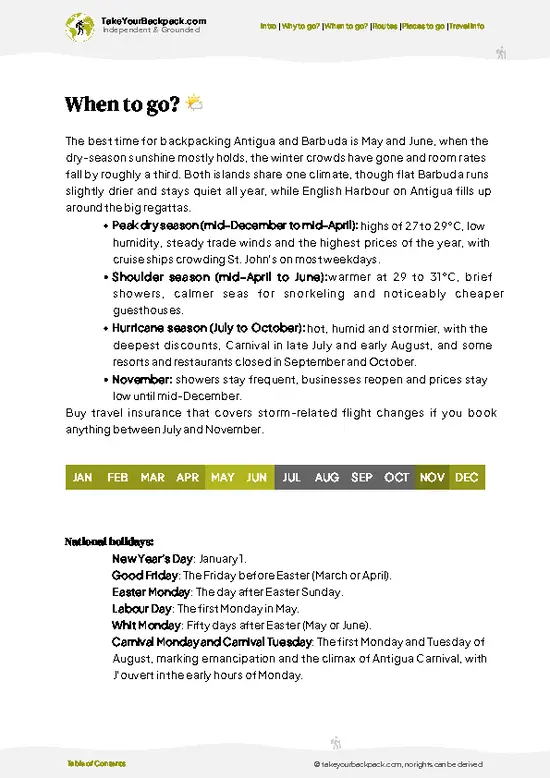
December to April is the easiest window for All Saints, with dry, breezy days and little rain.
  • Peak Season (December to April): Highs reach 28 to 30°C (82 to 86°F) and nights fall to 22 to 24°C (72 to 75°F). Rain is light, hiking trails stay firm, and daylight runs roughly 11 to 12 hours. Accommodation prices are at their highest, especially over Christmas and New Year.
  • Shoulder Months (May to June, November): Temperatures sit around 28 to 31°C (82 to 88°F) with showers becoming more frequent. Rates drop and crowds thin.
  • Wet and Hurricane Season (July to October): Humid heat of 30 to 33°C (86 to 91°F), heavier downpours and the peak of storm risk, especially August to October. Deals are the cheapest of the year, but some small businesses close.
  • Carnival (late July to early August): Prices rise
… read more 👉
December to April is the easiest window for All Saints, with dry, breezy days and little rain.
  • Peak Season (December to April): Highs reach 28 to 30°C (82 to 86°F) and nights fall to 22 to 24°C (72 to 75°F). Rain is light, hiking trails stay firm, and daylight runs roughly 11 to 12 hours. Accommodation prices are at their highest, especially over Christmas and New Year.
  • Shoulder Months (May to June, November): Temperatures sit around 28 to 31°C (82 to 88°F) with showers becoming more frequent. Rates drop and crowds thin.
  • Wet and Hurricane Season (July to October): Humid heat of 30 to 33°C (86 to 91°F), heavier downpours and the peak of storm risk, especially August to October. Deals are the cheapest of the year, but some small businesses close.
  • Carnival (late July to early August): Prices rise and rooms book out, though the festivities are mostly in St. John’s.
Book flexible rates if you travel between August and October.


source: climatestotravel.comJANJanuary: excellent for travelingFEBFebruary: excellent for travelingMARMarch: excellent for travelingAPRApril: highly recommended for travelingMAYMay: highly recommended for travelingJUNJune: fair for travelingJULJuly: fair for travelingAUGAugust: fair for travelingSEPSeptember: below average for travelingOCTOctober: fair for travelingNOVNovember: highly recommended for travelingDECDecember: excellent for traveling
when-to-go

✈️ The backpacker research shortcutAntigua & Barbuda Travel Guide

What the free pages can't give you: ready-made routes, every place ranked, and it works offline. All in 1 guide.
example page 0 from our offline Travel Guide for Antigua and Barbuda
example page 1 from our offline Travel Guide for Antigua and Barbuda
example page 2 from our offline Travel Guide for Antigua and Barbuda
example page 3 from our offline Travel Guide for Antigua and Barbuda
example page 4 from our offline Travel Guide for Antigua and Barbuda
example page 5 from our offline Travel Guide for Antigua and Barbuda
example page 6 from our offline Travel Guide for Antigua and Barbuda
example page 7 from our offline Travel Guide for Antigua and Barbuda
The digital guide (128 pages) contains:-page digital guide:
✅ Ready-made 2, 3 & 5-day routes
✅ All 36 places ranked, so you skip the overrated ones
✅ Works offline, all in 1 guide
✅ Cities, national parks, landmarks, beaches
✅ How to get around
👉 Click to see all 30+ guide features

📅 Plan smarter in minutes, not weeks
✅ Month by month travel advice
✅ Festivals & national holidays
✅ Budget expectations

🗺️ Go to the right places, skip the overrated ones
✅ Honest pros & cons of destinations
✅ Top hikes, parks & viewpoints
✅ Lesser-known places most travelers miss
✅ Clear “worth it vs skip it” guidance

🛏️ Travel smoothly without rookie mistakes
✅ Best areas to stay
✅ Transport systems explained simply
✅ Common scams & safety advice
✅ SIM cards, money & practical tips

🌍 Understand the country, not just visit it
✅ Culture & traditions
✅ Local customs
✅ Festivals worth planning around
✅ Traveler-friendly historical context
✅ Insights that make places more meaningful

📱 Built for real travel conditions
✅ Fully downloadable PDF
✅ Works completely offline
✅ Optimized for phone use
✅ Useful in remote areas & buses
✅ All in 1 guide
Stop searching, start planning
Get instant access to your full guide. 30‑day money-back guarantee.


By proceeding you agree to our terms.
Sent to your inbox immediately after payment • 100% Secure Checkout
Best Backpacking Travel Advisor 2025 tourism awardBest Backpacking
Travel Advisor
2025
What others say about Take Your Backpack Guides:
⭐⭐⭐⭐⭐
Fantastic, amazing amount of information!
⭐⭐⭐⭐⭐
My goodness this is amazing, it's what I've been looking for hats off too you!
⭐⭐⭐⭐⭐
I think this is absolutely BRILLIANT
⭐⭐⭐⭐
Very complete and informative. It's still missing places, but I gotta to commend you
⭐⭐⭐⭐⭐
This is truly amazing, thank you, can't wait to explore it with my kids!
⭐⭐⭐⭐⭐
Awesome resource, thank you!
⭐⭐⭐⭐⭐
This is amazing! Can't wait to explore the ones I haven't seen
⭐⭐⭐⭐
I love this! Well done, great idea.
⭐⭐⭐⭐⭐
Thanks for taking the time to make this gem!
⭐⭐⭐⭐⭐
This might be the best website I've ever seen.
⭐⭐⭐⭐⭐
Congratulations, and thank you so much for your work; it's incredibly valuable.
⭐⭐⭐⭐
In all seriousness I think you did a great job pointing out the important spots
⭐⭐⭐⭐⭐
10/10 very good
⭐⭐⭐⭐⭐
As someone who's only just starting to visit regularly this is awesome, thank you.
⭐⭐⭐⭐
Thank you very much! I'm going to visit my dad, it's going to be very useful!
⭐⭐⭐⭐⭐
This is really cool! We'll be travelling for the first time and this definitely come in handy.
⭐⭐⭐⭐⭐
You are now our minister of culture, congratulations 👨‍💼
⭐⭐⭐⭐⭐
Just wanted to tell you that this is a pearl! Going to follow your recommendations.
⭐⭐⭐⭐⭐
This is so cool. I'll definitely be using the resource for my travels soon.
⭐⭐⭐⭐⭐
This is very impressive! Good work.
⭐⭐⭐⭐⭐
This is an amazing and informative site. Very well done!

🛏️ Where to stay?Best areas to stay in Antigua & Barbuda

The best budget base for All Saints is St. John’s, about 20 to 30 minutes away by road, where most hostels and cheap guesthouses cluster. Dorm beds there run about US$25 to 45 a night, and the bus terminal makes it easy to reach the village.
The second option is English Harbour and Falmouth on the south coast. It has more yacht-crowd character and fewer bargain beds, but guesthouses and a few hostels are found within reach, and the nightlife is lively and safer to walk in than most places on the island. Expect to pay US$35 to 60 for a bed or basic room, more in winter.
In All Saints itself, accommodation … read more 👉
The best budget base for All Saints is St. John’s, about 20 to 30 minutes away by road, where most hostels and cheap guesthouses cluster. Dorm beds there run about US$25 to 45 a night, and the bus terminal makes it easy to reach the village.
The second option is English Harbour and Falmouth on the south coast. It has more yacht-crowd character and fewer bargain beds, but guesthouses and a few hostels are found within reach, and the nightlife is lively and safer to walk in than most places on the island. Expect to pay US$35 to 60 for a bed or basic room, more in winter.
In All Saints itself, accommodation is sparse: a few small guesthouses and rentals, so book ahead and expect to need transport for meals and supplies. Staying in the village suits travelers who want quiet, but you will want a rental car.
St. John’s is livelier by day, quieter after the shops close, and a bit rough around the edges at night, so take a taxi rather than walking long unlit stretches. Whichever you choose, book early for December to April, when beds fill fast.

🚌 Getting aroundMoving around without the hassle

All Saints is only walkable in short stretches along its main road, and once you head toward the pottery or rainforest hills the distances and midday heat make walking a poor idea. Antigua has no train, and traffic thickens near St. John’s in the morning and late afternoon. The smarter plan is to combine buses for the main road with a taxi or rental car for the places in between.
  • Walking. Free and fine for the village junction in the cool early morning. The road has narrow verges and few sidewalks, which is why you should stay off it after dark and keep to daylight hours.
  • Public minibuses. Shared vans run between St. John’s and the south and east of the island for roughly US$1 to 2 per ride. They have no printed timetable and leave when full, so flag them early in the day, as service thins out
… read more 👉
All Saints is only walkable in short stretches along its main road, and once you head toward the pottery or rainforest hills the distances and midday heat make walking a poor idea. Antigua has no train, and traffic thickens near St. John’s in the morning and late afternoon. The smarter plan is to combine buses for the main road with a taxi or rental car for the places in between.
  • Walking. Free and fine for the village junction in the cool early morning. The road has narrow verges and few sidewalks, which is why you should stay off it after dark and keep to daylight hours.
  • Public minibuses. Shared vans run between St. John’s and the south and east of the island for roughly US$1 to 2 per ride. They have no printed timetable and leave when full, so flag them early in the day, as service thins out by late afternoon and is scarce on Sundays. Ask the driver to confirm that the route passes All Saints before you board.
  • Taxis. Fixed government rates are posted by destination and are roughly US$25 to 45 from St. John’s or the airport, so agree the price before you get in. Ask your driver to wait during a stop, which is cheaper than booking a return.
  • Rental car. Cars cost about US$45 to 70 a day, plus a temporary local driving permit of around US$20. Driving is on the left, and roads have potholes and tight bends, so pick up the car in daylight and avoid steep back roads after rain. This is the best choice for splitting costs among two to four people.
  • Hitching and lifts. Locals often offer lifts and it is common on quiet roads, but travelers should stick to minibuses or taxis for reliability.

👛 Costs (as of 10 November 2026)Travel costs and budget guide for All Saints

All Saints costs backpackers roughly US$115 a day in high season, and most of that goes on a bed and a rental car or taxis, because Antigua has almost no hostel culture. Everything is paid in Eastern Caribbean dollars, though US dollars are widely accepted at shops and taxis. The village sits in the island’s interior, so you eat and shop locally and spend on transport to reach the coast.
CategoryBudget RangeLocal Reality
Dorm accommodationUS$45 to 70 (high season), US$35 to 55 (low season)Dorms are rare on the island, so expect a private guesthouse room or a small rental, often with a kitchenette.
MealsUS$25 to 40Bakery items and a rotis or stewed chicken plate with rice and peas run US$6 to 12 at local spots. Groceries are pricey because most food is imported.
Local transportUS$8 to 25Minibuses
… read more 👉
All Saints costs backpackers roughly US$115 a day in high season, and most of that goes on a bed and a rental car or taxis, because Antigua has almost no hostel culture. Everything is paid in Eastern Caribbean dollars, though US dollars are widely accepted at shops and taxis. The village sits in the island’s interior, so you eat and shop locally and spend on transport to reach the coast.
CategoryBudget RangeLocal Reality
Dorm accommodationUS$45 to 70 (high season), US$35 to 55 (low season)Dorms are rare on the island, so expect a private guesthouse room or a small rental, often with a kitchenette.
MealsUS$25 to 40Bakery items and a rotis or stewed chicken plate with rice and peas run US$6 to 12 at local spots. Groceries are pricey because most food is imported.
Local transportUS$8 to 25Minibuses along the main roads cost about US$1 to 2 a ride and thin out by late afternoon. Taxis are unmetered with fixed rates, often US$15 to 30 to reach the coast.
Basic activities/entry feesUS$5 to 20Potters at neighboring Sea View Farm sell pieces and let you watch the work. Beaches are free, and hiking the nearby hills costs nothing.
Miscellaneous expensesUS$5 to 15Bottled water, a local beer at US$2 to 4, and a SIM or data top-up.
Total Daily BudgetUS$115High-season estimate for one traveler.
Buying fruit, bread, and basics at the village shops and cooking in a kitchenette trims the meals row by half.
⚠️ Prices can change and everyone travels differently, so take this as a rough guide. Hope it helps you plan your adventure!

🚌 Day tripsExploring the surroundings

All Saints sits in the center of Antigua, so most day trips are a 20 to 50 minute drive and are easier with a car or a shared taxi.
Fig Tree Drive:
This scenic road winds south through rainforest, banana groves and fruit stands to Old Road. Allow half a day with stops, and go in the morning to avoid heat. By car it costs only fuel plus a snack or two, about US$10 to 20. First-timers often forget water.

Nelson’s Dockyard:
The Georgian naval dockyard at English Harbour is the island’s best-known historic site, with restored buildings, a museum and good views from Shirley Heights. Reaching it takes about 35 to 45 minutes by road. The entry fee is around US$10 to 15 and is valid for several days. Visit early on cruise-ship days, and go to Shirley Heights on Sunday evening for steel band and barbecue. … read more 👉
All Saints sits in the center of Antigua, so most day trips are a 20 to 50 minute drive and are easier with a car or a shared taxi.
Fig Tree Drive:
This scenic road winds south through rainforest, banana groves and fruit stands to Old Road. Allow half a day with stops, and go in the morning to avoid heat. By car it costs only fuel plus a snack or two, about US$10 to 20. First-timers often forget water.

Nelson’s Dockyard:
The Georgian naval dockyard at English Harbour is the island’s best-known historic site, with restored buildings, a museum and good views from Shirley Heights. Reaching it takes about 35 to 45 minutes by road. The entry fee is around US$10 to 15 and is valid for several days. Visit early on cruise-ship days, and go to Shirley Heights on Sunday evening for steel band and barbecue.

Devil’s Bridge:
On the east coast, waves have carved a natural limestone arch above blowholes. It takes about 40 minutes by car, costs nothing to enter, and is best in the morning. Stay well back from the edge, as waves have swept people off the rocks.

Half Moon Bay:
A crescent of pale sand with calmer water on the south east coast, around 45 minutes away. Bring your own food, since facilities are limited, and expect a total spend of US$15 to 30 with transport. Aim for weekdays from December to April.
👉 Explore Half Moon Bay

🛡️ SafetyStaying Safe: What Travelers Should Know

All Saints is a quiet inland village, and trouble is rare; the most common problems are petty theft from parked cars and unlit roads after dark. Do not leave bags or phones visible in a rental car, and park in view of houses or shops. Roads have narrow shoulders and few streetlights, so avoid walking them at night and take a taxi instead. Solo travelers, including women, generally report few problems here, though it makes sense to avoid empty stretches after dark and tell your guesthouse where you are going. Drivers can take bends fast, so keep to the verge and use a flashlight. Scams are uncommon. Some taxi drivers quote higher prices without posted rates, so ask the fare before getting in. Mosquitoes and strong sun are the everyday annoyances, so carry repellent and water. Hurricane season … read more 👉
All Saints is a quiet inland village, and trouble is rare; the most common problems are petty theft from parked cars and unlit roads after dark. Do not leave bags or phones visible in a rental car, and park in view of houses or shops. Roads have narrow shoulders and few streetlights, so avoid walking them at night and take a taxi instead. Solo travelers, including women, generally report few problems here, though it makes sense to avoid empty stretches after dark and tell your guesthouse where you are going. Drivers can take bends fast, so keep to the verge and use a flashlight. Scams are uncommon. Some taxi drivers quote higher prices without posted rates, so ask the fare before getting in. Mosquitoes and strong sun are the everyday annoyances, so carry repellent and water. Hurricane season runs June to November, so watch weather alerts then.

FAQFrequently asked questions about All Saints

All Saints is worth a half-day stop rather than a main destination. The pottery workshops at Sea View Farm, the shaded trails at Wallings and the fruit stands along Fig Tree Drive make a pleasant circuit. The beaches and Nelson’s Dockyard are 30 to 45 minutes away by road, so travelers usually combine them.
Half a day to one day is enough for All Saints itself. Add a second day if you want to hike at Wallings and drive the Fig Tree Drive route. Most travelers fit it into a five to seven day Antigua trip, with other days spent on the coast.
Yes, All Saints works easily as a day trip from St. John’s, which is about 20 to 30 minutes by road. A taxi costs roughly US$25 to 45 each way, while minibuses cost about US$1 to 2 but run less often. Leave in the morning so you can visit the pottery studios and return before the afternoon heat and thinner bus service.
⚠️ Things can change over time, so always validate details locally before you go.

Other Antiguan and Barbudan towns near All Saints

Explore more nearby:

  • Parham—Octagonal church, fishing jetty, wooden houses, sheltered sound| 6 km away
  • St. John’s—Twin-towered cathedral, Saturday market, Redcliffe Quay, pastel grid| 9 km away

💡 Not sure where to go next?
Create a personalized itinerary for Antigua & Barbuda including All Saints and the places that fit your trip.

Generate my itinerary

👉 Discover all towns

Or checkout all Antigua & Barbuda has to offer (think cities, towns, villages, national parks, hikes, beaches, festivals)
Country photo of Antigua & Barbuda

We 💚 feedbackParting advice and final tips

All Saints pairs well with a morning of Fig Tree Drive or Wallings Nature Reserve, then a beach afternoon on the south or west coast. I would stay a night, no more, and base the rest of the trip on the coast. Bring cash, buy a pineapple at a roadside stand, and leave the village by early evening if you need a bus.

✍️ Help improve this page!
The information on this page is based on in-depth research, insights shared by experienced travelers, and feedback from the local travel community in Antigua & Barbuda. While every effort is made to keep the information accurate and current, conditions can change — so if you spot anything incorrect or outdated, please get in touch.


🙋‍♂️ Give feedback

👋 Meet the founderWho’s Behind Take Your Backpack?

Johan, backpacker and founder of TakeYourBackpackHi, I’m Johan (Netherlands 🇳🇱), the creator of TakeYourBackpack. Over the past 30 years, I’ve backpacked through 88 countries across six continents, gaining extensive experience with independent travel, long-term trips, and overland routes.

This site is built on a combination of firsthand travel experience and carefully curated insights from other backpackers. Many guides are based on places I’ve personally visited, while others bring together tips, observations, and practical advice shared by trusted travelers I’ve met along the way.

The goal is to provide realistic, experience-driven guidance — not generic itineraries — so you can explore destinations with better context, clearer expectations, and more confidence.