


×

Antigua & Barbuda🇦🇬 | townsSt. John’sTwin-towered cathedral, Saturday market, Redcliffe Quay, pastel grid | things to do and best time to go

Explore Nelson’s Dockyard National ParkExplore Parham

Backpacking in St. John’s
🏆 Top picktown ranked #1
By Johan Kruseman 🇳🇱 | Updated October 22, 2026

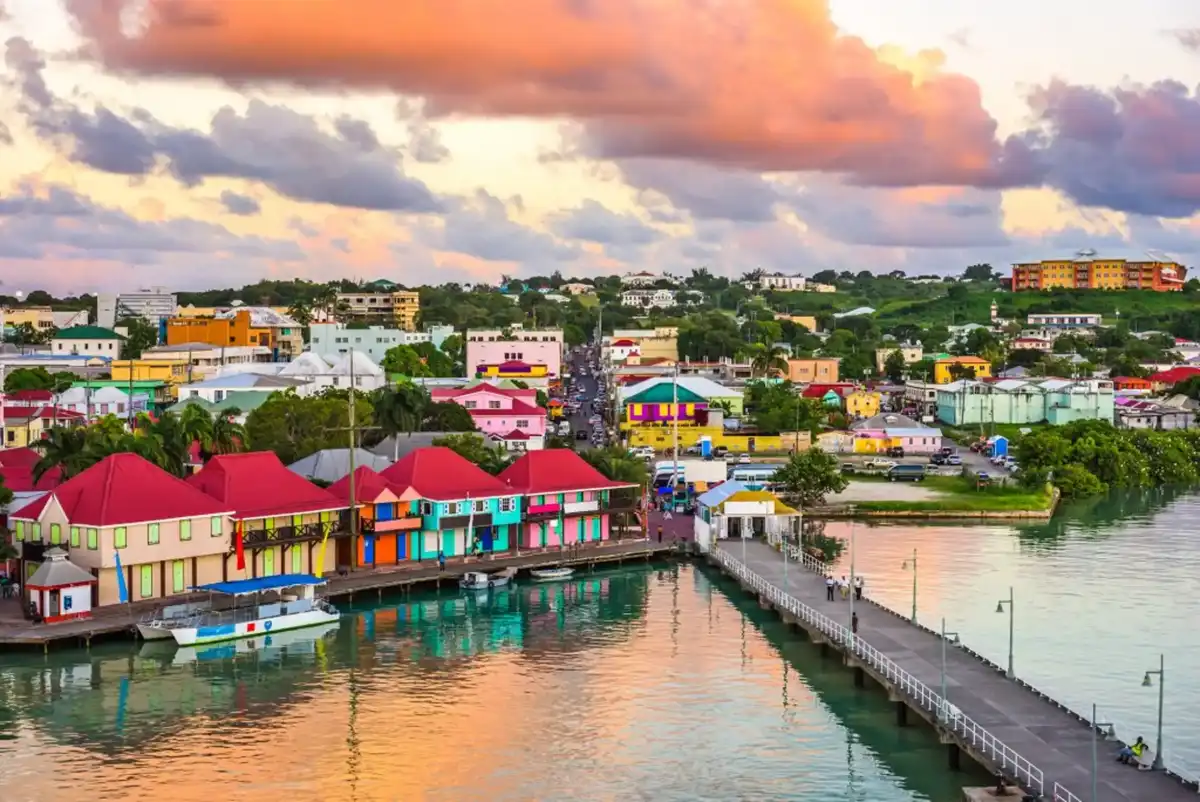
Cruise ships dock at the harbor most days of the winter season, and the waterfront shopping zone fills by 10 a.m., yet by mid-afternoon, once the ships sail, the center empties and the real town reappears. St. John’s sits on the northwest coast of Antigua, the capital of Antigua and Barbuda, and it works as a practical hub rather than a beach destination. The streets are a grid of low pastel buildings, minibus stands and rum shops, loud and a little tatty, with no real old-town charm to wander for hours. Beaches are a bus ride away, and most hostel-style beds are scarce, so socializing happens in cafés, bars and on the buses themselves. Meeting other backpackers is possible but not guaranteed. Go early on Saturday morning to the public market on Market Street, where vendors stack mangoes, soursop and hot peppers on tables, and the smell of fresh bread and frying fish follows you down the block.

Discover everything you want to know in the 📖 Antigua & Barbuda Travel Guide.


example page 0 from our offline Travel Guide for Antigua and Barbuda
example page 1 from our offline Travel Guide for Antigua and Barbuda
example page 2 from our offline Travel Guide for Antigua and Barbuda
example page 3 from our offline Travel Guide for Antigua and Barbuda
example page 4 from our offline Travel Guide for Antigua and Barbuda
example page 5 from our offline Travel Guide for Antigua and Barbuda
example page 6 from our offline Travel Guide for Antigua and Barbuda
example page 7 from our offline Travel Guide for Antigua and Barbuda
Loading the map 🌍
CLICK TO FILTER
towns
villages
landmarks
national parks
hikes
beaches
attractions
festivals
SHOW COUNTRY’S BESTSHOW ALL

✨ Why go?
Ranked #1 town in Antigua & Barbuda
Why St. John’s should be on your travel list

St. John’s earns a day or two rather than a week, and the reason is access. Every bus route on the island starts here, so you can wake up in a guesthouse, grab a seat in a minibus and be on a beach or at a historic site by lunchtime, then come back and eat well for little money. The Saturday market on Market Street is the best place to try local produce and street food such as pepperpot, saltfish and fungee, and the stalls near the bus station sell cheap hot lunches that locals actually queue for. The Heritage Quay and Redcliffe Quay waterfront areas give you restored warehouses, cafés and a place to sit with decent wifi. Slow travelers and solo backpackers who like to see how a Caribbean capital really works will enjoy it. Party seekers and beach-only travelers should treat it as a transit … read more 👉
St. John’s earns a day or two rather than a week, and the reason is access. Every bus route on the island starts here, so you can wake up in a guesthouse, grab a seat in a minibus and be on a beach or at a historic site by lunchtime, then come back and eat well for little money. The Saturday market on Market Street is the best place to try local produce and street food such as pepperpot, saltfish and fungee, and the stalls near the bus station sell cheap hot lunches that locals actually queue for. The Heritage Quay and Redcliffe Quay waterfront areas give you restored warehouses, cafés and a place to sit with decent wifi. Slow travelers and solo backpackers who like to see how a Caribbean capital really works will enjoy it. Party seekers and beach-only travelers should treat it as a transit stop. Evenings are quiet outside of cruise days, which suits early risers and anyone planning long bus days.

💡 HighlightsDon't-miss highlights and experiences

  1. St. John’s Cathedral: The twin-towered Anglican church dominates the skyline, and its interior is lined with dark pitch pine over the stone walls, built to shield the roof from hurricanes and earthquakes. Visit in the morning for cooler air and soft light in the churchyard, where old gravestones and the figures at the gate add context. Entry is usually free or by small donation, and 30 to 45 minutes is plenty.
  2. Museum of Antigua and Barbuda: Housed in the former courthouse on Long Street, it explains the island’s story through Arawak artifacts, plantation-era items and a cricket display. Allow about an hour. Entry is roughly US$3 to 5, and the building is a cool refuge on a hot afternoon.
  3. Redcliffe Quay: Old stone warehouses and former slave-trading yards turned into small shops, cafés and restaurants.
… read more 👉
  1. St. John’s Cathedral: The twin-towered Anglican church dominates the skyline, and its interior is lined with dark pitch pine over the stone walls, built to shield the roof from hurricanes and earthquakes. Visit in the morning for cooler air and soft light in the churchyard, where old gravestones and the figures at the gate add context. Entry is usually free or by small donation, and 30 to 45 minutes is plenty.
  2. Museum of Antigua and Barbuda: Housed in the former courthouse on Long Street, it explains the island’s story through Arawak artifacts, plantation-era items and a cricket display. Allow about an hour. Entry is roughly US$3 to 5, and the building is a cool refuge on a hot afternoon.
  3. Redcliffe Quay: Old stone warehouses and former slave-trading yards turned into small shops, cafés and restaurants. Come around lunch or late afternoon after the cruise crowds thin, spend 1 to 2 hours, and expect to pay US$8 to 20 for a meal.
  4. Saturday Public Market: Locals buy fruit, vegetables, spices and fish here from early morning, and it is at its best before 9 a.m. It is free to enter, and 1 hour is enough to taste and look. Bring small bills and a bag.
  5. Fort James: At the harbor mouth, a short drive or taxi ride from the center, this 18th-century fort has cannons pointing across the water and a clear view back over the bay. Go late afternoon for softer light. It is free, and 45 minutes is enough.
Day trips from St. John’s include Nelson’s Dockyard and Shirley Heights in the south, Betty’s Hope sugar plantation, Fort Barrington and the beaches at Dickenson Bay and Jolly Beach. The cathedral and the museum combine easily in one morning, since they are a few minutes’ walk apart.
Spotted a mistake or missing something? Contact us.

Things to do around St. John’s

Ratings based on Tripadvisor reviews. When you book through this link, you support our work at no extra cost to you.

🏘️ NeighborhoodsWhere things are and how it's laid out

St. John’s is small enough to cover on foot in a morning, and each corner has its own rhythm.
  • Heritage Quay and Redcliffe Quay: The cruise-ship waterfront, with duty-free shops and a food court, is busy on ship days and dead otherwise. Walk five minutes to Redcliffe Quay, where restored brick warehouses hold cafes and craft stalls in shaded courtyards. Go before noon, grab a coffee, and you get the old port at its most photogenic with no crowds.
  • Market Street and the Public Market: Friday and Saturday mornings are the day to come. Vendors stack mangoes, soursop, and fish, and the noise is part of the show. Buy a bag of local black pineapple in season and eat it on the spot.
  • Downtown and Church Street: St. John’s Cathedral, with its twin towers, sits on a hill above the grid of narrow streets.
… read more 👉
St. John’s is small enough to cover on foot in a morning, and each corner has its own rhythm.
  • Heritage Quay and Redcliffe Quay: The cruise-ship waterfront, with duty-free shops and a food court, is busy on ship days and dead otherwise. Walk five minutes to Redcliffe Quay, where restored brick warehouses hold cafes and craft stalls in shaded courtyards. Go before noon, grab a coffee, and you get the old port at its most photogenic with no crowds.
  • Market Street and the Public Market: Friday and Saturday mornings are the day to come. Vendors stack mangoes, soursop, and fish, and the noise is part of the show. Buy a bag of local black pineapple in season and eat it on the spot.
  • Downtown and Church Street: St. John’s Cathedral, with its twin towers, sits on a hill above the grid of narrow streets. Step inside for the dark pine interior, then walk down to the Museum of Antigua and Barbuda for a cheap, quick history lesson on the island.
  • Newgate Street and the bus stations: This is the working side of town, with chicken-and-roti counters and lunch spots at local prices. Aim for the 12:30 rush for the freshest pots and a seat next to real locals.
  • Fort James and Hodges Bay side: Head north along the coast for the old fort ruins and a view back across the harbor. A short ride gets you there, and late afternoon gives you cooler air and a long sunset horizon.

⌛️ 1 day1-day itinerary for St. John’s

8:00 AM, Market Street: Start at the public market, ideally on a Saturday, because the produce and the crowd are at their best before the sun gets strong. Walk the stalls, try a fresh juice or a fried bake, and then stroll uphill to the center of town.
9:30 AM, St. John’s Cathedral: Spend 30 to 45 minutes inside and around the churchyard while it is still cool. The wood interior and the old graves tell you a lot about the island’s past.
10:30 AM, Museum of Antigua and Barbuda: A short walk away, the museum gives context on Arawak life, plantations and cricket. It takes about an hour and prepares you for the rest of the day.
12:00 PM, Lunch near the bus station: Skip the waterfront menus for a plate of stewed meat or fish with rice and peas from a local counter, where the portions are large and … read more 👉
8:00 AM, Market Street: Start at the public market, ideally on a Saturday, because the produce and the crowd are at their best before the sun gets strong. Walk the stalls, try a fresh juice or a fried bake, and then stroll uphill to the center of town.
9:30 AM, St. John’s Cathedral: Spend 30 to 45 minutes inside and around the churchyard while it is still cool. The wood interior and the old graves tell you a lot about the island’s past.
10:30 AM, Museum of Antigua and Barbuda: A short walk away, the museum gives context on Arawak life, plantations and cricket. It takes about an hour and prepares you for the rest of the day.
12:00 PM, Lunch near the bus station: Skip the waterfront menus for a plate of stewed meat or fish with rice and peas from a local counter, where the portions are large and the neighbors are regulars. It is a slice of daily life most cruise visitors miss.
1:30 PM, Redcliffe Quay: Wander the restored warehouses, browse the craft shops and take a break with a coffee. The shade and the old stonework make it a pleasant pause in the heat.
3:30 PM, Fort James: Take a taxi or a long walk out to the harbor entrance and climb up to the cannon positions. The bay view helps you understand why the town was defended.
5:30 PM, Waterfront or a rum shop: Head back and finish with a cold local beer at a neighborhood bar, where talk of cricket and politics is free.

🌤️ When to go?Weather, crowds, and seasonal trade-offs

December through April is the easiest window for St. John’s, with dry days and a steady trade-wind breeze.
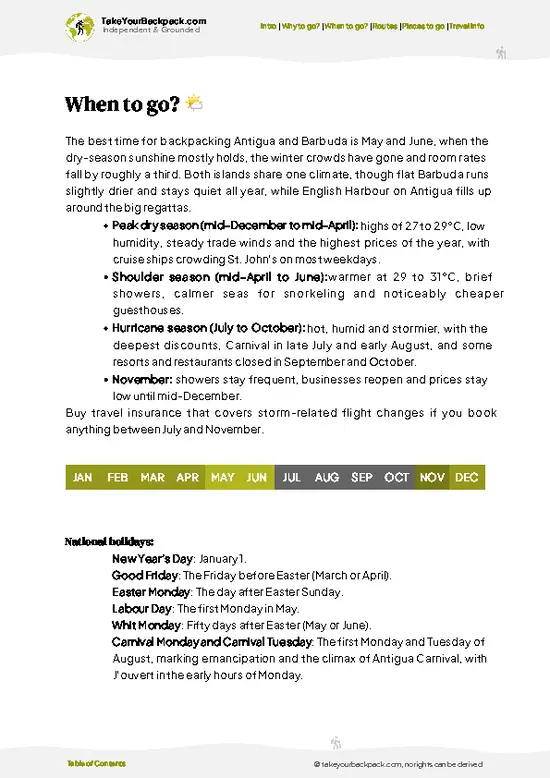
  • Peak Season (mid-December to April): Highs run 27 to 30°C (81 to 86°F), nights 22 to 24°C (72 to 75°F), and rain is brief. Daylight lasts about 11 to 12 hours. Cruise ships crowd the waterfront, and room rates run highest, especially over Christmas and New Year.
  • Shoulder Months (May to June, November): Expect 29 to 31°C (84 to 88°F), more humidity, and short showers. Rooms drop noticeably in price and the streets are calmer.
  • Summer Carnival (late July to early August): Parades, steel pan, and street parties fill the town. Beds get tight and prices climb, so book early.
  • Hurricane Season (June to November): Peak risk is August to October, with heat near 32°C (90°F) and heavy, humid days. Deals
… read more 👉
December through April is the easiest window for St. John’s, with dry days and a steady trade-wind breeze.
  • Peak Season (mid-December to April): Highs run 27 to 30°C (81 to 86°F), nights 22 to 24°C (72 to 75°F), and rain is brief. Daylight lasts about 11 to 12 hours. Cruise ships crowd the waterfront, and room rates run highest, especially over Christmas and New Year.
  • Shoulder Months (May to June, November): Expect 29 to 31°C (84 to 88°F), more humidity, and short showers. Rooms drop noticeably in price and the streets are calmer.
  • Summer Carnival (late July to early August): Parades, steel pan, and street parties fill the town. Beds get tight and prices climb, so book early.
  • Hurricane Season (June to November): Peak risk is August to October, with heat near 32°C (90°F) and heavy, humid days. Deals are the best of the year, but storms can cancel plans.
Book Carnival lodging months ahead, or come in May for lower rates and calm streets.


source: climatestotravel.comJANJanuary: excellent for travelingFEBFebruary: excellent for travelingMARMarch: excellent for travelingAPRApril: highly recommended for travelingMAYMay: good for travelingJUNJune: fair for travelingJULJuly: fair for travelingAUGAugust: fair for travelingSEPSeptember: below average for travelingOCTOctober: below average for travelingNOVNovember: fair for travelingDECDecember: excellent for traveling

✈️ The backpacker research shortcutAntigua & Barbuda Travel Guide

An offline-friendly backpacking guide with optimized travel routes, ranked highlights, transport advice, and the best areas to stay.
example page 0 from our offline Travel Guide for Antigua and Barbuda
example page 1 from our offline Travel Guide for Antigua and Barbuda
example page 2 from our offline Travel Guide for Antigua and Barbuda
example page 3 from our offline Travel Guide for Antigua and Barbuda
example page 4 from our offline Travel Guide for Antigua and Barbuda
example page 5 from our offline Travel Guide for Antigua and Barbuda
example page 6 from our offline Travel Guide for Antigua and Barbuda
example page 7 from our offline Travel Guide for Antigua and Barbuda
The digital guide (130 pages) contains:
✅ 36 highlights, ranked by travel appeal
✅ Optimized 2, 3 & 5-day travel routes
✅ Cities, national parks, landmarks, beaches
✅ How to get around
✅ Offline-friendly for travel without Wi-Fi
👉 Click to see all 30+ guide features

📅 Plan smarter in minutes, not weeks
✅ Month by month travel advice
✅ Festivals & national holidays
✅ Budget expectations

🗺️ Go to the right places, skip the overrated ones
✅ Honest pros & cons of destinations
✅ Top hikes, parks & viewpoints
✅ Lesser-known places most travelers miss
✅ Clear “worth it vs skip it” guidance

🛏️ Travel smoothly without rookie mistakes
✅ Best areas to stay
✅ Transport systems explained simply
✅ Common scams & safety advice
✅ SIM cards, money & practical tips

🌍 Understand the country, not just visit it
✅ Culture & traditions
✅ Local customs
✅ Festivals worth planning around
✅ Traveler-friendly historical context
✅ Insights that make places more meaningful

📱 Built for real travel conditions
✅ Fully downloadable PDF
✅ Works completely offline
✅ Optimized for phone use
✅ Useful in remote areas & buses
✅ Everything in one place
Stop searching, start planning
Get instant access to your full guide. 30‑day money-back guarantee.
+ Add another guide for just

By proceeding you agree to our terms.
Sent to your inbox immediately after payment • 100% Secure Checkout
Best Backpacking Travel Advisor 2025 tourism awardBest Backpacking
Travel Advisor
2025
What others say about Take Your Backpack Guides:
⭐⭐⭐⭐⭐
Fantastic, amazing amount of information!
⭐⭐⭐⭐⭐
My goodness this is amazing, it's what I've been looking for hats off too you!
⭐⭐⭐⭐⭐
I think this is absolutely BRILLIANT
⭐⭐⭐⭐
Very complete and informative. It's still missing places, but I gotta to commend you
⭐⭐⭐⭐⭐
This is truly amazing, thank you, can't wait to explore it with my kids!
⭐⭐⭐⭐⭐
Awesome resource, thank you!
⭐⭐⭐⭐⭐
This is amazing! Can't wait to explore the ones I haven't seen
⭐⭐⭐⭐
I love this! Well done, great idea.
⭐⭐⭐⭐⭐
Thanks for taking the time to make this gem!
⭐⭐⭐⭐⭐
This might be the best website I've ever seen.
⭐⭐⭐⭐⭐
Congratulations, and thank you so much for your work; it's incredibly valuable.
⭐⭐⭐⭐
In all seriousness I think you did a great job pointing out the important spots
⭐⭐⭐⭐⭐
10/10 very good
⭐⭐⭐⭐⭐
As someone who's only just starting to visit regularly this is awesome, thank you.
⭐⭐⭐⭐
Thank you very much! I'm going to visit my dad, it's going to be very useful!
⭐⭐⭐⭐⭐
This is really cool! We'll be travelling for the first time and this definitely come in handy.
⭐⭐⭐⭐⭐
You are now our minister of culture, congratulations 👨‍💼
⭐⭐⭐⭐⭐
Just wanted to tell you that this is a pearl! Going to follow your recommendations.
⭐⭐⭐⭐⭐
This is so cool. I'll definitely be using the resource for my travels soon.
⭐⭐⭐⭐⭐
This is very impressive! Good work.
⭐⭐⭐⭐⭐
This is an amazing and informative site. Very well done!

🛏️ Where to stay?How to pick the right area

The best budget base is central St. John’s itself, around downtown and the streets near the quays, because you can walk to the market, bus stations, and restaurants. Dorm-style beds are scarce across Antigua, and the island is better known for guesthouses and small apartments. Expect private rooms at about US$60 to 100 a night in high season, with shared setups at lower rates when you can find them.

Downtown is quiet and safe enough in the evening for short walks, though after dark many streets empty out once shops close, so a taxi back is sensible if you are alone. Noise tends to come from traffic … read more 👉
The best budget base is central St. John’s itself, around downtown and the streets near the quays, because you can walk to the market, bus stations, and restaurants. Dorm-style beds are scarce across Antigua, and the island is better known for guesthouses and small apartments. Expect private rooms at about US$60 to 100 a night in high season, with shared setups at lower rates when you can find them.

Downtown is quiet and safe enough in the evening for short walks, though after dark many streets empty out once shops close, so a taxi back is sensible if you are alone. Noise tends to come from traffic and early morning vendors, not nightlife, and cruise ship days can bring horn blasts and crowds around the waterfront.

The second area to consider is the Fort Road and Hodges Bay side to the north, which is a few minutes by taxi or minibus from the center. It is calmer, has more guesthouse and apartment options, and is close to a few small beaches. You will rely on buses or taxis for dinners, as late service is limited. Book early for December to April, when the cheapest rooms vanish first, and look for kitchen access to cut food costs.

🚌 Getting aroundHow to get from A to B

Walking is the easiest way to get around central St. John’s, because the grid of downtown streets is compact and flat, and you can cross it in about 15 minutes. Traffic is the main frustration, with slow, jammed roads at rush hour and on cruise-ship days. Public transport is cheap but runs on its own schedule, so give yourself slack.
  • Walking: Free and best for the quays, market, cathedral, and museum. Stick to shaded sides of streets at midday, and carry water. You end up spotting small rum shops and murals that no vehicle would show you.
  • Minibus: Privately run vans cost about US$1 to 2 within the island, and they leave from two main terminals, the West Bus Station near the market and the East Bus Station on Independence Avenue. Service starts early morning and thins out by late afternoon, with
… read more 👉
Walking is the easiest way to get around central St. John’s, because the grid of downtown streets is compact and flat, and you can cross it in about 15 minutes. Traffic is the main frustration, with slow, jammed roads at rush hour and on cruise-ship days. Public transport is cheap but runs on its own schedule, so give yourself slack.
  • Walking: Free and best for the quays, market, cathedral, and museum. Stick to shaded sides of streets at midday, and carry water. You end up spotting small rum shops and murals that no vehicle would show you.
  • Minibus: Privately run vans cost about US$1 to 2 within the island, and they leave from two main terminals, the West Bus Station near the market and the East Bus Station on Independence Avenue. Service starts early morning and thins out by late afternoon, with very little after dark. Wait until the van fills, so allow time. You ride shoulder to shoulder with commuters and get Soca at full volume.
  • Taxi: Rates are fixed by zone and not metered, and a ride across town costs roughly US$5 to 10, with the airport about US$12 to 15. Agree on the price before you get in and ask for it in US dollars if you wish. Taxis are the most practical way back after dark, and drivers often double as informal tour guides.
  • Rental car: Expect about US$45 to 70 per day, plus a temporary local driving permit of about US$20. Traffic keeps to the left, and the roads have potholes. A car makes sense if you want to reach Shirley Heights and the southern beaches in one day, with sunset views to show for it.
  • Ferry: The Barbuda Express to Barbuda leaves from the ferry dock at the bottom of High Street in St. John’s Harbour.

👛 Costs (as of 22 October 2026)Money, prices, and spending tips

St. John’s costs a backpacker about US$99 to 170 a day in high season, and Antigua is pricier than most Caribbean islands. Dorm beds are rare, so the figure uses a basic private room or shared guesthouse. Everything is paid in Eastern Caribbean currency, though many places also quote US dollars.
CategoryBudget RangeLocal Reality
Accommodation (shared or basic room)US$55 to 80 (high season); US$40 to 60 (low season)Hostel beds are scarce, so guesthouse rooms set the price. High season is December to April.
MealsUS$25 to 40Local rotis, chicken and rice, and fish plates cost US$7 to 12. Restaurant dinners climb above US$25.
Local transportUS$4 to 15Minibuses cost US$1 to 2 per ride. Taxis are US$5 to 15 around town.
Activities and entry feesUS$10 to 25Nelson’s Dockyard is about US$8 to 10, and the
… read more 👉
St. John’s costs a backpacker about US$99 to 170 a day in high season, and Antigua is pricier than most Caribbean islands. Dorm beds are rare, so the figure uses a basic private room or shared guesthouse. Everything is paid in Eastern Caribbean currency, though many places also quote US dollars.
CategoryBudget RangeLocal Reality
Accommodation (shared or basic room)US$55 to 80 (high season); US$40 to 60 (low season)Hostel beds are scarce, so guesthouse rooms set the price. High season is December to April.
MealsUS$25 to 40Local rotis, chicken and rice, and fish plates cost US$7 to 12. Restaurant dinners climb above US$25.
Local transportUS$4 to 15Minibuses cost US$1 to 2 per ride. Taxis are US$5 to 15 around town.
Activities and entry feesUS$10 to 25Nelson’s Dockyard is about US$8 to 10, and the museum a few dollars. Beaches are free.
MiscellaneousUS$5 to 10Water, sunscreen, snacks, and the occasional rum punch at around US$4 to 6.
Total Daily BudgetUS$99 to 170About US$135 a day at the midpoint of high season.
Cook some meals if your lodging has a kitchen and buy produce at the Friday and Saturday market to trim food costs.
⚠️ Prices can change and everyone travels differently, so take this as a rough guide. Hope it helps you plan your adventure!

🚌 Day tripsEasy escapes and nearby places

St. John’s is a handy base for day trips because most of the island sits within an hour by road, and minibuses reach the main hubs.
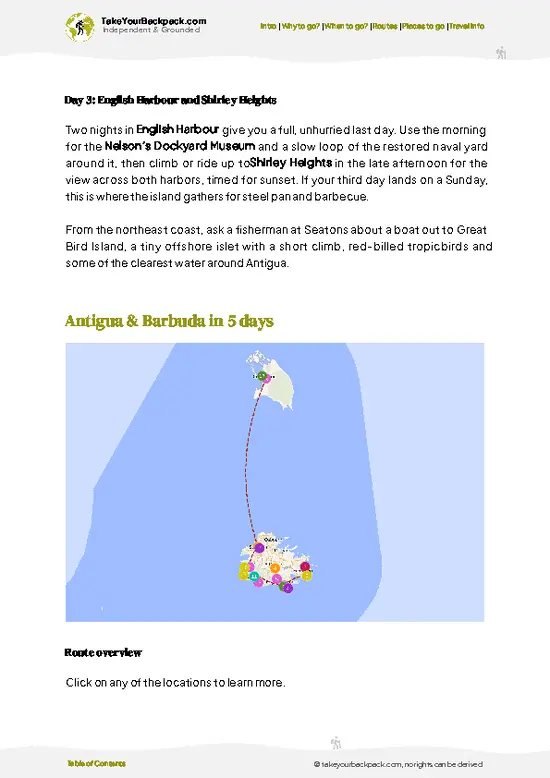
English Harbour and Nelson’s Dockyard: The restored Georgian naval dockyard is the island’s top historic site, with masts in the harbor and old stone buildings. Plan about 45 minutes by taxi or about 1 hour by minibus via a transfer. Entry is around US$8 to 10, and the full day costs about US$25 to 40 with lunch. Go in the dry months, and arrive early before tour groups. Beginners often skip the walking trails above the dockyard, and miss the best view.
👉 Explore Nelson’s Dockyard National Park
Shirley Heights Lookout: The hilltop above English Harbour gives a sweeping view of the south coast. On Sunday afternoons a steel band and grill party start around 4 pm, and … read more 👉
St. John’s is a handy base for day trips because most of the island sits within an hour by road, and minibuses reach the main hubs.
English Harbour and Nelson’s Dockyard: The restored Georgian naval dockyard is the island’s top historic site, with masts in the harbor and old stone buildings. Plan about 45 minutes by taxi or about 1 hour by minibus via a transfer. Entry is around US$8 to 10, and the full day costs about US$25 to 40 with lunch. Go in the dry months, and arrive early before tour groups. Beginners often skip the walking trails above the dockyard, and miss the best view.
👉 Explore Nelson’s Dockyard National Park
Shirley Heights Lookout: The hilltop above English Harbour gives a sweeping view of the south coast. On Sunday afternoons a steel band and grill party start around 4 pm, and entry is about US$10 to 15. Taxis cost around US$30 to 45 each way, so share. Many first-timers underestimate the late return, so arrange a driver beforehand.
👉 Explore Shirley Heights
Dickenson Bay and Darkwood Beach: Dickenson Bay is a lively north beach with calm water and beach bars, about 15 minutes by bus or taxi. Darkwood on the west coast is quieter, about 30 minutes by taxi, with gentle surf. Budget US$15 to 30 including lunch. Best from December to May, when seas are calmest.
👉 Explore Dickenson Bay
Betty’s Hope: This restored sugar plantation has two stone windmills and a small visitor center, and it tells the island’s colonial and slavery history. It is about 30 minutes by taxi, and entry is around US$5. Allow an hour, and bring water, as there is little shade. Combine it with a stop on the eastern coast.
👉 Explore Betty’s Hope

🛡️ SafetySafety Tips and Common Scams in St. John’s

St. John’s is broadly safe for backpackers, and daytime walking downtown is relaxed. Petty theft is the main concern, so keep phones and cameras tucked away in crowded spots like the market and the quays on cruise-ship days. Carry only the cash you need and leave your passport in your lodging.

After dark, many downtown streets empty out once shops close. Solo travelers, especially women, should take a taxi back rather than walk through quiet blocks, and avoid poorly lit side streets. Taxi fares are not metered, so confirm the price first to avoid a haggle at the end.

Occasional hawkers and tour touts approach near the waterfront. A polite no and a steady walk is enough. Sun and heat catch more people out than crime, so use sunscreen and drink water. Keep valuables out of sight in rental cars and beach bags, even for a short swim.

FAQTraveler FAQ

St. John’s is worth one or two days, but it is more of a cultural stop than a beach destination. You can cover the cathedral, Redcliffe Quay, the museum, and the Saturday market in about half a day, and entry costs are low at US$0 to 10. Beaches and Nelson’s Dockyard are a 15 to 45 minute ride away.
Two days suit St. John’s if you want the market, cathedral, museum, and Fort James at a relaxed pace. Add a day for English Harbour and Shirley Heights, which are about 45 minutes by taxi. A total of three days lets you fit in a beach afternoon at Dickenson Bay, only 15 minutes away.
St. John’s is the island’s main hub, so you can easily visit other Antigua sites from it, and most of the island is within an hour of the town by road. If you are visiting from a cruise ship, you can cover the downtown core in 3 to 4 hours on foot. Taxis to English Harbour run about US$30 to 45 each way, and minibuses cost US$1 to 2 but are slower.
⚠️ Things can change over time, so always validate details locally before you go.

Other Antiguan and Barbudan towns near St. John’s

Explore more nearby:

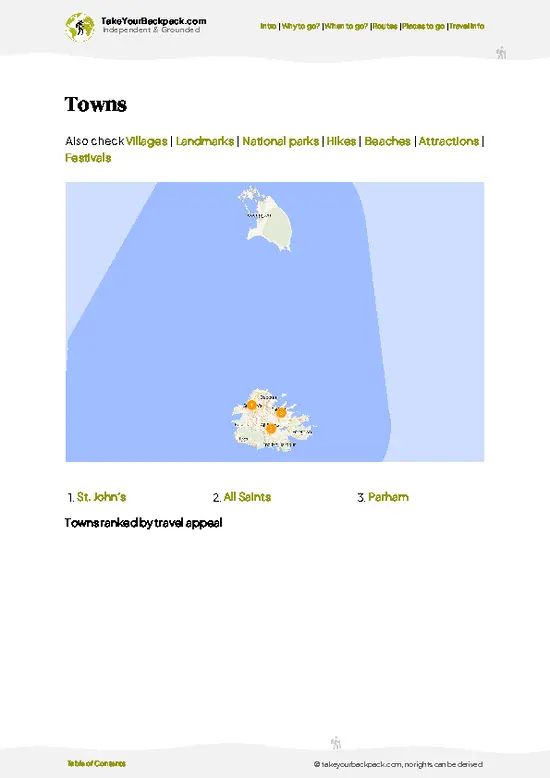
  • Parham—Octagonal church, fishing jetty, wooden houses, sheltered sound| 9 km away
  • All Saints—Antigua Black pineapples, windmill towers, rum shops, village churches| 9 km away

💡 Not sure where to go next?
Create a personalized itinerary for Antigua & Barbuda including St. John’s and the places that fit your trip.

Generate my itinerary

👉 Discover all towns

Or checkout all Antigua & Barbuda has to offer (think cities, towns, villages, national parks, hikes, beaches, festivals)
Country photo of Antigua & Barbuda

We 💚 feedbackParting advice and final tips

St. John’s trips people up when they treat it as a beach base and spend the day on a taxi meter. Do the opposite. Walk the center in the morning, then take a minibus to the sand. Carry small bills for buses and market stalls, and avoid the waterfront on cruise days if you want a quieter lunch.

✍️ Help improve this page!
The information on this page is based on in-depth research, insights shared by experienced travelers, and feedback from the local travel community in Antigua & Barbuda. While every effort is made to keep the information accurate and current, conditions can change — so if you spot anything incorrect or outdated, please get in touch.


🙋‍♂️ Give feedback

👋 Meet the founderWho’s Behind Take Your Backpack?

Johan, backpacker and founder of TakeYourBackpackHi, I’m Johan (Netherlands 🇳🇱), the creator of TakeYourBackpack. Over the past 3 decades, I’ve backpacked through 90+ countries across six continents, gaining extensive experience with independent travel, long-term trips, and overland routes.

This site is built on a combination of firsthand travel experience and carefully curated insights from other backpackers. Many guides are based on places I’ve personally visited, while others bring together tips, observations, and practical advice shared by trusted travelers I’ve met along the way.

The goal is to provide realistic, experience-driven guidance — not generic itineraries — so you can explore destinations with better context, clearer expectations, and more confidence.