×

Aruba🇦🇼 | best hikesWhere to Find the Best hikes in Aruba

Hikes in Aruba are short, hot and wide open, nothing like a jungle trek. The wild north coast and Arikok National Park have the best terrain, while the resort-lined west is mostly flat. Go at sunrise, when the trails are cool and empty. Independent travelers can keep costs low, since most trails are free or cost only a park fee.

By Johan Kruseman 🇳🇱 | Updated October 20, 2026
Explore the best beaches in Aruba

Why go?Understanding Their Importance

Aruba sits outside the hurricane belt and is semi-arid, so cactus, divi-divi trees and bare rock replace the lush forest most people expect from a Caribbean island. That shapes everything. Trails are short, exposed and mostly dry underfoot, and the island is only about 32 kilometers (20 miles) long, so nothing is remote. The terrain is volcanic, limestone and coral, with a rugged windward coast that feels worlds apart from the calm leeward beaches. Know before you choose Aruba: this is a destination for half-day outings, not multi-day treks. Shade is rare, so carry more water than seems sensible. Cunucu country roads are often rough, and a 4x4 or an ATV opens up the best sections. Bring sturdy shoes, because loose rock and sharp cactus are everywhere.
Behind the Scenes of Selection
The list of best hikes in Aruba is created based on scenery, challenge, trail quality, landmarks, and overall enjoyment. If you feel a hike is missing in this list, please let us know.

When to go?Best Time to Visit Aruba for hikes

Best months and weather: The best months for hiking in Aruba are December to April, when cooler trade winds keep daytime highs near 28 to 31°C (82 to 88°F) and rain is rare. Aruba is dry all year, averaging roughly 400 to 500 mm of rain, and most of it falls between October and January in short showers. The heat never really drops, so start walking before 8 a.m. in any season.Crowds and prices: Peak season runs from mid-December to April, when hotel rates can be 30 to 50 percent higher than in summer. May to June and September to early November are the shoulder periods, with fewer people on trails and cheaper rooms. Midday in July and August is punishing, though early mornings stay manageable. Check Arikok National Park opening hours before you go, and plan to be out before the late afternoon.

hike hoppingOptimizing Your Multi-Stop Itinerary

Pacing a multi-hike trip: A trip combining several hikes in Aruba needs 3 to 4 days, since each outing takes only a half day. Plan around two clusters: the Arikok National Park area in the center and southeast, and the north coast around the California Lighthouse. Drives between them take 20 to 40 minutes. Aruba has no long transfers, so the real constraint is heat, not distance.Direction and mistakes: Base yourself near Oranjestad or the Palm Beach strip, where buses run, then rent a car or join a jeep tour for the interior. Start each day with the farthest trailhead while it is still cool, and finish with something shaded or coastal. Allow 2 to 4 hours per stop. The usual mistake is stacking two hikes after midday, which leaves you drained and short on water. Another is trusting buses to … read more 👉
Pacing a multi-hike trip: A trip combining several hikes in Aruba needs 3 to 4 days, since each outing takes only a half day. Plan around two clusters: the Arikok National Park area in the center and southeast, and the north coast around the California Lighthouse. Drives between them take 20 to 40 minutes. Aruba has no long transfers, so the real constraint is heat, not distance.Direction and mistakes: Base yourself near Oranjestad or the Palm Beach strip, where buses run, then rent a car or join a jeep tour for the interior. Start each day with the farthest trailhead while it is still cool, and finish with something shaded or coastal. Allow 2 to 4 hours per stop. The usual mistake is stacking two hikes after midday, which leaves you drained and short on water. Another is trusting buses to reach trailheads, because they do not. Split the day instead: one hike at sunrise, a swim at noon.

The ListHighly Recommended hikes of Aruba

1 Hooiberg

587 concrete steps, 165-meter summit, 360-degree island view, cactus-dotted slopes

Climb a steady staircase of landings and rails to a summit platform overlooking Oranjestad, the Casibari boulders, the Atlantic coast and, on clear days, Venezuela.

aruba-hike-hooiberg
© Google | Luigi Arends
Loading the map 🌍

Expert viewPro Tips for Exploring the Best

How many hikes to do: Plan on 3 to 5 hikes. Aruba is small, trails are short, and the heat caps you at one solid outing per day, so more than five turns into repetition of cactus and rock.Which kind to prioritize: Budget travelers should lean toward coastal walks and free public trails. Those who want geology, caves and wildlife should put the national park first. Photographers do best at sunrise on the windward side. Anyone short on time can add one guided jeep or ATV outing for access to remote sections that a rental sedan cannot reach.What it costs: Expect US$40 to 90 a day for hiking-focused independent travel, depending on your lodging. Arikok National Park entry is about US$15 to 20 per person, while many coastal trails are free. A local bus ride is roughly US$2.60 to 3, a rental car … read more 👉
How many hikes to do: Plan on 3 to 5 hikes. Aruba is small, trails are short, and the heat caps you at one solid outing per day, so more than five turns into repetition of cactus and rock.Which kind to prioritize: Budget travelers should lean toward coastal walks and free public trails. Those who want geology, caves and wildlife should put the national park first. Photographers do best at sunrise on the windward side. Anyone short on time can add one guided jeep or ATV outing for access to remote sections that a rental sedan cannot reach.What it costs: Expect US$40 to 90 a day for hiking-focused independent travel, depending on your lodging. Arikok National Park entry is about US$15 to 20 per person, while many coastal trails are free. A local bus ride is roughly US$2.60 to 3, a rental car runs US$40 to 70 a day, and a guided jeep or hiking tour costs US$60 to 120. A typical hiking-focused visit lands around US$100 to 250 in activity and transport costs beyond lodging and food.Safety and etiquette: Carry at least 2 liters of water per person, plus a hat, sunscreen and closed shoes. The sun is the main danger, along with loose rock and sharp cactus spines. Cell signal can drop in remote areas, so tell someone your plan. Stay on marked paths, since the dry ecosystem recovers slowly. Do not touch or stack stones at cultural and archaeological sites, and never climb on cave walls where Indigenous Arawak drawings survive. Swimming at rugged windward beaches is dangerous because of strong currents. Keep valuables out of parked cars at trailheads.

✈️ The backpacker research shortcutAruba Travel Guide

An offline-friendly backpacking guide with optimized travel routes, ranked highlights, transport advice, and the best areas to stay.
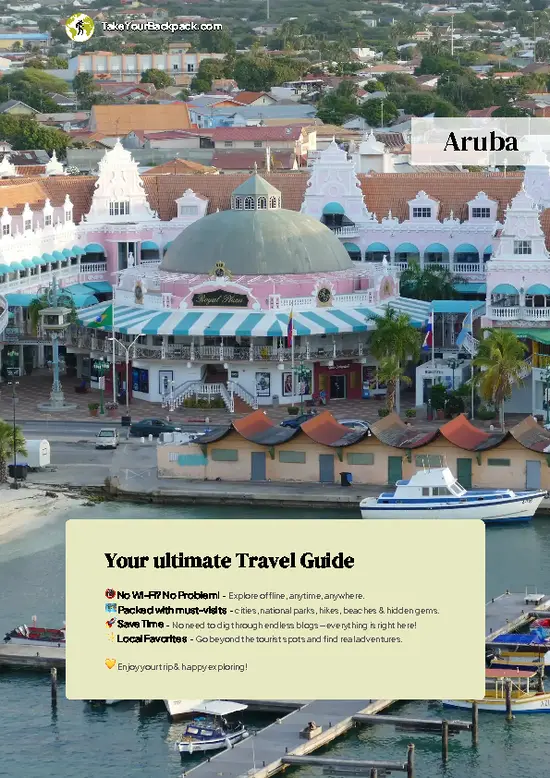
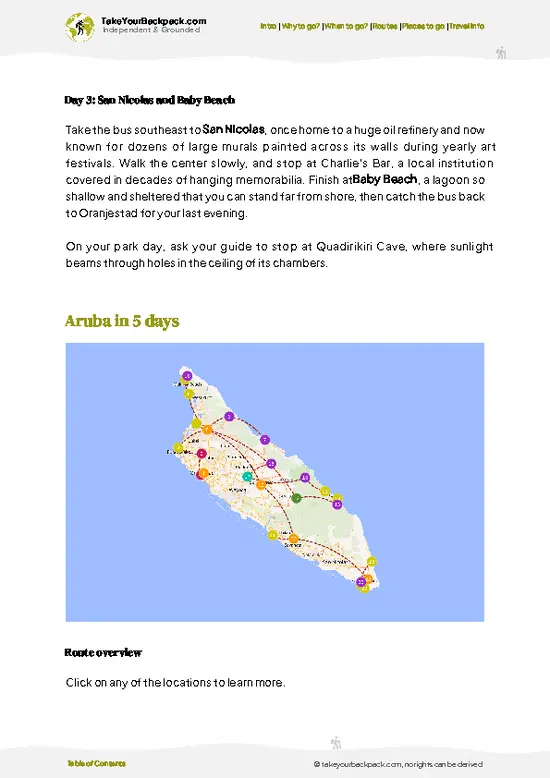
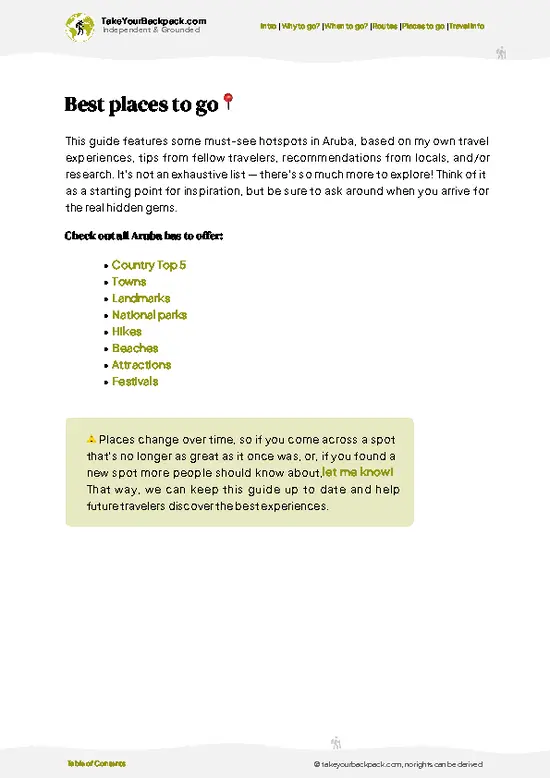
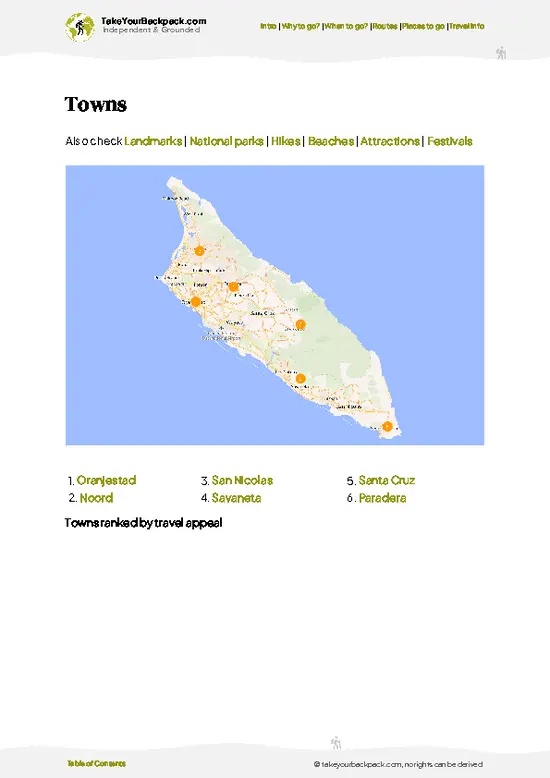
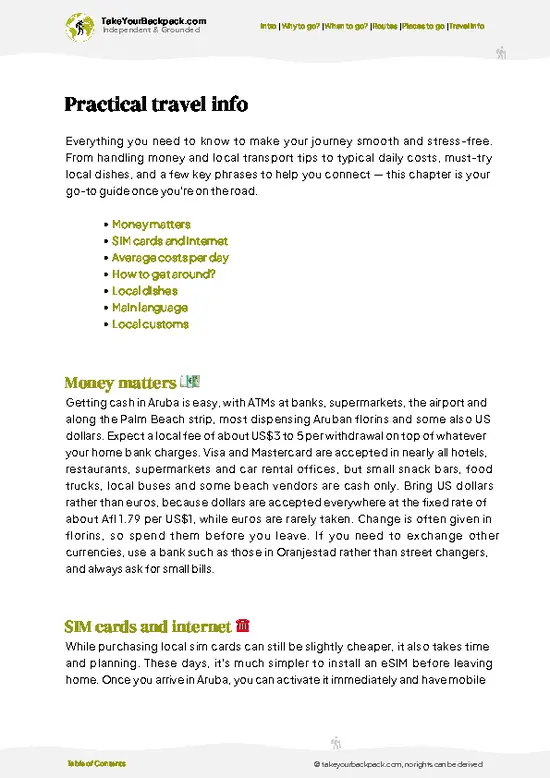
example page 0 from our offline Travel Guide for Aruba
example page 1 from our offline Travel Guide for Aruba
example page 2 from our offline Travel Guide for Aruba
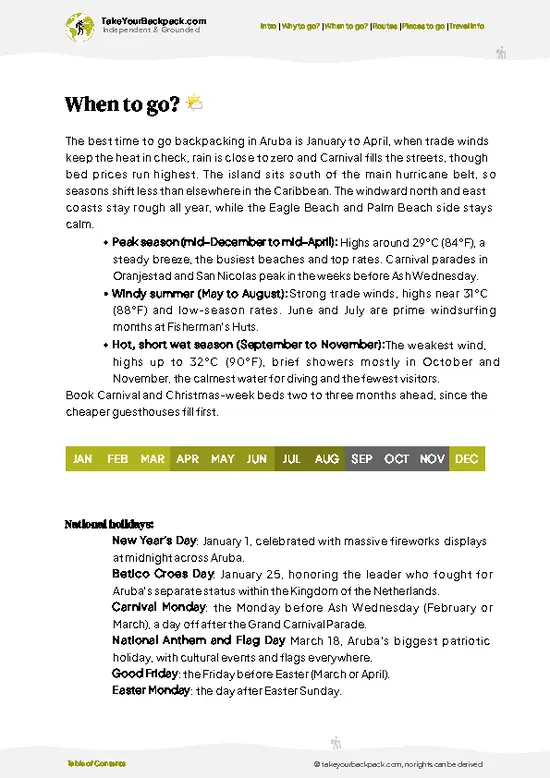
example page 3 from our offline Travel Guide for Aruba
example page 4 from our offline Travel Guide for Aruba
example page 5 from our offline Travel Guide for Aruba
example page 6 from our offline Travel Guide for Aruba
example page 7 from our offline Travel Guide for Aruba
The digital guide (138 pages) contains:
✅ 34 highlights, ranked by travel appeal
✅ Optimized 2, 3 & 5-day travel routes
✅ Cities, national parks, landmarks, beaches
✅ How to get around
✅ Offline-friendly for travel without Wi-Fi
👉 Click to see all 30+ guide features

📅 Plan smarter in minutes, not weeks
✅ Month by month travel advice
✅ Festivals & national holidays
✅ Budget expectations

🗺️ Go to the right places, skip the overrated ones
✅ Honest pros & cons of destinations
✅ Top hikes, parks & viewpoints
✅ Lesser-known places most travelers miss
✅ Clear “worth it vs skip it” guidance

🛏️ Travel smoothly without rookie mistakes
✅ Best areas to stay
✅ Transport systems explained simply
✅ Common scams & safety advice
✅ SIM cards, money & practical tips

🌍 Understand the country, not just visit it
✅ Culture & traditions
✅ 52 Essential phrases & customs
✅ Festivals worth planning around
✅ Traveler-friendly historical context
✅ Insights that make places more meaningful

📱 Built for real travel conditions
✅ Fully downloadable PDF
✅ Works completely offline
✅ Optimized for phone use
✅ Useful in remote areas & buses
✅ Everything in one place
Stop searching, start planning
Get instant access to your full guide. 30‑day money-back guarantee.
+ Add another guide for just

By proceeding you agree to our terms.
Sent to your inbox immediately after payment • 100% Secure Checkout
Best Backpacking Travel Advisor 2025 tourism awardBest Backpacking
Travel Advisor
2025
What others say about Take Your Backpack Guides:
⭐⭐⭐⭐⭐
Fantastic, amazing amount of information!
⭐⭐⭐⭐⭐
My goodness this is amazing, it's what I've been looking for hats off too you!
⭐⭐⭐⭐⭐
I think this is absolutely BRILLIANT
⭐⭐⭐⭐
Very complete and informative. It's still missing places, but I gotta to commend you
⭐⭐⭐⭐⭐
This is truly amazing, thank you, can't wait to explore it with my kids!
⭐⭐⭐⭐⭐
Awesome resource, thank you!
⭐⭐⭐⭐⭐
This is amazing! Can't wait to explore the ones I haven't seen
⭐⭐⭐⭐
I love this! Well done, great idea.
⭐⭐⭐⭐⭐
Thanks for taking the time to make this gem!
⭐⭐⭐⭐⭐
This might be the best website I've ever seen.
⭐⭐⭐⭐⭐
Congratulations, and thank you so much for your work; it's incredibly valuable.
⭐⭐⭐⭐
In all seriousness I think you did a great job pointing out the important spots
⭐⭐⭐⭐⭐
10/10 very good
⭐⭐⭐⭐⭐
As someone who's only just starting to visit regularly this is awesome, thank you.
⭐⭐⭐⭐
Thank you very much! I'm going to visit my dad, it's going to be very useful!
⭐⭐⭐⭐⭐
This is really cool! We'll be travelling for the first time and this definitely come in handy.
⭐⭐⭐⭐⭐
You are now our minister of culture, congratulations 👨‍💼
⭐⭐⭐⭐⭐
Just wanted to tell you that this is a pearl! Going to follow your recommendations.
⭐⭐⭐⭐⭐
This is so cool. I'll definitely be using the resource for my travels soon.
⭐⭐⭐⭐⭐
This is very impressive! Good work.
⭐⭐⭐⭐⭐
This is an amazing and informative site. Very well done!

🛏️ Where to stay?Where to Stay: Aruba Edition

Aruba has almost no true hostels, so budget travelers rely on small guesthouses, studio apartments and private rooms, typically AWG 105 to 215 (US$60 to 120) a night. Oranjestad is the cheapest base and the island’s bus hub, though downtown goes quiet after dark, while Noord puts inland apartments a short bus ride from the bars and casinos of Palm Beach, at a higher price. Eagle Beach is calmer and low-rise with easy beach access, and San Nicolas and Savaneta offer lower rates and a local feel near Baby Beach, but are 20 to 30 minutes from most restaurants and nightlife.

If you enjoy meeting fellow travelers, consider choosing hostels with high ratings for atmosphere. On the other hand, if you … read more 👉
Aruba has almost no true hostels, so budget travelers rely on small guesthouses, studio apartments and private rooms, typically AWG 105 to 215 (US$60 to 120) a night. Oranjestad is the cheapest base and the island’s bus hub, though downtown goes quiet after dark, while Noord puts inland apartments a short bus ride from the bars and casinos of Palm Beach, at a higher price. Eagle Beach is calmer and low-rise with easy beach access, and San Nicolas and Savaneta offer lower rates and a local feel near Baby Beach, but are 20 to 30 minutes from most restaurants and nightlife.

If you enjoy meeting fellow travelers, consider choosing hostels with high ratings for atmosphere. On the other hand, if you prefer having your own space, a hotel might be a better option.

ArubaExplore Beyond This Category

👋 Meet the founderWho’s Behind Take Your Backpack?

Johan, backpacker and founder of TakeYourBackpackHi, I’m Johan (Netherlands 🇳🇱), the creator of TakeYourBackpack. Over the past 3 decades, I’ve backpacked through 90+ countries across six continents, gaining extensive experience with independent travel, long-term trips, and overland routes.

This site is built on a combination of firsthand travel experience and carefully curated insights from other backpackers. Many guides are based on places I’ve personally visited, while others bring together tips, observations, and practical advice shared by trusted travelers I’ve met along the way.

The goal is to provide realistic, experience-driven guidance — not generic itineraries — so you can explore destinations with better context, clearer expectations, and more confidence.