×

The Bahamas🇧🇸 | national parksBlue Holes National ParkLimestone sinkhole pool, pine and coppice trail, Bahama woodstar, Fresh Creek batik | things to do and best time to go

Explore Exuma Cays Land and Sea ParkExplore Crab Replenishment Reserve

Backpacking in Blue Holes
👍 Recommendednational park ranked #3
By Johan Kruseman 🇳🇱 | Updated October 20, 2026

Blue Holes National Park is about water so clear and deep blue that a limestone sinkhole in the pine forest looks like a cut-out piece of sky. It sits on Andros, the largest and least developed island in Bahamas, in the central part of the island near Fresh Creek. The hiking is gentle: short, rooty paths through pine and coppice that end at a pool where you can swim or jump from the rock lip. The scenery pays off fast, the birdlife and the island’s rock iguanas are a bonus, and crowds are rare. Expect no cafes, no shuttle and patchy signage, so the vibe is quiet and self-sufficient. Get there mid-morning when the sun is high enough to light the water down into the hole. Bring bug spray, since mosquitoes and sand flies in the shaded forest are relentless, and carry your own water, because nothing is sold on the trail.

Discover everything you want to know in the 📖 The Bahamas Travel Guide.


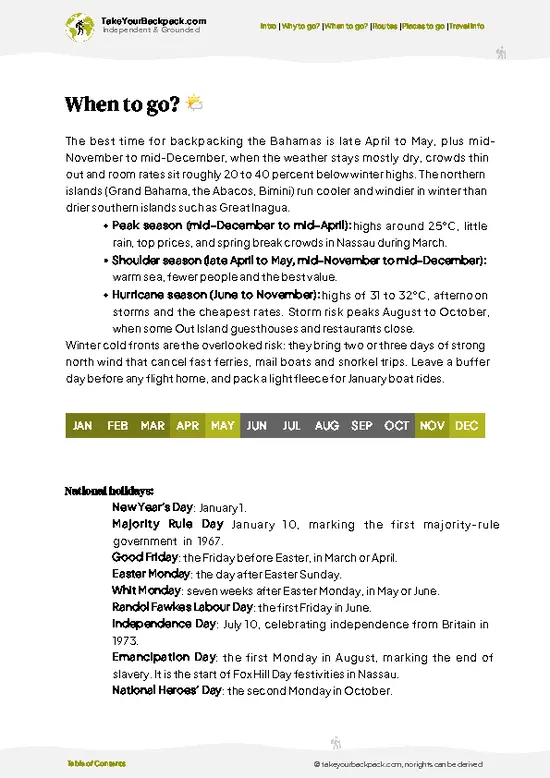
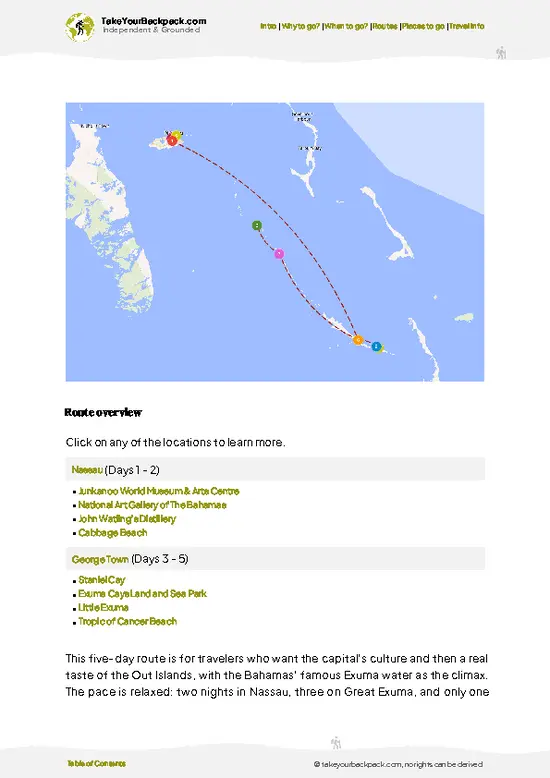
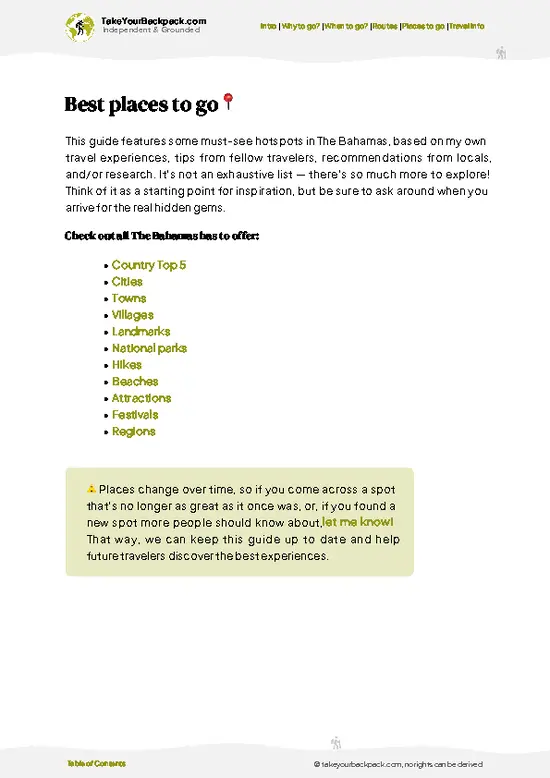
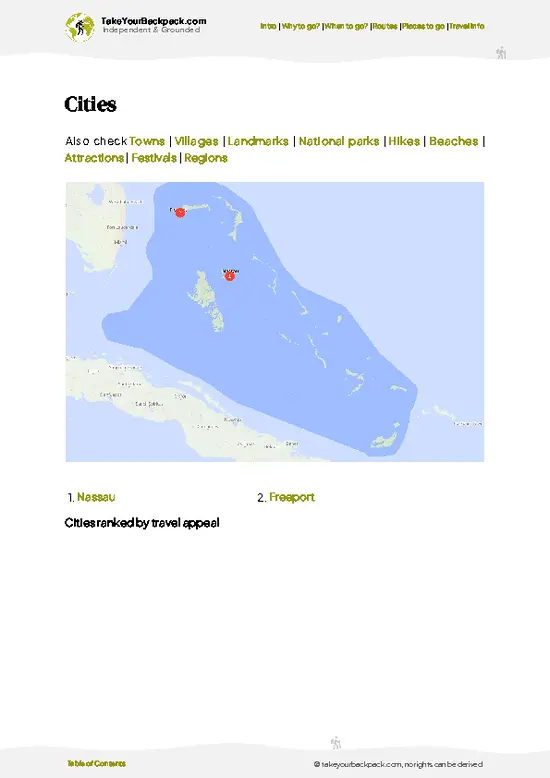
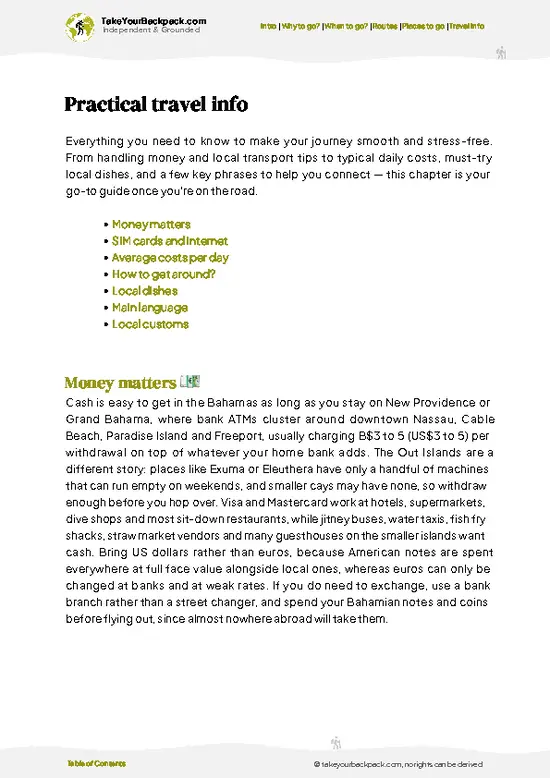
example page 0 from our offline Travel Guide for Bahamas
example page 1 from our offline Travel Guide for Bahamas
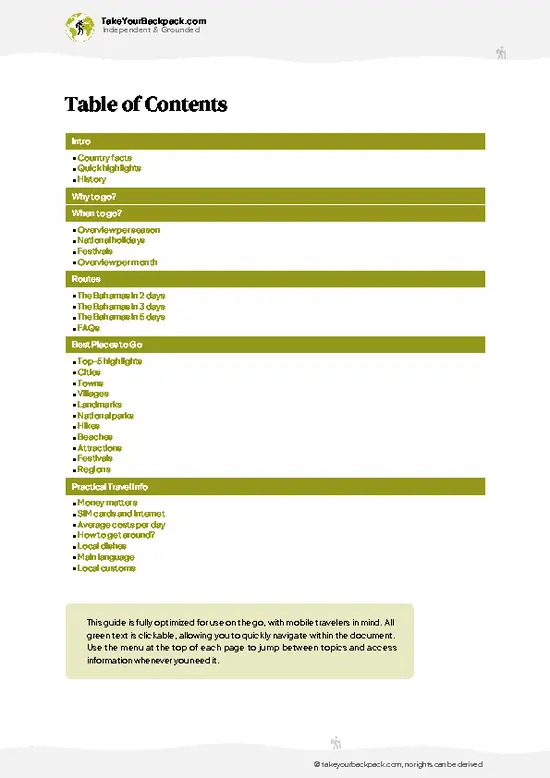
example page 2 from our offline Travel Guide for Bahamas
example page 3 from our offline Travel Guide for Bahamas
example page 4 from our offline Travel Guide for Bahamas
example page 5 from our offline Travel Guide for Bahamas
example page 6 from our offline Travel Guide for Bahamas
example page 7 from our offline Travel Guide for Bahamas
Loading the map 🌍
CLICK TO FILTER
cities
towns
villages
landmarks
national parks
hikes
beaches
attractions
festivals
regions
SHOW COUNTRY’S BESTSHOW ALL

✨ Why go?
Ranked #3 national park in The Bahamas
What sets this place apart

Blue Holes National Park suits backpackers who like finding things themselves. Andros has almost no tour-bus infrastructure, so you rent a car or arrange a local ride, then follow dirt tracks and the Queen’s Highway at your own pace. That freedom is the main draw. The park protects some of the island’s inland blue holes, flooded sinkholes linked to the same limestone cave systems that run under Andros and out toward the Andros Barrier Reef, one of the longest in the world. You can swim in one in the morning and snorkel offshore in the afternoon without ever joining a group. The park is also quiet enough that you may share a pool with no one but a few birds. Guesthouses and small lodges around Fresh Creek and Andros Town keep costs modest, and the island culture, from batik to bonefishing guides, is easy to meet on your own terms.

💡 HighlightsDon't-miss highlights and experiences

  1. Captain Bill’s Blue Hole: The park’s best-known swim spot, reached by a short forest path off the Queen’s Highway. The pool is a deep, clear circle of blue ringed by limestone, ideal for a cooling dip or a careful jump from the rock edge.
  2. Pine forest and coppice trails: The walk in passes Caribbean pine, palmetto and hardwood thickets. It is shaded, quiet and good for spotting small birds, including the Bahama woodstar.
  3. Andros Barrier Reef: The offshore reef lies just off the east coast and is the third-largest barrier reef in the world. Snorkelers and divers arrange boat trips from the Fresh Creek area.
  4. Androsia Batik Factory: A short drive from the park at Fresh Creek, this workshop prints bright batik fabric in the island’s own patterns. You can watch the waxing and dyeing and shop for cloth.
… read more 👉
  1. Captain Bill’s Blue Hole: The park’s best-known swim spot, reached by a short forest path off the Queen’s Highway. The pool is a deep, clear circle of blue ringed by limestone, ideal for a cooling dip or a careful jump from the rock edge.
  2. Pine forest and coppice trails: The walk in passes Caribbean pine, palmetto and hardwood thickets. It is shaded, quiet and good for spotting small birds, including the Bahama woodstar.
  3. Andros Barrier Reef: The offshore reef lies just off the east coast and is the third-largest barrier reef in the world. Snorkelers and divers arrange boat trips from the Fresh Creek area.
  4. Androsia Batik Factory: A short drive from the park at Fresh Creek, this workshop prints bright batik fabric in the island’s own patterns. You can watch the waxing and dyeing and shop for cloth.
  5. Fresh Creek and Andros Town: The tidal creek runs past small docks and fishing boats. It is a relaxed place to see how local people live and to find a guide or boat.
  6. Bonefish flats: The shallow flats and mangrove creeks around central Andros are among the Bahamas’ best for bonefishing. Even if you do not fish, a guided skiff trip reveals rays, turtles and wading birds.
  7. Andros rock iguana: The island’s large native iguana lives in rocky coppice and scrub. Sightings are never guaranteed, but staying quiet on the trails improves the odds.
Blue Holes National Park pairs best by combining Captain Bill’s Blue Hole in the morning with the Androsia Batik Factory in the afternoon.
Spotted a mistake or missing something? Contact us.

Things to do near Blue Holes National Park

Ratings based on Tripadvisor reviews. When you book through this link, you support our work at no extra cost to you.

🌤️ When to go?Best time to explore Blue Holes

  • Winter (December to March): Andros is at its most comfortable, with daytime highs of 24 to 27°C (75 to 81°F) and nights around 17 to 20°C (63 to 68°F). Daylight runs roughly 11 hours, so plan hikes and paddles for the morning. Bonefishing lodges fill up and prices are highest.
  • Spring (April to May): Highs reach 27 to 30°C (81 to 86°F), seas are calm and visibility in the blue holes and creeks is excellent. Crowds thin out and rates ease.
  • Summer (June to September): Expect 31 to 33°C (88 to 91°F) with heavy humidity, afternoon thunderstorms and swarms of mosquitoes and sand flies in the pine and mangrove areas. Days stretch to about 13 hours of light, and lodging is cheapest.
  • Hurricane Season (June to November): Peak risk falls between August and October. Flights and boats get canceled, so book
… read more 👉
  • Winter (December to March): Andros is at its most comfortable, with daytime highs of 24 to 27°C (75 to 81°F) and nights around 17 to 20°C (63 to 68°F). Daylight runs roughly 11 hours, so plan hikes and paddles for the morning. Bonefishing lodges fill up and prices are highest.
  • Spring (April to May): Highs reach 27 to 30°C (81 to 86°F), seas are calm and visibility in the blue holes and creeks is excellent. Crowds thin out and rates ease.
  • Summer (June to September): Expect 31 to 33°C (88 to 91°F) with heavy humidity, afternoon thunderstorms and swarms of mosquitoes and sand flies in the pine and mangrove areas. Days stretch to about 13 hours of light, and lodging is cheapest.
  • Hurricane Season (June to November): Peak risk falls between August and October. Flights and boats get canceled, so book flexible fares.
  • Autumn (October to November): Highs sit at 28 to 30°C (82 to 86°F) as the rain tapers off. Few visitors arrive.
Book a February or April trip early, since Andros has few beds and small-plane seats go quickly.


source: climatestotravel.comJANJanuary: highly recommended for travelingFEBFebruary: highly recommended for travelingMARMarch: highly recommended for travelingAPRApril: highly recommended for travelingMAYMay: fair for travelingJUNJune: fair for travelingJULJuly: fair for travelingAUGAugust: fair for travelingSEPSeptember: fair for travelingOCTOctober: fair for travelingNOVNovember: highly recommended for travelingDECDecember: highly recommended for traveling
when-to-go

✈️ The backpacker research shortcutThe Bahamas Travel Guide

An offline-friendly backpacking guide with optimized travel routes, ranked highlights, transport advice, and the best areas to stay.
example page 0 from our offline Travel Guide for Bahamas
example page 1 from our offline Travel Guide for Bahamas
example page 2 from our offline Travel Guide for Bahamas
example page 3 from our offline Travel Guide for Bahamas
example page 4 from our offline Travel Guide for Bahamas
example page 5 from our offline Travel Guide for Bahamas
example page 6 from our offline Travel Guide for Bahamas
example page 7 from our offline Travel Guide for Bahamas
The digital guide (185 pages) contains:
✅ 55 highlights, ranked by travel appeal
✅ Optimized 2, 3 & 5-day travel routes
✅ Cities, national parks, landmarks, beaches
✅ How to get around
✅ Offline-friendly for travel without Wi-Fi
👉 Click to see all 30+ guide features

📅 Plan smarter in minutes, not weeks
✅ Month by month travel advice
✅ Festivals & national holidays
✅ Budget expectations

🗺️ Go to the right places, skip the overrated ones
✅ Honest pros & cons of destinations
✅ Top hikes, parks & viewpoints
✅ Lesser-known places most travelers miss
✅ Clear “worth it vs skip it” guidance

🛏️ Travel smoothly without rookie mistakes
✅ Best areas to stay
✅ Transport systems explained simply
✅ Common scams & safety advice
✅ SIM cards, money & practical tips

🌍 Understand the country, not just visit it
✅ Culture & traditions
✅ Local customs
✅ Festivals worth planning around
✅ Traveler-friendly historical context
✅ Insights that make places more meaningful

📱 Built for real travel conditions
✅ Fully downloadable PDF
✅ Works completely offline
✅ Optimized for phone use
✅ Useful in remote areas & buses
✅ Everything in one place
Stop searching, start planning
Get instant access to your full guide. 30‑day money-back guarantee.
+ Add another guide for just

By proceeding you agree to our terms.
Sent to your inbox immediately after payment • 100% Secure Checkout
Best Backpacking Travel Advisor 2025 tourism awardBest Backpacking
Travel Advisor
2025
What others say about Take Your Backpack Guides:
⭐⭐⭐⭐⭐
Fantastic, amazing amount of information!
⭐⭐⭐⭐⭐
My goodness this is amazing, it's what I've been looking for hats off too you!
⭐⭐⭐⭐⭐
I think this is absolutely BRILLIANT
⭐⭐⭐⭐
Very complete and informative. It's still missing places, but I gotta to commend you
⭐⭐⭐⭐⭐
This is truly amazing, thank you, can't wait to explore it with my kids!
⭐⭐⭐⭐⭐
Awesome resource, thank you!
⭐⭐⭐⭐⭐
This is amazing! Can't wait to explore the ones I haven't seen
⭐⭐⭐⭐
I love this! Well done, great idea.
⭐⭐⭐⭐⭐
Thanks for taking the time to make this gem!
⭐⭐⭐⭐⭐
This might be the best website I've ever seen.
⭐⭐⭐⭐⭐
Congratulations, and thank you so much for your work; it's incredibly valuable.
⭐⭐⭐⭐
In all seriousness I think you did a great job pointing out the important spots
⭐⭐⭐⭐⭐
10/10 very good
⭐⭐⭐⭐⭐
As someone who's only just starting to visit regularly this is awesome, thank you.
⭐⭐⭐⭐
Thank you very much! I'm going to visit my dad, it's going to be very useful!
⭐⭐⭐⭐⭐
This is really cool! We'll be travelling for the first time and this definitely come in handy.
⭐⭐⭐⭐⭐
You are now our minister of culture, congratulations 👨‍💼
⭐⭐⭐⭐⭐
Just wanted to tell you that this is a pearl! Going to follow your recommendations.
⭐⭐⭐⭐⭐
This is so cool. I'll definitely be using the resource for my travels soon.
⭐⭐⭐⭐⭐
This is very impressive! Good work.
⭐⭐⭐⭐⭐
This is an amazing and informative site. Very well done!

🛏️ Where to stay?Best areas to stay in The Bahamas

Stay in Fresh Creek or Nicholls Town on Andros, because Blue Holes National Park has no lodging inside its boundaries. The park protects inland blue holes, pine forest and wetlands in the north-central part of the island, and you reach it by road from the settlements nearby.
Fresh Creek and Coakley Town sit on the central east coast and are the most practical base. Small guesthouses and family-run inns charge roughly US$90 to 140 a night for a double, and a couple of places serve home-cooked conch and peas and rice. Car rental is limited, so ask your host about a driver.
Nicholls Town and Mastic … read more 👉
Stay in Fresh Creek or Nicholls Town on Andros, because Blue Holes National Park has no lodging inside its boundaries. The park protects inland blue holes, pine forest and wetlands in the north-central part of the island, and you reach it by road from the settlements nearby.
Fresh Creek and Coakley Town sit on the central east coast and are the most practical base. Small guesthouses and family-run inns charge roughly US$90 to 140 a night for a double, and a couple of places serve home-cooked conch and peas and rice. Car rental is limited, so ask your host about a driver.
Nicholls Town and Mastic Point in the north offer simple motels and cottages at around US$100 to 160 a night. Both have a few small groceries and snack bars, and the airstrip at Nicholls Town gets you in quickly from Nassau.
South of Fresh Creek, Small Hope Bay has the island’s well-known dive resort, with rooms from about US$200 and up and meal packages. It makes a good splurge if you plan to dive the barrier reef.
There are no hostels and no official campgrounds, so lodging is the guesthouse circuit. Reserve ahead for winter, since rooms are few.

👛 Costs (as of 20 October 2026)Typical daily expenses

Blue Holes National Park costs roughly US$145 to 255 a day for a backpacker on Andros, and most of that goes to lodging and getting around. The table below shows typical ranges.
CategoryBudget RangeLocal Reality
Entrance FeeUS$0 to 5Access to the park is generally free or very low-cost, with no staffed gate at most points.
Accommodation (high season)US$90 to 140Guesthouses and small inns in Fresh Creek or Nicholls Town. Summer rates drop by 10 to 20 percent.
Local TransportUS$25 to 50Rental cars are scarce, so most visitors pay a driver or taxi for the day. Fuel is expensive.
GuideUS$0 to 60Optional but useful for finding blue holes and trailheads. Rates are negotiated with local operators.
Food and SuppliesUS$30 to 55Island grocery prices run high. A plate of conch or fish at a local spot costs
… read more 👉
Blue Holes National Park costs roughly US$145 to 255 a day for a backpacker on Andros, and most of that goes to lodging and getting around. The table below shows typical ranges.
CategoryBudget RangeLocal Reality
Entrance FeeUS$0 to 5Access to the park is generally free or very low-cost, with no staffed gate at most points.
Accommodation (high season)US$90 to 140Guesthouses and small inns in Fresh Creek or Nicholls Town. Summer rates drop by 10 to 20 percent.
Local TransportUS$25 to 50Rental cars are scarce, so most visitors pay a driver or taxi for the day. Fuel is expensive.
GuideUS$0 to 60Optional but useful for finding blue holes and trailheads. Rates are negotiated with local operators.
Food and SuppliesUS$30 to 55Island grocery prices run high. A plate of conch or fish at a local spot costs about US$12 to 20.
Total Daily BudgetUS$145 to 255The low end suits a shared ride and self-catering. Flights from Nassau are extra.


source: bahamas.com
⚠️ Prices can change and everyone travels differently, so take this as a rough guide. Hope it helps you plan your adventure!

🥾 TrailsDiscover Blue Holes's top trails and natural wonders

Blue Holes National Park offers short, easy walks rather than a long trail network, which makes it ideal for an unhurried half day. The paths are narrow tracks over flat limestone and through pine forest, with exposed roots and sharp rock underfoot, so closed shoes matter more than fitness.
  • Path to Captain Bill’s Blue Hole: A short, easy walk of roughly 10 to 20 minutes each way from the roadside. It runs through shaded pine and coppice on rooty, uneven ground and ends at the blue hole, where most people swim.
  • Pool edge and rim loop: A brief scramble around the limestone rim gives different angles
… read more 👉
Blue Holes National Park offers short, easy walks rather than a long trail network, which makes it ideal for an unhurried half day. The paths are narrow tracks over flat limestone and through pine forest, with exposed roots and sharp rock underfoot, so closed shoes matter more than fitness.
  • Path to Captain Bill’s Blue Hole: A short, easy walk of roughly 10 to 20 minutes each way from the roadside. It runs through shaded pine and coppice on rooty, uneven ground and ends at the blue hole, where most people swim.
  • Pool edge and rim loop: A brief scramble around the limestone rim gives different angles on the hole. The rock is rough and can be slick when wet, so go slowly.
  • Forest side tracks: Informal paths branch off through pine and scrub, good for birdwatching in the early morning. They are unmarked, so keep your bearings and do not stray far.
  • Wildlife: Look for the Bahama woodstar, lizards, butterflies and, with luck, rock iguanas. Insects are the most constant fauna, especially in damp, shaded stretches.
  • Difficulty: Easy overall, with the only real challenge being heat, bugs and footing. Cliff jumping into the hole carries real risk, so check the depth and your own limits first.
Getting to Blue Holes National Park without your own transport is difficult. Public buses are not part of island life on Andros, so most travelers rent a car, hire a taxi or arrange a pickup through their guesthouse. The Queen’s Highway runs along the east side, and the turnoffs are modest, so allow extra time to find the right one. The park is rarely crowded, and you may have a hole to yourself on a weekday. Bring water, snacks, bug repellent and sunscreen, since there are no shops or facilities at the site. Entry arrangements can vary, so ask your host before setting out.
⚠️ Hiking info can sometimes be outdated or inaccurate. Before you hit the trail, check the latest conditions with locals. If you do spot anything that's off, I'd love to hear from you, so I can update it for fellow travelers.

🛡️ SafetyStaying Safe: What Travelers Should Know

Blue Holes National Park is a quiet, lightly visited area, and the real challenges are heat, insects and remote tracks rather than crime or dangerous animals. The pine forest and mangrove edges are flat, but trails and bush roads are rough, poorly marked and often muddy or flooded after rain, so go with a local guide or a good offline map. Cell signal drops out inland.
Sun exposure is the biggest issue. Carry at least 3 liters of water per person, wear a hat, and start early before the midday heat. Mosquitoes and sand flies are heavy from late spring through autumn, so bring strong repellent and long, light clothing.
The blue holes themselves are deep and have strong tidal currents, and swimming in some is discouraged because of unstable water and submerged caves. Cave diving here is for certified … read more 👉
Blue Holes National Park is a quiet, lightly visited area, and the real challenges are heat, insects and remote tracks rather than crime or dangerous animals. The pine forest and mangrove edges are flat, but trails and bush roads are rough, poorly marked and often muddy or flooded after rain, so go with a local guide or a good offline map. Cell signal drops out inland.
Sun exposure is the biggest issue. Carry at least 3 liters of water per person, wear a hat, and start early before the midday heat. Mosquitoes and sand flies are heavy from late spring through autumn, so bring strong repellent and long, light clothing.
The blue holes themselves are deep and have strong tidal currents, and swimming in some is discouraged because of unstable water and submerged caves. Cave diving here is for certified specialists only. Poisonous gumbo limbo’s neighbor, the poisonwood tree, causes a bad rash, so avoid touching unfamiliar trees. Tell your host your route and return time.

FAQTraveler FAQ

Plan on 2 to 3 days for Blue Holes National Park, including time on Andros for the surrounding creeks and pine forest. One full day covers the main blue holes with a guide, while a second lets you add kayaking or bonefishing near Fresh Creek or Nicholls Town. Flights from Nassau take about 20 to 30 minutes.
Visiting Blue Holes National Park without a car is difficult but possible. Rental cars on Andros are limited, so most travelers hire a local driver or guide for roughly US$25 to 60 a day from Fresh Creek or Nicholls Town. Public transport is minimal, and the interior roads are rough and spread out, so arranging a ride in advance is wise.
Blue Holes National Park has no significant entrance fee, and access is generally free or costs only a few dollars (up to about US$5). No permit is normally required for hiking or visiting the main areas. Guides and boat trips are charged separately, usually US$40 to 100 depending on the length of the outing, and diving the caves needs certified specialists.
⚠️ Things can change over time, so always validate details locally before you go.

Other Bahamian national parks near Blue Holes

Explore more nearby:


💡 Not sure where to go next?
Create a personalized itinerary for The Bahamas including Blue Holes and the places that fit your trip.

Generate my itinerary

👉 Discover all national parks

Or checkout all The Bahamas has to offer (think cities, towns, villages, national parks, hikes, beaches, festivals)
Country photo of The Bahamas

We 💚 feedbackParting advice and final tips

Many travelers rush in at midday, jump straight into the pool and leave bitten and sunburned. Blue Holes National Park rewards a slower approach. I would arrive mid-morning, wear closed shoes, apply repellent before leaving the road, and then swim only after watching how the water looks and how deep it drops.

✍️ Help improve this page!
The information on this page is based on in-depth research, insights shared by experienced travelers, and feedback from the local travel community in The Bahamas. While every effort is made to keep the information accurate and current, conditions can change — so if you spot anything incorrect or outdated, please get in touch.


🙋‍♂️ Give feedback

👋 Meet the founderWho’s Behind Take Your Backpack?

Johan, backpacker and founder of TakeYourBackpackHi, I’m Johan (Netherlands 🇳🇱), the creator of TakeYourBackpack. Over the past 3 decades, I’ve backpacked through 90+ countries across six continents, gaining extensive experience with independent travel, long-term trips, and overland routes.

This site is built on a combination of firsthand travel experience and carefully curated insights from other backpackers. Many guides are based on places I’ve personally visited, while others bring together tips, observations, and practical advice shared by trusted travelers I’ve met along the way.

The goal is to provide realistic, experience-driven guidance — not generic itineraries — so you can explore destinations with better context, clearer expectations, and more confidence.