

×

The Bahamas🇧🇸 | regionsCat IslandMount Alvernia hermitage, Queen’s Highway, pink-tinged sand, rake ’n’ scrape | things to do and best time to go

Explore Berry IslandsExplore Eleuthera

Backpacking in Cat Island
👌 Worth visitingregion ranked #6
By Johan Kruseman 🇳🇱 | Updated October 20, 2026

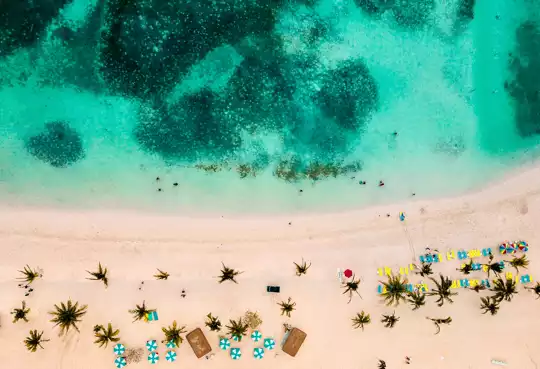
Cat Island rewards anyone willing to rent a car, because the single road, the Queen’s Highway, links every settlement and beach in a few easy hours of driving. The island sits in the central Bahamas, southeast of Nassau, long and thin like a bent arm. You get pink-tinged sand at Fine Bay, the highest point in the country at Mount Alvernia, and almost no tour buses. The flip side is thin infrastructure: few restaurants, early closing kitchens, and flights or the mail boat as your only ways in. Hawk’s Nest and Arthur’s Town feel lived in, not staged, and the Rake ’n’ Scrape Festival in spring fills the settlements with music. On day one, pick up a car, buy groceries in Arthur’s Town or New Bight, and finish at a Bight beach with a cold Kalik as the light fades.

Discover everything you want to know in the 📖 The Bahamas Travel Guide.


example page 0 from our offline Travel Guide for Bahamas
example page 1 from our offline Travel Guide for Bahamas
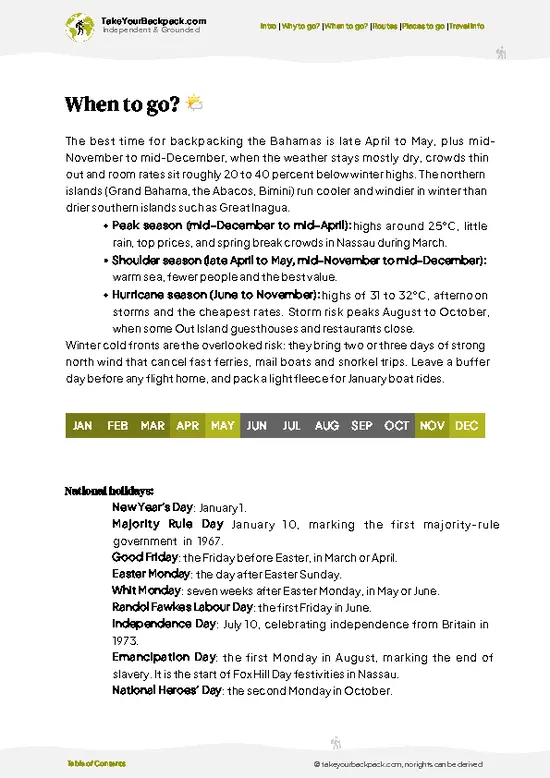
example page 2 from our offline Travel Guide for Bahamas
example page 3 from our offline Travel Guide for Bahamas
example page 4 from our offline Travel Guide for Bahamas
example page 5 from our offline Travel Guide for Bahamas
example page 6 from our offline Travel Guide for Bahamas
example page 7 from our offline Travel Guide for Bahamas
Loading the map 🌍
CLICK TO FILTER
cities
towns
villages
landmarks
national parks
hikes
beaches
attractions
festivals
regions
SHOW COUNTRY’S BESTSHOW ALL

✨ Why go?
Ranked #6 region in The Bahamas
Reasons people choose to visit here

Cat Island suits backpackers who want empty coastline without a string of transfers. One road, roughly 80 miles end to end, means you can sleep in one place and still reach most of what matters. The Atlantic side brings surf, cliffs and long pink-white beaches, while the calm Caribbean-facing shore gives you flat, clear water for snorkeling. Culture is close by: Mount Alvernia and the Hermitage sit a short drive from settlements where bush medicine and rake ’n’ scrape music are still part of ordinary life. Slow travel works here because there is nothing to rush toward. You can spend a morning on the sand, an afternoon hiking the hermit’s stone path, and an evening eating peas and rice at a settlement bar. Add in Hawk’s Nest for diving and bonefishing, and you can mix nature and culture without moving beds every night.

💡 HighlightsMust-see experiences and standout moments

  1. The Hermitage on Mount Alvernia: Father Jerome, an architect turned priest, built this tiny stone monastery by hand on the highest point in the Bahamas. The short climb passes Stations of the Cross carved into the rock, and the top gives wide views over the island.
  2. Fine Bay Beach: Long, quiet sand with a pink tint and very few footprints. Good for walking and swimming when the water is calm.
  3. Bight Settlement: The Bight, near New Bight and Orange Creek, has local bars, small shops and the kind of conversations you will not get at resorts.
  4. Pigeon Cay Beach: A pale, protected stretch with shallow turquoise water, ideal for lazy swims and photos.
  5. Columbus Point: A windswept, remote stretch of sand and rock at the southern end, with big open sea views.
  6. Port Howe ruins: Old stone buildings from the Loyalist
… read more 👉
  1. The Hermitage on Mount Alvernia: Father Jerome, an architect turned priest, built this tiny stone monastery by hand on the highest point in the Bahamas. The short climb passes Stations of the Cross carved into the rock, and the top gives wide views over the island.
  2. Fine Bay Beach: Long, quiet sand with a pink tint and very few footprints. Good for walking and swimming when the water is calm.
  3. Bight Settlement: The Bight, near New Bight and Orange Creek, has local bars, small shops and the kind of conversations you will not get at resorts.
  4. Pigeon Cay Beach: A pale, protected stretch with shallow turquoise water, ideal for lazy swims and photos.
  5. Columbus Point: A windswept, remote stretch of sand and rock at the southern end, with big open sea views.
  6. Port Howe ruins: Old stone buildings from the Loyalist era, slowly reclaimed by bush. Lesser known, and quiet.
  7. Old Bight Cemetery and church: A glimpse of settlement life that most visitors drive past.
  8. Hawk’s Nest Creek: Bonefishing flats and dive access, with a small airstrip and marina nearby.
  9. Arthur’s Town: The home of Sidney Poitier’s childhood. Small shops, a clear sense of daily life and a good place for supplies.
  10. Fernandez Bay: A gentle crescent of calm water with simple beachfront stays, good for sunset swims.
Cat Island pairs best when you hike the Hermitage in the cool morning and finish the afternoon on Fine Bay.
Spotted a mistake or missing something? Contact us.

Things to do near Cat Island

Ratings based on Tripadvisor reviews. When you book through this link, you support our work at no extra cost to you.

⌛️ 5 daysSeeing the highlights in 5 days

Plan on driving, with slow stops, and take the midday heat off in the shade or in the water. Roads are straight, but distances between food and fuel are long, so you need a car and a full tank.
Day 1: Arthur’s Town: Arrive by air or mail boat and collect groceries here, since choices thin out as you go south. Poitier’s hometown sets the tone: small, unhurried, and a good place to learn where each settlement’s one bar is.
Day 2: Hawk’s Nest: Head to the northern end for snorkeling or diving, then watch the flats at the creek. It is a calmer day, built around the water instead of the road.
Day 3: Mount Alvernia: Climb early before the heat builds. The Hermitage is compact, and you can finish in a couple of hours, leaving the afternoon for the Bight and its bars.
Day 4: Fine Bay and Pigeon Cay: Spend … read more 👉
Plan on driving, with slow stops, and take the midday heat off in the shade or in the water. Roads are straight, but distances between food and fuel are long, so you need a car and a full tank.
Day 1: Arthur’s Town: Arrive by air or mail boat and collect groceries here, since choices thin out as you go south. Poitier’s hometown sets the tone: small, unhurried, and a good place to learn where each settlement’s one bar is.
Day 2: Hawk’s Nest: Head to the northern end for snorkeling or diving, then watch the flats at the creek. It is a calmer day, built around the water instead of the road.
Day 3: Mount Alvernia: Climb early before the heat builds. The Hermitage is compact, and you can finish in a couple of hours, leaving the afternoon for the Bight and its bars.
Day 4: Fine Bay and Pigeon Cay: Spend this on the beaches. Rotate between shade and swimming so the sun never beats you.
Day 5: Port Howe and Columbus Point: Drive south for the quiet ruins and the wild point. This is the detour that adds the most, because the southern road is nearly empty and the coast opens up.
If you only have one day, make it the Mount Alvernia morning followed by Fine Bay in the afternoon, which captures the island’s history and its sand together.

🌤️ When to go?Best time to visit Cat Island

Cat Island is at its most comfortable from December to April, when daytime highs run 24 to 28°C (75 to 82°F) and the trade winds keep the beaches dry and breezy.
  • Winter and Spring (December to April): Nights dip to 17 to 21°C (63 to 70°F) and daylight lasts about 11 to 13 hours. Rain is rare and the sea is clear. Rooms and rental cars cost the most and sell out around Christmas and Easter.
  • Summer (May to August): Highs reach 31 to 33°C (88 to 91°F) with humid air and long days of about 13 hours. Prices drop 20 to 30 percent, and the Cat Island Rake n Scrape Festival in June draws crowds. Some small guesthouses close.
  • Hurricane Season (September to November): Highs stay at 29 to 32°C (84 to 90°F). Storms peak in September and October, so many places shut down, but bargains are plentiful and the
… read more 👉
Cat Island is at its most comfortable from December to April, when daytime highs run 24 to 28°C (75 to 82°F) and the trade winds keep the beaches dry and breezy.
  • Winter and Spring (December to April): Nights dip to 17 to 21°C (63 to 70°F) and daylight lasts about 11 to 13 hours. Rain is rare and the sea is clear. Rooms and rental cars cost the most and sell out around Christmas and Easter.
  • Summer (May to August): Highs reach 31 to 33°C (88 to 91°F) with humid air and long days of about 13 hours. Prices drop 20 to 30 percent, and the Cat Island Rake n Scrape Festival in June draws crowds. Some small guesthouses close.
  • Hurricane Season (September to November): Highs stay at 29 to 32°C (84 to 90°F). Storms peak in September and October, so many places shut down, but bargains are plentiful and the island is empty.
Book flights and a rental car a few weeks ahead for the winter months, since the island has very few of either.


source: climatestotravel.comJANJanuary: excellent for travelingFEBFebruary: excellent for travelingMARMarch: excellent for travelingAPRApril: highly recommended for travelingMAYMay: highly recommended for travelingJUNJune: good for travelingJULJuly: good for travelingAUGAugust: fair for travelingSEPSeptember: fair for travelingOCTOctober: fair for travelingNOVNovember: good for travelingDECDecember: excellent for traveling
bahamas-region-cat-island
© Google | Agata S-ka

✈️ The backpacker research shortcutThe Bahamas Travel Guide

An offline-friendly backpacking guide with optimized travel routes, ranked highlights, transport advice, and the best areas to stay.
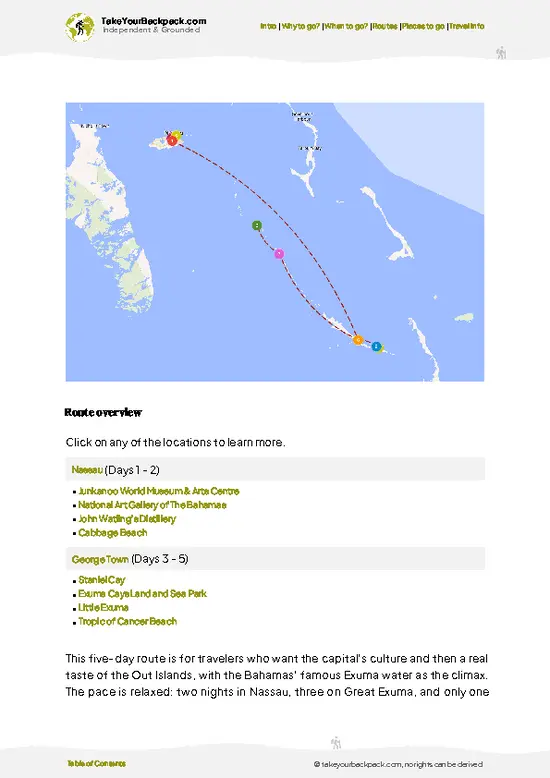
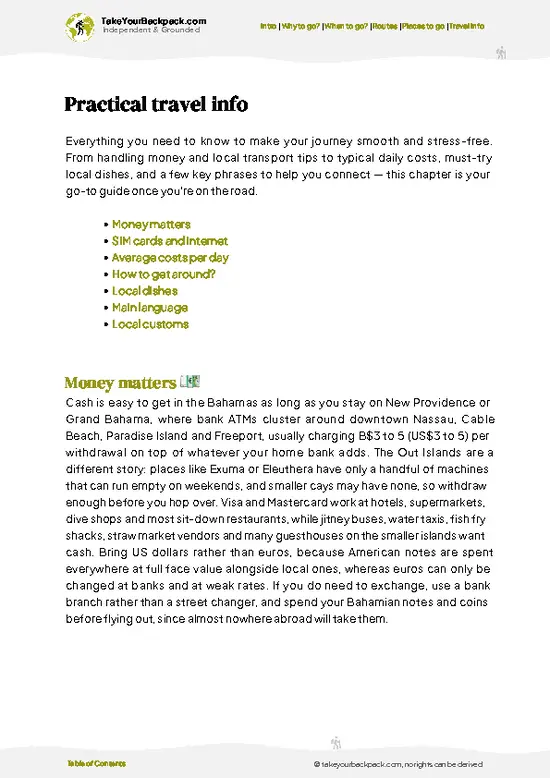
example page 0 from our offline Travel Guide for Bahamas
example page 1 from our offline Travel Guide for Bahamas
example page 2 from our offline Travel Guide for Bahamas
example page 3 from our offline Travel Guide for Bahamas
example page 4 from our offline Travel Guide for Bahamas
example page 5 from our offline Travel Guide for Bahamas
example page 6 from our offline Travel Guide for Bahamas
example page 7 from our offline Travel Guide for Bahamas
The digital guide (185 pages) contains:
✅ 55 highlights, ranked by travel appeal
✅ Optimized 2, 3 & 5-day travel routes
✅ Cities, national parks, landmarks, beaches
✅ How to get around
✅ Offline-friendly for travel without Wi-Fi
👉 Click to see all 30+ guide features

📅 Plan smarter in minutes, not weeks
✅ Month by month travel advice
✅ Festivals & national holidays
✅ Budget expectations

🗺️ Go to the right places, skip the overrated ones
✅ Honest pros & cons of destinations
✅ Top hikes, parks & viewpoints
✅ Lesser-known places most travelers miss
✅ Clear “worth it vs skip it” guidance

🛏️ Travel smoothly without rookie mistakes
✅ Best areas to stay
✅ Transport systems explained simply
✅ Common scams & safety advice
✅ SIM cards, money & practical tips

🌍 Understand the country, not just visit it
✅ Culture & traditions
✅ Local customs
✅ Festivals worth planning around
✅ Traveler-friendly historical context
✅ Insights that make places more meaningful

📱 Built for real travel conditions
✅ Fully downloadable PDF
✅ Works completely offline
✅ Optimized for phone use
✅ Useful in remote areas & buses
✅ Everything in one place
Stop searching, start planning
Get instant access to your full guide. 30‑day money-back guarantee.
+ Add another guide for just

By proceeding you agree to our terms.
Sent to your inbox immediately after payment • 100% Secure Checkout
Best Backpacking Travel Advisor 2025 tourism awardBest Backpacking
Travel Advisor
2025
What others say about Take Your Backpack Guides:
⭐⭐⭐⭐⭐
Fantastic, amazing amount of information!
⭐⭐⭐⭐⭐
My goodness this is amazing, it's what I've been looking for hats off too you!
⭐⭐⭐⭐⭐
I think this is absolutely BRILLIANT
⭐⭐⭐⭐
Very complete and informative. It's still missing places, but I gotta to commend you
⭐⭐⭐⭐⭐
This is truly amazing, thank you, can't wait to explore it with my kids!
⭐⭐⭐⭐⭐
Awesome resource, thank you!
⭐⭐⭐⭐⭐
This is amazing! Can't wait to explore the ones I haven't seen
⭐⭐⭐⭐
I love this! Well done, great idea.
⭐⭐⭐⭐⭐
Thanks for taking the time to make this gem!
⭐⭐⭐⭐⭐
This might be the best website I've ever seen.
⭐⭐⭐⭐⭐
Congratulations, and thank you so much for your work; it's incredibly valuable.
⭐⭐⭐⭐
In all seriousness I think you did a great job pointing out the important spots
⭐⭐⭐⭐⭐
10/10 very good
⭐⭐⭐⭐⭐
As someone who's only just starting to visit regularly this is awesome, thank you.
⭐⭐⭐⭐
Thank you very much! I'm going to visit my dad, it's going to be very useful!
⭐⭐⭐⭐⭐
This is really cool! We'll be travelling for the first time and this definitely come in handy.
⭐⭐⭐⭐⭐
You are now our minister of culture, congratulations 👨‍💼
⭐⭐⭐⭐⭐
Just wanted to tell you that this is a pearl! Going to follow your recommendations.
⭐⭐⭐⭐⭐
This is so cool. I'll definitely be using the resource for my travels soon.
⭐⭐⭐⭐⭐
This is very impressive! Good work.
⭐⭐⭐⭐⭐
This is an amazing and informative site. Very well done!

🛏️ Where to stay?Best areas and accommodation options

New Bight is the most practical base on Cat Island because it sits roughly in the middle, with the airstrip, a grocery store, and the road to Mount Alvernia close by. Staying there puts every part of the island within about an hour’s drive. Guesthouses and small inns charge around US$90 to 160 a night, and the owners are usually local families who will share ideas for the day.
Arthur’s Town in the north is a second option. It is quiet but has a few shops, a bakery, and the birthplace of Sidney Poitier, so you can walk around and talk to residents on the veranda. Prices are similar and the flights … read more 👉
New Bight is the most practical base on Cat Island because it sits roughly in the middle, with the airstrip, a grocery store, and the road to Mount Alvernia close by. Staying there puts every part of the island within about an hour’s drive. Guesthouses and small inns charge around US$90 to 160 a night, and the owners are usually local families who will share ideas for the day.
Arthur’s Town in the north is a second option. It is quiet but has a few shops, a bakery, and the birthplace of Sidney Poitier, so you can walk around and talk to residents on the veranda. Prices are similar and the flights from Nassau land close by.
For beach time, the Fernandez Bay area and the stretch near Port Howe in the south offer calm water and long empty sand. Nights there are dark and silent, perfect for stargazing, but you need a car. Dorm beds are essentially absent on the island, so solo travelers should expect to meet others over dinner at the small resorts rather than in a hostel common room. Camping is informal and best arranged with a host.

🚌 Getting aroundHow to get around Cat Island

Cat Island has no bus or train station, so from the airstrip at Arthur’s Town or New Bight you reach your lodging by taxi (US$15 to 60 depending on distance) or a car left waiting by your host. Most backpackers rent a car because one paved road, the Queen’s Highway, runs the 77 miles (about 124 km) of the island, and public transport barely exists. That road is quiet and reliable, with goats and the odd chicken crossing it.
  • Rental car: Expect US$80 to 120 a day, and book early because the fleet is tiny. You get freedom to stop at a roadside conch stand, climb to the Hermitage on Mount Alvernia for the view, or drive out to the empty sand of Fernandez Bay at dusk.
  • Island taxi: Drivers are usually owners who know everyone, with fares of about US$2 to 3 a mile. Ask for a half-day tour (US$100 to
… read more 👉
Cat Island has no bus or train station, so from the airstrip at Arthur’s Town or New Bight you reach your lodging by taxi (US$15 to 60 depending on distance) or a car left waiting by your host. Most backpackers rent a car because one paved road, the Queen’s Highway, runs the 77 miles (about 124 km) of the island, and public transport barely exists. That road is quiet and reliable, with goats and the odd chicken crossing it.
  • Rental car: Expect US$80 to 120 a day, and book early because the fleet is tiny. You get freedom to stop at a roadside conch stand, climb to the Hermitage on Mount Alvernia for the view, or drive out to the empty sand of Fernandez Bay at dusk.
  • Island taxi: Drivers are usually owners who know everyone, with fares of about US$2 to 3 a mile. Ask for a half-day tour (US$100 to 150) and you will get stories about every settlement you pass, plus a stop at the right bakery.
  • Flights: Bahamasair and small charter planes link Nassau to Arthur’s Town, New Bight and Cat Island’s northern airstrip in about 40 minutes, for US$100 to 200 each way. You see the sandbars and pink-tinted flats from the window.
  • Mailboat: The weekly boat from Nassau takes 12 to 15 hours and costs about US$60 to 100 one way. It is slow and bumpy, but you eat Bahamian food on deck and watch the island rise from the water in the morning.
  • Bicycle or walking: Within a single settlement such as Port Howe or Bennett’s Harbour, you can cover the distance on foot or a rented bike (US$15 to 25 a day). Flat roads and a salty breeze make it a pleasant hour.
Fill your tank whenever you pass a station, since gas stops are far apart, and carry cash for taxis and snacks.

🍲 FoodEating & Drinking in Cat Island

Cat Island eats fish and starch in the best way. The signature is cracked conch, pounded, battered, fried gold and squeezed with lime, plus conch salad chopped to order with onion, pepper and sour orange. Look for peas n rice, johnnycake with a dense, sweet crumb, and boiled fish in a peppery broth that locals eat for breakfast. Order guava duff for dessert and a cold Kalik beer, or a rum punch with a heavy hand of nutmeg.
Most eating happens at settlement bars, family-run takeout windows, and small restaurants beside the road. Meals cost US$12 to 25. Fresh bread arrives from home bakeries, with coconut and raisin loaves still warm, and grocery stores in New Bight and Arthur’s Town stock the basics for self-catering.
Greet people with a “good morning” or “good afternoon” before ordering, because … read more 👉
Cat Island eats fish and starch in the best way. The signature is cracked conch, pounded, battered, fried gold and squeezed with lime, plus conch salad chopped to order with onion, pepper and sour orange. Look for peas n rice, johnnycake with a dense, sweet crumb, and boiled fish in a peppery broth that locals eat for breakfast. Order guava duff for dessert and a cold Kalik beer, or a rum punch with a heavy hand of nutmeg.
Most eating happens at settlement bars, family-run takeout windows, and small restaurants beside the road. Meals cost US$12 to 25. Fresh bread arrives from home bakeries, with coconut and raisin loaves still warm, and grocery stores in New Bight and Arthur’s Town stock the basics for self-catering.
Greet people with a “good morning” or “good afternoon” before ordering, because it matters here. Service is relaxed, so a plate may take 40 minutes while the cook finishes your fish. Many places open only on certain days and close once the food runs out, so ask in advance and carry cash, since cards are often unavailable.

FAQTraveler FAQ

Three to five days is ideal for Cat Island. That gives you time to drive the 77-mile Queen’s Highway, climb Mount Alvernia (the highest point in the Bahamas at about 63 meters), and spend a full day on the beaches near Fernandez Bay. A long weekend feels rushed because of the slow pace and distances between settlements.
On Cat Island, getting around without a car means taxis, which cost about US$2 to 3 a mile, or a guided half-day tour for US$100 to 150. Public buses do not operate, so arrange pickups from the Arthur’s Town or New Bight airstrip in advance. Bikes rent for about US$15 to 25 a day for short trips within a settlement.
Cat Island is known for its quiet pink and white sand beaches, Mount Alvernia with the hermitage built by Father Jerome, and the Rake n Scrape music tradition celebrated at the June festival. It is also the birthplace of actor Sidney Poitier. Visitors come for long empty shores, fresh conch, and a pace of life far from Nassau, a flight of about 40 minutes.
⚠️ Things can change over time, so always validate details locally before you go.

Other Bahamian regions near Cat Island

Explore more nearby:

  • Eleuthera—Glass Window Bridge, Atlantic surf, pineapple farms, caves| 98 km away
  • Exuma—Swimming pigs, nurse sharks, Thunderball Grotto, Georgetown fish fry| 103 km away
  • Rum Cay—Coral wall diving, HMS Conqueror wreck, Port Nelson, salt flats| 106 km away

💡 Not sure where to go next?
Create a personalized itinerary for The Bahamas including Cat Island and the places that fit your trip.

Generate my itinerary

👉 Discover all regions

Or checkout all The Bahamas has to offer (think cities, towns, villages, national parks, hikes, beaches, festivals)
Country photo of The Bahamas

We 💚 feedbackIs it worth it?

Cat Island punishes travelers who arrive with an empty tank and an empty cooler, because fuel and food stops are far apart and kitchens close early. Fill up whenever you pass a pump, buy groceries in Arthur’s Town, and ask your host about dinner by midafternoon. Then slow down, because the island rewards it.

✍️ Help improve this page!
The information on this page is based on in-depth research, insights shared by experienced travelers, and feedback from the local travel community in The Bahamas. While every effort is made to keep the information accurate and current, conditions can change — so if you spot anything incorrect or outdated, please get in touch.


🙋‍♂️ Give feedback

👋 Meet the founderWho’s Behind Take Your Backpack?

Johan, backpacker and founder of TakeYourBackpackHi, I’m Johan (Netherlands 🇳🇱), the creator of TakeYourBackpack. Over the past 3 decades, I’ve backpacked through 90+ countries across six continents, gaining extensive experience with independent travel, long-term trips, and overland routes.

This site is built on a combination of firsthand travel experience and carefully curated insights from other backpackers. Many guides are based on places I’ve personally visited, while others bring together tips, observations, and practical advice shared by trusted travelers I’ve met along the way.

The goal is to provide realistic, experience-driven guidance — not generic itineraries — so you can explore destinations with better context, clearer expectations, and more confidence.