×

Botswana🇧🇼 | national parksKgalagadi Transfrontier ParkNossob riverbed, red dunes, cheetah, unfenced camps | things to do and best time to go

Explore Chobe National ParkExplore Linyanti Wildlife Reserve

Backpacking in Kgalagadi Transfrontier Park
👍 Recommendednational park ranked #6
By Johan Kruseman 🇳🇱 | Updated October 22, 2026

Kgalagadi Transfrontier Park lets you drive between two countries on one permit system, with no border post to clear between the Botswana and South African sides. The park sits in the far southwest of Botswana, on the edge of the Kalahari, where red dunes run to the horizon along the dry Nossob and Auob riverbeds. Lions, cheetahs, gemsbok and raptors are the draw, and sightings are good but never guaranteed. Roads are sand, so a high-clearance 4x4 is needed on the Botswana side, and fuel, water and food must be carried in because nothing is sold inside. Book campsites months ahead, since walk-ins are turned away when full. Watch the heat and the gate closing times, which catch people out every year. It suits self-sufficient, patient drivers and campers. It will frustrate anyone without a 4x4, or anyone expecting guaranteed sightings and hotel comforts.

Discover everything you want to know in the 📖 Botswana Travel Guide.


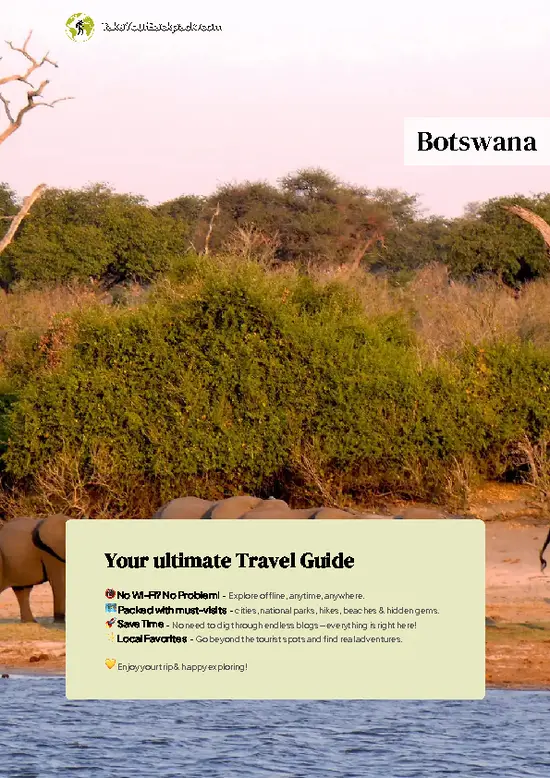
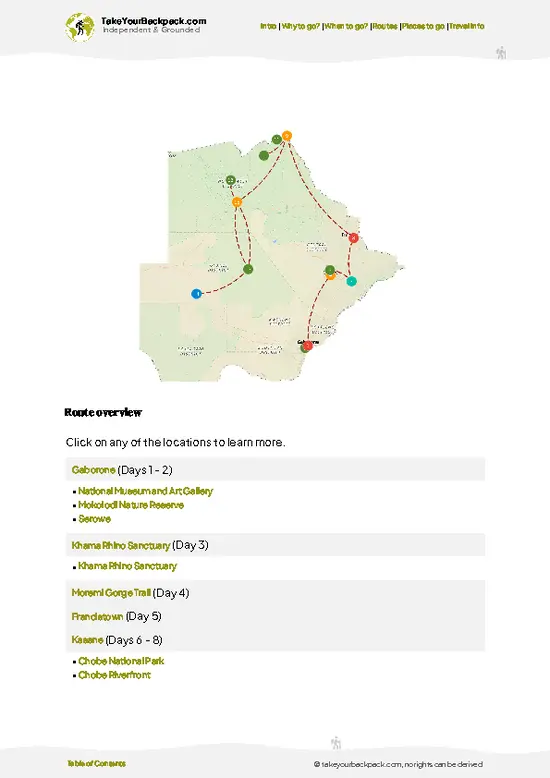
example page 0 from our offline Travel Guide for Botswana
example page 1 from our offline Travel Guide for Botswana
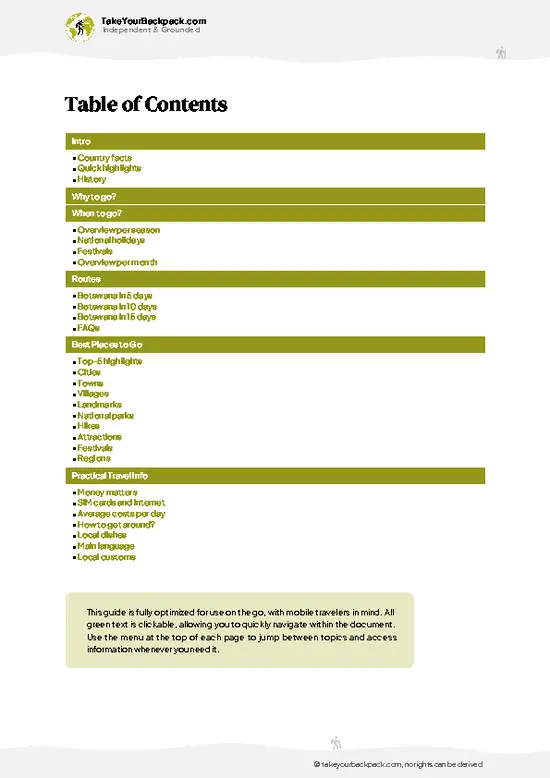
example page 2 from our offline Travel Guide for Botswana
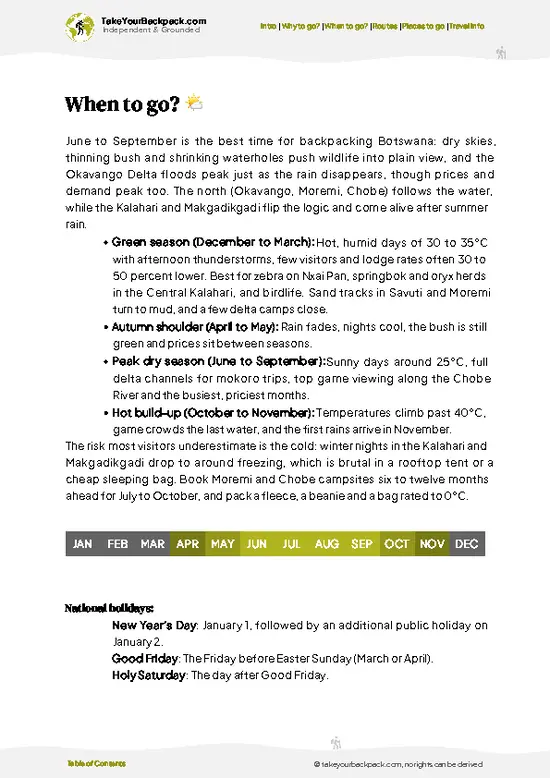
example page 3 from our offline Travel Guide for Botswana
example page 4 from our offline Travel Guide for Botswana
example page 5 from our offline Travel Guide for Botswana
example page 6 from our offline Travel Guide for Botswana
example page 7 from our offline Travel Guide for Botswana
Loading the map 🌍
CLICK TO FILTER
cities
towns
villages
landmarks
national parks
hikes
attractions
festivals
regions
SHOW COUNTRY’S BESTSHOW ALL

✨ Why go?
Ranked #6 national park in Botswana
What makes this national park worth exploring

Kgalagadi Transfrontier Park works for backpackers who want a wild place on their own terms rather than from a tour truck. The main reason is the Nossob riverbed, a dry channel where you can park at a waterhole and wait for hours while gemsbok, springbok and the occasional black-maned lion come to you. Nobody schedules it. You set the pace, and a flask of coffee and a folding chair are all the equipment you need. The second reason is the wilderness camping. The unfenced Botswana-side campsites at Polentswa, Rooiputs and Mabuasehube put you alone among the dunes and pans, with no neighbors and a sky that is hard to describe without sounding silly. It is self-drive country, so tours add little unless you lack a vehicle. Hitching in is not realistic, but renting a 4x4 with two or three people … read more 👉
Kgalagadi Transfrontier Park works for backpackers who want a wild place on their own terms rather than from a tour truck. The main reason is the Nossob riverbed, a dry channel where you can park at a waterhole and wait for hours while gemsbok, springbok and the occasional black-maned lion come to you. Nobody schedules it. You set the pace, and a flask of coffee and a folding chair are all the equipment you need. The second reason is the wilderness camping. The unfenced Botswana-side campsites at Polentswa, Rooiputs and Mabuasehube put you alone among the dunes and pans, with no neighbors and a sky that is hard to describe without sounding silly. It is self-drive country, so tours add little unless you lack a vehicle. Hitching in is not realistic, but renting a 4x4 with two or three people splits the cost and makes the whole trip manageable.

💡 HighlightsEssential experiences to have while exploring Kgalagadi Transfrontier Park

  1. Nossob riverbed: The dry river channel is the park's main wildlife corridor, where lion, leopard and cheetah can turn up along the track.
  2. Kalahari black-maned lions: The park is known for its dark-maned lions, often resting under camelthorn trees near the riverbed.
  3. Cheetah on the dunes: Open ground makes sightings of these cats easier than in thicker bush.
  4. Gemsbok and springbok herds: Large numbers gather along the dry rivers, with gemsbok well adapted to the harsh climate.
  5. Raptors and sociable weavers: Martial eagles, pale chanting goshawks and huge weaver nests hang in the trees.
  6. Red dune landscape: Parallel red dunes with golden grass and sparse acacias make a photogenic backdrop, especially after rain.
  7. Remote wilderness campsites: Unfenced camps give nights with huge stars and distant lion calls.
… read more 👉
  1. Nossob riverbed: The dry river channel is the park's main wildlife corridor, where lion, leopard and cheetah can turn up along the track.
  2. Kalahari black-maned lions: The park is known for its dark-maned lions, often resting under camelthorn trees near the riverbed.
  3. Cheetah on the dunes: Open ground makes sightings of these cats easier than in thicker bush.
  4. Gemsbok and springbok herds: Large numbers gather along the dry rivers, with gemsbok well adapted to the harsh climate.
  5. Raptors and sociable weavers: Martial eagles, pale chanting goshawks and huge weaver nests hang in the trees.
  6. Red dune landscape: Parallel red dunes with golden grass and sparse acacias make a photogenic backdrop, especially after rain.
  7. Remote wilderness campsites: Unfenced camps give nights with huge stars and distant lion calls.
Allow at least three to four days to cover these sights properly, since distances are long and driving is slow on sand.
Spotted a mistake or missing something? Contact us.

🌤️ When to go?Weather, crowds, and seasonal trade-offs

  • Cool Dry Season (May to September): Days run 20 to 27°C (68 to 81°F) and nights drop to 0 to 5°C (32 to 41°F), with frost possible in July. Daylight lasts roughly 11 hours. Animals gather along the Nossob and Auob riverbeds, so sightings are easiest. Prices and crowds peak in July and August.
  • Hot Season (October to December): Afternoons reach 35 to 42°C (95 to 108°F). Days are long, about 13 to 14 hours of light. Dust storms are common, but lambing season starts in November and brings predators to the herds.
  • Green Season (January to April): Thunderstorms arrive in short bursts, highs sit at 32 to 38°C (90 to 100°F), and the dunes turn green. Visitor numbers and rates fall, and calving springbok draw cheetah and lion.
Book Botswana-side camps (Mabuasehube, Two Rivers, Polentswe) months ahead for … read more 👉
  • Cool Dry Season (May to September): Days run 20 to 27°C (68 to 81°F) and nights drop to 0 to 5°C (32 to 41°F), with frost possible in July. Daylight lasts roughly 11 hours. Animals gather along the Nossob and Auob riverbeds, so sightings are easiest. Prices and crowds peak in July and August.
  • Hot Season (October to December): Afternoons reach 35 to 42°C (95 to 108°F). Days are long, about 13 to 14 hours of light. Dust storms are common, but lambing season starts in November and brings predators to the herds.
  • Green Season (January to April): Thunderstorms arrive in short bursts, highs sit at 32 to 38°C (90 to 100°F), and the dunes turn green. Visitor numbers and rates fall, and calving springbok draw cheetah and lion.
Book Botswana-side camps (Mabuasehube, Two Rivers, Polentswe) months ahead for June to August, or go in March for easier availability.


source: climatestotravel.comJANJanuary: fair for travelingFEBFebruary: fair for travelingMARMarch: good for travelingAPRApril: good for travelingMAYMay: highly recommended for travelingJUNJune: excellent for travelingJULJuly: excellent for travelingAUGAugust: excellent for travelingSEPSeptember: highly recommended for travelingOCTOctober: good for travelingNOVNovember: fair for travelingDECDecember: fair for traveling
when-to-go

✈️ The backpacker research shortcutBotswana Travel Guide

An offline-friendly backpacking guide with optimized travel routes, ranked highlights, transport advice, and the best areas to stay.
example page 0 from our offline Travel Guide for Botswana
example page 1 from our offline Travel Guide for Botswana
example page 2 from our offline Travel Guide for Botswana
example page 3 from our offline Travel Guide for Botswana
example page 4 from our offline Travel Guide for Botswana
example page 5 from our offline Travel Guide for Botswana
example page 6 from our offline Travel Guide for Botswana
example page 7 from our offline Travel Guide for Botswana
The digital guide (172 pages) contains:
✅ 38 highlights, ranked by travel appeal
✅ Optimized 5, 10 & 15-day travel routes
✅ Cities, national parks, landmarks, beaches
✅ How to get around
✅ Offline-friendly for travel without Wi-Fi
👉 Click to see all 30+ guide features

📅 Plan smarter in minutes, not weeks
✅ Month by month travel advice
✅ Festivals & national holidays
✅ Budget expectations

🗺️ Go to the right places, skip the overrated ones
✅ Honest pros & cons of destinations
✅ Top hikes, parks & viewpoints
✅ Lesser-known places most travelers miss
✅ Clear “worth it vs skip it” guidance

🛏️ Travel smoothly without rookie mistakes
✅ Best areas to stay
✅ Transport systems explained simply
✅ Common scams & safety advice
✅ SIM cards, money & practical tips

🌍 Understand the country, not just visit it
✅ Culture & traditions
✅ 52 Essential phrases & customs
✅ Festivals worth planning around
✅ Traveler-friendly historical context
✅ Insights that make places more meaningful

📱 Built for real travel conditions
✅ Fully downloadable PDF
✅ Works completely offline
✅ Optimized for phone use
✅ Useful in remote areas & buses
✅ Everything in one place
Stop searching, start planning
Get instant access to your full guide. 30‑day money-back guarantee.
+ Add another guide for just

By proceeding you agree to our terms.
Sent to your inbox immediately after payment • 100% Secure Checkout
Best Backpacking Travel Advisor 2025 tourism awardBest Backpacking
Travel Advisor
2025
What others say about Take Your Backpack Guides:
⭐⭐⭐⭐⭐
Fantastic, amazing amount of information!
⭐⭐⭐⭐⭐
My goodness this is amazing, it's what I've been looking for hats off too you!
⭐⭐⭐⭐⭐
I think this is absolutely BRILLIANT
⭐⭐⭐⭐
Very complete and informative. It's still missing places, but I gotta to commend you
⭐⭐⭐⭐⭐
This is truly amazing, thank you, can't wait to explore it with my kids!
⭐⭐⭐⭐⭐
Awesome resource, thank you!
⭐⭐⭐⭐⭐
This is amazing! Can't wait to explore the ones I haven't seen
⭐⭐⭐⭐
I love this! Well done, great idea.
⭐⭐⭐⭐⭐
Thanks for taking the time to make this gem!
⭐⭐⭐⭐⭐
This might be the best website I've ever seen.
⭐⭐⭐⭐⭐
Congratulations, and thank you so much for your work; it's incredibly valuable.
⭐⭐⭐⭐
In all seriousness I think you did a great job pointing out the important spots
⭐⭐⭐⭐⭐
10/10 very good
⭐⭐⭐⭐⭐
As someone who's only just starting to visit regularly this is awesome, thank you.
⭐⭐⭐⭐
Thank you very much! I'm going to visit my dad, it's going to be very useful!
⭐⭐⭐⭐⭐
This is really cool! We'll be travelling for the first time and this definitely come in handy.
⭐⭐⭐⭐⭐
You are now our minister of culture, congratulations 👨‍💼
⭐⭐⭐⭐⭐
Just wanted to tell you that this is a pearl! Going to follow your recommendations.
⭐⭐⭐⭐⭐
This is so cool. I'll definitely be using the resource for my travels soon.
⭐⭐⭐⭐⭐
This is very impressive! Good work.
⭐⭐⭐⭐⭐
This is an amazing and informative site. Very well done!

🛏️ Where to stay?Where staying makes the most sense

Inside the park you sleep in the Botswana-side campsites at Two Rivers, Polentswe, Rooiputs and Mabuasehube, which are the only options for backpackers. Every site is unfenced, basic and bookable through Botswana’s Department of Wildlife and National Parks (DWNP), with a few pit toilets, no power and little or no water at some sites, so bring your own. Rooiputs and Polentswe sit on the Nossob riverbed, while Mabuasehube’s pans in the northeast offer a quieter stay among dunes. A 4x4 is required for all of them.
On the South African side, SANParks rest camps such as Twee Rivieren, Mata Mata and … read more 👉
Inside the park you sleep in the Botswana-side campsites at Two Rivers, Polentswe, Rooiputs and Mabuasehube, which are the only options for backpackers. Every site is unfenced, basic and bookable through Botswana’s Department of Wildlife and National Parks (DWNP), with a few pit toilets, no power and little or no water at some sites, so bring your own. Rooiputs and Polentswe sit on the Nossob riverbed, while Mabuasehube’s pans in the northeast offer a quieter stay among dunes. A 4x4 is required for all of them.
On the South African side, SANParks rest camps such as Twee Rivieren, Mata Mata and Nossob have chalets, tents and campsites with showers, shops and fuel. You can cross between sides without exiting Botswana formalities if you stay within the park, though you need to follow the rules for the boundary gate.
Outside the park, the nearest base is Tsabong, about 3 to 4 hours away, with a few guesthouses. Upington in South Africa has the widest choice of hostels and cheap guesthouses, and it is the usual place to stock up before entering.

👛 Costs (as of 22 October 2026)Typical daily expenses

Expect to spend about US$115 a day at Kgalagadi Transfrontier Park if you camp and self-cater in a rented 4x4 with shared costs. Fees are paid in Botswana pula, and fuel is the largest variable.
CategoryBudget RangeLocal Reality
Entrance feesUS$15 to 30Foreign visitors pay per person plus a vehicle fee per day, cheaper for residents of the region.
Camping (high season)US$25 to 40Per person at DWNP sites with no facilities beyond basic toilets, rates dip in the green season.
Vehicle hire shareUS$50 to 90A 4x4 with camping gear from Upington or Gaborone, split among passengers.
FuelUS$10 to 25Fuel is limited inside the Botswana side, so fill up in Tsabong or at Twee Rivieren.
Food and waterUS$10 to 20Stock up in Upington or Tsabong, because there are no shops at Botswana-side camps.
Total Daily BudgetUS$115Per
… read more 👉
Expect to spend about US$115 a day at Kgalagadi Transfrontier Park if you camp and self-cater in a rented 4x4 with shared costs. Fees are paid in Botswana pula, and fuel is the largest variable.
CategoryBudget RangeLocal Reality
Entrance feesUS$15 to 30Foreign visitors pay per person plus a vehicle fee per day, cheaper for residents of the region.
Camping (high season)US$25 to 40Per person at DWNP sites with no facilities beyond basic toilets, rates dip in the green season.
Vehicle hire shareUS$50 to 90A 4x4 with camping gear from Upington or Gaborone, split among passengers.
FuelUS$10 to 25Fuel is limited inside the Botswana side, so fill up in Tsabong or at Twee Rivieren.
Food and waterUS$10 to 20Stock up in Upington or Tsabong, because there are no shops at Botswana-side camps.
Total Daily BudgetUS$115Per person per day for a shared 4x4 camping trip.
⚠️ Prices can change and everyone travels differently, so take this as a rough guide. Hope it helps you plan your adventure!

🥾 TrailsExploring Kgalagadi Transfrontier Park: trails, terrain, and views

Kgalagadi Transfrontier Park does not permit walking away from vehicles, so there are no hiking trails in the usual sense. Exploring means driving sand tracks and stepping out only at designated spots.
  • Nossob riverbed drive: Follow the dry riverbed track, which is slow, sandy and the best route for spotting predators. Plan a half day or more, since you stop often.
  • Dune track routes: Tracks cross red dunes with steep, soft sand that need low tire pressure and a confident driver. Difficulty is moderate to hard for vehicles.
  • Waterhole stops: Sit quietly at artificial waterholes where gemsbok, springbok
… read more 👉
Kgalagadi Transfrontier Park does not permit walking away from vehicles, so there are no hiking trails in the usual sense. Exploring means driving sand tracks and stepping out only at designated spots.
  • Nossob riverbed drive: Follow the dry riverbed track, which is slow, sandy and the best route for spotting predators. Plan a half day or more, since you stop often.
  • Dune track routes: Tracks cross red dunes with steep, soft sand that need low tire pressure and a confident driver. Difficulty is moderate to hard for vehicles.
  • Waterhole stops: Sit quietly at artificial waterholes where gemsbok, springbok and birds of prey gather. Hours can pass easily here.
  • Wildlife: Lion, leopard, cheetah, hyena, gemsbok, eland and many raptors are all regular sights.
  • Terrain: Deep red sand, sparse grass and dry riverbeds, with sections that can be corrugated or very soft.
Getting here is hard without your own vehicle. Public transport does not reach the park, so most visitors arrive in a rented high-clearance 4x4 from larger towns, and some join organized overland trips. Crowds are minimal, with few vehicles on the tracks even in busy months. An entrance fee applies, typically around US$15 to 25 per adult per day plus a vehicle fee, and campsites must be booked ahead. Carry all fuel, food and water, a tire compressor, a spare tire and a recovery kit.
⚠️ Hiking info can sometimes be outdated or inaccurate. Before you hit the trail, check the latest conditions with locals. If you do spot anything that's off, I'd love to hear from you, so I can update it for fellow travelers.

🛡️ SafetyStaying Safe: What Travelers Should Know

Kgalagadi is straightforward if you respect heat, distance and unfenced wildlife. Summer afternoons top 40°C (104°F), so drive and walk early and rest in shade, and winter nights are freezing, so bring a proper sleeping bag. Sand tracks on the Botswana side are deep, and a high-clearance 4x4 with recovery gear, two spare tires and a compressor is necessary. Help can be hours away, so carry at least 5 liters of water per person per day, extra fuel and a satellite messenger.
Lions, leopards, hyenas and cheetahs move through the campsites, so keep food locked in the vehicle, sleep in a tent zipped shut and use a flashlight at night. Do not walk away from camp, and never leave your vehicle outside designated points. Scorpions and snakes are active in warm months, so shake out boots.

FAQCommon questions from travelers

Kgalagadi Transfrontier Park needs 3 to 5 days for a satisfying visit. That gives you time for the Nossob and Auob riverbeds, plus a night at Twee Rivieren or Mata Mata on the South African side. Add 2 more days if you want to reach Mabuasehube in the northeast.
Visiting Kgalagadi Transfrontier Park without a car is very difficult, since there is no public transport inside the park and the Botswana-side tracks are deep sand. Most backpackers join a guided camping safari from Upington (about 4 to 5 hours from the gate) or rent a 4x4. Tsabong has minibuses from Gaborone, but they stop well short of the park.
Yes, Kgalagadi Transfrontier Park charges daily entry fees and requires a booking for any overnight stay. Foreign visitors pay roughly US$15 to 30 per person per day plus a vehicle fee, and campsites cost about US$25 to 40 per person per night. Reserve through DWNP, and carry your passport for the border-free crossing between the Botswana and South African sides.
⚠️ Things can change over time, so always validate details locally before you go.

Other Botswanan national parks near Kgalagadi Transfrontier Park

Explore more nearby:


💡 Not sure where to go next?
Create a personalized itinerary for Botswana including Kgalagadi Transfrontier Park and the places that fit your trip.

Generate my itinerary

👉 Discover all national parks

Or checkout all Botswana has to offer (think cities, towns, villages, national parks, hikes, beaches, festivals)
Country photo of Botswana

We 💚 feedbackFinal thoughts on exploring Kgalagadi Transfrontier Park

Travelers often underestimate how slow the sand tracks are, then rush between camps and drive in the heat. Kgalagadi Transfrontier Park works best when you plan short daily distances, stop at waterholes and spend the middle hours in camp. I would book fewer nights in more places and carry extra water.

✍️ Help improve this page!
The information on this page is based on in-depth research, insights shared by experienced travelers, and feedback from the local travel community in Botswana. While every effort is made to keep the information accurate and current, conditions can change — so if you spot anything incorrect or outdated, please get in touch.


🙋‍♂️ Give feedback

👋 Meet the founderWho’s Behind Take Your Backpack?

Johan, backpacker and founder of TakeYourBackpackHi, I’m Johan (Netherlands 🇳🇱), the creator of TakeYourBackpack. Over the past 3 decades, I’ve backpacked through 90+ countries across six continents, gaining extensive experience with independent travel, long-term trips, and overland routes.

This site is built on a combination of firsthand travel experience and carefully curated insights from other backpackers. Many guides are based on places I’ve personally visited, while others bring together tips, observations, and practical advice shared by trusted travelers I’ve met along the way.

The goal is to provide realistic, experience-driven guidance — not generic itineraries — so you can explore destinations with better context, clearer expectations, and more confidence.