×

Brazil🇧🇷 | villagesMorro de São PauloCar-free island, Segunda Praia barracas, Portuguese fort ruins, numbered beaches | things to do and best time to go

Explore Sítio Roberto Burle MarxExplore São Tomé das Letras

Backpacking in Morro de São Paulo
🏆 Top pickvillage ranked #1
By Johan Kruseman 🇳🇱 | Updated October 19, 2026

Morro de São Paulo was a sleepy fishing and coconut village with sand lanes and a handful of rooms for rent. Today it is a car-free beach town of pousadas, beach bars and zipline billboards that fills fast in high season. It sits on the northern tip of Tinharé Island in Bahia, in northeastern Brazil, south of Salvador. The main street, Caminho da Praia, is a tight, noisy strip of tour touts and caipirinha stands. Skip the shopping stretch and put your time into the sand. The beaches run numbered from Primeira to Quarta, and the walk along them gives you open water and coconut palms. Evenings are social on Segunda Praia, where hostel crowds drift between beach bars, and early and quiet on the far beaches. I walked from Segunda to Terceira Praia on a falling tide and had the wet sand almost to myself, with a cold coconut waiting at the end. Check the tide table on your phone before you go.

Discover everything you want to know in the 📖 Brazil Travel Guide.


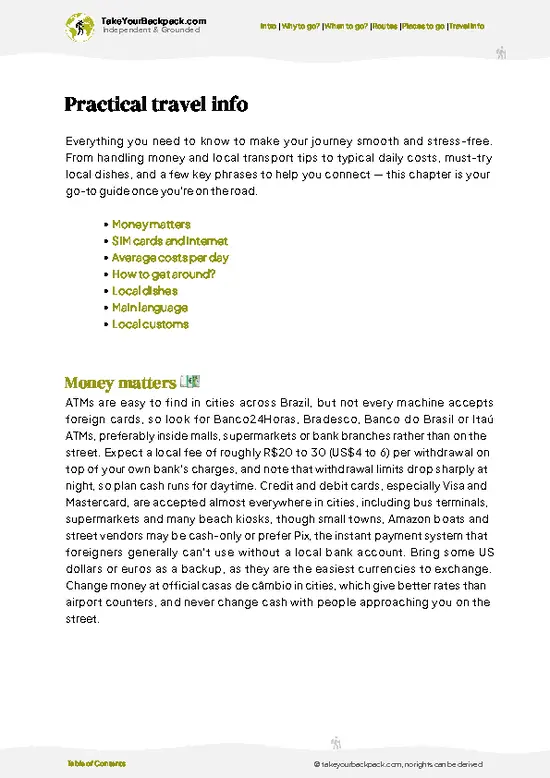
example page 0 from our offline Travel Guide for Brazil
example page 1 from our offline Travel Guide for Brazil
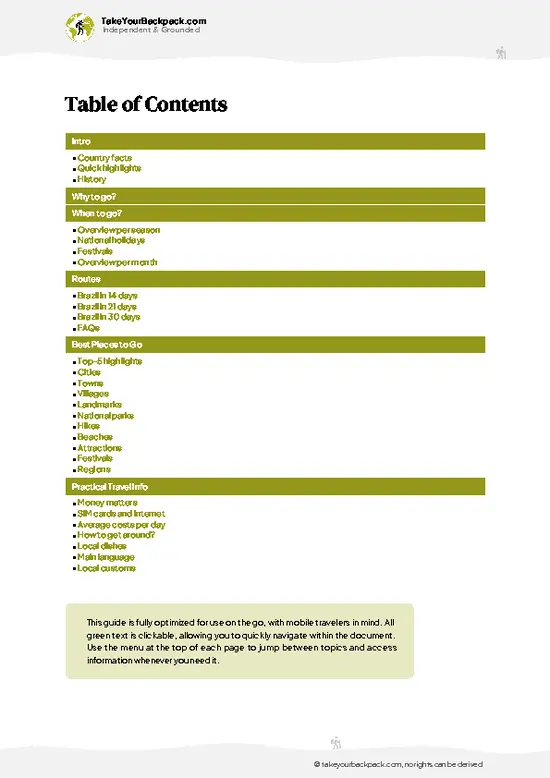
example page 2 from our offline Travel Guide for Brazil
example page 3 from our offline Travel Guide for Brazil
example page 4 from our offline Travel Guide for Brazil
example page 5 from our offline Travel Guide for Brazil
example page 6 from our offline Travel Guide for Brazil
example page 7 from our offline Travel Guide for Brazil
Loading the map 🌍
CLICK TO FILTER
cities
towns
villages
landmarks
national parks
hikes
beaches
attractions
festivals
regions
SHOW COUNTRY’S BESTSHOW ALL

✨ Why go?
Ranked #1 village in Brazil
Why Morro de São Paulo should be on your travel list

Morro de São Paulo works because the beaches are lined up in a row you can walk end to end, with no car, no bus and no timetable. Backpackers who want sun, warm shallow water and easy company get all three here, and it is one of the few Bahia stops where meeting people takes no effort. The social center is Segunda Praia, where hostels, beach bars and sunset crowds sit within a few minutes of each other. Move toward Quarta Praia and Praia do Encanto and the crowd thins, the water turns calm and clear at low tide, and you can float among natural pools. Most people stay three to five nights. Some linger longer because the pace is slow and the island has boat trips to quieter villages. It suits solo travelers who want built-in company, couples after beach days, and slow travelers who like swimming … read more 👉
Morro de São Paulo works because the beaches are lined up in a row you can walk end to end, with no car, no bus and no timetable. Backpackers who want sun, warm shallow water and easy company get all three here, and it is one of the few Bahia stops where meeting people takes no effort. The social center is Segunda Praia, where hostels, beach bars and sunset crowds sit within a few minutes of each other. Move toward Quarta Praia and Praia do Encanto and the crowd thins, the water turns calm and clear at low tide, and you can float among natural pools. Most people stay three to five nights. Some linger longer because the pace is slow and the island has boat trips to quieter villages. It suits solo travelers who want built-in company, couples after beach days, and slow travelers who like swimming over sightseeing. It does not suit anyone hoping for a hushed hideaway in January or carnival week, when the lanes are packed and the music runs late. Come in the shoulder months and the town feels far more relaxed.

💡 HighlightsDon't-miss highlights and experiences

  1. Segunda Praia: The beach most people come for, and the easiest place to meet other travelers. Barracas (beach shacks) line the sand with lounge chairs, grilled fish and cold coconuts, and the water is warm and shallow enough for easy swimming. Go in the morning for space and again near dusk for the social scene. Sand access is free, and chairs are usually covered by ordering from the barraca. Plan two to four hours, or the whole day.
  2. Fortaleza ruins and the Portaló: The old stone gateway (Portaló) and the fort walls above the village date to the 17th century, when the Portuguese fortified the headland against Dutch attack. Stand at the ramparts and you look out over the bay, the lighthouse hill and the mouth of the channel. Early morning is cooler and quiet. Access is free and a visit takes
… read more 👉
  1. Segunda Praia: The beach most people come for, and the easiest place to meet other travelers. Barracas (beach shacks) line the sand with lounge chairs, grilled fish and cold coconuts, and the water is warm and shallow enough for easy swimming. Go in the morning for space and again near dusk for the social scene. Sand access is free, and chairs are usually covered by ordering from the barraca. Plan two to four hours, or the whole day.
  2. Fortaleza ruins and the Portaló: The old stone gateway (Portaló) and the fort walls above the village date to the 17th century, when the Portuguese fortified the headland against Dutch attack. Stand at the ramparts and you look out over the bay, the lighthouse hill and the mouth of the channel. Early morning is cooler and quiet. Access is free and a visit takes 30 to 60 minutes, easily combined with a walk to the lighthouse and the zipline platform nearby, where a ride costs roughly US$15 to 25.
  3. Fonte Grande: This 18th-century stone fountain sits at the foot of the old town, where villagers once drew water. Reaching it means a short stair walk downhill from the gateway. It is a small stop, best in the cooler early morning or late afternoon, and free to visit. Allow 20 to 30 minutes, and bring your camera for the shaded stonework and the sea view on the way back.
Beyond the village, easy boat trips reach Gamboa do Morro across the mangrove channel, the island of Boipeba with its quiet beaches and natural pools, and the fishing village of Garapuá on the island's southern shore. If time is short, skip Fonte Grande and spend the saved half hour on the ruins or the beach.
Spotted a mistake or missing something? Contact us.

Things to do around Morro de São Paulo

Ratings based on Tripadvisor reviews. When you book through this link, you support our work at no extra cost to you.

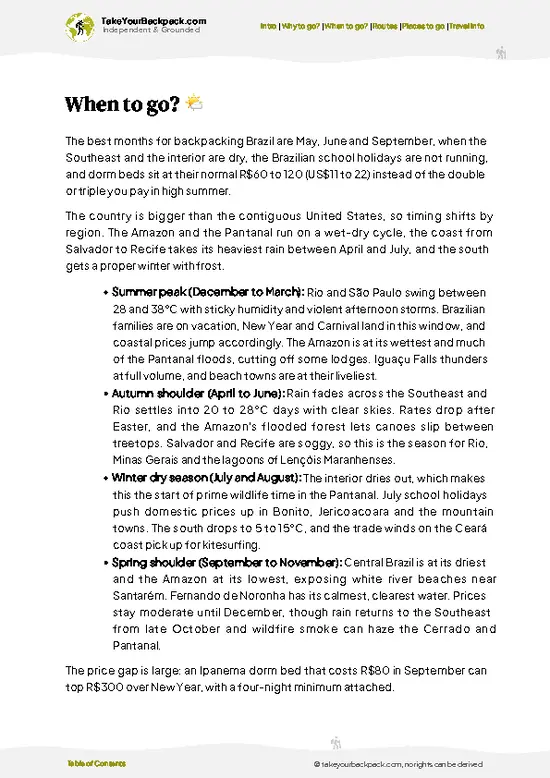
🌤️ When to go?When to go for the best experience

  • Summer (December to March): Hot and humid at 24 to 31°C (75 to 88°F), with long days of about 13 hours of light and the warmest sea. Crowds and prices peak around Christmas, New Year and Carnival, when beds can cost double and need booking weeks ahead.
  • Autumn (April to June): Rain is most frequent in April to June, in short heavy bursts, at 22 to 28°C (72 to 82°F). Prices drop and the beaches empty out. Boat trips sometimes get canceled when seas are rough.
  • Winter (July to August): Mild and breezier at 20 to 27°C (68 to 81°F), with days of about 11 hours of light. Brazilian school holidays in July bring a moderate bump in visitors and rates.
  • Spring (September to November): Mostly sunny, 22 to 29°C (72 to 84°F), with calm water and the best value. Diving and snorkeling visibility is often at its
… read more 👉
  • Summer (December to March): Hot and humid at 24 to 31°C (75 to 88°F), with long days of about 13 hours of light and the warmest sea. Crowds and prices peak around Christmas, New Year and Carnival, when beds can cost double and need booking weeks ahead.
  • Autumn (April to June): Rain is most frequent in April to June, in short heavy bursts, at 22 to 28°C (72 to 82°F). Prices drop and the beaches empty out. Boat trips sometimes get canceled when seas are rough.
  • Winter (July to August): Mild and breezier at 20 to 27°C (68 to 81°F), with days of about 11 hours of light. Brazilian school holidays in July bring a moderate bump in visitors and rates.
  • Spring (September to November): Mostly sunny, 22 to 29°C (72 to 84°F), with calm water and the best value. Diving and snorkeling visibility is often at its best, and weekdays feel quiet.
Arrive on a weekday in September or October for the clearest water and the lowest bed prices.


source: climatestotravel.comJANJanuary: highly recommended for travelingFEBFebruary: highly recommended for travelingMARMarch: excellent for travelingAPRApril: highly recommended for travelingMAYMay: fair for travelingJUNJune: fair for travelingJULJuly: good for travelingAUGAugust: good for travelingSEPSeptember: good for travelingOCTOctober: good for travelingNOVNovember: fair for travelingDECDecember: highly recommended for traveling
brazil-city-morro-de-sao-paulo
© Google | Anthony Claul

✈️ The backpacker research shortcutBrazil Travel Guide

An offline-friendly backpacking guide with optimized travel routes, ranked highlights, transport advice, and the best areas to stay.
example page 0 from our offline Travel Guide for Brazil
example page 1 from our offline Travel Guide for Brazil
example page 2 from our offline Travel Guide for Brazil
example page 3 from our offline Travel Guide for Brazil
example page 4 from our offline Travel Guide for Brazil
example page 5 from our offline Travel Guide for Brazil
example page 6 from our offline Travel Guide for Brazil
example page 7 from our offline Travel Guide for Brazil
The digital guide (410 pages) contains:
✅ 146 highlights, ranked by travel appeal
✅ Optimized 14, 21 & 30-day travel routes
✅ Cities, national parks, landmarks, beaches
✅ How to get around
✅ Offline-friendly for travel without Wi-Fi
👉 Click to see all 30+ guide features

📅 Plan smarter in minutes, not weeks
✅ Month by month travel advice
✅ Festivals & national holidays
✅ Budget expectations

🗺️ Go to the right places, skip the overrated ones
✅ Honest pros & cons of destinations
✅ Top hikes, parks & viewpoints
✅ Lesser-known places most travelers miss
✅ Clear “worth it vs skip it” guidance

🛏️ Travel smoothly without rookie mistakes
✅ Best areas to stay
✅ Transport systems explained simply
✅ Common scams & safety advice
✅ SIM cards, money & practical tips

🌍 Understand the country, not just visit it
✅ Culture & traditions
✅ 52 Essential phrases & customs
✅ Festivals worth planning around
✅ Traveler-friendly historical context
✅ Insights that make places more meaningful

📱 Built for real travel conditions
✅ Fully downloadable PDF
✅ Works completely offline
✅ Optimized for phone use
✅ Useful in remote areas & buses
✅ Everything in one place
Stop searching, start planning
Get instant access to your full guide. 30‑day money-back guarantee.
+ Add another guide for just

By proceeding you agree to our terms.
Sent to your inbox immediately after payment • 100% Secure Checkout
Best Backpacking Travel Advisor 2025 tourism awardBest Backpacking
Travel Advisor
2025
What others say about Take Your Backpack Guides:
⭐⭐⭐⭐⭐
Fantastic, amazing amount of information!
⭐⭐⭐⭐⭐
My goodness this is amazing, it's what I've been looking for hats off too you!
⭐⭐⭐⭐⭐
I think this is absolutely BRILLIANT
⭐⭐⭐⭐
Very complete and informative. It's still missing places, but I gotta to commend you
⭐⭐⭐⭐⭐
This is truly amazing, thank you, can't wait to explore it with my kids!
⭐⭐⭐⭐⭐
Awesome resource, thank you!
⭐⭐⭐⭐⭐
This is amazing! Can't wait to explore the ones I haven't seen
⭐⭐⭐⭐
I love this! Well done, great idea.
⭐⭐⭐⭐⭐
Thanks for taking the time to make this gem!
⭐⭐⭐⭐⭐
This might be the best website I've ever seen.
⭐⭐⭐⭐⭐
Congratulations, and thank you so much for your work; it's incredibly valuable.
⭐⭐⭐⭐
In all seriousness I think you did a great job pointing out the important spots
⭐⭐⭐⭐⭐
10/10 very good
⭐⭐⭐⭐⭐
As someone who's only just starting to visit regularly this is awesome, thank you.
⭐⭐⭐⭐
Thank you very much! I'm going to visit my dad, it's going to be very useful!
⭐⭐⭐⭐⭐
This is really cool! We'll be travelling for the first time and this definitely come in handy.
⭐⭐⭐⭐⭐
You are now our minister of culture, congratulations 👨‍💼
⭐⭐⭐⭐⭐
Just wanted to tell you that this is a pearl! Going to follow your recommendations.
⭐⭐⭐⭐⭐
This is so cool. I'll definitely be using the resource for my travels soon.
⭐⭐⭐⭐⭐
This is very impressive! Good work.
⭐⭐⭐⭐⭐
This is an amazing and informative site. Very well done!

🛏️ Where to stay?How to pick the right area

The best budget beds in Morro de São Paulo are hostels and simple pousadas in the lanes around the Praça Aureliano Lima and along First Beach, where dorms run US$15 to 30 and private rooms US$35 to 80 outside peak season.
Around the village center: This is where I would stay if you have limited time. You are a short walk from the stone gateway, the Portaló, the Fonte Grande stairs, the ferry pier and the evening restaurants. Expect noise from bars on weekends, so pack earplugs.
First Beach (Primeira Praia): Cheaper pousadas sit a few minutes from the lively beach bars, with simple rooms with fans … read more 👉
The best budget beds in Morro de São Paulo are hostels and simple pousadas in the lanes around the Praça Aureliano Lima and along First Beach, where dorms run US$15 to 30 and private rooms US$35 to 80 outside peak season.
Around the village center: This is where I would stay if you have limited time. You are a short walk from the stone gateway, the Portaló, the Fonte Grande stairs, the ferry pier and the evening restaurants. Expect noise from bars on weekends, so pack earplugs.
First Beach (Primeira Praia): Cheaper pousadas sit a few minutes from the lively beach bars, with simple rooms with fans or air conditioning. Sleep here if you want to be out of bed and in the surf quickly.
Second Beach (Segunda Praia): This is the social heart, with beach bars, party hostels and reggae and forró nights. Dorms here fill fast, and rooms cost US$40 to 100 in high season.
Third and Fourth Beach: Quieter, with calmer water and tidal pools at low tide. Rooms cost US$30 to 70 and the walk back at night is long and dark, so bring a flashlight.
Book ahead for December to February and Carnival. Carry cash for small pousadas, since card machines sometimes fail. Remember there is a tourist environmental fee (TUPA) charged on arrival, around US$16 per person.

🚌 Day tripsWhere to go beyond the main area

Morro de São Paulo works well as a base for boat-based day trips, since every operator sells tours from the pier or the beach, and nothing requires a rental car.
Gamboa do Morro by Boat:
This small fishing village across the bay is reached by boat in about 15 to 25 minutes, or by a walk of about 2 km along the shore at low tide from the village. Expect to pay roughly US$10 to 20. Go in the morning to see the mangrove channels and to eat fresh seafood at a modest lunch spot for US$8 to 15. Check the tide table first, as first-timers often get stranded by the incoming water.

Boipeba Island:
Boipeba is quieter, with natural pools at Cova da Onça and sandy lanes without cars. A speedboat takes about 1 to 1.5 hours each way, and day tours cost around US$30 to 50. It is a full day, so book the earliest … read more 👉
Morro de São Paulo works well as a base for boat-based day trips, since every operator sells tours from the pier or the beach, and nothing requires a rental car.
Gamboa do Morro by Boat:
This small fishing village across the bay is reached by boat in about 15 to 25 minutes, or by a walk of about 2 km along the shore at low tide from the village. Expect to pay roughly US$10 to 20. Go in the morning to see the mangrove channels and to eat fresh seafood at a modest lunch spot for US$8 to 15. Check the tide table first, as first-timers often get stranded by the incoming water.

Boipeba Island:
Boipeba is quieter, with natural pools at Cova da Onça and sandy lanes without cars. A speedboat takes about 1 to 1.5 hours each way, and day tours cost around US$30 to 50. It is a full day, so book the earliest boat and avoid choppy April to June days. Most newcomers underestimate the return time and miss the last crossing.

Cairu Town:
The historic town of Cairu has a hilltop 17th-century convent and a quiet colonial center, reached by a boat of about 30 to 45 minutes. It suits a slow half day with a budget of US$15 to 30 including transport and a simple lunch. Go in the dry months from September to February, and carry water, since shade is scarce.

Garapuá Beach:
Garapuá is a calm fishing village with long shallow beaches and natural pools at low tide. Boat transfers take about 30 to 40 minutes and cost US$15 to 30 return, while lunch is US$10 to 18. Arrive on a weekday to enjoy the empty sand.

FAQTraveler FAQ

The usual way to reach Morro de São Paulo is a catamaran from Salvador, a crossing of about 2 to 2.5 hours that costs roughly US$25 to 40 each way. Another route is a bus or ferry to Valença followed by a 30 to 40 minute speedboat. Expect the full trip to take 3 to 4 hours, and book catamaran seats ahead in December to February.
Yes, Morro de São Paulo is worth it if you want white-sand beaches, warm water and easy social nightlife without a car. Three nights is a good minimum, and September to November gives clearer water and fewer people. It gets crowded and pricey at New Year and Carnival, so go outside those periods for a calmer stay.
A day trip from Salvador is possible but tight, since the catamaran takes around 2 to 2.5 hours each way and costs US$50 to 80 return. Morro de São Paulo is far better with at least one or two nights to enjoy all four beaches and sunsets from the Fonte Grande. If you are short on time, take the earliest boat and the last return, which gives about 5 hours on the island.
⚠️ Things can change over time, so always validate details locally before you go.

Ideas for continuing your journey

Morro de São Paulo isn’t the only highlight in Brazil. Explore all what Brazil has to offer.
Country photo of Brazil

We 💚 feedbackIs it worth it?

Give Morro de São Paulo three nights if you want the beaches and a boat day, and four if you plan to walk out to the far sands and wait for calm weather. One night is only enough to feel the crowd and leave. Come in the shoulder months, and pack light for the narrow lanes.

✈️ When did I visit Brazil?
Call it good timing or luck, but I was able to celebrate Carnaval in Rio de Janeiro in February 2022, after a round trip in the north and east coast.

✍️ Help improve this page!
The information on this page is based on my own backpacking experience in Brazil, supplemented with up-to-date research and feedback from other travelers. Travel details can change, so if you notice anything outdated or incomplete, feel free to let me know.


🙋‍♂️ Give feedback

👋 Meet the founderWho’s Behind Take Your Backpack?

Johan, backpacker and founder of TakeYourBackpackHi, I’m Johan (Netherlands 🇳🇱), the creator of TakeYourBackpack. Over the past 3 decades, I’ve backpacked through 90+ countries across six continents, gaining extensive experience with independent travel, long-term trips, and overland routes.

This site is built on a combination of firsthand travel experience and carefully curated insights from other backpackers. Many guides are based on places I’ve personally visited, while others bring together tips, observations, and practical advice shared by trusted travelers I’ve met along the way.

The goal is to provide realistic, experience-driven guidance — not generic itineraries — so you can explore destinations with better context, clearer expectations, and more confidence.