×

Brazil🇧🇷 | best villagesTop-Rated 2 villages in Brazil

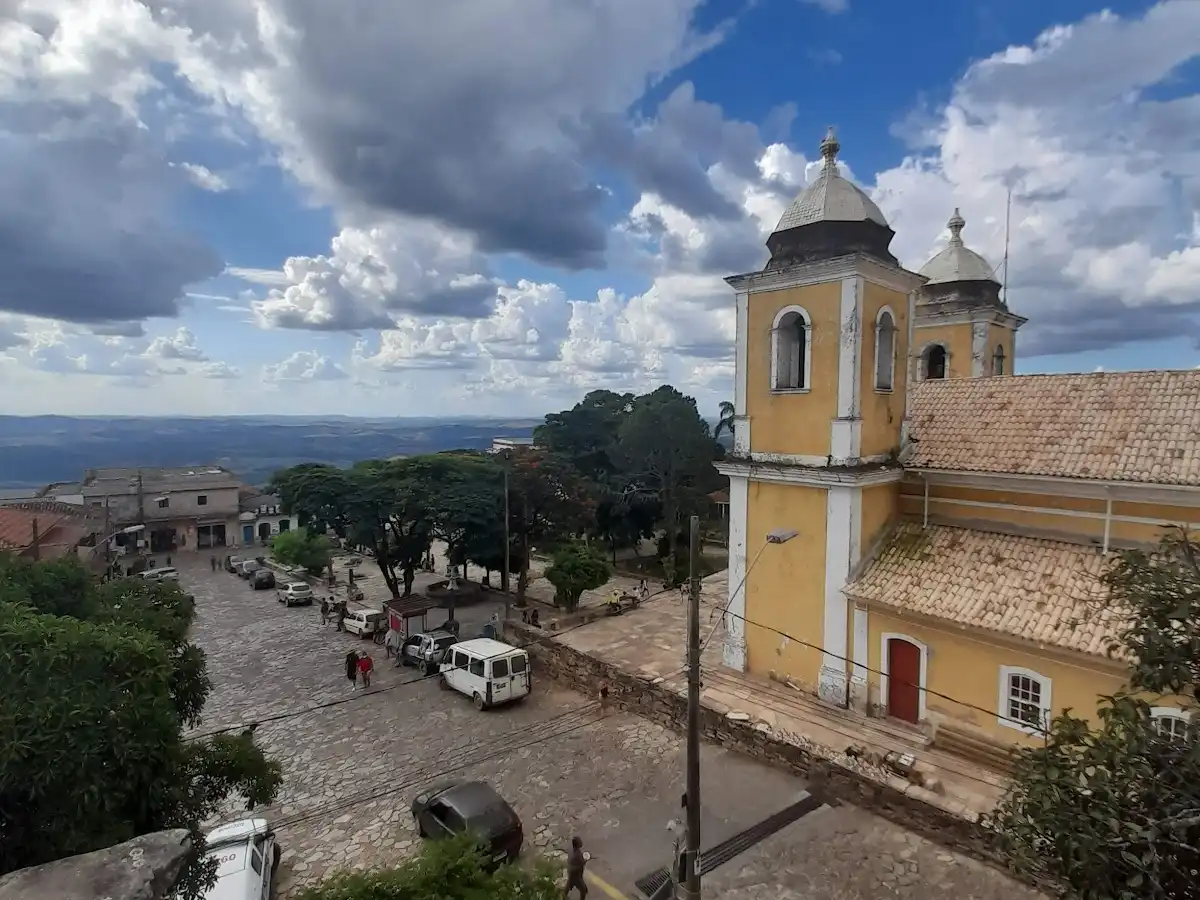
Villages in Brazil are not one product. The country is bigger than the contiguous United States, and the word “village” covers colonial mining towns, Atlantic fishing hamlets, Amazon river communities and quilombo settlements. Pick the wrong type and you lose days to buses for very little.

The colonial towns of Minas Gerais and the Rio de Janeiro coast are the easiest: cobblestones, baroque churches, plenty of pousadas and decent roads, but also weekend crowds and prices that climb fast. The beach villages of the Northeast and Bahia suit independent travelers best. Sand streets, simple guesthouses and kitesurf or buggy culture keep costs moderate, though the best ones take a long bus plus a boat or 4x4 transfer. Amazon and river villages are the hardest and most expensive per day, because you pay for boats and guides, and they are worth it only if you want rainforest, not a quick photo stop. The highland villages of the South, with German and Italian heritage, are tidy, pricey and often skippable for a tight budget.

Backpacking here works when you match the village type to your time and money. Skip anything that needs two days of transit for one afternoon.

By Johan Kruseman 🇳🇱 | Updated October 20, 2026
Explore the best landmarks in Brazil

Why go?Key Factors That Shape the Experience

Brazil’s villages exist in such different forms because of how the country was settled. The Portuguese built coastal ports first, then pushed inland for gold and diamonds in the 1700s. That gave Brazil baroque mining towns in the interior highlands, sugar-era settlements along the Northeast coast, and fishing communities that stayed small because the land behind them was poor. Add the Amazon basin, where settlement follows rivers rather than roads, and the Italian and German immigrant villages of the South, and you get a country with several village traditions rather than one.

The flip side is that Brazil is not a place where villages sit close together, linked by trains or short hikes, as in much of Europe. Distances are huge, long-distance buses are the backbone of independent travel, and … read more 👉
Brazil’s villages exist in such different forms because of how the country was settled. The Portuguese built coastal ports first, then pushed inland for gold and diamonds in the 1700s. That gave Brazil baroque mining towns in the interior highlands, sugar-era settlements along the Northeast coast, and fishing communities that stayed small because the land behind them was poor. Add the Amazon basin, where settlement follows rivers rather than roads, and the Italian and German immigrant villages of the South, and you get a country with several village traditions rather than one.

The flip side is that Brazil is not a place where villages sit close together, linked by trains or short hikes, as in much of Europe. Distances are huge, long-distance buses are the backbone of independent travel, and a flight is often the sensible choice between regions. A traveler who expects to drift from village to village on foot will be disappointed. Most stops need a base city, a transfer, or both.

Climate shapes the experience as much as geography. The tropical coast has a rainy season that turns dirt roads to mud and cancels boat trips. The Amazon floods on a yearly cycle, which changes whether you move by canoe or on foot. The southern highlands get genuinely cold in winter, which suits fondue and wool more than beach hammocks.

Before choosing Brazil for villages, know three things. First, infrastructure varies sharply: ATMs, reliable signal and card acceptance are common in colonial and tourist beach towns and patchy in remote ones, so carry cash for the smaller places. Second, Portuguese matters. English is limited outside the busiest guesthouses, and a few phrases and a translation app make a real difference. Third, popular villages swell on holidays, long weekends and Carnival, and prices can double. Visited on an ordinary weekday, the same places are calmer and cheaper. Brazil rewards travelers who choose a few regions and go deep, and it punishes anyone trying to see everything.
Behind the Scenes of Selection
The list of best villages in Brazil is created based on authenticity, scenic beauty, community spirit, traditions, and overall character. If you feel a village is missing in this list, please let us know.

When to go?Seasonal Guide to Visiting

Best months and why: The best months for most villages in Brazil are May to September, when the dry season brings clear skies, lower humidity and passable roads across the Southeast, the Center-West and much of Minas Gerais. Days sit around 20 to 28°C in the colonial highlands, with cool nights that can drop to 8 to 12°C. Rainfall is minimal, often under 50 mm a month, so cobbled lanes, waterfall walks and viewpoints all work.

Regional differences: Brazil does not have one calendar. The Northeast coast from Bahia to Ceará is hot all year, 26 to 32°C, but the heaviest rain falls roughly April to July in the eastern stretch, while September to February is drier and windier, which is also kitesurf season. The Amazon is humid at 25 to 33°C all year. High water, around March to June, gives access … read more 👉
Best months and why: The best months for most villages in Brazil are May to September, when the dry season brings clear skies, lower humidity and passable roads across the Southeast, the Center-West and much of Minas Gerais. Days sit around 20 to 28°C in the colonial highlands, with cool nights that can drop to 8 to 12°C. Rainfall is minimal, often under 50 mm a month, so cobbled lanes, waterfall walks and viewpoints all work.

Regional differences: Brazil does not have one calendar. The Northeast coast from Bahia to Ceará is hot all year, 26 to 32°C, but the heaviest rain falls roughly April to July in the eastern stretch, while September to February is drier and windier, which is also kitesurf season. The Amazon is humid at 25 to 33°C all year. High water, around March to June, gives access by boat into flooded forest. Low water, roughly August to November, opens beaches and trails but makes some channels shallow. The South has real seasons: summer is warm and wet, winter from June to August can fall to near freezing in the highlands, which suits the cozy hill villages but not beach plans.

Shoulder seasons: April, October and November are good value in most regions. Showers are shorter, crowds are thin and guesthouses often discount by 15 to 30 percent compared with peak rates. In the Southeast, the summer rains from November to March bring afternoon storms that can close waterfall trails and cut dirt roads, so plan outdoor time for mornings.

Peak periods and what to skip: Peak pricing matters more than the weather. Carnival (February or early March), Christmas to New Year, Easter and July school holidays push rates up by 50 to 100 percent in popular colonial and beach villages, and rooms sell out weeks ahead. Long weekends bring day-trippers from São Paulo and Rio. The weeks around New Year are not worth the money in most small villages: you pay double for a crowded version. Book ahead if you must travel then, and otherwise choose midweek in the dry season for the best mix of quiet streets, open restaurants and reasonable prices. A few remote or river communities close or reduce services in the wettest months, so confirm boat and lodging availability before booking.

village hoppingTips for Visiting Multiple Destinations

How many days to plan: A trip combining several villages in Brazil needs 14 to 21 days, and anything under 10 should stay in one region. Distances are the reason: Brazil’s regions are separated by 1,000 to 3,000 km, and a single transfer can eat a day.

Which regions pair well: The strongest cluster is the Southeast: Rio de Janeiro state, the Costa Verde coast and the highlands of Minas Gerais connect through Rio and São Paulo, with road transfers of 3 to 7 hours. The Bahia and Northeast coast forms a second cluster, linked through Salvador, with buses or boat connections of 3 to 8 hours between coastal stops. The Amazon should be treated as its own trip, entered by flight to Manaus or Belém, because river travel is slow and expensive. The South pairs with the Southeast by air or a long overnight … read more 👉
How many days to plan: A trip combining several villages in Brazil needs 14 to 21 days, and anything under 10 should stay in one region. Distances are the reason: Brazil’s regions are separated by 1,000 to 3,000 km, and a single transfer can eat a day.

Which regions pair well: The strongest cluster is the Southeast: Rio de Janeiro state, the Costa Verde coast and the highlands of Minas Gerais connect through Rio and São Paulo, with road transfers of 3 to 7 hours. The Bahia and Northeast coast forms a second cluster, linked through Salvador, with buses or boat connections of 3 to 8 hours between coastal stops. The Amazon should be treated as its own trip, entered by flight to Manaus or Belém, because river travel is slow and expensive. The South pairs with the Southeast by air or a long overnight bus, but it fits poorly with the tropical north.

Direction and transport: Travel north or south along one coast rather than zigzagging. A sensible direction is Southeast first, then a flight from Rio or São Paulo to Salvador, then up the Northeast coast. Reverse it if you arrive in the north. Between regions, flights of 2 to 3 hours often cost US$40 to 120 (about R$220 to 650) when booked early, and beat 20 to 30 hour buses on time and often on total cost. Within regions, comfortable coaches cost roughly R$60 to 200 (US$11 to 36) per leg.

Time per stop: Allow 2 to 3 nights per village. One night is mostly wasted on transfers, while more than four is only useful for beach or river villages where the point is to slow down. Add a buffer day before any international flight.

Planning mistakes: The most common error is stacking too many stops. Four or five villages in two weeks means more time on buses than in the places themselves, so choose two regions and drop the rest. Another is ignoring transfer details: many beach and river villages depend on tides, ferry schedules or a few daily departures, and missing one costs a day. Check timetables the day before and buy tickets early for weekends and holidays. Finally, travelers underestimate distance on a map. Brazil’s scale makes a short-looking hop a full day, so always check actual travel time before committing.

The ListMust-Visit villages in Brazil

1 Morro de São Paulo

Car-free island, Segunda Praia barracas, Portuguese fort ruins, numbered beaches

Walk the numbered beaches from Segunda to Terceira on a falling tide, then climb to the 17th-century gateway and fort walls above the bay.

brazil-city-morro-de-sao-paulo
© Google | Anthony Claul

2 São Tomé das Letras

Quartz-stone streets, cave chapel, boulder house, Mantiqueira lookouts

Climb to the Cruzeiro hilltop at late afternoon, then duck into the damp cave below the church.

brazil-city-sao-tome-das-letras
© Google |
Loading the map 🌍

Expert viewExpert Commentary on villages

How many villages to visit: Plan on four to six villages in a two to three week trip, and no more than two or three in one week. Brazil’s transfers are long, and each village needs at least two nights before it stops feeling like a transit stop. Beyond six, you are collecting names rather than seeing places, and the costs of buses, boats and repeated check-ins add up without adding much.

Choosing between the kinds: Match the type to your style. If you like walking, history and cooler evenings, choose colonial highland towns: they are the easiest, with the most hostels and the best food per real. If you want sun, simplicity and a social scene, pick beach and fishing villages in Bahia and the Northeast. If you want wildlife and are willing to pay for it, an Amazon river community is the right … read more 👉
How many villages to visit: Plan on four to six villages in a two to three week trip, and no more than two or three in one week. Brazil’s transfers are long, and each village needs at least two nights before it stops feeling like a transit stop. Beyond six, you are collecting names rather than seeing places, and the costs of buses, boats and repeated check-ins add up without adding much.

Choosing between the kinds: Match the type to your style. If you like walking, history and cooler evenings, choose colonial highland towns: they are the easiest, with the most hostels and the best food per real. If you want sun, simplicity and a social scene, pick beach and fishing villages in Bahia and the Northeast. If you want wildlife and are willing to pay for it, an Amazon river community is the right choice, but only with a licensed operator, and only when you can give it 3 to 5 days. The German and Italian highland villages of the South suit travelers who want cool weather and good cafés, but they are priced for domestic weekenders and offer less for a tight budget. Skip any village whose main draw is a single photo spot. It will not fill a day.

What it costs: A realistic backpacker budget is US$35 to 60 a day (about R$190 to 330) in colonial and beach villages, covering a dorm or basic room at US$12 to 30, meals at US$8 to 18, and local transport. Double rooms in popular places run US$35 to 80, and in peak season they can double. Amazon visits cost far more, often US$80 to 200 a day with lodge, meals, boat and guide. Village entry fees are usually low or free, but trail, park and boat fees add up: expect US$2 to 15 for a trail or waterfall site, US$10 to 40 for a half-day boat trip, and US$20 to 60 for a guided hike or buggy tour. Intercity buses cost roughly US$10 to 40 per leg.

Costs and delays that catch travelers out: Peak dates are the biggest budget trap. Carnival, New Year and July holidays can double lodging rates, and last-minute rooms in small villages may not exist at all, so book weeks ahead or travel midweek. Cash is the second. Many small places do not take foreign cards, and village ATMs can be empty or reject foreign cards, so withdraw in the last large town and carry R$300 to 500 extra. Pix, the local instant payment system, is widely used but usually needs a Brazilian bank account, so do not count on it.

Transfers cause the delays. Boats and ferries depend on tides and weather, rain can shut dirt roads, and some villages have only one or two departures a day. Keep a buffer day before any flight and confirm return times when you arrive. Buying a guide on the spot is another leak: agree the price, duration and what is included in writing or on a message before starting, and use licensed local guides where the trail or river requires one.

Safety: Small villages are generally calmer than big cities, but petty theft happens, especially around beach bars, bus stations and crowded festival nights. Keep your phone out of sight on the street, do not walk empty beaches or unlit roads at night, and use a registered taxi or pousada pickup after dark. Sun and water are bigger risks than crime: the tropical sun burns within 20 minutes, and sea currents and waterfall pools claim swimmers every year, so heed local flags and warnings. Carry mosquito repellent, and check current yellow fever vaccination advice for rural and Amazon regions before you travel.

Cultural considerations: Learn a few phrases of Portuguese. Greeting people with “bom dia” and “obrigado” (“obrigada” if you are a woman) opens doors, and English is rare outside tourist guesthouses. Villagers are usually friendly, but ask before photographing people, especially in Indigenous and quilombo communities, where visits should be arranged through community-run tourism and not by walking in. Dress modestly for churches in colonial towns, and expect a slower pace: lunch runs 12 to 2 pm, and many small shops close for part of the afternoon. Tip about 10 percent where a service charge is not already added, and do not haggle over village prices, which are rarely inflated for no reason.

What is not worth the money: Skip package tours that bundle a village into a rushed day trip from a big city: you spend four to six hours in a van for ninety minutes on the ground. Do not pay for a guide to walk you down a main street you can see on foot. Spend instead on a good local guide for river, forest or hiking days, and on a decent room in a place with a short stay. That is where the money changes the trip.

✈️ The backpacker research shortcutBrazil Travel Guide

An offline-friendly backpacking guide with optimized travel routes, ranked highlights, transport advice, and the best areas to stay.
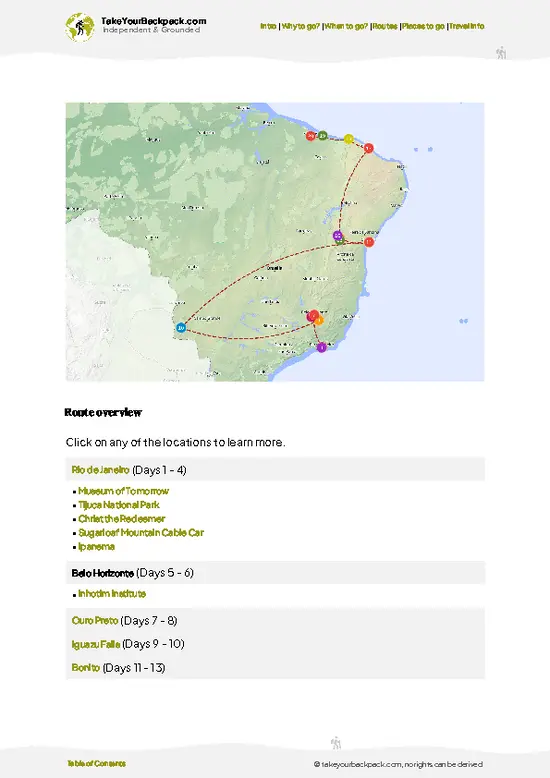
example page 0 from our offline Travel Guide for Brazil
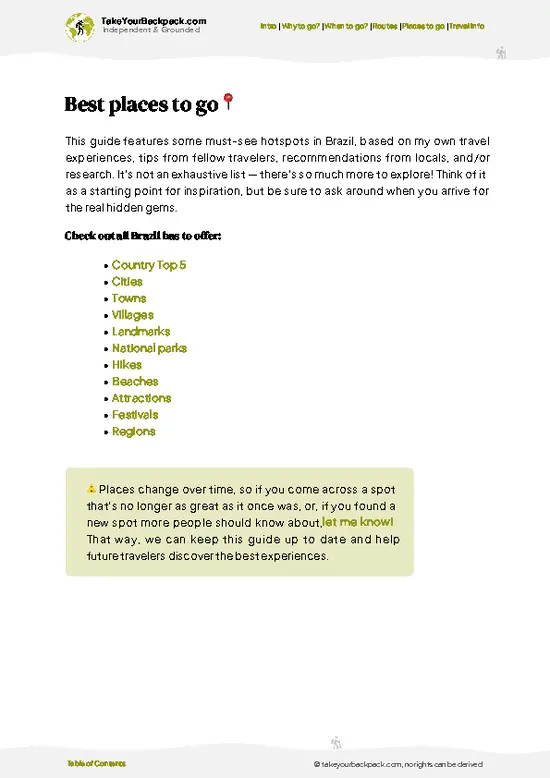
example page 1 from our offline Travel Guide for Brazil
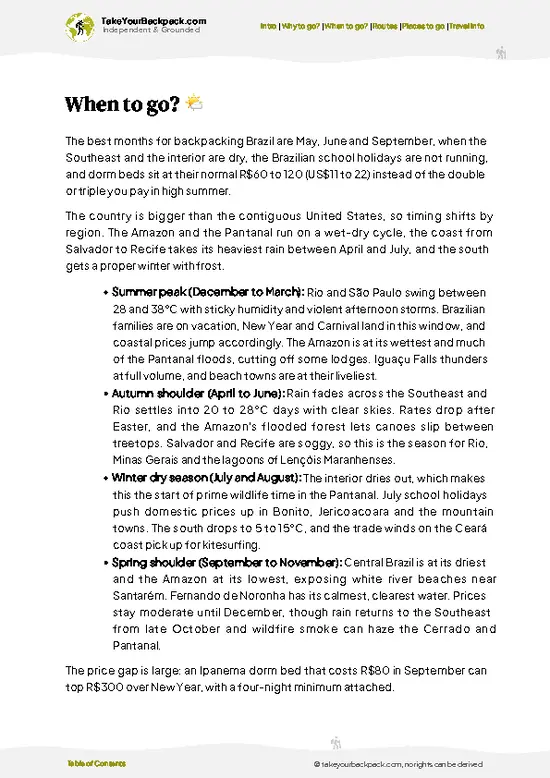
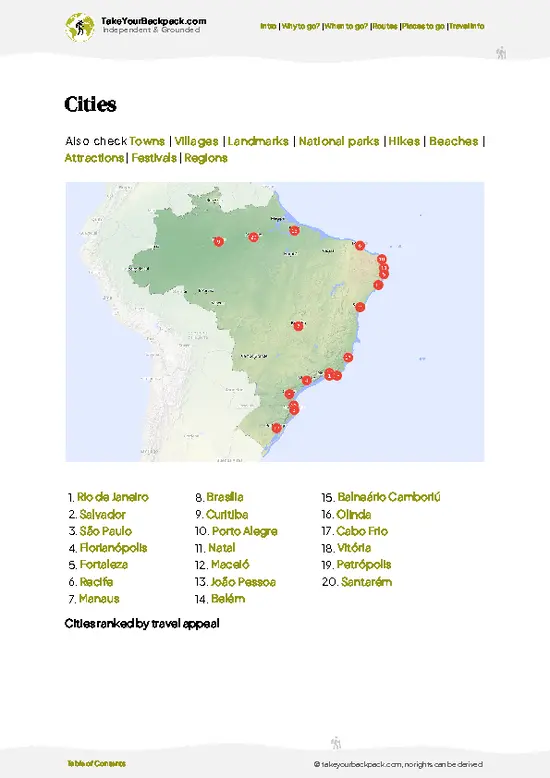
example page 2 from our offline Travel Guide for Brazil
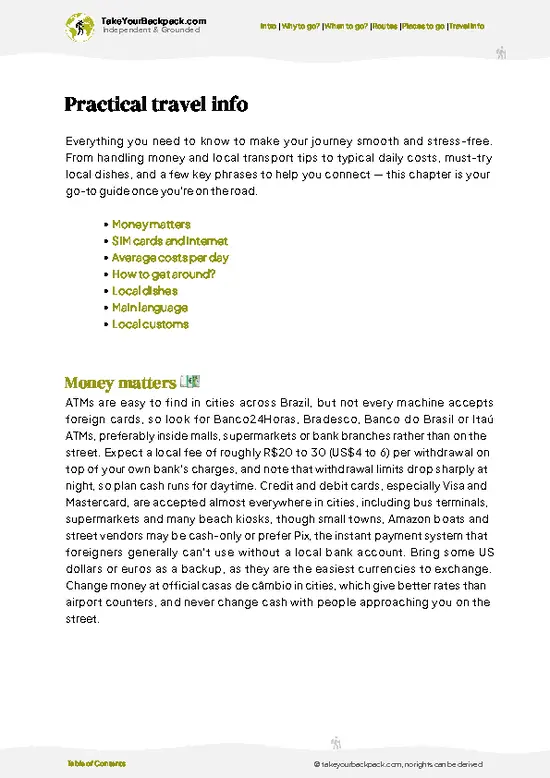
example page 3 from our offline Travel Guide for Brazil
example page 4 from our offline Travel Guide for Brazil
example page 5 from our offline Travel Guide for Brazil
example page 6 from our offline Travel Guide for Brazil
example page 7 from our offline Travel Guide for Brazil
The digital guide (410 pages) contains:
✅ 146 highlights, ranked by travel appeal
✅ Optimized 14, 21 & 30-day travel routes
✅ Cities, national parks, landmarks, beaches
✅ How to get around
✅ Offline-friendly for travel without Wi-Fi
👉 Click to see all 30+ guide features

📅 Plan smarter in minutes, not weeks
✅ Month by month travel advice
✅ Festivals & national holidays
✅ Budget expectations

🗺️ Go to the right places, skip the overrated ones
✅ Honest pros & cons of destinations
✅ Top hikes, parks & viewpoints
✅ Lesser-known places most travelers miss
✅ Clear “worth it vs skip it” guidance

🛏️ Travel smoothly without rookie mistakes
✅ Best areas to stay
✅ Transport systems explained simply
✅ Common scams & safety advice
✅ SIM cards, money & practical tips

🌍 Understand the country, not just visit it
✅ Culture & traditions
✅ 52 Essential phrases & customs
✅ Festivals worth planning around
✅ Traveler-friendly historical context
✅ Insights that make places more meaningful

📱 Built for real travel conditions
✅ Fully downloadable PDF
✅ Works completely offline
✅ Optimized for phone use
✅ Useful in remote areas & buses
✅ Everything in one place
Stop searching, start planning
Get instant access to your full guide. 30‑day money-back guarantee.
+ Add another guide for just

By proceeding you agree to our terms.
Sent to your inbox immediately after payment • 100% Secure Checkout
Best Backpacking Travel Advisor 2025 tourism awardBest Backpacking
Travel Advisor
2025
What others say about Take Your Backpack Guides:
⭐⭐⭐⭐⭐
Fantastic, amazing amount of information!
⭐⭐⭐⭐⭐
My goodness this is amazing, it's what I've been looking for hats off too you!
⭐⭐⭐⭐⭐
I think this is absolutely BRILLIANT
⭐⭐⭐⭐
Very complete and informative. It's still missing places, but I gotta to commend you
⭐⭐⭐⭐⭐
This is truly amazing, thank you, can't wait to explore it with my kids!
⭐⭐⭐⭐⭐
Awesome resource, thank you!
⭐⭐⭐⭐⭐
This is amazing! Can't wait to explore the ones I haven't seen
⭐⭐⭐⭐
I love this! Well done, great idea.
⭐⭐⭐⭐⭐
Thanks for taking the time to make this gem!
⭐⭐⭐⭐⭐
This might be the best website I've ever seen.
⭐⭐⭐⭐⭐
Congratulations, and thank you so much for your work; it's incredibly valuable.
⭐⭐⭐⭐
In all seriousness I think you did a great job pointing out the important spots
⭐⭐⭐⭐⭐
10/10 very good
⭐⭐⭐⭐⭐
As someone who's only just starting to visit regularly this is awesome, thank you.
⭐⭐⭐⭐
Thank you very much! I'm going to visit my dad, it's going to be very useful!
⭐⭐⭐⭐⭐
This is really cool! We'll be travelling for the first time and this definitely come in handy.
⭐⭐⭐⭐⭐
You are now our minister of culture, congratulations 👨‍💼
⭐⭐⭐⭐⭐
Just wanted to tell you that this is a pearl! Going to follow your recommendations.
⭐⭐⭐⭐⭐
This is so cool. I'll definitely be using the resource for my travels soon.
⭐⭐⭐⭐⭐
This is very impressive! Good work.
⭐⭐⭐⭐⭐
This is an amazing and informative site. Very well done!

🛏️ Where to stay?Where to Stay: Brazil Edition

Brazil has plenty of hostels, with dorm beds typically running R$50 to 120 (about US$9 to 22) a night and private rooms in simple guesthouses (pousadas) from roughly R$150 (US$27). In Rio de Janeiro, Ipanema and Copacabana put you a short walk from the beach and metro with decent street safety, while Botafogo is cheaper and full of bars, and Santa Teresa and Lapa trade easy beach access for hillside character and loud weekend nightlife that gets sketchy on empty streets after dark. In São Paulo, Vila Madalena and Pinheiros offer the best mix of bars, street art and safety near the metro, and in Salvador the Pelourinho is atmospheric but deserted and risky at night, so many travelers pick seafront … read more 👉
Brazil has plenty of hostels, with dorm beds typically running R$50 to 120 (about US$9 to 22) a night and private rooms in simple guesthouses (pousadas) from roughly R$150 (US$27). In Rio de Janeiro, Ipanema and Copacabana put you a short walk from the beach and metro with decent street safety, while Botafogo is cheaper and full of bars, and Santa Teresa and Lapa trade easy beach access for hillside character and loud weekend nightlife that gets sketchy on empty streets after dark. In São Paulo, Vila Madalena and Pinheiros offer the best mix of bars, street art and safety near the metro, and in Salvador the Pelourinho is atmospheric but deserted and risky at night, so many travelers pick seafront Barra for quieter, safer streets.

If you enjoy meeting fellow travelers, consider choosing hostels with high ratings for atmosphere. On the other hand, if you prefer having your own space, a hotel might be a better option.

BrazilExplore Beyond This Category

👋 Meet the founderWho’s Behind Take Your Backpack?

Johan, backpacker and founder of TakeYourBackpackHi, I’m Johan (Netherlands 🇳🇱), the creator of TakeYourBackpack. Over the past 3 decades, I’ve backpacked through 90+ countries across six continents, gaining extensive experience with independent travel, long-term trips, and overland routes.

This site is built on a combination of firsthand travel experience and carefully curated insights from other backpackers. Many guides are based on places I’ve personally visited, while others bring together tips, observations, and practical advice shared by trusted travelers I’ve met along the way.

The goal is to provide realistic, experience-driven guidance — not generic itineraries — so you can explore destinations with better context, clearer expectations, and more confidence.