×

Burkina Faso🇧🇫 | festivalsFESTIMADédougou mask parades, Bwa leaf masks, plank masks, craft stalls | things to do and best time to go

Explore SIAOExplore Jazz à Ouaga

Backpacking in FESTIMA
👍 Recommendedfestival ranked #3
By Johan Kruseman 🇳🇱 | Updated October 22, 2026

FESTIMA began in the mid-1990s as a way to bring masks out of village rituals and onto a public stage, and for years it drew mostly regional audiences and a few researchers. Today it is one of West Africa’s major mask gatherings, with troupes arriving from several countries. It takes place in Dédougou, a town in the west of Burkina Faso, to the west of Ouagadougou. It runs every two years, usually for about a week in the dry months, and combines mask dances, craft displays, talks and evening concerts. The crowd is mostly Burkinabè families, collectors, scholars and a handful of backpackers. Skip the long official speeches. Go for the mask outings, which are loud, dusty and close enough to feel the fiber skirts brush past. Unlike the Semaine Nationale de la Culture in Bobo-Dioulasso, which spreads across many art forms, FESTIMA keeps masks as its single focus.

Discover everything you want to know in the 📖 Burkina Faso Travel Guide.
Safety warning

The current risk level for Burkina Faso is high. Check the advice before going.


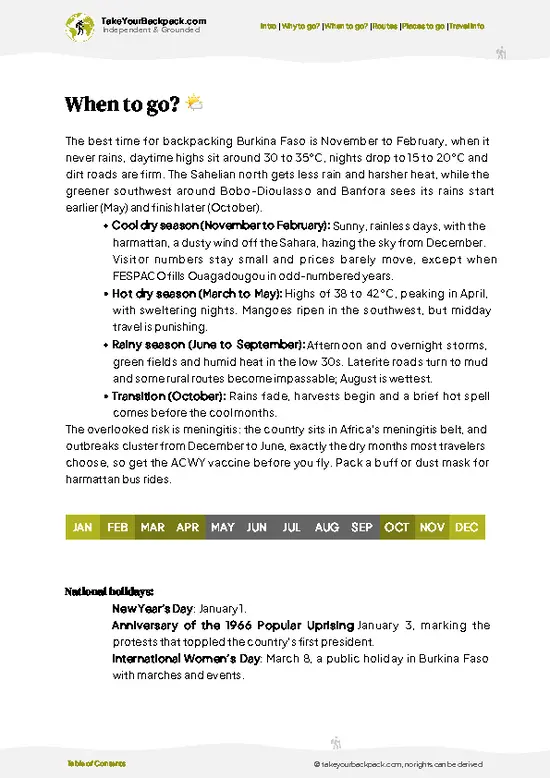
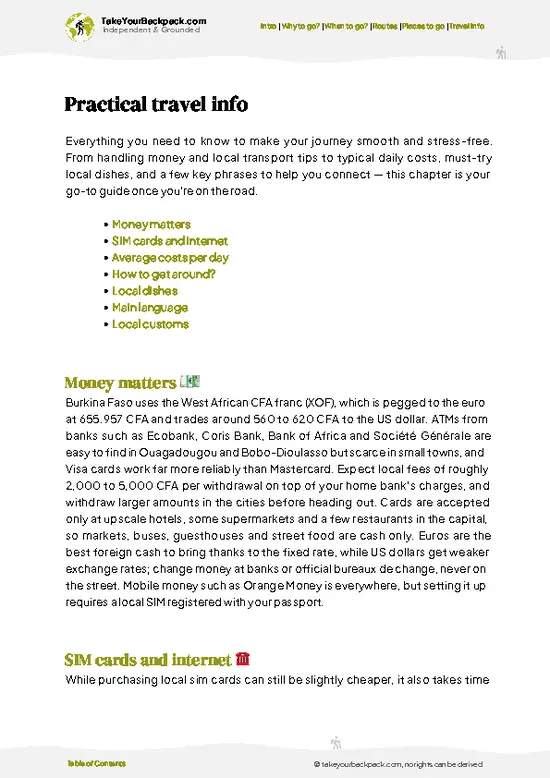
example page 0 from our offline Travel Guide for Burkina Faso
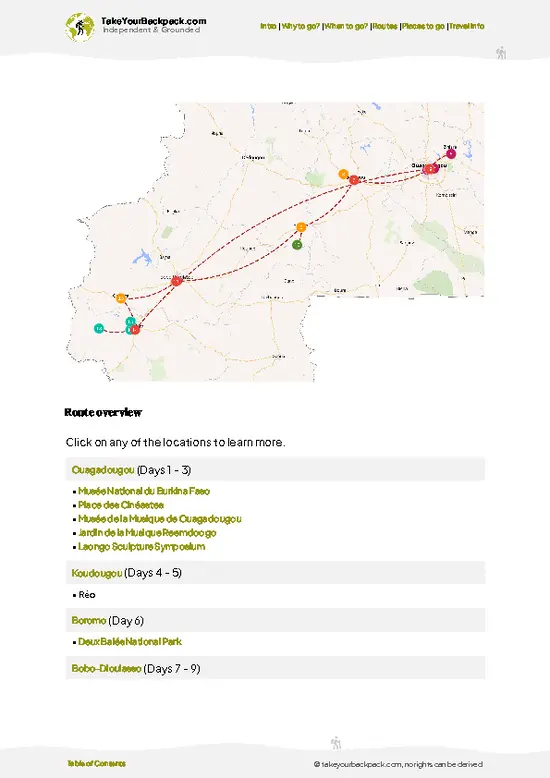
example page 1 from our offline Travel Guide for Burkina Faso
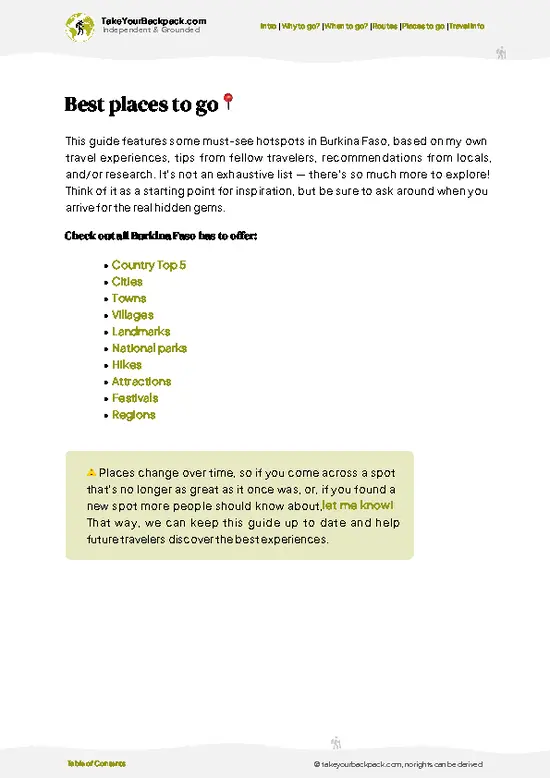
example page 2 from our offline Travel Guide for Burkina Faso
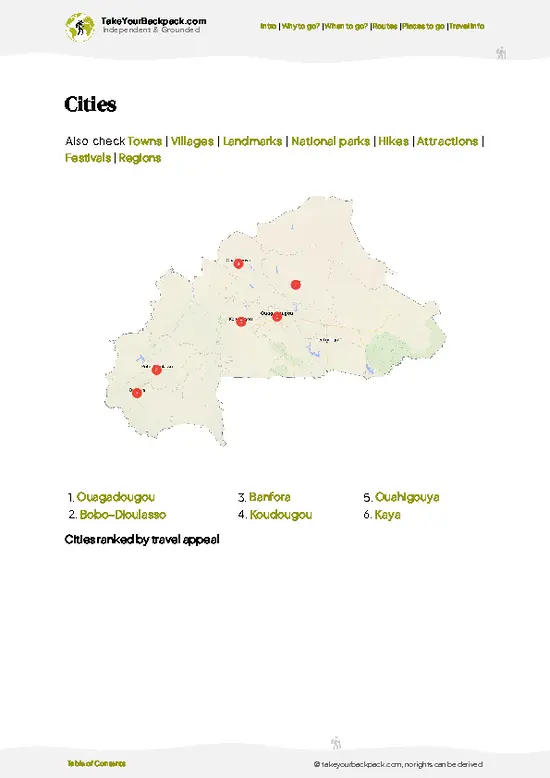
example page 3 from our offline Travel Guide for Burkina Faso
example page 4 from our offline Travel Guide for Burkina Faso
example page 5 from our offline Travel Guide for Burkina Faso
example page 6 from our offline Travel Guide for Burkina Faso
example page 7 from our offline Travel Guide for Burkina Faso
Loading the map 🌍
CLICK TO FILTER
cities
towns
villages
landmarks
national parks
hikes
attractions
festivals
regions
SHOW COUNTRY’S BESTSHOW ALL

✨ Why go?
Ranked #3 festival in Burkina Faso
Why visitors keep coming back

FESTIMA gives you something that is nearly impossible to arrange on your own: dozens of mask societies performing in one town, in one week, with the communities that own them standing right there to explain what each figure means. Normally you would need months of village hopping and a patient guide to see even a fraction. Here the Dédougou mask arena does the work for you, and the Bwa and Nuna groups from the surrounding region show up in force, so you see styles that rarely leave their home villages.

The social side is easy. Dédougou is small, so everyone ends up in the same few streets, and a mask fan from Mali, a Burkinabè schoolteacher and a visiting curator will all end up sharing the same bench and the same grilled fish. It also anchors a longer route well. Pair it with Bobo-Dioulasso … read more 👉
FESTIMA gives you something that is nearly impossible to arrange on your own: dozens of mask societies performing in one town, in one week, with the communities that own them standing right there to explain what each figure means. Normally you would need months of village hopping and a patient guide to see even a fraction. Here the Dédougou mask arena does the work for you, and the Bwa and Nuna groups from the surrounding region show up in force, so you see styles that rarely leave their home villages.

The social side is easy. Dédougou is small, so everyone ends up in the same few streets, and a mask fan from Mali, a Burkinabè schoolteacher and a visiting curator will all end up sharing the same bench and the same grilled fish. It also anchors a longer route well. Pair it with Bobo-Dioulasso and the Bwa country on either side, and the festival becomes the high point of a trip built around West African art rather than just another stop on the map.

💡 HighlightsKey sights and experiences for travelers

  1. The mask parades through Dédougou: This is what FESTIMA is known for. Troupes move through the streets with drummers and singers, each mask in full costume, and crowds of locals follow along. Stand at a corner rather than the main viewing area and you get far closer.
  2. Bwa leaf masks: Dancers covered head to foot in fresh green leaves and fibers are one of the signature sights of this region. They spin and crouch to a fast drum beat, and the rustle is audible over the crowd. They are linked to the Bwa people’s relationship with the bush spirits.
  3. Plank masks: Tall wooden planks carved with geometric patterns in black, white and red, often several meters high, are carried by dancers who bend almost to the ground and swing them upright again. They are the most photographed masks of the festival and
… read more 👉
  1. The mask parades through Dédougou: This is what FESTIMA is known for. Troupes move through the streets with drummers and singers, each mask in full costume, and crowds of locals follow along. Stand at a corner rather than the main viewing area and you get far closer.
  2. Bwa leaf masks: Dancers covered head to foot in fresh green leaves and fibers are one of the signature sights of this region. They spin and crouch to a fast drum beat, and the rustle is audible over the crowd. They are linked to the Bwa people’s relationship with the bush spirits.
  3. Plank masks: Tall wooden planks carved with geometric patterns in black, white and red, often several meters high, are carried by dancers who bend almost to the ground and swing them upright again. They are the most photographed masks of the festival and the hardest to forget once you see one tilt over a crowd.
  4. The craft and art exhibitions: Stalls and displays gather carvers, weavers, leatherworkers and bronze casters from different regions and neighboring countries. This is the place to buy a mask or textile directly from the maker, and to ask how a piece is used, which tells you whether it is a ritual object or made for sale.
  5. Evening concerts and street life: After dark the focus shifts to live music and impromptu dancing, with local bands, traditional ensembles and visiting artists. The atmosphere is relaxed, the crowd mixed in age, and food stalls stay open late around the main squares.
At FESTIMA the street parades cost nothing to watch, while the exhibitions and organized evening events may carry a small entry fee.
Spotted a mistake or missing something? Contact us.

🌤️ When to go?When is the celebration of FESTIMA?

FESTIMA, the international masks and arts festival, is held in Dédougou every second year (even-numbered years) in late February or early March, runs about a week, and the organizers announce the exact dates each edition.
  • Best days: The opening parade and the final two days bring the biggest mask outings and the most dancers. Midweek is calmer, with more room to photograph and talk to mask societies.
  • Weather: Days reach 34 to 38°C (93 to 100°F) with dry harmattan dust and almost no rain. Nights drop to 18 to 22°C (64 to 72°F). Bring a scarf for dust, a hat, sunglasses, a refillable 1.5 liter bottle and a light layer.
  • Booking: Lock in a bed 4 to 6 weeks ahead, since Dédougou has limited rooms. Prices rise by roughly 30 to 50 percent during the festival week.
  • Arrival and departure: Reach Dédougou
… read more 👉
FESTIMA, the international masks and arts festival, is held in Dédougou every second year (even-numbered years) in late February or early March, runs about a week, and the organizers announce the exact dates each edition.
  • Best days: The opening parade and the final two days bring the biggest mask outings and the most dancers. Midweek is calmer, with more room to photograph and talk to mask societies.
  • Weather: Days reach 34 to 38°C (93 to 100°F) with dry harmattan dust and almost no rain. Nights drop to 18 to 22°C (64 to 72°F). Bring a scarf for dust, a hat, sunglasses, a refillable 1.5 liter bottle and a light layer.
  • Booking: Lock in a bed 4 to 6 weeks ahead, since Dédougou has limited rooms. Prices rise by roughly 30 to 50 percent during the festival week.
  • Arrival and departure: Reach Dédougou the day before opening. Buses and shared taxis out fill up on the closing morning, so leave early or the following day.
Be in the arena before mid-morning, when the shade and the crowd are both at their best.


source: climatestotravel.comJANJanuary: excellent for travelingFEBFebruary: not recommended for travelingMARMarch: not recommended for travelingAPRApril: not recommended for travelingMAYMay: not recommended for travelingJUNJune: not recommended for travelingJULJuly: not recommended for travelingAUGAugust: not recommended for travelingSEPSeptember: not recommended for travelingOCTOctober: not recommended for travelingNOVNovember: not recommended for travelingDECDecember: not recommended for traveling

✈️ The backpacker research shortcutBurkina Faso Travel Guide

An offline-friendly backpacking guide with optimized travel routes, ranked highlights, transport advice, and the best areas to stay.
example page 0 from our offline Travel Guide for Burkina Faso
example page 1 from our offline Travel Guide for Burkina Faso
example page 2 from our offline Travel Guide for Burkina Faso
example page 3 from our offline Travel Guide for Burkina Faso
example page 4 from our offline Travel Guide for Burkina Faso
example page 5 from our offline Travel Guide for Burkina Faso
example page 6 from our offline Travel Guide for Burkina Faso
example page 7 from our offline Travel Guide for Burkina Faso
The digital guide (273 pages) contains:
✅ 63 highlights, ranked by travel appeal
✅ Optimized 5, 10 & 15-day travel routes
✅ Cities, national parks, landmarks, beaches
✅ How to get around
✅ Offline-friendly for travel without Wi-Fi
👉 Click to see all 30+ guide features

📅 Plan smarter in minutes, not weeks
✅ Month by month travel advice
✅ Festivals & national holidays
✅ Budget expectations

🗺️ Go to the right places, skip the overrated ones
✅ Honest pros & cons of destinations
✅ Top hikes, parks & viewpoints
✅ Lesser-known places most travelers miss
✅ Clear “worth it vs skip it” guidance

🛏️ Travel smoothly without rookie mistakes
✅ Best areas to stay
✅ Transport systems explained simply
✅ Common scams & safety advice
✅ SIM cards, money & practical tips

🌍 Understand the country, not just visit it
✅ Culture & traditions
✅ 52 Essential phrases & customs
✅ Festivals worth planning around
✅ Traveler-friendly historical context
✅ Insights that make places more meaningful

📱 Built for real travel conditions
✅ Fully downloadable PDF
✅ Works completely offline
✅ Optimized for phone use
✅ Useful in remote areas & buses
✅ Everything in one place
Stop searching, start planning
Get instant access to your full guide. 30‑day money-back guarantee.
+ Add another guide for just

By proceeding you agree to our terms.
Sent to your inbox immediately after payment • 100% Secure Checkout
Best Backpacking Travel Advisor 2025 tourism awardBest Backpacking
Travel Advisor
2025
What others say about Take Your Backpack Guides:
⭐⭐⭐⭐⭐
Fantastic, amazing amount of information!
⭐⭐⭐⭐⭐
My goodness this is amazing, it's what I've been looking for hats off too you!
⭐⭐⭐⭐⭐
I think this is absolutely BRILLIANT
⭐⭐⭐⭐
Very complete and informative. It's still missing places, but I gotta to commend you
⭐⭐⭐⭐⭐
This is truly amazing, thank you, can't wait to explore it with my kids!
⭐⭐⭐⭐⭐
Awesome resource, thank you!
⭐⭐⭐⭐⭐
This is amazing! Can't wait to explore the ones I haven't seen
⭐⭐⭐⭐
I love this! Well done, great idea.
⭐⭐⭐⭐⭐
Thanks for taking the time to make this gem!
⭐⭐⭐⭐⭐
This might be the best website I've ever seen.
⭐⭐⭐⭐⭐
Congratulations, and thank you so much for your work; it's incredibly valuable.
⭐⭐⭐⭐
In all seriousness I think you did a great job pointing out the important spots
⭐⭐⭐⭐⭐
10/10 very good
⭐⭐⭐⭐⭐
As someone who's only just starting to visit regularly this is awesome, thank you.
⭐⭐⭐⭐
Thank you very much! I'm going to visit my dad, it's going to be very useful!
⭐⭐⭐⭐⭐
This is really cool! We'll be travelling for the first time and this definitely come in handy.
⭐⭐⭐⭐⭐
You are now our minister of culture, congratulations 👨‍💼
⭐⭐⭐⭐⭐
Just wanted to tell you that this is a pearl! Going to follow your recommendations.
⭐⭐⭐⭐⭐
This is so cool. I'll definitely be using the resource for my travels soon.
⭐⭐⭐⭐⭐
This is very impressive! Good work.
⭐⭐⭐⭐⭐
This is an amazing and informative site. Very well done!

🛏️ Where to stay?Where staying makes the most sense

Stay in central Dédougou, within walking distance of the main market and the bus park, because that is where the festival traffic, the food and the other travelers all converge.
The center is the safest bet for backpackers. Streets near the market stay busy into the evening, motorbike taxis are easy to flag down, and you can reach the festival grounds in 10 to 15 minutes by moto. Budget guesthouses and small auberges here fill first, so book early. Rooms with a fan and a shared or private bathroom run about €10 to 30 during the festival.
For a more social base, look at the quarters around the main … read more 👉
Stay in central Dédougou, within walking distance of the main market and the bus park, because that is where the festival traffic, the food and the other travelers all converge.
The center is the safest bet for backpackers. Streets near the market stay busy into the evening, motorbike taxis are easy to flag down, and you can reach the festival grounds in 10 to 15 minutes by moto. Budget guesthouses and small auberges here fill first, so book early. Rooms with a fan and a shared or private bathroom run about €10 to 30 during the festival.
For a more social base, look at the quarters around the main roundabouts, where the small maquis and courtyard bars sit. Solo travelers meet journalists, photographers, volunteers and visiting artists there, and it is easy to share a moto taxi in the evening.
Homestays arranged through local contacts or festival volunteers are a good alternative. You eat with a family, pay roughly €5 to 12 a night, and get a ready-made guide to mask etiquette.
Avoid the far outskirts. Lighting is poor after dark and getting back late is harder when moto taxis are scarce. Choose a spot with a secure gate and a fan, since dust and heat make sleep difficult.

👛 Costs (as of 22 October 2026)Travel costs and budget guide for FESTIMA

FESTIMA costs roughly €20 to 61 a day for an independent traveler, with accommodation the biggest swing because rooms in Dédougou are scarce and prices rise in festival week.
CategoryBudget RangeLocal Reality
Festival tickets€2 to 8Entry to main arena events and evening shows is modest. Many street parades and mask outings in town are open to watch, though a few venues charge separately.
Accommodation€10 to 30Basic fan rooms run higher in high season than in the low season. Homestays can be cheaper at about €5 to 12.
Local transport€1 to 5Motorbike taxis cost about €0.30 to 1 per short ride. Intercity buses to and from Ouagadougou or Bobo-Dioulasso cost extra, around €6 to 12 each way.
Food & drinks€4 to 10Street plates and grilled meat are cheap. Dolo, bissap and bottled water add only small
… read more 👉
FESTIMA costs roughly €20 to 61 a day for an independent traveler, with accommodation the biggest swing because rooms in Dédougou are scarce and prices rise in festival week.
CategoryBudget RangeLocal Reality
Festival tickets€2 to 8Entry to main arena events and evening shows is modest. Many street parades and mask outings in town are open to watch, though a few venues charge separately.
Accommodation€10 to 30Basic fan rooms run higher in high season than in the low season. Homestays can be cheaper at about €5 to 12.
Local transport€1 to 5Motorbike taxis cost about €0.30 to 1 per short ride. Intercity buses to and from Ouagadougou or Bobo-Dioulasso cost extra, around €6 to 12 each way.
Food & drinks€4 to 10Street plates and grilled meat are cheap. Dolo, bissap and bottled water add only small amounts, and a sit-down meal costs more.
Miscellaneous expenses€3 to 8Photo permissions, small gifts for mask societies, craft purchases, a sun hat or a phone SIM with data.
Total Daily Budget€20 to 61Travel to Dédougou and any departure surcharges are on top of this daily figure.
⚠️ Prices can change and everyone travels differently, so take this as a rough guide. Hope it helps you plan your adventure!

🍲 FoodWhat to Eat & Drink

The festival grounds and the streets around them turn into one long outdoor kitchen, and you eat standing, walking or perched on a plastic stool.
Grilled meat is the backbone. Brochettes of beef and mutton, whole grilled chicken and fish come off charcoal grills and are served in paper with raw onions and a hot pepper powder. Women's stalls sell riz gras, tô (a thick millet or sorghum paste) with gombo or leaf sauce, and fried plantains and beignets for snacks. A plate costs about €1.50 to 4.
For drinks, the local star is dolo, a sour millet beer served in a calabash and passed around. Take a sip, then hand it on. Refusing every offer can seem unfriendly, so accept at least once. Sweet options include bissap (hibiscus), ginger juice and zoom-koom, a millet drink with a tangy kick, all sold in … read more 👉
The festival grounds and the streets around them turn into one long outdoor kitchen, and you eat standing, walking or perched on a plastic stool.
Grilled meat is the backbone. Brochettes of beef and mutton, whole grilled chicken and fish come off charcoal grills and are served in paper with raw onions and a hot pepper powder. Women's stalls sell riz gras, tô (a thick millet or sorghum paste) with gombo or leaf sauce, and fried plantains and beignets for snacks. A plate costs about €1.50 to 4.
For drinks, the local star is dolo, a sour millet beer served in a calabash and passed around. Take a sip, then hand it on. Refusing every offer can seem unfriendly, so accept at least once. Sweet options include bissap (hibiscus), ginger juice and zoom-koom, a millet drink with a tangy kick, all sold in bagged or bottled portions for under €0.50. Cold bottled beer and water are everywhere.
Pay in cash, in small notes, since stalls rarely have change for big bills and cards are not accepted. Lines are loose, so say what you want and wait your turn. Portions are generous and easy to share, and eating from a communal bowl with your right hand is normal. Eat at busy stalls where food moves fast, and carry hand sanitizer.

FAQTraveler FAQ

FESTIMA is held every second year, in even-numbered years, in late February or early March. It lasts about a week in Dédougou, in the Boucle du Mouhoun region. Organizers announce exact dates each edition, so check the opening parade day before booking transport.
Attending FESTIMA costs roughly €20 to 61 a day all-in for a backpacker. Entry to arena events is about €2 to 8, a basic room in Dédougou runs €10 to 30 in festival week, and street meals cost around €1.50 to 4 a plate. Moto taxis add €1 to 5 a day.
Tickets for FESTIMA are usually bought at the gate or at the arena entrance in Dédougou, so advance purchase is rarely needed for general entry. The real advance booking is your bed, which should be reserved 4 to 6 weeks ahead because rooms are limited. Bring cash in small notes, since cards are not accepted.
⚠️ Things can change over time, so always validate details locally before you go.

Other Burkinabé festivals near FESTIMA

Explore more nearby:

  • Festival des Masques et des Arts de Boni—Village masks, balafon drumming, elder explanations, millet beer| 100 km away
  • Nakamtenga—rural crafts, community workshops, sustainable projects| 209 km away
  • FESPACO—Yennenga Stallion prize, biennial film week, open-air screenings, MICA market| 211 km away

💡 Not sure where to go next?
Create a personalized itinerary for Burkina Faso including FESTIMA and the places that fit your trip.

Generate my itinerary

👉 Discover all festivals

Or checkout all Burkina Faso has to offer (think cities, towns, villages, national parks, hikes, beaches, festivals)
Country photo of Burkina Faso

We 💚 feedbackFinal thoughts on celebrating the FESTIMA

FESTIMA is easy to treat as a spectacle, but the part first-timers overlook is the quiet time between performances, when masked dancers rest in the shade and families explain what each figure represents. I would arrive a day early, sort out a bed before the crowds, and carry a scarf for the dust. Ask before photographing any mask up close.

✍️ Help improve this page!
The information on this page is based on in-depth research, insights shared by experienced travelers, and feedback from the local travel community in Burkina Faso. While every effort is made to keep the information accurate and current, conditions can change — so if you spot anything incorrect or outdated, please get in touch.


🙋‍♂️ Give feedback

👋 Meet the founderWho’s Behind Take Your Backpack?

Johan, backpacker and founder of TakeYourBackpackHi, I’m Johan (Netherlands 🇳🇱), the creator of TakeYourBackpack. Over the past 3 decades, I’ve backpacked through 90+ countries across six continents, gaining extensive experience with independent travel, long-term trips, and overland routes.

This site is built on a combination of firsthand travel experience and carefully curated insights from other backpackers. Many guides are based on places I’ve personally visited, while others bring together tips, observations, and practical advice shared by trusted travelers I’ve met along the way.

The goal is to provide realistic, experience-driven guidance — not generic itineraries — so you can explore destinations with better context, clearer expectations, and more confidence.