×

Burkina Faso🇧🇫 | best festivalsDiscover the 5 Best festivals Across Burkina Faso

Festivals in Burkina Faso are mostly large, biennial, state-backed events in cities, plus mask and music gatherings that depend on local ceremony calendars. The capital, Ouagadougou, carries the big cinema, crafts and jazz dates. Hotels fill, prices climb, and crowds are heavy but easy to reach. Bobo-Dioulasso and Koudougou are smaller, cheaper and more relaxed, with music and culture programs you can reach by bus. Rural mask festivals in the west and north are the most authentic, but the least reliable. Skip them without local contacts. For an independent traveler, the city festivals are the sensible choice, as long as dates are checked first.

By Johan Kruseman 🇳🇱 | Updated October 23, 2026
Explore the best regions in Burkina Faso

Why go?Why Travelers Love These Spots

Burkina Faso suits festivals because culture is organized around public performance. More than 60 ethnic groups, including the Mossi, Bobo, Lobi, Bwa and Gurunsi, keep mask traditions, drumming and dance tied to funerals, harvests and initiations. Since independence the state has also treated the arts as national policy, which is why Ouagadougou became West Africa’s film capital and hosts a large biennial crafts fair. That mix of living ritual and organized programming is rare in the region.

Several things count against it. Most major events are biennial and alternate years, so a trip planned around one date can land in the wrong year. Dates shift, and official announcements often come late. Village ceremonies follow no tourist calendar, and outsiders may be refused entry to parts of them.

The … read more 👉
Burkina Faso suits festivals because culture is organized around public performance. More than 60 ethnic groups, including the Mossi, Bobo, Lobi, Bwa and Gurunsi, keep mask traditions, drumming and dance tied to funerals, harvests and initiations. Since independence the state has also treated the arts as national policy, which is why Ouagadougou became West Africa’s film capital and hosts a large biennial crafts fair. That mix of living ritual and organized programming is rare in the region.

Several things count against it. Most major events are biennial and alternate years, so a trip planned around one date can land in the wrong year. Dates shift, and official announcements often come late. Village ceremonies follow no tourist calendar, and outsiders may be refused entry to parts of them.

The biggest factor is security. Armed groups operate across large parts of the north, east and the Boucle du Mouhoun, and many foreign governments advise against travel to most of the country. Festival towns in the west and center are far easier to justify than anything near the borders. Infrastructure is basic outside the two main cities: few ATMs, patchy power, thin hotel stock. Anyone choosing Burkina for festivals should plan around Ouagadougou, Bobo-Dioulasso and Koudougou, and treat remote events as a bonus only when a local host confirms access.
Our Approach to Ranking
The list of best festivals in Burkina Faso is created based on energy, traditions, crowd experience, activities, and overall excitement. If you feel a festival is missing in this list, please let us know.

When to go?Seasonal Guide to Visiting

Best months: November to February is the best window for festivals in Burkina Faso, because it is the dry season with the lowest humidity and daytime highs of roughly 30 to 35°C, and nights can fall to 16 to 20°C in the Harmattan months. Rain is close to zero, so outdoor stages, screenings and processions run on schedule. The trade-off is Harmattan dust from December to February, which hazes the sky and irritates the throat and eyes. Bring a scarf and eye drops.

Shoulder seasons: March to May is the hot season. Ouagadougou regularly hits 38 to 42°C in the afternoon, and outdoor events shift to the evening. A festival in these months is still worth attending, but plan nothing between noon and 4 pm. Hotels without reliable air-conditioning are poor value then. October is workable: the rains are … read more 👉
Best months: November to February is the best window for festivals in Burkina Faso, because it is the dry season with the lowest humidity and daytime highs of roughly 30 to 35°C, and nights can fall to 16 to 20°C in the Harmattan months. Rain is close to zero, so outdoor stages, screenings and processions run on schedule. The trade-off is Harmattan dust from December to February, which hazes the sky and irritates the throat and eyes. Bring a scarf and eye drops.

Shoulder seasons: March to May is the hot season. Ouagadougou regularly hits 38 to 42°C in the afternoon, and outdoor events shift to the evening. A festival in these months is still worth attending, but plan nothing between noon and 4 pm. Hotels without reliable air-conditioning are poor value then. October is workable: the rains are tapering, roads are still muddy in places, and the south-west around Bobo-Dioulasso stays green and wetter than the north.

Skip the rains: June to September brings 500 to 900 mm of rain over the season in the south and center, less in the Sahel. Dirt roads wash out, flights and buses run late, and open-air programs get canceled. It is not worth planning a festival trip then.

Prices and crowds: During major events in Ouagadougou, rooms can cost 30 to 100 percent more than usual, and cheaper guesthouses sell out weeks ahead. Book early, or stay in a nearby town and commute.

festival hoppingSuggested Travel Strategies

How long it takes: A trip linking several festivals in Burkina Faso needs 10 to 14 days, because the main stops are far apart and every transfer eats half a day. Travel in one direction: start in Ouagadougou, continue to Koudougou, then finish in Bobo-Dioulasso. Ouagadougou has the international airport and the best bus links, and Bobo has road and rail ties toward Côte d’Ivoire and Mali, so you can exit west or return by air.

Time per stop: Give Ouagadougou 3 to 4 days, since the big events spread across the city and cross-town taxis eat time. Koudougou needs 1 to 2 days. Bobo-Dioulasso deserves 3 to 4, with room for day trips toward Banfora. The road from Ouagadougou to Koudougou is about 100 km (1.5 to 2 hours). Ouagadougou to Bobo is roughly 360 km, 5 to 6 hours by coach with companies … read more 👉
How long it takes: A trip linking several festivals in Burkina Faso needs 10 to 14 days, because the main stops are far apart and every transfer eats half a day. Travel in one direction: start in Ouagadougou, continue to Koudougou, then finish in Bobo-Dioulasso. Ouagadougou has the international airport and the best bus links, and Bobo has road and rail ties toward Côte d’Ivoire and Mali, so you can exit west or return by air.

Time per stop: Give Ouagadougou 3 to 4 days, since the big events spread across the city and cross-town taxis eat time. Koudougou needs 1 to 2 days. Bobo-Dioulasso deserves 3 to 4, with room for day trips toward Banfora. The road from Ouagadougou to Koudougou is about 100 km (1.5 to 2 hours). Ouagadougou to Bobo is roughly 360 km, 5 to 6 hours by coach with companies such as TSR or Rakieta.

Planning mistakes: The first is chasing two biennial events that fall in different years. Check which year the festival runs before booking flights. The second is cramming Ouagadougou and Bobo into a single day and arriving after dark. Do not travel at night: roads have checkpoints, unlit trucks and poor surfaces. Leave early morning and arrive by mid-afternoon. The third is adding remote northern or eastern towns for a single ceremony. The added travel days and security risk are not worth it. Keep extra buffer days at each end for delayed buses.

The ListThe Best festivals of Burkina Faso

1 FESPACO

Yennenga Stallion prize, biennial film week, open-air screenings, MICA market

Queue for new African films at city cinemas and neighborhood open-air screenings, then catch the closing night when the Yennenga Stallion winners are announced.

2 SIAO

National pavilions, bogolan cloth, bronze casting, fairground food courts

Walk country-by-country pavilions to compare leather, bronze and textiles, watch weavers and dyers at work, and finish with live music after the heat drops.

3 FESTIMA

Dédougou mask parades, Bwa leaf masks, plank masks, craft stalls

Follow drum-led troupes through Dédougou as leaf-covered dancers spin and tall carved planks tilt over the crowd, then buy directly from carvers and weavers.

4 Jazz à Ouaga

Free courtyard concerts, Institut Français, jam sessions, balafon-jazz fusion

Spend warm evenings at open-air shows where local bands blend jazz with djembe and balafon, then follow musicians to late jam sessions in small venues.

5 Festival des Masques et des Arts de Boni

Village masks, balafon drumming, elder explanations, millet beer

Stand close to masked dancers in fiber and carved wood, ask elders what each figure represents, and eat with villagers once the dancing winds down.

Loading the map 🌍

Expert viewExpert Commentary on festivals

How many to attend: Two festivals is the number I would advise, three at the absolute most. Burkina’s main events are spread across a country with slow roads and uneven security, and each one needs a day for arrival, a day or two of attendance and a recovery day. Squeezing in more means you spend the trip on buses and miss the actual programs.

Which kind to prioritize: Travelers who want easy, comfortable logistics should choose the big city events in Ouagadougou: they have English-friendly information desks, ATMs, taxis and a wide range of hotels. Travelers who want music and nightlife do better in Koudougou or Bobo-Dioulasso, where crowds are smaller and drinks and food cost less. Travelers chasing traditional mask and village ceremonies should only go with a local host or an established … read more 👉
How many to attend: Two festivals is the number I would advise, three at the absolute most. Burkina’s main events are spread across a country with slow roads and uneven security, and each one needs a day for arrival, a day or two of attendance and a recovery day. Squeezing in more means you spend the trip on buses and miss the actual programs.

Which kind to prioritize: Travelers who want easy, comfortable logistics should choose the big city events in Ouagadougou: they have English-friendly information desks, ATMs, taxis and a wide range of hotels. Travelers who want music and nightlife do better in Koudougou or Bobo-Dioulasso, where crowds are smaller and drinks and food cost less. Travelers chasing traditional mask and village ceremonies should only go with a local host or an established guide, and should accept that dates can shift or events can be closed to outsiders. Anything that needs a long drive in the north or east is not worth the risk or the time.

What it costs: A realistic budget is US$25 to 45 a day, or roughly 15,000 to 27,000 CFA francs, covering a guesthouse room at 8,000 to 20,000 CFA francs (US$13 to 33), street meals at 1,000 to 2,500 francs, and local transport. Entry varies widely. Cinema screenings and cultural shows run about 1,000 to 3,000 francs (US$2 to 5), concerts 3,000 to 10,000 francs (US$5 to 17), and many street events are free. A local guide for a village ceremony typically costs 15,000 to 30,000 francs a day (US$25 to 50), and a moto-taxi ride in town is 500 to 1,500 francs. Expect to add 30 to 100 percent to room prices during major events, so book the bed before the ticket. Bring enough cash in CFA francs, because card acceptance is rare and ATMs run dry during big events.

Safety and etiquette: Check current government advisories before you book, and keep to the center and south-west. Do not travel at night. Register with your embassy if it offers it, and carry a photocopy of your passport and visa, since checkpoints are common. Always ask before photographing masked dancers, elders or ceremonies, and expect to pay a small fee or make a gift in some villages. Masks are sacred objects, so never touch them or step into the dancing ground uninvited. Dress modestly, with covered shoulders and knees. Skip the cheapest tap-water ice at crowded events and carry purified water, and keep your phone and wallet out of sight in dense crowds.

✈️ The backpacker research shortcutBurkina Faso Travel Guide

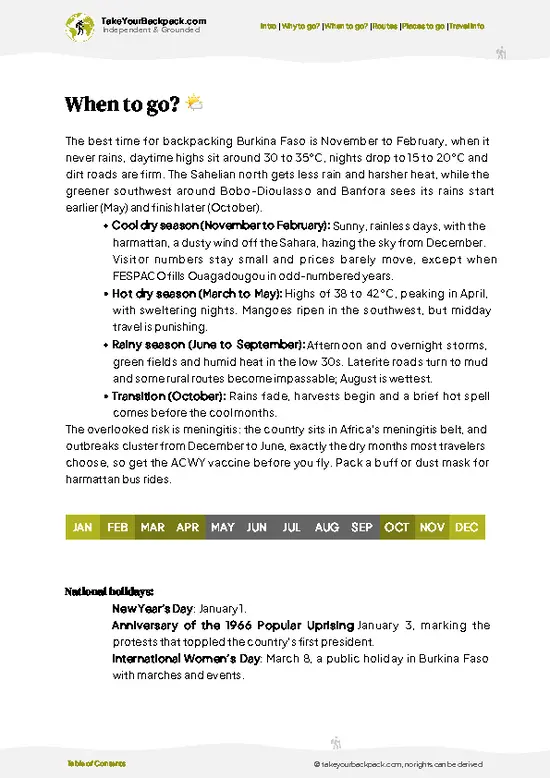
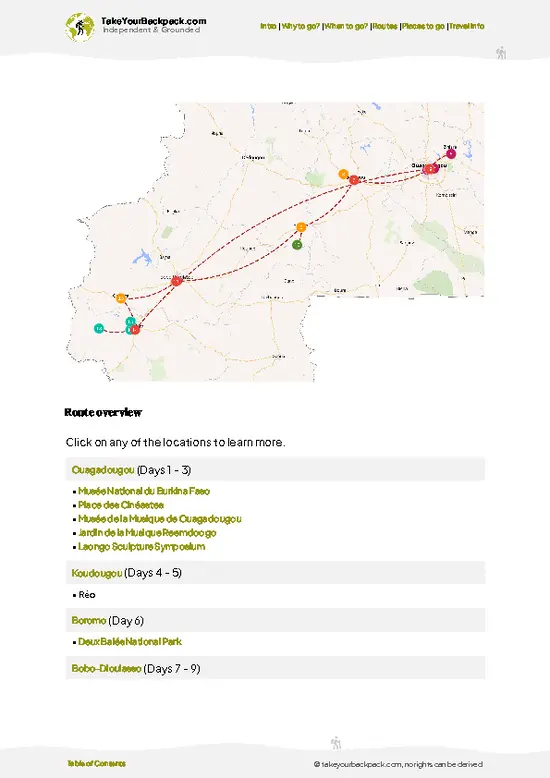
An offline-friendly backpacking guide with optimized travel routes, ranked highlights, transport advice, and the best areas to stay.
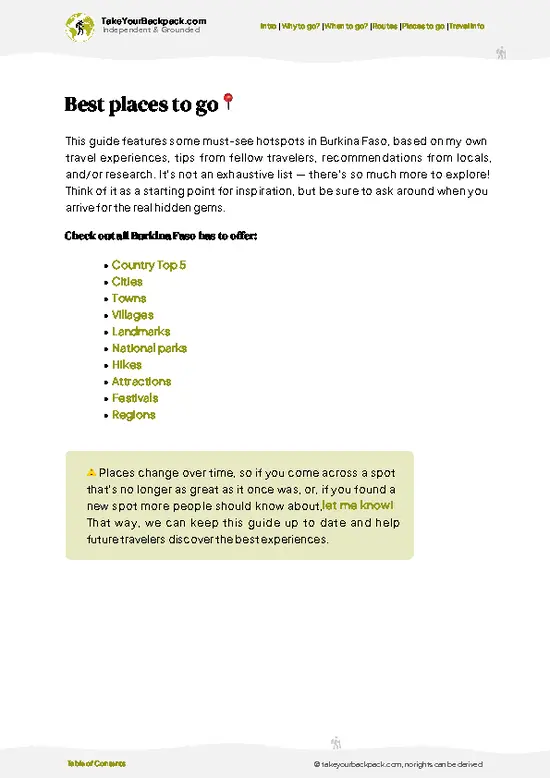
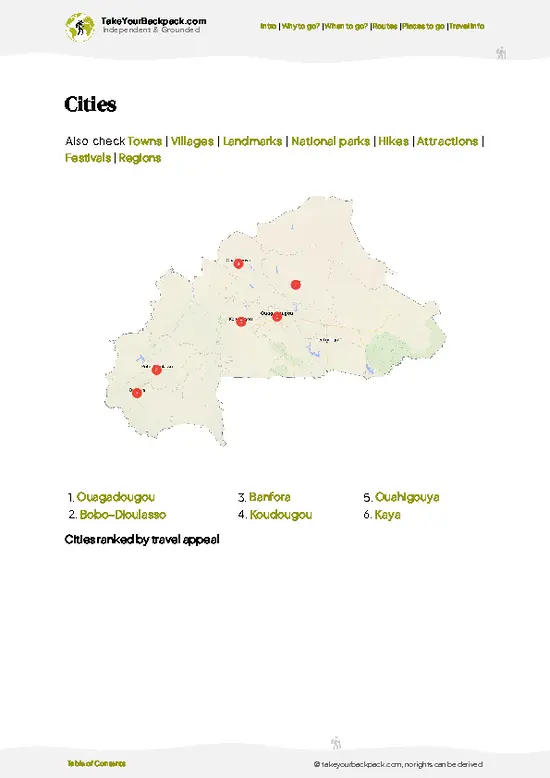
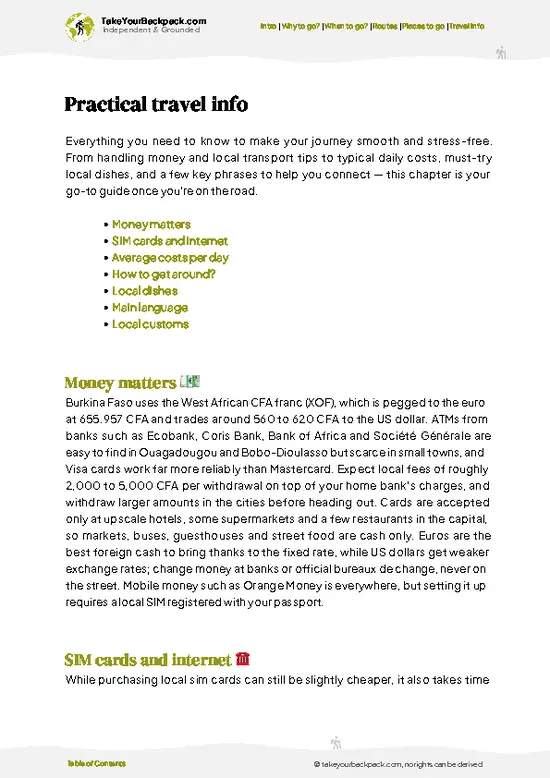
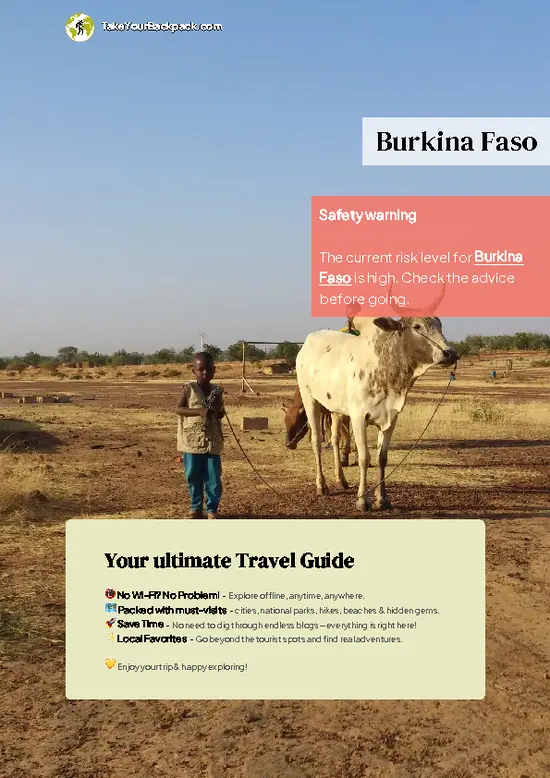
example page 0 from our offline Travel Guide for Burkina Faso
example page 1 from our offline Travel Guide for Burkina Faso
example page 2 from our offline Travel Guide for Burkina Faso
example page 3 from our offline Travel Guide for Burkina Faso
example page 4 from our offline Travel Guide for Burkina Faso
example page 5 from our offline Travel Guide for Burkina Faso
example page 6 from our offline Travel Guide for Burkina Faso
example page 7 from our offline Travel Guide for Burkina Faso
The digital guide (273 pages) contains:
✅ 63 highlights, ranked by travel appeal
✅ Optimized 5, 10 & 15-day travel routes
✅ Cities, national parks, landmarks, beaches
✅ How to get around
✅ Offline-friendly for travel without Wi-Fi
👉 Click to see all 30+ guide features

📅 Plan smarter in minutes, not weeks
✅ Month by month travel advice
✅ Festivals & national holidays
✅ Budget expectations

🗺️ Go to the right places, skip the overrated ones
✅ Honest pros & cons of destinations
✅ Top hikes, parks & viewpoints
✅ Lesser-known places most travelers miss
✅ Clear “worth it vs skip it” guidance

🛏️ Travel smoothly without rookie mistakes
✅ Best areas to stay
✅ Transport systems explained simply
✅ Common scams & safety advice
✅ SIM cards, money & practical tips

🌍 Understand the country, not just visit it
✅ Culture & traditions
✅ 52 Essential phrases & customs
✅ Festivals worth planning around
✅ Traveler-friendly historical context
✅ Insights that make places more meaningful

📱 Built for real travel conditions
✅ Fully downloadable PDF
✅ Works completely offline
✅ Optimized for phone use
✅ Useful in remote areas & buses
✅ Everything in one place
Stop searching, start planning
Get instant access to your full guide. 30‑day money-back guarantee.
+ Add another guide for just

By proceeding you agree to our terms.
Sent to your inbox immediately after payment • 100% Secure Checkout
Best Backpacking Travel Advisor 2025 tourism awardBest Backpacking
Travel Advisor
2025
What others say about Take Your Backpack Guides:
⭐⭐⭐⭐⭐
Fantastic, amazing amount of information!
⭐⭐⭐⭐⭐
My goodness this is amazing, it's what I've been looking for hats off too you!
⭐⭐⭐⭐⭐
I think this is absolutely BRILLIANT
⭐⭐⭐⭐
Very complete and informative. It's still missing places, but I gotta to commend you
⭐⭐⭐⭐⭐
This is truly amazing, thank you, can't wait to explore it with my kids!
⭐⭐⭐⭐⭐
Awesome resource, thank you!
⭐⭐⭐⭐⭐
This is amazing! Can't wait to explore the ones I haven't seen
⭐⭐⭐⭐
I love this! Well done, great idea.
⭐⭐⭐⭐⭐
Thanks for taking the time to make this gem!
⭐⭐⭐⭐⭐
This might be the best website I've ever seen.
⭐⭐⭐⭐⭐
Congratulations, and thank you so much for your work; it's incredibly valuable.
⭐⭐⭐⭐
In all seriousness I think you did a great job pointing out the important spots
⭐⭐⭐⭐⭐
10/10 very good
⭐⭐⭐⭐⭐
As someone who's only just starting to visit regularly this is awesome, thank you.
⭐⭐⭐⭐
Thank you very much! I'm going to visit my dad, it's going to be very useful!
⭐⭐⭐⭐⭐
This is really cool! We'll be travelling for the first time and this definitely come in handy.
⭐⭐⭐⭐⭐
You are now our minister of culture, congratulations 👨‍💼
⭐⭐⭐⭐⭐
Just wanted to tell you that this is a pearl! Going to follow your recommendations.
⭐⭐⭐⭐⭐
This is so cool. I'll definitely be using the resource for my travels soon.
⭐⭐⭐⭐⭐
This is very impressive! Good work.
⭐⭐⭐⭐⭐
This is an amazing and informative site. Very well done!

🛏️ Where to stay?Where to Stay: Burkina Faso Edition

Backpacker hostels with dorms barely exist in Burkina Faso, so budget travel here means simple auberges, church-run mission guesthouses and basic hotels at roughly 8,000 to 20,000 CFA (US$13 to 33) a night, almost all of them in the two cities still realistic for visitors. In Ouagadougou, the city center around the cathedral and the big avenues puts you near markets, maquis bars and live music but is noisy and dusty. Zone du Bois and Ouaga 2000 are quieter, greener and better guarded, at the cost of higher prices and a taxi ride for everything, while in Bobo-Dioulasso the cheap rooms cluster near the Grand Marché and the train station, walkable to the old Kibidwé quarter and the evening music … read more 👉
Backpacker hostels with dorms barely exist in Burkina Faso, so budget travel here means simple auberges, church-run mission guesthouses and basic hotels at roughly 8,000 to 20,000 CFA (US$13 to 33) a night, almost all of them in the two cities still realistic for visitors. In Ouagadougou, the city center around the cathedral and the big avenues puts you near markets, maquis bars and live music but is noisy and dusty. Zone du Bois and Ouaga 2000 are quieter, greener and better guarded, at the cost of higher prices and a taxi ride for everything, while in Bobo-Dioulasso the cheap rooms cluster near the Grand Marché and the train station, walkable to the old Kibidwé quarter and the evening music scene.

If you enjoy meeting fellow travelers, consider choosing hostels with high ratings for atmosphere. On the other hand, if you prefer having your own space, a hotel might be a better option.

Burkina FasoExplore Beyond This Category

👋 Meet the founderWho’s Behind Take Your Backpack?

Johan, backpacker and founder of TakeYourBackpackHi, I’m Johan (Netherlands 🇳🇱), the creator of TakeYourBackpack. Over the past 3 decades, I’ve backpacked through 90+ countries across six continents, gaining extensive experience with independent travel, long-term trips, and overland routes.

This site is built on a combination of firsthand travel experience and carefully curated insights from other backpackers. Many guides are based on places I’ve personally visited, while others bring together tips, observations, and practical advice shared by trusted travelers I’ve met along the way.

The goal is to provide realistic, experience-driven guidance — not generic itineraries — so you can explore destinations with better context, clearer expectations, and more confidence.