×

Burkina Faso🇧🇫 | attractionsMusée National du Burkina FasoBwa leaf masks, Lobi statues, Faso Dan Fani cloth, ethnographic key | things to do and best time to go

Explore Laongo Sculpture SymposiumExplore Musée de la Musique de Ouagadougou

Backpacking in Musée National du Burkina Faso
🏆 Top pickattraction ranked #1
By Johan Kruseman 🇳🇱 | Updated October 22, 2026

The masks are the draw: carved wooden faces and plank-shaped headdresses from the peoples of Burkina Faso, gathered in one place. What matters just as much, and gets overlooked, is that the museum gives you a key to everything you will later see on the road, from Lobi figures to woven cloth patterns. It stands in Ouagadougou, Burkina Faso’s capital. Crowds are rarely an issue, so you can stand in front of a piece for as long as you like. Entry is cheap, and the whole visit fits into a morning. I would not expect slick multimedia or deep English labeling, and it will not fill a day. What you get is a compact, well-chosen ethnographic collection that makes the rest of the country easier to read. A good first day: arrive when it opens, spend ninety minutes with the masks and instruments, then walk out to a maquis for lunch.

Discover everything you want to know in the 📖 Burkina Faso Travel Guide.
Safety warning

The current risk level for Burkina Faso is high. Check the advice before going.


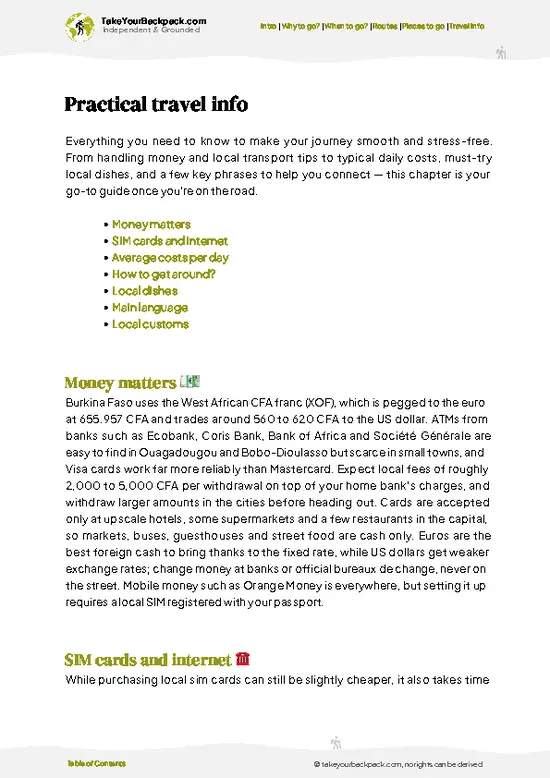
example page 0 from our offline Travel Guide for Burkina Faso
example page 1 from our offline Travel Guide for Burkina Faso
example page 2 from our offline Travel Guide for Burkina Faso
example page 3 from our offline Travel Guide for Burkina Faso
example page 4 from our offline Travel Guide for Burkina Faso
example page 5 from our offline Travel Guide for Burkina Faso
example page 6 from our offline Travel Guide for Burkina Faso
example page 7 from our offline Travel Guide for Burkina Faso
Loading the map 🌍
CLICK TO FILTER
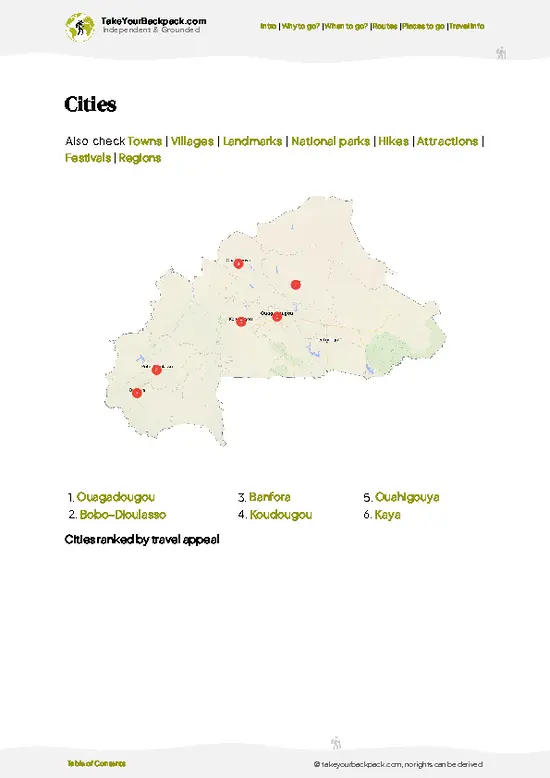
cities
towns
villages
landmarks
national parks
hikes
attractions
festivals
regions
SHOW COUNTRY’S BESTSHOW ALL

✨ Why go?
Ranked #1 attraction in Burkina Faso
What sets this place apart

Musée National du Burkina Faso is the quickest way to understand the cultures you will meet outside the capital. Ouagadougou has plenty of street life but few places that explain it, and this is one. Seeing Bwa leaf masks and Mossi plank masks behind glass first means that a village ceremony or a craft market later makes more sense. You learn what the shapes signify, which ethnic group makes which style, and why the objects were never just decoration.

The second reason is simple value. With a low ticket price and few visitors, you get quiet time with objects that are usually only glimpsed at roadside stalls. Lobi wooden figures and the cloth tradition of Faso Dan Fani are far better understood with a curator’s grouping than in a hurried bargaining session. It also suits a hot afternoon, when … read more 👉
Musée National du Burkina Faso is the quickest way to understand the cultures you will meet outside the capital. Ouagadougou has plenty of street life but few places that explain it, and this is one. Seeing Bwa leaf masks and Mossi plank masks behind glass first means that a village ceremony or a craft market later makes more sense. You learn what the shapes signify, which ethnic group makes which style, and why the objects were never just decoration.

The second reason is simple value. With a low ticket price and few visitors, you get quiet time with objects that are usually only glimpsed at roadside stalls. Lobi wooden figures and the cloth tradition of Faso Dan Fani are far better understood with a curator’s grouping than in a hurried bargaining session. It also suits a hot afternoon, when the streets outside are punishing and a few hours indoors is welcome.

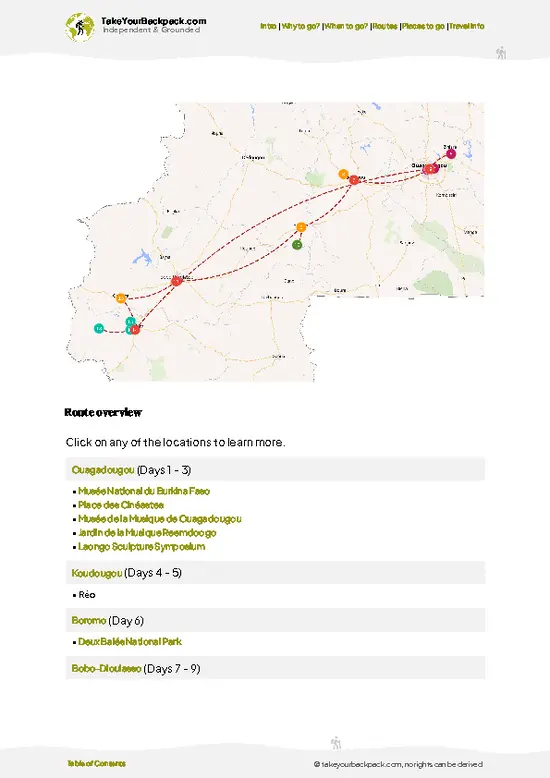
For a country route, treat it as the orientation stop before you head to Bobo-Dioulasso or the south.

💡 HighlightsEssential experiences to have while visiting Musée National du Burkina Faso

  1. Mask collection: The core of the museum. Leaf-covered masks from the Bwa, tall plank masks from the Mossi region and animal-shaped examples show how varied the carving styles are, and each one is tied to a specific ceremony or society.
  2. Lobi figures: Standing wooden statues from the southwest, carved to protect households and settle spiritual matters. They are stark, angular and quietly intense, and worth lingering over.
  3. Musical instruments: Balafons, drums and string instruments are displayed with their regional origins. You can see how the gourd resonators and skin heads are built, which helps when you later hear them played live.
  4. Textiles and Faso Dan Fani cloth: Handwoven cotton strips sewn into patterned panels, a source of national pride. Look at the geometric patterns and how color is used
… read more 👉
  1. Mask collection: The core of the museum. Leaf-covered masks from the Bwa, tall plank masks from the Mossi region and animal-shaped examples show how varied the carving styles are, and each one is tied to a specific ceremony or society.
  2. Lobi figures: Standing wooden statues from the southwest, carved to protect households and settle spiritual matters. They are stark, angular and quietly intense, and worth lingering over.
  3. Musical instruments: Balafons, drums and string instruments are displayed with their regional origins. You can see how the gourd resonators and skin heads are built, which helps when you later hear them played live.
  4. Textiles and Faso Dan Fani cloth: Handwoven cotton strips sewn into patterned panels, a source of national pride. Look at the geometric patterns and how color is used to mark identity and occasion.
  5. Traditional tools and household objects: Farming implements, calabash containers, pottery and everyday items give a grounded picture of rural life that the ceremonial pieces do not.
  6. Costumes and regalia: Outfits and ornaments used in dances and festivals. Seen up close, the fibers, cowries and beadwork explain why masquerades are so visually striking.
Musée National du Burkina Faso sells tickets at the door, so there is nothing to book ahead.
Spotted a mistake or missing something? Contact us.

Things to do near Musée National du Burkina Faso

Ratings based on Tripadvisor reviews. When you book through this link, you support our work at no extra cost to you.

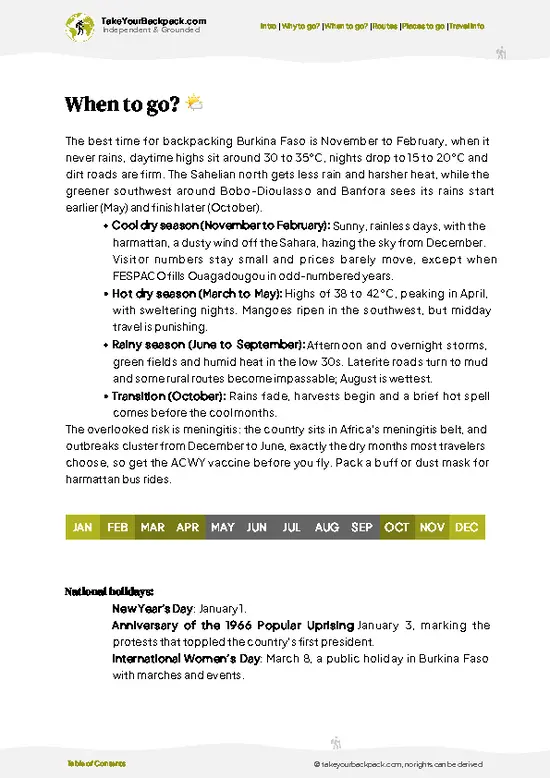
🌤️ When to go?Seasonal considerations and timing

  • Cool Dry Season (November to February): Mornings sit around 16 to 22°C (61 to 72°F) and afternoons reach 32 to 35°C (90 to 95°F), with dusty harmattan haze some days. This is the easiest window for walking the museum’s open grounds and the city between exhibits. Rooms and transport cost the most, though Ouagadougou stays modest by regional standards.
  • Hot Season (March to May): Afternoons climb to 38 to 42°C (100 to 108°F). Go when doors open and leave before noon. Crowds are thin and beds are easy to find, so this is a fine time for a visit if you can handle the heat.
  • Rainy Season (June to October): Highs of 30 to 34°C (86 to 93°F), with heavy downpours in July and August that flood streets and slow motorbike taxis. Indoor galleries stay a good refuge, and daylight runs about 12 hours. Prices
… read more 👉
  • Cool Dry Season (November to February): Mornings sit around 16 to 22°C (61 to 72°F) and afternoons reach 32 to 35°C (90 to 95°F), with dusty harmattan haze some days. This is the easiest window for walking the museum’s open grounds and the city between exhibits. Rooms and transport cost the most, though Ouagadougou stays modest by regional standards.
  • Hot Season (March to May): Afternoons climb to 38 to 42°C (100 to 108°F). Go when doors open and leave before noon. Crowds are thin and beds are easy to find, so this is a fine time for a visit if you can handle the heat.
  • Rainy Season (June to October): Highs of 30 to 34°C (86 to 93°F), with heavy downpours in July and August that flood streets and slow motorbike taxis. Indoor galleries stay a good refuge, and daylight runs about 12 hours. Prices dip slightly.
  • Festival Periods: Ouagadougou fills during large cultural events such as FESPACO in late February or early March of odd-numbered years, raising bed prices and crowding the city.
Aim for a weekday morning, when the galleries are quietest and the air is still bearable.


source: climatestotravel.comJANJanuary: excellent for travelingFEBFebruary: excellent for travelingMARMarch: highly recommended for travelingAPRApril: fair for travelingMAYMay: fair for travelingJUNJune: below average for travelingJULJuly: below average for travelingAUGAugust: below average for travelingSEPSeptember: below average for travelingOCTOctober: highly recommended for travelingNOVNovember: excellent for travelingDECDecember: excellent for traveling
when-to-go

✈️ The backpacker research shortcutBurkina Faso Travel Guide

An offline-friendly backpacking guide with optimized travel routes, ranked highlights, transport advice, and the best areas to stay.
example page 0 from our offline Travel Guide for Burkina Faso
example page 1 from our offline Travel Guide for Burkina Faso
example page 2 from our offline Travel Guide for Burkina Faso
example page 3 from our offline Travel Guide for Burkina Faso
example page 4 from our offline Travel Guide for Burkina Faso
example page 5 from our offline Travel Guide for Burkina Faso
example page 6 from our offline Travel Guide for Burkina Faso
example page 7 from our offline Travel Guide for Burkina Faso
The digital guide (273 pages) contains:
✅ 63 highlights, ranked by travel appeal
✅ Optimized 5, 10 & 15-day travel routes
✅ Cities, national parks, landmarks, beaches
✅ How to get around
✅ Offline-friendly for travel without Wi-Fi
👉 Click to see all 30+ guide features

📅 Plan smarter in minutes, not weeks
✅ Month by month travel advice
✅ Festivals & national holidays
✅ Budget expectations

🗺️ Go to the right places, skip the overrated ones
✅ Honest pros & cons of destinations
✅ Top hikes, parks & viewpoints
✅ Lesser-known places most travelers miss
✅ Clear “worth it vs skip it” guidance

🛏️ Travel smoothly without rookie mistakes
✅ Best areas to stay
✅ Transport systems explained simply
✅ Common scams & safety advice
✅ SIM cards, money & practical tips

🌍 Understand the country, not just visit it
✅ Culture & traditions
✅ 52 Essential phrases & customs
✅ Festivals worth planning around
✅ Traveler-friendly historical context
✅ Insights that make places more meaningful

📱 Built for real travel conditions
✅ Fully downloadable PDF
✅ Works completely offline
✅ Optimized for phone use
✅ Useful in remote areas & buses
✅ Everything in one place
Stop searching, start planning
Get instant access to your full guide. 30‑day money-back guarantee.
+ Add another guide for just

By proceeding you agree to our terms.
Sent to your inbox immediately after payment • 100% Secure Checkout
Best Backpacking Travel Advisor 2025 tourism awardBest Backpacking
Travel Advisor
2025
What others say about Take Your Backpack Guides:
⭐⭐⭐⭐⭐
Fantastic, amazing amount of information!
⭐⭐⭐⭐⭐
My goodness this is amazing, it's what I've been looking for hats off too you!
⭐⭐⭐⭐⭐
I think this is absolutely BRILLIANT
⭐⭐⭐⭐
Very complete and informative. It's still missing places, but I gotta to commend you
⭐⭐⭐⭐⭐
This is truly amazing, thank you, can't wait to explore it with my kids!
⭐⭐⭐⭐⭐
Awesome resource, thank you!
⭐⭐⭐⭐⭐
This is amazing! Can't wait to explore the ones I haven't seen
⭐⭐⭐⭐
I love this! Well done, great idea.
⭐⭐⭐⭐⭐
Thanks for taking the time to make this gem!
⭐⭐⭐⭐⭐
This might be the best website I've ever seen.
⭐⭐⭐⭐⭐
Congratulations, and thank you so much for your work; it's incredibly valuable.
⭐⭐⭐⭐
In all seriousness I think you did a great job pointing out the important spots
⭐⭐⭐⭐⭐
10/10 very good
⭐⭐⭐⭐⭐
As someone who's only just starting to visit regularly this is awesome, thank you.
⭐⭐⭐⭐
Thank you very much! I'm going to visit my dad, it's going to be very useful!
⭐⭐⭐⭐⭐
This is really cool! We'll be travelling for the first time and this definitely come in handy.
⭐⭐⭐⭐⭐
You are now our minister of culture, congratulations 👨‍💼
⭐⭐⭐⭐⭐
Just wanted to tell you that this is a pearl! Going to follow your recommendations.
⭐⭐⭐⭐⭐
This is so cool. I'll definitely be using the resource for my travels soon.
⭐⭐⭐⭐⭐
This is very impressive! Good work.
⭐⭐⭐⭐⭐
This is an amazing and informative site. Very well done!

🛏️ Where to stay?Choosing the right base

Centre-ville and the neighborhoods around Ouaga 2000’s older edges are the most practical areas for backpackers visiting Musée National du Burkina Faso, which sits on the western side of the city center. Staying central means you can reach the museum by a short motorbike or taxi ride and get back easily after dark.
The central district around Avenue Kwame Nkrumah, with the Grand Marché area close by, is the busiest choice. It has the widest range of cheap guesthouses, street food stalls, and money changers, and you will meet other budget travelers in the cafés and at shared taxi stops. The trade-off … read more 👉
Centre-ville and the neighborhoods around Ouaga 2000’s older edges are the most practical areas for backpackers visiting Musée National du Burkina Faso, which sits on the western side of the city center. Staying central means you can reach the museum by a short motorbike or taxi ride and get back easily after dark.
The central district around Avenue Kwame Nkrumah, with the Grand Marché area close by, is the busiest choice. It has the widest range of cheap guesthouses, street food stalls, and money changers, and you will meet other budget travelers in the cafés and at shared taxi stops. The trade-off is noise, traffic, and the need for care with bags in crowded market lanes.
Secteur 15 and neighboring Zone du Bois quarters to the west and south are calmer, with a mix of small guesthouses, a few expat-oriented restaurants, and quieter streets. They suit solo travelers who want sleep and a safer feel at night, and many places have shared courtyards where conversation comes easily.
Gounghin and the areas toward the museum are residential and local, with fewer visitor services but lower prices. If you choose them, arrange transport back in the evening rather than walking. In every area, pick places with secure gates and a night guard, and ask the owner to call a trusted taxi.

👛 Costs (as of 22 October 2026)Typical daily expenses

Musée National du Burkina Faso costs about €13 to 29 per day for a backpacker including a high-season bed, food, and local transport. Travelers pay in West African CFA francs, and cash is the norm.
CategoryBudget RangeLocal Reality
Museum entry€1 to 3A small fee for foreign adults, often lower for residents and students. Card payment is not expected.
Photography€0 to 3A camera permit may be charged in some areas. Ask at the ticket desk.
Guide€0 to 5Staff may walk you through the mask and instrument displays for a tip.
Local transport€1 to 4Motorbike taxis and green city taxis cover the ride. Agree on the fare before you set off.
Accommodation (high season)€8 to 15Basic guesthouse rooms or dorm beds in Ouagadougou. Fans are common and air conditioning costs more.
Accommodation (low season)€6 to 12Prices
… read more 👉
Musée National du Burkina Faso costs about €13 to 29 per day for a backpacker including a high-season bed, food, and local transport. Travelers pay in West African CFA francs, and cash is the norm.
CategoryBudget RangeLocal Reality
Museum entry€1 to 3A small fee for foreign adults, often lower for residents and students. Card payment is not expected.
Photography€0 to 3A camera permit may be charged in some areas. Ask at the ticket desk.
Guide€0 to 5Staff may walk you through the mask and instrument displays for a tip.
Local transport€1 to 4Motorbike taxis and green city taxis cover the ride. Agree on the fare before you set off.
Accommodation (high season)€8 to 15Basic guesthouse rooms or dorm beds in Ouagadougou. Fans are common and air conditioning costs more.
Accommodation (low season)€6 to 12Prices ease in the rainy months from June to October.
Food and drink€3 to 8Rice dishes, grilled chicken, and street snacks are cheap. Sit-down meals cost more.
Total Daily Budget€13 to 29Per person, per day, in high season.


source: museenational.bf
⚠️ Prices can change and everyone travels differently, so take this as a rough guide. Hope it helps you plan your adventure!

FAQCommon questions from travelers

Plan on 1.5 to 2 hours at Musée National du Burkina Faso, which is enough to see the main galleries of masks, instruments, and traditional costumes. Add another 30 minutes if you want a staff member to explain the displays. Combine it with a trip to the nearby Grand Marché or a craft center for a full half day.
Musée National du Burkina Faso is worth the small fee of roughly €1 to 3 if you want context for the masks and cultures you will meet elsewhere in the country. The collections are compact, so you can finish in under two hours. Expect basic labeling and a modest setting rather than a big, modern museum.
From central Ouagadougou, Musée National du Burkina Faso is a 10 to 20 minute ride by taxi or motorbike taxi, usually €1 to 4 depending on your bargaining. Agree on the fare before you leave. Most travelers arrive by air at Ouagadougou airport, about 15 to 25 minutes from the center, or by bus from Bobo-Dioulasso in roughly 5 to 6 hours.
⚠️ Things can change over time, so always validate details locally before you go.

Other Burkinabé attractions near Musée National du Burkina Faso

Explore more nearby:


💡 Not sure where to go next?
Create a personalized itinerary for Burkina Faso including Musée National du Burkina Faso and the places that fit your trip.

Generate my itinerary

👉 Discover all attractions

Or checkout all Burkina Faso has to offer (think cities, towns, villages, national parks, hikes, beaches, festivals)
Country photo of Burkina Faso

We 💚 feedbackKey takeaways before you go

Musée National du Burkina Faso needs about ninety minutes to two hours, and I would not stretch it further. Go early in the day before the heat builds, spend your longest stretch with the masks and Lobi figures, and skim the rest. Bring small change for the ticket, and pair it with a late lunch nearby so the morning feels complete.

✍️ Help improve this page!
The information on this page is based on in-depth research, insights shared by experienced travelers, and feedback from the local travel community in Burkina Faso. While every effort is made to keep the information accurate and current, conditions can change — so if you spot anything incorrect or outdated, please get in touch.


🙋‍♂️ Give feedback

👋 Meet the founderWho’s Behind Take Your Backpack?

Johan, backpacker and founder of TakeYourBackpackHi, I’m Johan (Netherlands 🇳🇱), the creator of TakeYourBackpack. Over the past 3 decades, I’ve backpacked through 90+ countries across six continents, gaining extensive experience with independent travel, long-term trips, and overland routes.

This site is built on a combination of firsthand travel experience and carefully curated insights from other backpackers. Many guides are based on places I’ve personally visited, while others bring together tips, observations, and practical advice shared by trusted travelers I’ve met along the way.

The goal is to provide realistic, experience-driven guidance — not generic itineraries — so you can explore destinations with better context, clearer expectations, and more confidence.